From October 2026 to summer 2027, the collector's agenda comes down to a few dates to remember. October 2026: Marvel's Midnight line, The Demon #1 and Jonah Hex and the Shadow of Death #1 on the 7th, then a big DC day on the 28th with Absolute Batman #25. November 4, 2026: Avengers #1 by Zdarsky and Checchetto, with a lineup public since August 20, 2026, the same Wednesday as the unfilled orders for Amazing Spider-Man #1000. December 2026: three creator returns twenty-five years later, and no Absolute Batman. January and February 2027: TMNT #25, the Absolute Batman #26 special, then the return at #27. This article details none of these topics: it sorts them by date and points, for each, to the guide devoted to it.
A publishing calendar is not a shopping list. Read as one, it costs a lot and builds nothing: you buy nine Wednesdays in a row, stop at the tenth, and are left with a shelf of mismatched #1s. Read as an agenda of decisions, it becomes the most useful tool of the year, because it lets you choose in advance, in cold blood, what you will take and what you will let pass.
That is the purpose of this page. It covers the period from October 2, 2026, the date it is written, to summer 2027. Each deadline appears with its date, the creative team when published, and a sentence or two on what a reader actually has to decide. Sometimes the honest answer is: nothing, it is a release to read, not a trade-off.
Deliberately, nothing is developed here. The forty-seven guides of the winter dossier do that work series by series and character by character. This page is the orientation table that leads to them, and it reads in one go.
How to use this calendar
Every line of a release agenda belongs to one of four categories, and the category dictates the decision far better than the enthusiasm of the moment.
The release to read
A chapter in a series you already follow. No decision: the order was placed long ago, or it never will be. These lines serve only so you do not miss an issue.
The launch to test
A #1 of a series you know nothing about yet. The decision concerns a single reading copy, not a lot. A modern #1 is almost always findable afterward, sometimes in second printing.
The milestone to reserve
A round-number issue, the end of a run, an announced first appearance. It is the only category where preordering at a bookstore is justified, because the quantity printed is decided by orders.
The false deadline
An expected announcement, a film release date, a casting rumor. Nothing to buy, nothing to reserve. These lines appear in the calendar so that you know they call for no action.
One benchmark holds across the whole period: the gap between the cover date of an American issue and its on-sale date is about two months. The dates that follow are on-sale dates, not cover dates. And an American release is not a French release: the translated edition arrives later, in collected form, and that lag is good news for anyone who wants to read without rushing.
October 2026
Wednesday, October 7. Marvel opens its Midnight Universe line with three forty-page #1s under parental advisory: Midnight X-Men by Jonathan Hickman and Matteo Della Fonte, Midnight Fantastic Four by Benjamin Percy and Kev Walker, Midnight Spider-Man by Phillip Kennedy Johnson and SCIETRONIC. The same Wednesday, DC publishes The Demon #1, written and drawn by James Harren around Jason Blood, and Jonah Hex and the Shadow of Death #1, a six-issue miniseries carried solo by Michael Walsh. Absolute Superman #24 also comes out that day.
To decide: three horror #1s at Marvel and two at DC on the same Wednesday makes five paid tests at once. Pick two. The history of Etrigan and the Demon and the Jonah Hex dossier help you know which of the two DC titles will speak to you, and the overview of the horror wave explains why both publishers are going there at the same time.
October 8 to 11. The New York convention is held at the Javits convention center. Panels are scheduled, nothing has been said there yet as these lines are written. A false deadline par excellence: simply note that spring 2027 programs often get clarified there.
Wednesday, October 14. VisionQuest begins streaming on Disney's platform, until November 25, with Paul Bettany as the white Vision and James Spader as Ultron. Nothing to buy, but a series that puts a 1968 antagonist back at the center of the game: the key issues of Ultron sort out what is scarce from what is simply expensive.
Wednesday, October 21. Absolute Flash #20, and the end of the five-issue miniseries Avengers: Armageddon.
Friday, October 23. Release of the film Clayface, directed by James Watkins with Tom Rhys Harries. A second-tier character moves to the forefront for the first time in cinema: the Clayface guide shows the appearances that truly matter, and there are fewer than you would think.
Wednesday, October 28. The busiest day of the month at DC. Absolute Batman #25 and Absolute Wonder Woman #25 come out together, accompanied by Justice League: Dark Realm Special #1, which marks Dan Mora's first script and introduces the origin of the Cadejos, and DC All In Saga: Darkseid vs. The World #1, forty-eight pages by Snyder and Williamson, drawn by Sanford Greene.
To decide: Absolute Batman #25 is a milestone doubling as the end of a stage, so preordering is justified. For the rest, the guide to the Absolute line and the key issues of the Absolute universe let you decide whether you follow one series, two, or the entire line. The Darkseid dossier sheds light on the 28th's special.
November 2026
Wednesday, November 4. The densest Wednesday of the period. Avengers #1 by Zdarsky and Checchetto arrives with a lineup made public on August 20, 2026: Spider-Man, Wolverine, Captain Marvel, Daredevil, Luke Cage and Miracleman, embodied by David Colton, the Captain America introduced in the series Zdarsky launched on July 2, 2025. The switch was played out in Avengers: Armageddon #4, released on September 16, 2026. There is therefore no lineup mystery to solve, and that is precisely what the dossier devoted to the team's composition dismantles.
The same day, Marvel fills the unfilled orders for Amazing Spider-Man #1000, released on September 30, 2026 and sold out that very day. At DC, Gangs of Gotham #1 by Cantwell and Henderson spotlights Anarky, Jason Aaron's Absolute Superman #25 closes one stage and opens another, and Brombal's Batgirl #25 brings back David Cain.
To decide: if you are still waiting for Amazing Spider-Man #1000, this is the day to watch at your bookstore, and the issue guide details the object. Two other pages explain what happened on September 30 and how to react next time: the mechanics of allocated covers and what to do when facing a stockout on release day.
Wednesday, November 11. Absolute Batman: Beyond Ark M #1, by Snyder and Tieri, drawn by Francavilla. It is the issue that fills the place left by the main series' pause.
During the month, at Marvel. Jean Grey #1, a five-issue miniseries by MacKay and Antônio, after the Phoenix's arrival at the end of DNX; Spider-Woman #1 for the character's fiftieth anniversary, with Carnage; Predator vs. Punisher #1, a four-issue mini by Tieri and Saíz, with the Kingpin and Jigsaw; X-Orcists #1, which brings together Magik, Juggernaut and Madelyne Pryor; Ashley Allen's Friendly Neighborhood Mary Jane #1; the end of DNX, a crossover between the X-Men and the Fantastic Four. At Image, Daniel Warren Johnson's Chainkata #1 in forty ad-free pages, Exquisite Corpses: Lone Gunman #1, and The Snail, a horror one-shot by Garth Ennis and John McCrea. DC's Naughty List #1 and Justice League Unlimited #25 land on the 25th.
To decide: November lines up five Marvel #1s in four weeks, and none deserves to be bought in duplicate. Character guides are for exactly this: Jean Grey and the Phoenix, Spider-Woman for her fiftieth anniversary, Magik, and licensed crossovers to understand why these series become scarce faster than the others.
December 2026
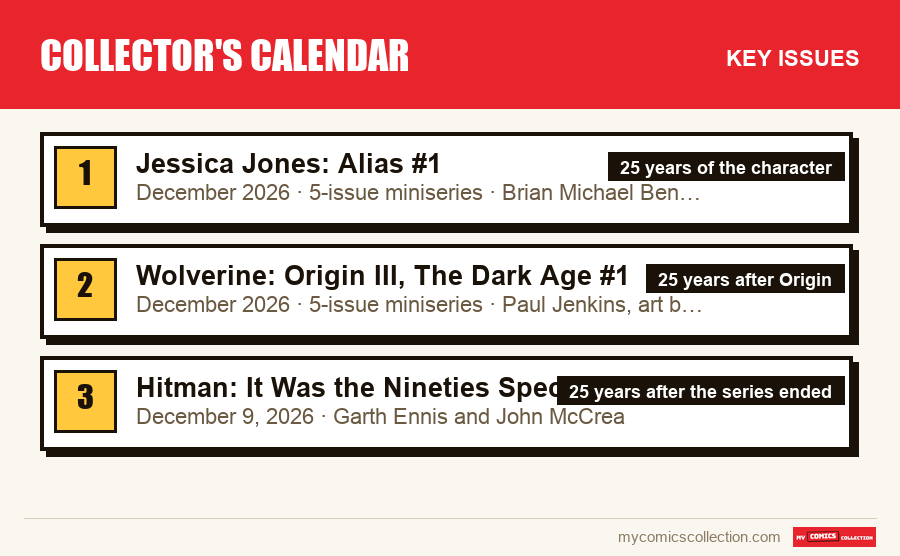
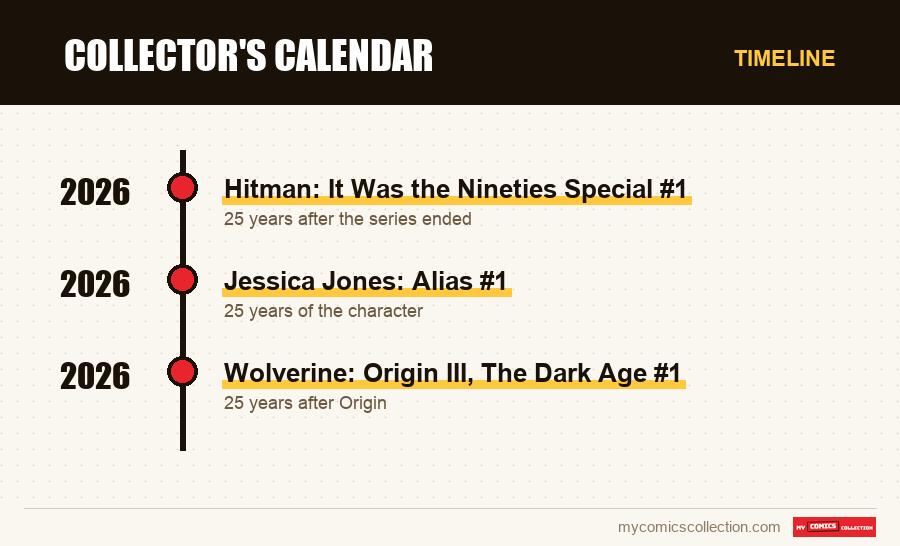
December is the month of anniversaries. Three creative teams return to a character a quarter century after having left their mark on them, and it is not a scheduling coincidence.
Jessica Jones: Alias #1
The two original creators take up the character they created together. The configuration is rare: writer and artist reunited, not just one of the two called back for the signature.
Wolverine: Origin III, The Dark Age #1
Jenkins returns to Logan's youth twenty-five years after the series that gave him a past, this time in the 1950s.
Hitman: It Was the Nineties Special #1
The historic duo finds Tommy Monaghan again a quarter century after closing his series. Ennis and McCrea also sign The Snail at Image in November: two chances to read them six weeks apart.
To decide: these three returns are milestones, not tests. Before reserving all three, read what creator returns are really worth and the strategy to adopt toward anniversary issues. Both pages exist because the answer is not the same from case to case.
The month's other deadlines, at Marvel. Maximum X-Men #1 by Yost and Daniel, with Storm and Wolverine facing the Annihilation Wave; Fugitive X-Force #1, where Boom-Boom takes the team's lead, Cable's mind being compromised; Your Friendly Neighborhood Spider-Man #1, timed to the second animated season; Amazing Spider-Man: Symbie #1. The Boom-Boom dossier explains why this choice of leader is not trivial.
At DC. Batman #16 on December 2 by Fraction and Jiménez; Action Comics #1105 on December 9, which continues Mark Waid's "Lex Luthor: Year One"; Detective Comics #1116 on December 16, where Tom Taylor has Clark Kent jailed; Superman #45 on December 23, in Nekron's Deadlands. And two ends of the road awaited for months: Wonder Woman #40, conclusion of the Wonder War and last issue of Tom King and Daniel Sampere's run, as well as Poison Ivy #50, milestone of G. Willow Wilson's run.
To decide: the end of a run is the moment a series becomes a complete object, so the question is no longer "do I buy this issue" but "do I complete the series." The review of Tom King's run, the review of the Poison Ivy run and the tracker for "Lex Luthor: Year One" each answer that question. On the Wonder Woman side, the arrival of a new character in the title's lineage is covered separately in the Trinity dossier.
Friday, December 18. Release of Avengers: Doomsday, directed by the Russo brothers, in post-production at the time of writing. A false deadline as far as collecting goes: a film does not create scarcity, it shifts attention.
And an absence. There is no issue of Absolute Batman in December 2026. The series pauses after #25 on October 28. It is the most discussed gap of the period, and it has its dedicated analysis, because the absence of a title whose writer announces nearly half a million monthly copies ripples through the rest of the shelf.
January and February 2027
January 2027. TMNT #25 opens Matthew Rosenberg and Juann Cabal's run at IDW. At DC, an Absolute Batman #26 special is scheduled, devoted to Barbara Gordon. These are the only two January deadlines known as of October 2, 2026: that month's solicitation wave is not published, and anything circulating beyond that is supposition.
The second season of Your Friendly Neighborhood Spider-Man also arrives in January, which explains the #1 timed to it in December.
To decide: a team change on an ongoing series is the best entry point there is, because you start at the beginning without catching up on two hundred issues. The guide to the new run says where to start, and the Roninverse guide covers the parallel branch.
February 2027. Absolute Batman resumes at #27, with Snyder on script and Dragotta on art. Four months after #25, the series regains its rhythm and its duo. For anyone who has let the line pass since its launch, it is the most legible entry window of the year, with the Batman hub and the line guide cited above as a starting point.
Spring and summer 2027
March 2027. Third season of Daredevil: Born Again, eight episodes.
March 31, 2027. A digital comics platform ceases operations in North America. For anyone who built a library there, it is a deadline to handle before the date and not after, because a digital library cannot be recovered once the service is closed.
July 9, 2027. Release of Man of Tomorrow, written and directed by James Gunn, with David Corenswet as Superman, Nicholas Hoult as Lex Luthor and Lars Eidinger as Brainiac. Two dossiers cover the consequence for the collection: the key issues tied to the film and Brainiac's bibliography, whose exposure on this scale is a first. The Superman hub completes the picture.
Summer 2027. TMNT: The Last Ronin III concludes the Roninverse, with Eastman, Waltz, Isaac and Esau Escorza, Ben Bishop and Luis Antonio Delgado. Also in 2027, an eight-episode series around Jimmy Olsen, The People v. Gorilla Grodd, is expected from mid to late year: see the key issues of Grodd.
December 17, 2027. Avengers: Secret Wars. The date is published, it bounds the current cycle.
Undated. Marvel's manga program at Kadokawa, five titles including a Spider-Man by tokitokoro and a Spider-Gwen by Ryusei Yamada, directed from Japan by C.B. Cebulski, the previous agreement having ended on September 30, 2026: the analysis of the agreement explains what that changes. And a Clone Saga series in development, centered on Ben Reilly and Kaine Parker, for a paid platform and then a streaming platform, with no announced date: the Ben Reilly and Kaine dossier sorts through a bibliography reputed to be unreadable, and the Spider-Man hub gives the context.
The September 2026 DC relaunches, to catch up on now
Three series launched on September 2, 2026 under the Next Level banner enter winter with three or four issues on the clock: Teen Titans #1 by Higgins and Di Nicuolo, Legion of Super-Heroes #1 by Williamson and Sherman, The Doom Patrol #1 by Van Poelgeest and Henrichon, to which is added Superman: The Stranger #1, six issues under the Black Label banner carried solo by Wes Craig.
To decide: this is the catch-up window. A three-month-old series can still be completed at cover price, which will no longer be true in a year. The Next Level overview says which to follow, and each has its dossier: Teen Titans, the Legion of Super-Heroes, Doom Patrol.
What this calendar does not say
A release agenda gives dates, not values. Four limits must accompany its reading, and they hold for the whole period.
No market value is announced here. An issue that has not come out has no market price, and no source consulted publishes a quantified price movement for these weeks. What can be observed is a relative hierarchy and a scarcity: that is the subject of the guide on reading weekly sales charts, which also explains why a one-week chart of cases never turns into an annual market share.
Announced volumes are not print runs. The figures made public in 2026 by publishers concern specialty store preorders, sometimes cumulative sales. Three cases from the year show this well, and they are gathered in the dossier on high-volume original creations.
The year's records are not only about comics. The highest amounts published in 2026 concern a trading card, a sports magazine and a sealed video game. Two pages put these results in their place: where collectibles money really goes and what youth licenses bring to the shelf. On the comics proper, the set of original Superman #75 art put back on sale in 2026 and the market for signed and certified items each have their guide, with estimates and results carefully distinguished.
Nothing has come out of the October convention yet. An announcement may drop there, it has not dropped. In the same way, a series in development with no date is not a scheduled series, and an editorial line can be extended: Marvel Zombies: War Zone #1 and Alien vs. X-Men #1, with an original story by Chris Claremont about Kitty Pryde and Juggernaut, belong to cycles whose continuation is undated. Their dossiers are here: Marvel Zombies and Alien vs. X-Men. Finally, a series aired from August 16 to October 4, 2026 has just ended and its effect on the shelf is being measured now: see the key issues tied to Lanterns.
The simplest way to keep this agenda
Nine months of deadlines, some forty series involved, a dozen #1s: no memory holds that, and a handwritten list goes stale at the first release delay. The useful reflex is to turn the agenda into a tracking list right now, while it is flat and no decision is urgent.
Concretely: enter the series you already follow, check off the #1s you agree to test, mark the three or four milestones you will reserve at a bookstore, and ignore everything else until it becomes concrete. The collection tracking app does this, and the estimate is for knowing what you already own before adding anything. A collection is built by subtraction at least as much as by addition.
One last point of method. The dates in this calendar will move. Issues will slip a week, a miniseries will gain a chapter, a film date will shift. This is not a flaw of the agenda, it is the normal functioning of periodical publishing. The right habit is not to recheck everything every week, but to come back to this page at the turn of the month and look only at the next four weeks.