On September 30, 2026, Marvel put on sale an issue with nine allocated covers, all sent back to press right after: Bermejo, McGuinness, Medina, Ramos, Martin, Young, a remastered Ditko, a Momoko and Miller, and a Campbell. "Allocated" does not mean "rare": it means the publisher apportioned these covers among shops instead of letting them order freely. Seven different mechanisms coexist under the word "variant": allocation, ratio, incentive variant, retailer exclusive, foil, facsimile and blank cover. Only one of them produces a truly measurable scarcity, and it is not the one announcements put forward. This article dismantles how a variant is made and distributed, then gives the verification method for a buyer who has no access to the original order form.
One issue, nine covers, a second press run for each of them: the September 30, 2026 release provided a rare textbook case, because the publisher itself explained what it was doing. Usually, the collector discovers a variant when it is offered for resale, never knowing how it got there. This time, for once, the plumbing was visible.
This plumbing deserves to be understood for a very prosaic reason. Nearly all buying decisions on the modern secondary market rest on an intuition of scarcity, and that intuition is manufactured upstream by commercial rules nobody reads. Knowing whether the copy you are looking at exists in a few hundred or in several tens of thousands of units does not depend on its look, but on the channel through which it was distributed, and this channel leaves legible traces. We leave aside the issue's content and the question of shop sellouts, which belong to other subjects: here, we only talk about manufacturing, apportioning and verification.
What the word "allocated" really means
In the American circuit, a shop does not receive what it wants: it orders on a form issued several weeks before release, and the distributor delivers what it can. When demand exceeds the planned print capacity, the publisher goes into allocation: it decides itself the quantity served to each point of sale, often in proportion to the shop's historical orders.
Allocation is therefore a rationing operation, not a scarcity operation. The nuance is crucial. An allocated cover can exist in very large numbers while being unfindable the first week, because the printed copies are stuck in the logistics chain or arrive in waves. And that is precisely what happened on September 30, 2026: the nine covers were allocated, then sent back to press, with fulfillment of unfilled orders announced for November 4, 2026.
Sending an alternate cover back to press is an editorial move with heavy consequences for the collector. It means the final quantity of that cover was not known when the first copies went up for resale. Any scarcity estimate made in the days following release therefore rested on a figure still open. This is the first lesson of the case: an allocated cover is a cover whose print run is not closed.
Second lesson, less intuitive: an allocation signals a forecasting error, not a scarcity choice. If the intention had been to limit the object, the mechanism used would have been the ratio, which mathematically caps quantities.
The seven mechanisms hiding behind a single word
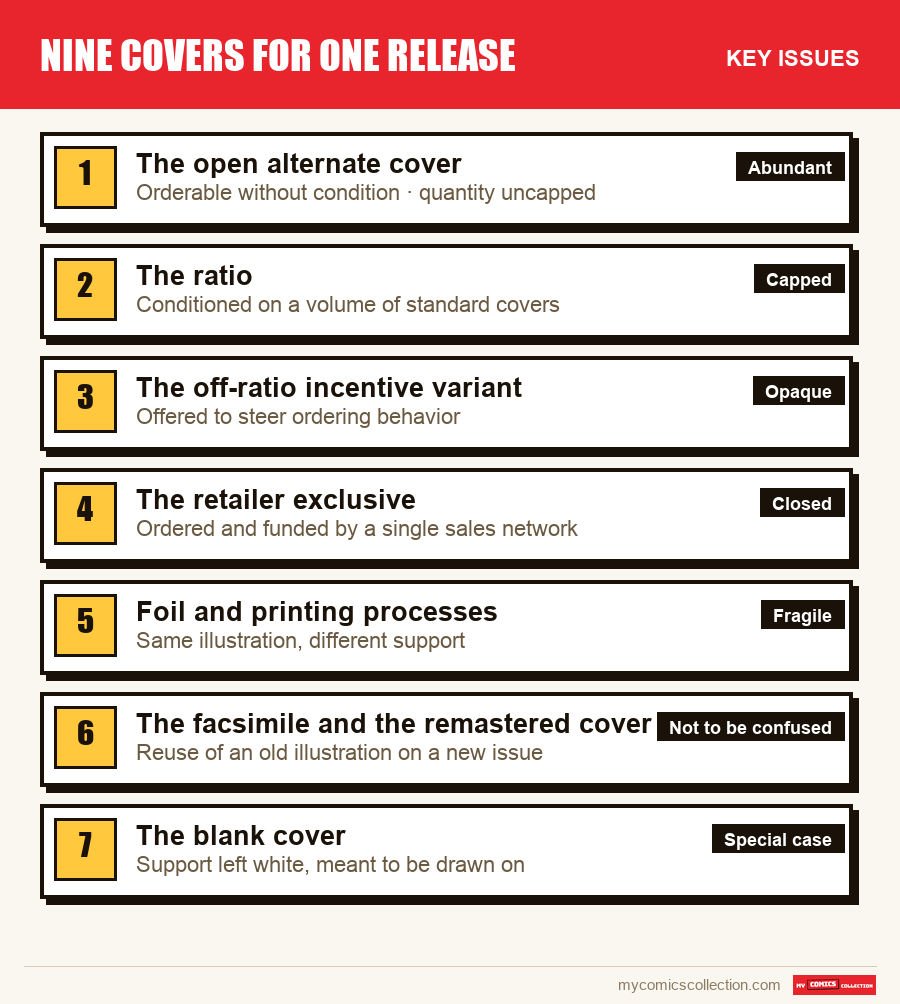
English uses "variant" to designate objects made according to mutually incompatible logics. Here they are separated, from most abundant to most constrained.
The open alternate cover
This is the most common and least constrained version. The publisher offers a second, a third, a ninth illustration on the order form, and each shop takes as many as it wishes. The print run follows demand, with no upper limit. In the September 30 case, most of the nine covers fall in this category, which their return to press moreover confirms: you do not send back to press an object whose limitation is the principle.
The ratio
The ratio is the only mechanism whose quantity is bounded by an arithmetic rule. To obtain a copy of this illustration, the shop must commit to a fixed number of copies of the main version. The print run's ceiling is therefore deduced from the main version's print run, divided by the required threshold. It is an order-of-magnitude reasoning, never an exact figure, since not all shops cross the threshold.
The off-ratio incentive variant
A variant handed out not against a volume, but against a behavior: having ordered an entire line, having kept one's numbers on a faltering series, having taken part in a commercial operation. No calculation is possible, because the rule is not published and the number of eligible shops is not known. It is the category where a scarcity narrative is easiest to invent.
The retailer exclusive
Here the chain orders and pays for an illustration that exists nowhere else. The print run is decided by the sponsor, not the publisher, and it is sometimes announced publicly. When it is and it is low, it is the only off-ratio category that approaches verifiable scarcity. When it is not, the object joins the previous category. The reading rule is simple: an exclusive with no announced quantity brings no scarcity information.
Foil and printing processes
Gilding, metallic effect, glossy ink, embossing, die-cut: these are finishing processes, applied to a print run whose quantity can be perfectly ordinary. Their collecting specificity lies elsewhere: these surfaces mark. A light crease on matte paper stays discreet, the same crease on a reflective surface becomes a scar visible under any lighting. The 1990s produced a considerable stock of them, and it is preservation, far more than print run, that sorts them today.
The facsimile and the remastered cover
Two different objects that vocabulary confuses. The facsimile is the reissue of an old issue, reproduced identically, ads included, and clearly identified as a reissue. The remastered cover, for its part, takes an archive illustration and applies it to a new issue, with contemporary interior content. The one attributed to Steve Ditko among the nine September 30, 2026 covers belongs to the second category: it is a 2026 issue carrying a drawing from another era.
The blank cover
An object apart, because its value comes not from the publisher but from what is added on it. The print run of a blank cover is generally open; what becomes unique is the hand-drawn copy. You then move from a print-run logic to an artwork-on-printed-support logic, with the authentication problems that implies.
The order adjustment window, the link nobody looks at
Between the initial order form and printing, there is a deadline after which quantities are frozen. This adjustment window lets a shop correct its numbers based on the first signals: an announcement, a trailer, a content rumor. It is the real regulating organ of the primary market, and it explains a lot.
First effect: an announcement landing before this date inflates the print run, an announcement landing after leaves it unchanged and creates a shortage. Two issues with identical success can therefore present totally different quantities, for a single calendar reason. That is why the scarcity hierarchy in a given year is often counterintuitive.
Second effect, even more useful to whoever buys: the window explains allocations. When adjustments all flow in the same direction on a much-awaited release, the planned capacity is exceeded, and the publisher rations. What happened at the end of September 2026 is therefore not an isolated accident but the normal functioning of a system under tension, pushed to its breaking point by demand concentrated on a single date.
Third effect, often ignored: sending an alternate cover back to press, like the one decided on the nine covers, is only possible because the print files already exist. It is cheap for the publisher, and that is why the reflex is now systematic. A collector betting on the shortage of an open cover is betting against a decision the publisher can reverse in a week. The question of successive reprints and their effect on the first printing is covered in our guide to second printings.
Which of these categories produces real scarcity
The answer fits in one sentence: the one whose quantity is bounded by a written, public rule before printing. Which leaves, in practice, the ratio, and the retailer exclusive when it announces its figure. Everything else produces variety, not scarcity.
This distinction between variety and scarcity is the central point. Nine covers on one release means nine objects to collect, therefore nine lines in a collection list, and nine occasions to spend. It does not mean nine rare objects. The abundance of illustrations on one issue signals on the contrary a very high print run release, since a publisher does not spread nine images over a confidential title. The number of covers is an indicator of volume, not of scarcity.
Three cross-checks help keep a cool head. First, an object whose quantity is unknown cannot be claimed rare, and the burden of proof lies with the seller. Next, a cover's scarcity says nothing about the content's scarcity, identical from one version to the other, and it is the content that grounds an issue's legacy. Finally, a scarcity built by an ordering rule can be undone by a publisher decision, whereas a scarcity arising from the natural destruction of an old print run is irreversible.
A last historical landmark helps put things in perspective. The practice of multiple covers was not born in 2026: it goes back to 1986, with The Man of Steel and its two covers signed by John Byrne. It ran away in 1991 with X-Men #1, whose first four covers formed a composite image and which still holds a certified sales record, with more than eight million copies according to the records certification body. Then in 1995 with an issue 1 offered in thirteen covers, and in 1996 with another in eight covers. As for the record for the number of versions of a single issue, it is held by the first episode of a 2003 horror series, with more than two hundred fifty versions recorded. Nine covers, put in perspective, is a modest figure.
Verifying what you buy when you are far from the source
The collector outside the American market has no access to the original order form, does not see the quantities allocated to each shop, and almost always buys from a photograph. Here is the procedure to reduce uncertainty to what is verifiable.
Identify the category before looking at the price
Ask the seller a single question: what rule limited the ordering of this copy? A numerical ratio indicates a ratio variant. The name of a sales network indicates an exclusive. An artist's name indicates an open cover, and the word "variant" then adds nothing. A seller who talks about scarcity without citing a rule does not know what they are selling.
Read the back cover and the legal block
The indications of print run, reprint and process appear in the legal information box inside or on the back. That is where the mention of a reprint, a facsimile, a press run number is read. Demand a sharp photo of this area: it is far more informative than the cover image, and its absence in a listing is in itself a signal.
Compare the barcodes and price marks
On the same issue, versions are often distinguished by a barcode suffix or by a different price mark. Two copies presented as identical but carrying distinct codes are not the same object. It is the fastest check, and it is done from a simple photo of the cover's bottom.
Have the label validated by a third party when the price gap justifies it
The main interest of certification on an alternate cover is not the condition grade: it is the label wording written on the slab, which names the version and commits a third party. On an object whose value rests entirely on the variant's identification, this line of text is often worth more than the grade itself. Reading a grading label is learned in half an hour.
Keep a list that distinguishes the copy from the cover
Nine covers for one issue guarantees an unintended duplicate within the year. A collection list that only notes the number protects against nothing: you need a field for the version, one for the press run, one for the printing process. Issue-by-issue tracking and the missing list become essential as soon as a series multiplies versions.
Wait for the end of the reprint cycle before paying for the shortage
When a cover is allocated then sent back to press, unfilled orders arrive several weeks after release. In the case studied, fulfillment was announced for early November 2026. Buying during the unavailability window is paying for a temporary supply deficit. To estimate where you stand, an indicative estimate before buying avoids confusing shortage and value.
What the nine-cover episode does not say
We must also name what this case does not establish, because shortcuts are tempting. It establishes no value hierarchy among the nine illustrations: no price exists on an object on sale for a few days and whose print run is not closed. It does not establish either that the multiplication of covers is becoming general, since a single very high-audience title can absorb this treatment without it applying to the rest of the catalog. It says nothing, finally, about these covers' five-year trajectory: what makes a modern issue last comes down to the content and the characters that come out of it, not to the identity of the ninth version's signer. The market for the character concerned counts founding issues whose legacy was decided on a first appearance or a death, never on an alternate cover.
What the case does establish, and it is already a lot, is the mechanics. A much-awaited release saturates print capacity, the publisher rations, then corrects by sending back to press, and the apparent scarcity of the first week dissipates. Whoever has understood this cycle can stop chasing the nine versions of the same issue and focus on those whose limitation rule is written.