The census published by CGC, officially named the Population Report, counts one thing only: the number of copies CGC has graded, broken down by title, issue, grade and label type. CGC says so itself in the notice that accompanies the report: the data "reflects only the quantities and types of items already graded" and is "not an indicator of value or scarcity." The whole art therefore lies in reading a submission statistic as a submission statistic, and not as an inventory of the print run. A low number can mean "impossible to find" just as it can mean "nobody thought it worth paying to have it graded." This article explains how the line is built, what feeds it, what never enters it, and the four false lines of reasoning it most often provokes.
Few tools are as consulted and as badly read as the census. In a discussion between collectors, announcing a population figure is enough to close the debate: "there are only twelve in 9.8." The figure has the quiet authority of numbers. It is public, free, verifiable, updated, and it carries the name of a respected grading service. Everything conspires to take it for what it is not, namely a census in the strict sense.
This misunderstanding is not an expert's subtlety. It changes the nature of what you think you know. A census is read the way a poll is read: starting with the question of the sample. Who was counted, by what mechanism, and with what filter at the entrance. Without this precaution, the same row of numbers can be used to demonstrate one thing and its opposite.
The most interesting part is that CGC hides nothing. The report's limits are written in black and white on the page that publishes it, and we will start there, because almost nobody reads them. The factual elements of this article come from CGC's public pages consulted on October 1st, 2026: the Population Report page, the labels page, the grading scale page, the glossary, the warranty page and the services grid.
What the census counts, in CGC's own words
The report is officially called the Population Report. Its introduction page gives a one-line definition: it shows the latest count of the comics, magazines, pulps, concert posters and lobby cards that CGC has graded. Every word of this sentence deserves attention, and the verb above all. What is counted is a grading operation carried out by a company, not an object existing in the world.
The report's organization follows the collector's logic: publisher, then title, then issue. Within an issue, the graded copies are distributed by step of the CGC grid, which runs from 0.5 to 10.0 according to the official scale page, and by label type. A last-updated date is displayed at the top of the report. That is the whole of what the tool claims to offer.
The notice accompanying the report is far more explicit than the definition. It states that census or population reports "reflect only the quantities and types of items already graded" by the group's companies, and that they are "not an indicator of value or scarcity." It adds that the report is provided for informational purposes for enthusiasts and should not serve as the basis for a purchase or an investment. It finally specifies that the company gives no guarantee as to the accuracy or reliability of the published information.
That is the essential. The tool most cited for judging scarcity carries, from its own publisher's hand, a warning that it does not measure scarcity. It is not a legal boilerplate clause to brush aside: it is the exact description of what the tool does.
A tension CGC has not resolved
The situation is all the more interesting because the same site says two different things in two different places. CGC's glossary defines the census report as the list of comics graded by CGC that shows the relative rarity between issues, and also the relative rarity of a grade. The report page, for its part, asserts that it is not an indicator of scarcity.
The two formulations are not incompatible if you pay attention to the adjective. The glossary speaks of relative rarity, and it is right in one specific case: within a single issue, the shape of the distribution by grade is usable information, because all the copies counted underwent the same filter. The report page speaks of scarcity in general, and it is right too: a row's total says nothing about the number of copies in existence.
The reading lesson is therefore of surgical precision. The census allows internal comparisons, from one grade to another for the same issue submitted under comparable conditions. It does not allow external comparison, from one issue to another, and even less from one era to another. Most uses made of it in discussions belong to the second category.
A census unit is not a copy, it is a certification
Here is the technical point that changes the most, and the one understood latest. When you read "240" in a cell, you are not reading "240 physical objects." You are reading "240 certifications issued at this grade for this issue." Between the two lies the whole life cycle of a slab.
A certified copy is not frozen in its case for eternity. It can come out, and that happens constantly. CGC's warranty page is formal about the consequences: the warranty does not apply to items removed from a CGC holder, nor if the holder has been damaged, unsealed, altered or modified. In other words, opening the holder ends the contractual relationship between the object and its grade. The warranty is also limited to ten years from the grading date.
What then becomes of the corresponding census row? The question deserves an honest answer: the CGC public pages consulted describe no procedure by which an individual would obtain the removal of a certification from the report after unsealing a copy. Nothing indicates that such a removal is automatic, and nothing describes how to request it. This is, however, perfectly consistent with the report's official definition, since it presents itself as a count of what has been graded, not of what is currently in a holder.
Immediate practical consequence: a copy unsealed then sent back for grading produces a new entry. If it gets the same grade, the cell gains a unit without any new comic having been discovered. If it gets a higher grade, two cells are now fed by a single physical object. The census adds up grading events, and the sum of events necessarily exceeds the number of objects as soon as some objects produce several events.
The reholder case is different and worth distinguishing, because the two are often confused. The services grid describes this treatment as the re-encapsulation of a comic already in a CGC holder into a new CGC holder, specifying that the grade assigned should not change, except for damage occurring after encapsulation, in which case it is adjusted. It is therefore not a new evaluation. The article on the CGC reholder details this service, and the one on cracking a slab covers the decision to open. For our subject, just remember that not all returns to the workshop weigh the same on the numbers.
Label columns do not add up innocently
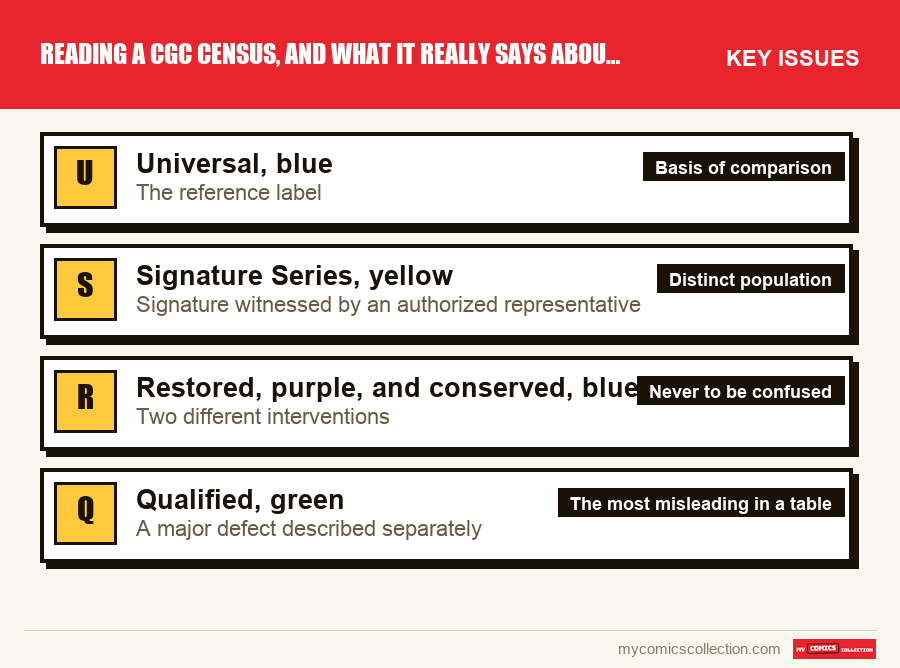
The census breaks down graded copies by label type, and that is where many readings go astray. The official labels page lists more than the four usually talked about. You need to know them to know what you are adding up.
Universal, blue
CGC describes it as the one assigned to items that are simply the grade indicated, any particular information, for example an unverifiable signature, being noted on the label. It is the column that can be considered homogeneous, and thus the only one on which a comparison of distribution by grade makes immediate sense.
Signature Series, yellow
Official definition: the label is applied to items whose signatures were all applied under the direct observation of an authorized CGC or JSA representative. A distinct label, black and yellow, covers autographs authenticated by JSA experts without a witness at the time of signing.
Restored, purple, and conserved, blue-gray
The restored label is applied to any comic showing traces of repair aimed at giving it back the look of its original state. The conserved label covers comics that have undergone specific repairs intended to improve structural integrity and long-term preservation. The glossary adds that restoration consists of bringing the comic back to a known or presumed state by adding non-original material, for aesthetic purposes. The scale page also mentions a grid specific to restoration, with a quality rated A to C and a quantity of 1 to 5.
Qualified, green
CGC reserves it, according to both its labels page and its glossary, for items showing a significant defect that requires a specific description. The displayed grade does not take this isolated defect into account, which is described separately.
Two other categories complete the picture and deserve to be known. The pedigree label, gold, is applied to comics from a collection recognized as a pedigree by CGC, the glossary defining a pedigree as a comic from a widely known first-owner collection. And the no-grade mention, abbreviated NG, applies notably to comics lacking an entire cover or more than half of their interior pages, or verified for authenticity alone. Add labels for partial submissions, single page or cover only, as well as a custom label offer that changes nothing about the evaluation. So many rows that do not mean the same thing and that a single total flattens.
The filter at the entrance, and why the pyramid is false
We come to the most structuring bias, and one that can be demonstrated without speculating. Grading is a paid service, billed per piece. Nobody sends a copy if the cost of the operation exceeds the expected benefit. This calculation, repeated millions of times by thousands of people, constitutes the filter that decides what enters the census. The census is therefore not a random sample of what exists: it is the set of copies for which someone judged the expense rational.
This reasoning is nothing abstract, and it is actually written into the commercial offer itself. CGC's services grid includes a grade pre-screening service, described as a selective encapsulation from a minimum grade threshold defined by the customer, with a variant for bulk shipments of twenty-five pieces or more. Translation: you can ask that the copy be encapsulated only if it reaches at least the targeted grade. Copies that fail the threshold are not encapsulated.
Take the measure of what this implies for the numbers. There is an official mechanism, sold as such, that makes it possible to examine copies and rule out of encapsulation those whose grade is judged insufficient. Low and middle grades are by construction under-represented in the census, not through an accident of collection, but through a device the tool and its publisher own. The "pyramid" you think you see in a population table, wide at the bottom and tapering at the top, is a shape partly manufactured by the entry filter.
This filter does not weigh the same everywhere, and that is precisely what makes it dangerous. On a modern issue bought new from a retailer, the copy goes to grading in near-perfect condition, and the vast majority of submissions aim for and obtain the top of the scale. On an old issue that has passed through sixty years of hands, attics and moves, the same filter eliminates an enormous proportion of what survives. Two census rows of comparable shape can thus cover material realities with no relation.
The four false lines of reasoning the census provokes
Confusing a low number with scarcity
This is the founding error, and the costliest. A low number answers the question "how many copies have been graded," and there are at least three possible answers that have nothing to do with each other. First answer: the issue is indeed hard to find. Second answer: the issue is common but of insufficient interest for anyone to incur grading fees, and a huge print run can perfectly well display a derisory population. Third answer: the issue is recent and time has not yet done its work. All three produce the same cell. Nothing in the census alone allows choosing between them. You have to look elsewhere for what the number does not contain.
Confusing absolute scarcity with high-grade scarcity
These are two independent properties that carry the same name in everyday conversation. Absolute scarcity is a question of the number of surviving copies, all conditions combined, and the census says almost nothing about it since it ignores everything that has not passed through it. High-grade scarcity is a question of survival in good condition, and it is only on this ground that the census brings something, because the distribution by step within a single issue highlights the difficulty of reaching the top of the scale. An issue can be commonplace and almost impossible to find in high grade. Another can be truly rare and yet over-represented in high grade, because the few surviving copies were kept by careful people. Confusing the two leads to paying for one scarcity for another.
Comparing two issues from different eras
This is the most widespread use and the least defensible. Putting side by side the population of a 1960s issue and that of last year's issue, then concluding the first is rarer because its total is lower, assumes the two figures were produced by the same process. They were not. The grading service did not exist when the first came out, so it was submitted late, in dribs and drabs, according to the fame acquired in the meantime. The second was submitted en masse, new, in the weeks following its release, often by people who buy precisely to have it graded. Comparing the two totals is comparing two submission histories, not two levels of scarcity. We detail this point just after, because it deserves more than a warning.
Taking the top of the table as an established fact
The census is consulted as a photograph and used as a prediction. Yet the top of the table is the most unstable zone of the whole report, because it is where small numbers rule: a few new entries are enough for the hierarchy to change completely. The position you read today is a position of the day. We return to this in detail below.
Why comparison between eras is structurally invalid
It is worth dismantling this comparison properly, because it comes up in almost every discussion and has the look of common sense. The implicit reasoning is as follows: if issue A has fewer graded copies than issue B, then A is rarer than B. This reasoning is valid only if the probability, for an existing copy, of one day being submitted for grading is the same for A and for B. This condition is never met between two eras.
At least three reasons oppose it, and they play in opposite directions, which forbids even correcting the bias with a simple rule. First, the length of exposure to the service: an issue published before third-party grading existed went through decades during which no copy could enter the census, then a period of gradual catch-up, uneven according to the issue's fame. A recent issue enters the census as soon as it is published, and often massively.
Second, the very reason for submission has changed in nature. Having an old issue graded is most often a matter of confirming an object already reputed precious, which concentrates submissions on a handful of famous issues and leaves the rest in the shade. Having a recent issue graded is often an anticipation move applied en masse to everything that looks promising. The filter has neither the same selectivity nor the same target.
Third, workshop and market practices evolve, and with them the ease of reaching a given grade. Preparation techniques, available services and submission volume have not been constant over time. A figure accumulated over twenty years was not produced by a homogeneous process. Nothing therefore allows treating two totals as two measurements of the same phenomenon, not even by bringing them to a common base.
The practical conclusion is austere but clear: the census answers well the question "how are the graded copies of this precise issue distributed by grade," and it does not answer the question "is this issue rarer than that one." The second question requires information the report does not contain, starting with the print run and survival, and it is more honest to say you are not settling it than to settle it with the wrong tool.
The census is a flow, not a state
Last property, and perhaps the most underestimated: the census changes. It also carries a last-updated date, which is the explicit admission that it is a snapshot. Reading it as a definitive state amounts to reading an account statement as a net worth.
The direction of change is always the same, because the mechanism is one-way: entries are added, and no public procedure describes an exit. Each cell can therefore only grow or stagnate. There is no cell that shrinks because copies were lost, damaged or unsealed in the real world. The census ignores destruction. It is a cumulative counter, and a cumulative counter does not measure a stock.
This has a direct consequence on the notion of best known copy. If the scale goes up to 10.0 according to the official scale page, then there is always, above the highest grade currently recorded for an issue, room for better, as long as that issue has not reached the ceiling. A top of the table is not a world record: it is the best result obtained so far by the copies submitted so far. Two restrictions, not one.
The speed at which this position erodes is not the same everywhere, and that is information you can obtain yourself without any speculation: just record an issue's figures several months apart and compare. An issue whose population stays stable for years has probably exhausted the pool of submittable copies. An issue whose population climbs at every reading has not finished moving, and the top you read there today tells you nothing about the one you will read there next year. This reading over time, rather than the reading of an isolated figure, is what distinguishes competent use from naive use.
A six-step reading method
First check you are on the right row
The report is organized by publisher, title then issue. Series relaunched several times under the same title, reprints and cover variants multiply neighboring rows. Make sure you have in front of you the row of the object you are talking about before drawing the slightest conclusion. A good share of the figures cited in discussions are figures taken from the row next door.
Note the update date
It is displayed. A figure without its date has no argumentative value, since the counter has no reason to have stayed the same. As soon as you cite a figure, cite the date with it, exactly as you date a sale result.
Isolate the label before looking at the grade
Read the universal column alone first. It is the only population whose members underwent homogeneous treatment. Bring in the signed, restored, conserved, qualified or pedigree copies only afterward, knowing what each category adds that is particular. A total that mixes everything no longer answers any precise question.
Read the shape, not the total
The only robust information in the report is how graded copies are distributed among the steps within a single issue. Look at the curve and not the sum. Where is the bulk of the pack, and from which step do the numbers become very small. This shape tells you about the difficulty of reaching the top of the scale for this precise issue, and that is already a lot.
Explicitly state the missing hypothesis
Before concluding anything, write down the sentence the census did not give you. For example: "I assume this issue has been widely submitted," or "I assume this issue's population has stabilized." Making the hypothesis visible lets you either check it elsewhere, or realize you cannot check it, which is itself a useful conclusion.
Record the figure and come back to it
Log the figure and its date in your own tracking, next to the certification number of the copies you own. A single measurement says nothing of a dynamic; two spaced measurements begin to talk. It is the most profitable use of the census, and the most rarely practiced.
Two tools usefully complete this reading. The certification verification service lets you check that a certification number matches the copy presented, a point covered in verifying a CGC certification. And a personal tracker lets you keep a record of your successive readings, which the article on tracking your graded copies describes. For the basics of the grading scale itself, see the CGC scale explained and the complete grading guide.
What the census will never contain
Let's end with the list of absent information, because knowing what is missing is part of reading skill. Raw copies do not appear, that is, the very large majority of what exists, and the report gives no way to estimate their number. Copies graded by other services do not appear: each grading company can only count what it has itself processed, and there is no common counter. The original print run does not appear, which is publisher and distribution data, with no relation to the activity of a grading workshop.
The survival rate does not appear either, that is, the proportion of copies still existing, which is precisely the question a collector asks when talking about scarcity. Neither demand, nor transaction frequency, nor any price appear: the official notice is explicit on this point, the report is not an indicator of value. And geographic location does not appear, which matters when the real availability of a copy depends on the continent where it sleeps.
The census remains a precious instrument all the same, provided you use it for what it is: a statistic on the activity of a grading workshop, profitably readable within an issue and over time, mute as soon as you ask it to compare objects nothing authorizes comparing. The collector who has understood this cites fewer figures, but no longer asks the wrong question.