The CGC grading scale runs from 0.5 (Poor) to 10.0 (Gem Mint), with each grade reflecting precise physical criteria. A CGC 9.8 is the collector gold standard for modern comics, while anything above 9.4 is considered investment-grade. Each 0.2-point jump can mean hundreds or thousands of dollars in value difference on key issues like Amazing Spider-Man #300.
Whether you are buying your first graded comic or deciding which raw books to submit, knowing exactly what each CGC grade means is essential. The difference between a 9.6 and a 9.8 is not just two-tenths of a point: it can be the difference between a $600 comic and a $2,000 comic. This reference guide has every CGC grade explained in detail: the physical criteria behind each number and the real-world price impact using one of the most actively traded books in the hobby: Amazing Spider-Man #300.
Why the CGC grading scale matters
The Certified Guaranty Company (CGC) is the industry reference for comic book certification. Founded in 2000, CGC uses a standardized numerical scale to evaluate the physical condition of a comic. That number: printed on the blue universal label inside the sealed slab: determines how much a comic is worth on the open market.
The scale is not linear in value. A comic graded 9.8 is not merely "twice as good" as a 4.9. On key issues, the jump from 9.6 to 9.8 can triple the price, while the gap from 4.0 to 5.0 might add only a few dollars. Once you have all CGC grades explained and mapped to real dollar values, you can spot the price cliffs that separate smart buys from overpaying.
The complete CGC grading scale: 0.5 to 10.0
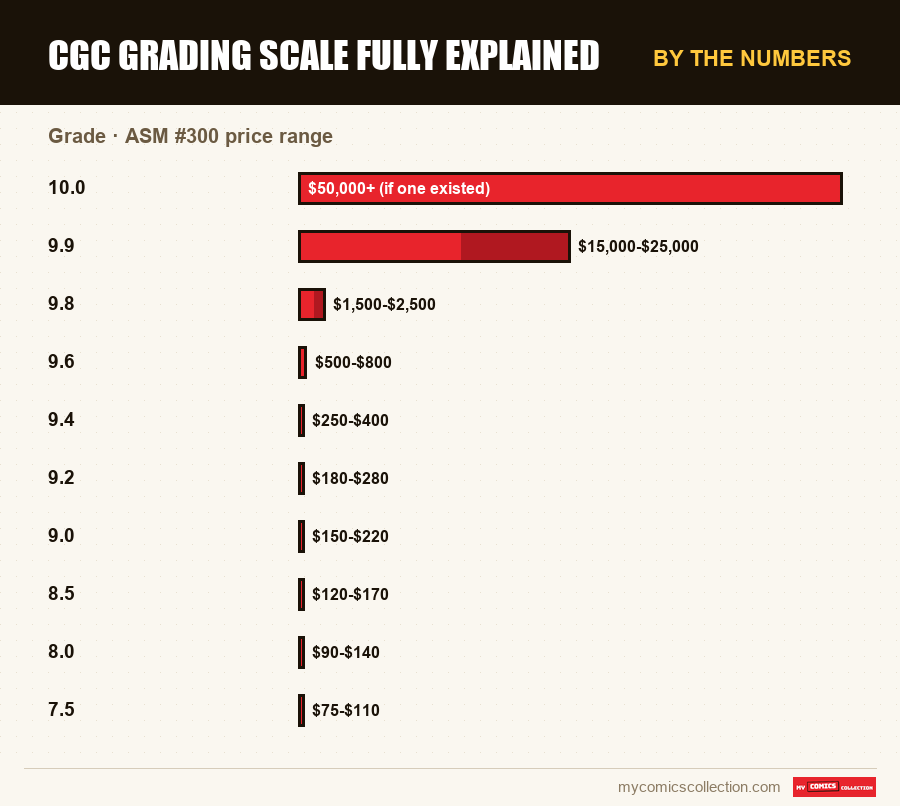
Below is every grade CGC assigns, with the official label, physical description, and an approximate market price for Amazing Spider-Man #300 (1988, first full appearance of Venom) to illustrate how grade translates to dollars. Prices reflect typical 2025-2026 eBay sold listings and auction results.
| Grade | Label | Physical characteristics | ASM #300 price range |
|---|---|---|---|
| 10.0 | Gem Mint | Absolute perfection. No defects of any kind under any light or magnification. Essentially never awarded to comics that have been read or handled. | $50,000+ (if one existed) |
| 9.9 | Mint | Nearly perfect in every way. A single barely perceptible flaw may exist. Extraordinarily rare: fewer than a handful exist for most titles. | $15,000-$25,000 |
| 9.8 | Near Mint/Mint (NM/M) | The collector gold standard. A nearly perfect book with only the slightest manufacturing defects: a tiny color-breaking crease on the spine, a minor bindery defect. White pages, sharp corners, flat cover, bright inks. | $1,500-$2,500 |
| 9.6 | Near Mint+ (NM+) | Minor imperfections visible only on close inspection. Perhaps a small stress mark on the spine or a lightly pushed staple. Overall impression is still outstanding. | $500-$800 |
| 9.4 | Near Mint (NM) | Well-preserved with minimal wear. A tiny corner blunt, slight spine stress, or a barely visible crease. Pages are white to off-white. Still an excellent-looking book. | $250-$400 |
| 9.2 | Near Mint- (NM-) | Light handling evidence. Minor cover wear, a small crease, or a slightly rolled spine. Cover gloss is largely preserved. A very attractive copy overall. | $180-$280 |
| 9.0 | Very Fine/Near Mint (VF/NM) | Sharp copy with minor wear. Small creases, light fingerprints, or a minor ink scuff. Cover retains good gloss. Spine may show minor stress lines. | $150-$220 |
| 8.5 | Very Fine+ (VF+) | An attractive, above-average copy. Limited cover wear, minor creasing, slight staple discoloration possible. Pages off-white to white. | $120-$170 |
| 8.0 | Very Fine (VF) | Moderate cover wear with some creasing. A small tear or stress mark is acceptable. Cover gloss is noticeably reduced but still present. Pages off-white. | $90-$140 |
| 7.5 | Fine/Very Fine (FN/VF) | Visible creasing on the cover. Spine may be slightly rolled. A small piece of tape or minor color-breaking fold is possible. Still a presentable, collectible copy. | $75-$110 |
| 7.0 | Fine (FN+) | A clean copy with noticeable wear. Multiple creases, minor spine splitting, slightly blunted corners. Staples may be lightly rusted. | $60-$90 |
| 6.5 | Fine+ (FN) | Noticeable wear throughout but still presentable. Creasing across the cover, moderate spine stress, corners worn. Pages are tan to off-white. | $50-$75 |
| 6.0 | Fine (FN) | An average used comic in decent shape. Moderate creasing, minor tears possible, reduced cover gloss. Spine may show minor splits. | $40-$60 |
| 5.5 | Very Good/Fine (VG/FN) | Heavy cover wear. Multiple creases, minor soiling, some color loss at edges. Staples may be discolored. Complete and readable. | $30-$50 |
| 5.0 | Very Good (VG+) | Significant wear. Cover largely creased, small tears possible, moderate soiling. Spine may have small splits. Pages tan. | $25-$40 |
| 4.5 | Very Good+ (VG+) | Significant stress marks and creasing. Tears up to 1/4 inch, moderate staining, cover nearly flat from wear. Still structurally intact. | $20-$35 |
| 4.0 | Very Good (VG) | A well-read copy. Major stress marks, 1/4 to 1/2 inch tears, noticeable staining. Cover has lost most of its gloss. Pages are tan to brown. | $15-$30 |
| 3.5 | Good/Very Good (GD/VG) | Major defects present. Large creases, small to medium tears, pieces may be missing from cover edges. Staples rusted, spine heavily stressed. | $10-$20 |
| 3.0 | Good (GD+) | Heavy wear and defects. Cover may be detached at one staple. Tears, stains, and creasing throughout. Pages browning. Complete but battered. | $8-$15 |
| 2.5 | Good+ (GD+) | Heavy damage including tape residue, large tears, heavy staining. Cover may be partially detached. Pages may be brittle. | $5-$12 |
| 2.0 | Good (GD) | Heavily damaged. Cover creased and torn, tape repairs common, heavy soiling. Spine may be split. Still complete: all pages and covers present. | $4-$10 |
| 1.8 | Good- (GD-) | Barely holding together. Major tears, heavy staining, cover nearly separated. May have small pieces missing from pages or cover. | $3-$8 |
| 1.5 | Fair/Good (FR/GD) | Extremely worn. Major defects throughout. Cover heavily damaged, pages may be missing coupons or small pieces. | $2-$6 |
| 1.0 | Fair (FR) | Barely intact. Cover is heavily damaged or partially missing. Extensive tears, stains, and brittleness. Readable but in very poor shape. | $2-$5 |
| 0.5 | Poor (PR) | Extremely damaged. Cover may be missing large sections. Pages torn, stained, or missing. The comic exists in its most minimal collectible form. Valuable only for extreme rarities. | $1-$3 |
Key takeaway: on Amazing Spider-Man #300, the jump from 9.6 ($500-$800) to 9.8 ($1,500-$2,500) represents a 3x price multiplier: for a difference of just 0.2 points on the scale. This pattern holds across virtually every popular key issue in the hobby.
The "sweet spot" grades for collectors: 9.4 to 9.6
Not every collector needs a 9.8. In fact, experienced buyers often target the 9.4 to 9.6 range because it offers the best balance of visual quality and affordability. Here is why these grades deserve serious attention.
9.6 (Near Mint+) is often the smartest buy on popular key issues. You get a book that looks almost indistinguishable from a 9.8 to the naked eye, but at one-third to one-half the price. On Amazing Spider-Man #300, that means paying $500-$800 instead of $1,500-$2,500 for a book that presents beautifully in a display case.
9.4 (Near Mint) is the gateway to serious collecting. At this grade, the comic still looks excellent: sharp corners, clean cover, minimal wear. For books you plan to hold long-term rather than flip, a 9.4 often represents outstanding value. You save significantly compared to a 9.6 while still owning an investment-grade copy.
The math is simple: a collector who buys ten key issues at 9.4 can build a broader, more diversified collection than someone who spends the same budget on three books at 9.8. For most collectors, portfolio diversity matters more than chasing the highest possible grade on every book.
CGC grade vs. raw condition: estimating before you submit
Before spending $40 to $150 on CGC submission fees, you want a reasonable estimate of what grade your comic will receive. Here are the key things professional graders look at, and how to approximate them at home.
Cover gloss and color: hold the comic at an angle under a bright light. A 9.4+ book will reflect light cleanly across the entire cover. Dull spots, fingerprint marks, or color-breaking creases immediately drop you into the 8.0-9.2 range.
Spine stress and ticks: run your finger gently along the spine. Small horizontal lines (stress ticks) are the most common grade-reducing defect. A few minor ticks: 9.4 territory. Ticks with color breaks: 9.0 or lower.
Corners: examine each corner closely. Perfectly sharp corners support a 9.6-9.8 grade. Blunted or lightly dinged corners pull you down to 9.2-9.4. Rounded or folded corners drop you below 9.0.
Page quality: CGC evaluates page color separately (White, Off-White/White, Off-White, Cream, Tan). White pages support higher grades and add a premium. Tan or brown pages on a modern comic suggest environmental damage that will lower the overall grade.
Staples: check for rust, migration staining, or misalignment. Clean, tight staples are consistent with 9.4+. Rusty staples alone can drag a book below 8.0.
A realistic self-assessment before submission can save you money. If your comic realistically grades at 8.5 or below and is not a major key issue, the grading fees may not be justified. The sweet spot for profitable grading is when you are confident the book will hit 9.4 or higher on a title where grade premium is significant.
The price cliff between grades: where 0.2 points means thousands
The CGC market is defined by steep price cliffs at certain grade thresholds. Understanding these cliffs helps you make better buying and selling decisions.
The 9.6 to 9.8 cliff is the steepest in the hobby. On key issues from the 1980s and 1990s, jumping from 9.6 to 9.8 typically multiplies the price by 2x to 4x. This is because 9.8 is the highest grade most comics can realistically achieve: it represents the top of the accessible market, and scarcity drives aggressive premiums.
The 9.4 to 9.6 cliff is the second most significant. On popular books, expect a 1.5x to 2.5x multiplier. A 9.6 crosses the psychological threshold where buyers view the comic as "premium grade" rather than merely "nice condition."
The 9.0 to 9.2 cliff matters less in dollar terms but is important for perception. Below 9.0, many serious collectors consider a book to have "visible flaws." Above 9.0, it is still in the Near Mint family.
Below 8.0, grade premiums flatten dramatically for modern comics. A 7.0 and a 6.0 of the same Modern Age key issue are often within $20-$30 of each other. The exception is Golden and Silver Age books, where even a 3.0 or 4.0 carries meaningful value because surviving copies at any grade are rare.
Here is the price cliff in action on Amazing Spider-Man #300:
| Grade | Typical price | Jump from grade below |
|---|---|---|
| 9.8 NM/M | $1,500-$2,500 | +200% to +300% vs. 9.6 |
| 9.6 NM+ | $500-$800 | +80% to +120% vs. 9.4 |
| 9.4 NM | $250-$400 | +40% to +60% vs. 9.2 |
| 9.2 NM- | $180-$280 | +15% to +25% vs. 9.0 |
| 9.0 VF/NM | $150-$220 | +25% to +40% vs. 8.5 |
| 8.0 VF | $90-$140 | +20% to +30% vs. 7.0 |
The pattern is clear: the higher you climb on the comic book grading scale, the steeper the price curve becomes. The top of the scale is where fortunes are made, and where overpaying by one grade step hurts the most.
Frequently asked questions
Track your CGC grades with precision
My Comics Collection manages all your graded and raw comics in one place: CGC grade, certification number, real-time valuation, insurance export. Try free for 7 days.
🚀 Free 7-day trial, no commitment