
You've heard of CGC (Certified Guaranty Company) and you want to take the plunge. Your collection is growing, some issues seem to be worth something, and you're wondering which ones deserve encapsulation in that coveted yellow slab. But grading a comic costs money, and it's irreversible if you pick wrong.
You've heard of CGC (Certified Guaranty Company) and you want to take the plunge. Your collection is growing, some issues seem to be worth something, and you're wondering which ones deserve encapsulation in that coveted yellow slab. But grading a comic costs money, and it's irreversible if you pick wrong.
This guide is for you. We'll go through how to intelligently pick your first (and second, and third) CGC submission without wasting your budget, and maximizing your chances of getting a grade that truly enhances your investment.
Understanding why grading exists
CGC was born in 2000 from a simple need: create an objective standard to evaluate comic condition. Before CGC, buying a "Very Good" comic from an eBay seller was a lottery. After CGC, you know exactly what you're buying: an issue graded by independent experts and encapsulated in a plastic slab that prevents any future deterioration.
The graded comics market has become substantial. As of 2025, CGC had graded over 12 million comics since its founding. On major auctions, graded copies consistently sell higher than their ungraded equivalents: sometimes 2x more, sometimes 10x more for the highest grades.
The fundamental grading rule: The total cost of CGC submission (service fees + outbound shipping + return shipping + insurance + customs) should represent less than one-third of your graded comic's estimated final value. Below that ratio, you lose money.
CGC service levels explained
CGC offers several service levels with different turnaround times and pricing. In 2026, here's what you can expect:
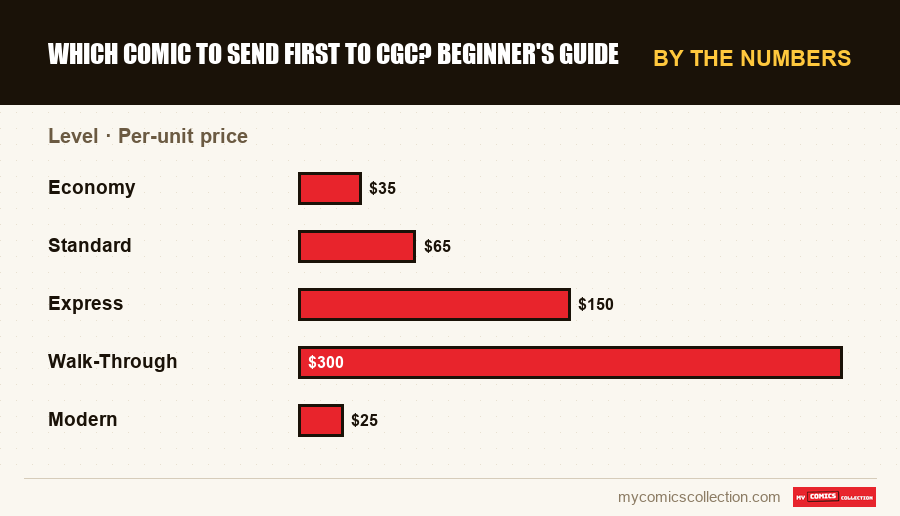
| Level | Per-unit price | Estimated turnaround | Max comic value |
|---|---|---|---|
| Economy | $35 | 120+ days | $400 |
| Standard | $65 | 60 days | $1,000 |
| Express | $150 | 20 business days | $2,500 |
| Walk-Through | $300 | 3 business days | Unlimited |
| Modern | $25 | 120+ days | $200 (post-1975) |
For a beginner, the Economy tier is the logical starting point. Yes, 120 days of waiting is long, but at $35 per comic, it's the only tier that lets you be profitable on moderately valued comics ($100-400 in grade 9.0).
The Modern tier ($25) is interesting if you have recent comics in very good condition: comics from 1975 or after, ungraded value under $200. It's the ideal entry point to test the process without spending too much.
How to choose your first comic to submit
It's the central question, and the answer comes down to three criteria you must evaluate in order.
Criterion 1: Apparent condition (estimated grade)
CGC grades comics on a 0.5 to 10.0 scale. The value difference between a 9.4 and a 9.8 can be considerable for a key issue: sometimes double or triple. But if your comic has clearly visible defects (rounded corners, stains, reading marks), it won't climb above 7.0-8.0, and in that case CGC fees often absorb all the benefit.
Before submitting, honestly assess your comic's condition:
- Straight spine with no crease? (crucial for high grades)
- Cover without foxing or moisture stains?
- Interior pages white and without yellowing?
- Original staples, no rust?
- Crisp corners, no rounding or creasing?
If you answer "yes" to all these points, your comic is probably in 8.0+ condition. If you have doubts on several points, the grade will likely fall between 5.0 and 7.0: generally insufficient to recoup grading fees.
Criterion 2: Comic value (cost/benefit ratio)
Here's the calculation you must do before each CGC submission. Take a concrete example:
Sample calculation, Amazing Spider-Man #300
- Estimated ungraded value in VF (8.0): $275
- Value CGC 9.0 per recent sales: $495
- Value CGC 9.4: $715
- Value CGC 9.8: $1,650+
- Economy CGC fees: $35
- Outbound shipping (insured): $50
- Return shipping: $45
- Total fees: ~$130
- Profitable as soon as grade 9.0 (net gain: ~$90)
In this example, even a middling grade (9.0) is profitable. But for a comic worth $55 ungraded, the same $130 in fees makes the operation unprofitable unless you hit an exceptional 9.8.
Criterion 3: Upside potential (speculation)
A third factor sometimes comes into play: you're anticipating value growth. If your comic is worth $90 today but you expect it to be worth $330 in 2 years (because the character is entering the MCU, for example), sending it now via Economy can be relevant. You'll receive your slab in 4 months and benefit from the rise with an already-certified comic.
Identify your best CGC candidates in your collection
My Comics Collection shows each comic's estimated value next to its recorded condition, so you can work out which ones deserve grading and at what service level.
Analyze my collection free7-day trial
Practical guide: preparing and shipping your CGC submission
Once you've picked your comic, here's exactly how to proceed for your first submission.
Create your CGC account
Go to cgccomics.com and create your account. You'll need an address, a payment method (international card accepted) and a valid email address. The account is free.
Create your online submission
In your member area, create a new submission. Select the service level, enter each comic's details (title, number, year, publisher, variant if applicable). CGC generates a form to print and slide into your package.
Package your comics correctly
Each comic must be in a plastic bag with a board (bag & board) of the right size. Stack the comics straight, wrap in bubble wrap and place in a rigid, well-padded box. CGC provides detailed packaging instructions on its site.
Choose carrier and insurance
UPS and FedEx are the most reliable options for US-bound and domestic shipments. Declare the comics' real value for insurance: never under-declare. In case of loss or damage during transport, you're reimbursed based on the declared value.
Track your submission
CGC updates your submission status online. You can track progress (received, in grading, encapsulated, shipped). The process takes time: that's normal. Don't worry if your first Economy submission takes 5-6 months.
Receive and verify your slabs
On receipt, immediately verify the grade matches your estimate, the slab isn't damaged and the comic is correctly identified (title, number, variant). In case of error, CGC has a dispute procedure.
Collecting this series?
Track what you own, what you are missing and what your collection is worth. 7 day trial.
Start my trial →The comic types that deserve CGC (and the ones that don't)
Yes, submit to CGC:
- Confirmed key issues: first appearances of major characters, first issues of major series (ASM #300, New Mutants #98, Hulk #181...)
- Very high-grade copies (estimated 9.4+): the value difference between a 9.4 and a 9.8 justifies the fees
- High speculative upside comics: if you anticipate major appreciation tied to the MCU/DCU
- Rare vintage issues: Golden Age (before 1956), Silver Age (1956-1970), Bronze Age (1970-1985)
- Signed comics: CGC offers special labels (SS: Signature Series) for comics signed in the presence of an authorized CGC witness
No, don't submit to CGC:
- Modern comics without particular collecting interest (ungraded value under $35)
- Comics in poor condition (VG and below) except rare exceptions
- Complete series runs without key issues: grading 50 ordinary issues doesn't make sense
- Recent comics printed in millions of copies without particular potential
CGC turnaround times in 2026: what to expect
CGC turnaround times have seen major fluctuations in recent years. In 2021-2022, during the COVID-era comics boom, Economy turnarounds hit 18-24 months. By 2026, the situation has normalized:
- Economy ($35): 4-6 months including shipping
- Standard ($65): 2-3 months
- Express ($150): 4-6 weeks
- Walk-Through ($300): 1-2 weeks
For your first submission, the Economy level is plenty. You're not in a hurry, and the 4-6 month wait lets you learn to evaluate your comics during that time.
The CBCS alternative: when to go there instead of CGC?
CGC is the market leader, but CBCS (Comics Book Certification Service) offers similar services. CBCS advantages: generally shorter turnarounds for economy tiers, and CBCS labels are increasingly accepted by serious collectors.
However, on the resale market, CGC slabs generally command a 10 to 20% premium over equivalent CBCS. For a first grading experience, CGC remains the recommended choice, especially if you plan to resell.
Practical tip: For your very first submission, send 3 to 5 comics together. Shipping costs represent the same expense whether you send 1 or 5 comics. Grouping your submissions significantly improves the overall profitability of each grading.
Frequently asked questions about CGC grading
Your collection always ready for grading
My Comics Collection lets you note the estimated condition of each comic next to its estimated value, and tag the copies of your submission in progress. Prepare your next CGC submission in 5 minutes.
Prepare my CGC submission7-day trial