You've decided to sell part or all of your comics collection. Maybe to fund new purchases, free up space, or simply because life has changed. Whatever the reason, reselling comics is a process that deserves as much thought as buying: if not more.
You've decided to sell part or all of your comics collection. Maybe to fund new purchases, free up space, or simply because life has changed. Whatever the reason, reselling comics is a process that deserves as much thought as buying, if not more. Because selling mistakes cost dearly: undervaluing rare pieces, selling through the wrong channel, getting scammed by a dishonest buyer, neglecting platform fees... The list of traps is long.
This complete guide gives you the methods, platforms and protections you need to resell your collection at the best price, safely.
First step: identify what you actually have
Before putting anything up for sale, you need to do a complete and honest inventory of your collection. This is the step most sellers rush through, and it's where hundreds, sometimes thousands, of dollars get lost.
Identifying hidden key issues
A "key issue" is a number with particular importance in comics history: first appearance of a character, first meeting, death of a major character, major identity change, first issue of an influential series, issue drawn by an artist who became a cult figure.
These comics can hide in an ordinary longbox without you knowing they're worth 10, 50 or 500 times more than the comics around them. Absolute rule: never sell as a lot without verifying each issue against a key issue list.
Resources for identifying your key issues:
- Comic Book Herald: lists of key issues by character and by series
- Key Collector Comics (app): app dedicated to identifying key issues with values
- Reddit r/comicbookcollecting: active community that can help identify specific pieces
- MyComicShop and eBay (completed sales): to verify real market value of a given issue
Evaluating the condition of each piece
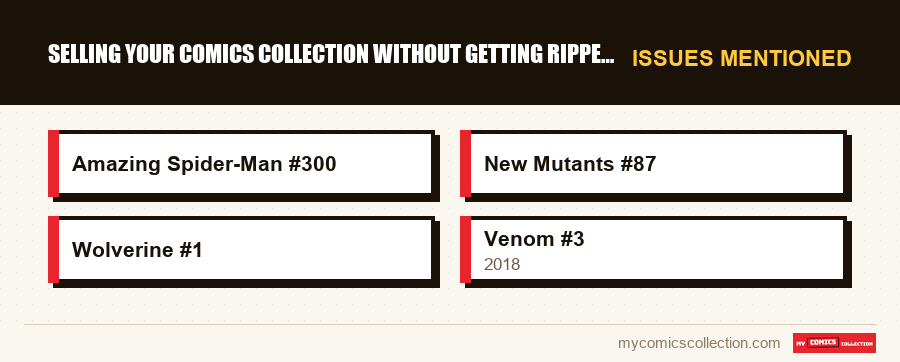
A comic's condition is the most decisive factor in its market value, often more than the edition itself. An Amazing Spider-Man #300 in 9.8 sells for about $1,350. In 7.0, about $90. In 4.0, about $40. The value difference between one grade and another can exceed 90% of total value.
Learn the grading scale: Near Mint (9.0-9.8), Very Fine (7.5-8.5), Fine (5.5-6.5), Very Good (3.5-4.5), and be honest in your self-assessment. Overvaluing your comics' condition leads to disputes with buyers, refund demands and negative feedback.
Practical tip: If you have key issues worth more than $110, seriously consider having them certified by CGC before selling. A certified comic often sells 30 to 50% more than a raw copy described as being in the same condition, because the buyer doesn't have to trust your self-assessment.
Estimate your collection before selling
My Comics Collection lets you inventory each issue with its condition, current value and estimated worth, so you know exactly what you're going to sell and at what price.
Evaluate my collection →7-day trial.
Choosing the right sales platform
Platform choice is crucial. Each channel has its advantages, disadvantages, typical buyers and fees. There's no universal "best platform": it depends on what you're selling and your goal.
eBay
International audienceThe reference platform for key issues and CGC-certified comics. Worldwide audience, auction or fixed-price system. Fees: about 12-15% of sale price. Limited seller protection but strong buyer protection. Ideal for rare high-value pieces.
Hip Comic
Comics-specializedAmerican platform dedicated exclusively to comics. Targeted audience of serious collectors. Fees slightly lower than eBay. Less volume than eBay but more qualified buyers. Excellent for mid-range comics and complete series.
MyComicShop
Buyback or marketplaceOffers both direct sale to their stock (they buy your collection with a discount) and a marketplace. Direct buyback is fast but you get 30 to 50% of market value. The marketplace is similar to eBay but less traffic.
Facebook Marketplace
Local marketUseful for large volumes of common comics sold locally (no shipping fees, no platform fees). Less specialized audience: buyers know less about prices. Higher scam risk on big transactions.
Facebook Groups
Active communityGroups like "Comics for Sale" or "Comic Collectors Network" are active and let you sell without platform fees. Payment often via Venmo or PayPal friends (no protection). Good for lots of comics and complete series.
Heritage Auctions
Premium piecesThe reference auction house for high-value comics (Golden Age, Silver Age, high-grade CGC slabs). High commission (15-25%) but audience of wealthy buyers ready to pay top prices. Reserve for pieces worth more than $550-1,100.
How to estimate the right sale price
The question every seller asks: how do I know if I'm selling too high (and won't find a buyer) or too cheap (and losing money)?
The eBay completed sales method
It's the most reliable and simplest method. On eBay, you can filter search results to show only completed sales ("Sold Items" in advanced search filters). This gives you the prices at which other copies of the same issue, in similar condition, actually sold: not asking prices, but prices paid.
Search the same title + issue + condition. Look at the last 5 to 10 completed sales for a reliable average. Account for condition (a 7.0 vs. an 8.5 have very different values), presence or absence of CGC certification and any shipping fees included in the price.
The Overstreet guide
The Overstreet Comic Book Price Guide is the industry's historical reference, published annually since 1970. It lists values for virtually every published comic by condition. However, it has two important limits: it's published once a year (so lags fast market movements) and it reflects US prices that may differ from your local market.
Use Overstreet as a starting point and historical reference, but always validate with recent eBay sales.
GoCollect and Comics Price Guide
These specialized sites aggregate real sales data (mainly eBay) and display price evolution over time. GoCollect offers very useful price evolution charts to see if a comic is rising or falling. Some advanced features are paid but basic search is free.
Collecting this series?
Track what you own, what you are missing and what your collection is worth. 7 day trial.
Start my trial →The mistakes that cost money
Here are the most expensive mistakes observed in first-time sellers.
Mistake 1: Selling as a lot without sorting
This is mistake number one. A lot of "200 Marvel comics from the 90s" sold for $55 can contain key issues alone worth $220 to $550. Copies like New Mutants #87 (first appearance of Cable), Wolverine #1 from 1982, or even less-known issues that have recently become key issues can hide in any longbox. Sort and identify each issue before creating lots.
Mistake 2: Undervaluing key issues through ignorance
If you lack deep key issue knowledge, you risk selling a character's first appearance for $5 when it's worth $165. This happens more often than people think, especially with characters whose popularity has exploded recently thanks to the MCU or series announcements. New Mutants #87, Venom #3 (2018) and similar: comics that seemed ordinary and became sought after overnight.
Mistake 3: Neglecting photos
Online, photos make the sale. A comic listed with blurry, poorly lit photos that don't show real defects triggers either return requests (if actual condition is worse than stated) or no buyers (if the photos don't inspire confidence). Systematically photograph: full cover, back, angles and any visible defect. Transparency about defects reassures the buyer and reduces disputes.
Mistake 4: Forgetting platform and shipping fees
On eBay, fees represent about 12 to 15% of the total sale price (including shipping if paid). If you sell a comic for $33 with $5 shipping, eBay takes about $5.75. You have $32.25 left, from which you still need to deduct the actual cost of packaging and shipping (often $5 to $9). In the end, you actually collect $23-27 for a comic listed at $33.
Mistake 5: Accepting unprotected payments
On Facebook groups and classifieds, you'll often be offered payment by bank transfer or PayPal "friends and family" (no fees). These methods offer no protection in case of dispute. If the buyer claims they never received the package or the contents differed from your description, you have no recourse. Only accept payments with buyer/seller protection on official platforms.
Classic buyer-side scams
Even as a seller, you can be the victim of scams. Here are the most common patterns.
The abusive "not as described"
The buyer receives the comic, opens it and then opens an "Item not as described" dispute claiming condition doesn't match what was listed: sometimes to get a partial refund, sometimes to keep the comic and get money back. Protection: photograph the comic's condition in detail before shipping, photograph the packaging and ship with tracking. In case of dispute, these photos are your main defense.
The "never received" with collusion
The buyer claims they never received the package to get a refund: when they actually did. Absolute protection: always ship with a tracking number. If the platform shows "delivered," the "never received" dispute is generally rejected. Without tracking, you automatically lose this type of dispute.
Comic substitution on returns
An unscrupulous buyer purchases a comic in good condition, claims there's a problem, returns a copy in poor condition or even a different comic and demands a refund. Protection: carefully photograph the copy before shipping (including distinctive characteristics if possible: a specific stain, a particular light wear). On receiving the return, compare immediately.
Watch for checks and money orders: Never accept check payment for a comic sale. Fraudulent checks exist and can take several weeks to come back unpaid: by which time you've already shipped your package.
Packaging: don't sabotage the transaction at the last step
A comic that arrives damaged from bad packaging is a problem that falls entirely on you as a seller. Comic shipping packaging follows precise rules.
Place the comic in a bag with rigid backing
Even for shipping, the comic must be in a protective bag with a rigid backing board. This prevents creases during transport.
Wrap in multiple protective layers
Bubble wrap around the bag, then rigid cardboard on each side (at least two rigid boards slightly larger than the comic). This cardboard sandwich prevents flexing during transport.
Clearly mark "Do Not Bend"
Write "DO NOT BEND" in large letters on the envelope or box. It guarantees nothing but reduces rough handling.
Photograph the package before shipping
A photo of the final packaging with the weight on the scale is extra protection in case of "contents differ from what was received" disputes.
FAQ, Reselling comics
Sell at the right price with a well-valued collection
With My Comics Collection, catalog your collection, identify your key issues, track values, updated daily, and prepare your sales with all the information needed to sell at the best price.
Prepare my sale →7-day trial, start in 60 seconds.