You just found the deal of a lifetime: an Amazing Fantasy #15 graded CGC 6.0 for $3,000, sold by an enthusiastic private seller on Facebook Marketplace or a classified ad. Too good to be true?
You just found the deal of a lifetime: an Amazing Fantasy #15 graded CGC 6.0 for $3,000, sold by an enthusiastic private seller on Facebook Marketplace or a classified ad. Too good to be true? Maybe. Counterfeit CGC slabs exist, they have become more sophisticated over the years, and they specifically target collectors who don't know what to look for to tell a real slab from a fake.
This guide gives you the concrete tools to verify the authenticity of a CGC slab before any purchase. Whether you're dealing with a seller in person or browsing an online listing, this knowledge can save you thousands of dollars.
Why CGC counterfeits exist and are on the rise
CGC (Certified Guaranty Company) has been the gold standard for comic grading since its founding in 2000. A CGC-certified comic consistently sells for more than a "raw" (uncertified) copy of the same issue in the same condition. This certification premium can reach 200 to 500% on popular key issues. This value differential creates a strong incentive for fraud.
CGC slab counterfeits come in three main forms:
- The fully fabricated slab: A plastic case produced by hand, with a printed label imitating the CGC look. Quality ranges from crudely obvious to surprisingly convincing.
- The opened and resealed slab: A genuine CGC slab is opened, the valuable comic removed and replaced with an inferior copy (or a fake), then resealed. The grade on the label remains accurate but no longer matches the comic inside.
- The reused certification number: A fake slab bears the certification number of a real slab that exists in the CGC database, creating an illusion of legitimacy upon online verification. The catch: the real slab with that number exists elsewhere.
Important data point: According to estimates from the collector community, counterfeits account for less than 0.5% of total CGC transactions. But on the informal market (Facebook, classifieds, flea markets), the rate is believed to be significantly higher. The risk is concentrated on high-value slabs ($500+) sold outside certified platforms.
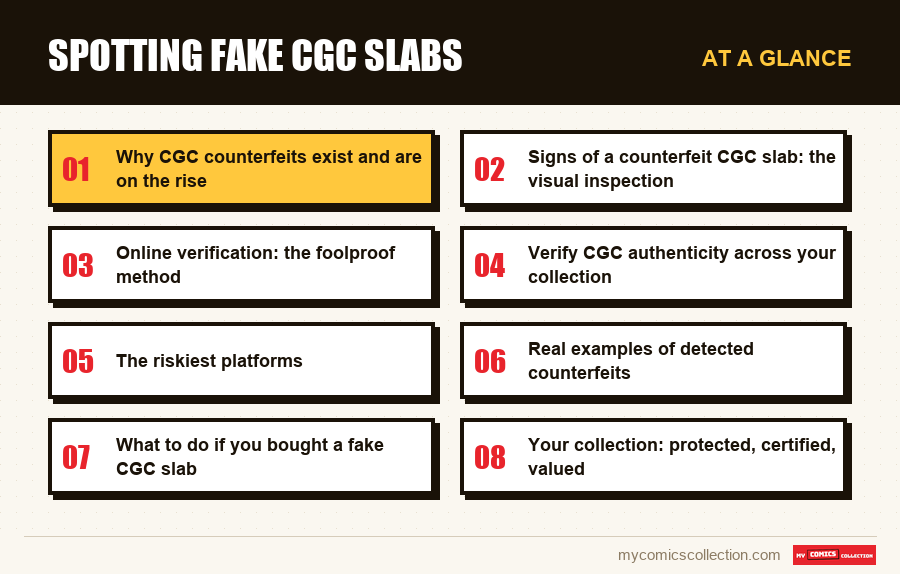
Signs of a counterfeit CGC slab: the visual inspection
Before even looking up the certification number, a careful visual inspection can reveal a lot. Here are the points to systematically examine.
The plastic case
The original CGC case is made of high-quality polycarbonate. It has perfect transparency, no bubbles, no scratches (unless damaged after certification), and a characteristic rigidity. Fake cases are often:
- Slightly yellowish or milky (lower quality plastic)
- With visible micro air bubbles on the edges or within the material
- Lighter than the original (reduced plastic thickness)
- With less clean seams -- the junction edges between the two halves of the case are less neat
- Missing the characteristic sealing joint visible on the sides
The CGC label
The label is often the weak point of counterfeits. On a genuine CGC slab:
- The typography is crisp and smudge-free under magnification
- The colors are precise -- the yellow of the Universal label is a specific yellow, not just any yellow
- The CGC logo is centered and precisely aligned
- The certification number is engraved or printed with high-resolution ink
- The microtext (very small text often present around the label) is readable under magnification
On fake labels:
- The edges may be slightly blurry if the printing is not high-resolution
- The background color may be slightly off
- The fonts don't exactly match the official CGC fonts
- The certification number may have an incorrect format (the format has evolved over the years)
The security hologram
CGC slabs include a security hologram visible at certain angles. It's one of the hardest elements to counterfeit. A genuine CGC hologram:
- Shows depth effects and color shifts depending on the viewing angle
- Is perfectly flat and integrated into the label (not stuck on top)
- Displays micro-elements visible under magnification
Fake holograms are often flat, without real depth effects, or simply absent. Some fake slabs use decorative holographic stickers that produce an iridescent effect but lack the security features of a real certification hologram.
Internal markings
Inside the CGC slab, between the first layer of the case and the comic, you'll typically find a backing board and a characteristic vacuum seal. The comic doesn't move inside the slab -- it's held firmly in place. If you can hear the comic shifting or see abnormal spacing, that's suspicious.
Maximum red flag: If the seller refuses to let you handle the slab (only "showing" you photos) or pressures you to buy quickly without giving you time to verify, walk away. A legitimate seller has no reason to refuse an inspection.
Online verification: the foolproof method
The most important and most reliable step is direct verification on the official CGC website. This verification can be done in a few minutes and is absolutely decisive.
Find the certification number on the label
Every CGC slab has a unique 10-digit certification number. It's located on the label, usually at the bottom. Write it down carefully -- a single wrong digit and the lookup will fail.
Go to CGCComics.com
Navigate to the "Verify" section or use the "Cert Lookup" function directly on cgccomics.com. Enter the certification number. If the number doesn't exist in their database, the slab is definitely fake.
Verify that the data matches exactly
The title, issue number, grade, and label type displayed online must exactly match what's printed on the physical slab. A grade of 9.6 online for a physical slab graded 9.8 is clear fraud. A mismatch on the title or issue number is equally damning.
Verify the label type
CGC uses several label types identifiable by their color: yellow (Universal, unrestored), blue (Qualified), purple (Restored), green (Signature Series), orange (Qualified). Make sure the physical label color exactly matches what the database indicates.
Check the certification history if available
The CGC database sometimes displays the ownership and submission history of a slab. If a "new" slab was certified 15 years ago with multiple ownership transfers, that may indicate it has been circulating for a long time -- verify that the physical condition is consistent with the age of the certification.
Verify CGC authenticity across your collection
My Comics Collection lets you record the CGC certification numbers for all your slabs, track them, and quickly detect any inconsistencies when buying or selling.
Secure my collection7-day trial -- no charge during the trial.
Collecting this series?
Track what you own, what you are missing and what your collection is worth. 7 day trial.
Start my trial →The riskiest platforms
Not all buying channels carry the same level of risk. Here's an honest assessment of the different markets.
High risk
- Facebook groups dedicated to comics: No seller verification, payment often via wire transfer or PayPal Friends & Family (no buyer protection), impossible to verify the seller's history. Fake slab fraud is well-documented on these platforms.
- Craigslist and local classifieds: No reputation system, transactions often in cash, seller hard to trace in case of problems.
- Flea markets and informal conventions: No guarantees, no recourse, sometimes with time pressure ("it's the last one, someone else already asked for it").
Moderate risk
- eBay: eBay's feedback system and buyer protection significantly reduce the risk. But malicious sellers do exist -- always check feedback, previous sales, and ask for additional photos. The eBay Money Back Guarantee covers "not as described" claims.
- Mercari, Vinted, Depop: Variable protections depending on the country, a less specialized community means less peer verification.
Low risk
- Heritage Auctions, ComicConnect, ComicLink: These specialized auction houses are the safest channels. They have their own verification process, and their reputation depends on the authenticity of the lots they sell.
- Established specialized retailers: Professional dealers with a long-standing reputation in the hobby.
- CBCS (another grading company): A direct competitor to CGC, with its own online verification system. CBCS slabs can also be verified on their website.
Real examples of detected counterfeits
The collector community has documented several cases of counterfeit slabs. Here's what the analyses revealed about the techniques used and the signals that enabled detection.
Case 1: The resealed slab (the "crack and swap")
In 2021, several cases were documented on CGC forums of slabs containing comics whose condition didn't match the displayed grade. Analysis showed faint adhesive traces on the case joints, proving it had been opened. The certification number was valid but corresponded to a slab sold by the original owner several years earlier -- the fraudster had purchased the empty slab or stolen it to substitute a lower-quality comic.
Case 2: The homemade printed label
Collectors received slabs with labels whose typography was slightly different. Under magnification, the print resolution was insufficient -- the letters showed slight jagged edges characteristic of standard inkjet printing. The certification number on the label was not in the CGC database. The yellow background color was slightly more orange than the official CGC yellow.
Case 3: The duplicated certification number
An unscrupulous seller sold slabs bearing the certification number of a real existing slab. Online verification therefore returned legitimate data. But by comparing the information with photos of the original slab (published in previously documented sales), the differences in appearance between the real and fake slab were identified. This technique is the most elaborate and requires cross-referencing multiple verification sources.
Pre-purchase CGC slab verification checklist
- Certification number verified on cgccomics.com
- Online data exactly matching the physical slab (title, grade, label)
- Correct label color (yellow, green, blue, purple, orange)
- Case free of bubbles, opacity, or irregular seams
- Hologram with visible depth effect under different angles
- Comic not moving inside the slab
- Seller with verifiable history and positive feedback
- Photos of the certification + detailed case photos available
What to do if you bought a fake CGC slab
If you suspect you've purchased a counterfeit, here are the steps to follow immediately and in order.
- Document everything: Take screenshots of the original listing, all exchanges with the seller, and the payment receipt. Photograph the slab from every angle. Don't resell it -- doing so could expose you to legal action.
- Contact CGC: Report the fake slab directly through cgccomics.com. CGC maintains a database of known counterfeits and can provide an official confirmation of authenticity or fraud.
- Open a dispute through the purchase platform: On eBay, open an "Item not as described" case within 30 days. On PayPal, the deadline is 180 days. Provide all your photographic evidence and the CGC response if available.
- File a police report for significant amounts: Counterfeiting fraud is a criminal offense. For amounts over $1,000, a formal complaint with all your evidence is recommended and can lead to prosecution.
- Alert the community: CGC forums, Reddit (r/comicbookcollecting), and specialized groups allow you to warn other collectors about an identified fraudulent seller.
FAQ -- Fake CGC slabs
Your collection: protected, certified, valued
My Comics Collection lets you centralize all your CGC slabs with their certification numbers, estimate the value of each certified copy, and build a protected inventory of your collection.
Protect my collection7-day trial -- start now.