You've come across a comic with a yellow CGC label and wondered what sets it apart from the usual blue label? Or maybe you're planning to get a comic signed by your favorite artist at an upcoming convention and want to know if the CGC Signature Series process is worth the expense?
You've come across a comic with a yellow CGC label and wondered what sets it apart from the usual blue label? Or maybe you're planning to get a comic signed by your favorite artist at an upcoming convention and want to know if the CGC Signature Series process is worth the expense? This guide gives you all the answers: how it works, real costs, which artists to target, and most importantly, the situations where it's an excellent decision versus those where it's a waste of money.
The CGC Signature Series is one of the most debated products in the comic book collecting community. On one side, copies that sell for two to three times the "raw" market price. On the other, signed comics that sit unsold for months because the artist isn't well-known enough or because the comic has no connection to their signature. In 2026, the market has become considerably more sophisticated, here's what you need to know.
Financial disclaimer: The information in this article is provided for educational purposes only and does not constitute investment advice. Prices of CGC Signature Series encapsulated comics are subject to market fluctuations. Past performance does not guarantee future results. Consult a professional before making any purchase for investment purposes.
What is the CGC Signature Series and how does it work?
The CGC Signature Series is a service offered by the Certified Guaranty Company (CGC), the world's leading authority for comic book certification. The concept is simple but the process is rigorous: authenticate signatures placed on collectible comics and encapsulate them with a grade.
What fundamentally distinguishes the CGC Signature Series from a simply signed comic is the concept of witnessing : the mandatory presence of a CGC-authorized witness at the time of signing. When you get your comic signed on the street or in a shop, you have no guarantee that the signature is authentic for a third party. The CGC Signature Series solves this problem.
The witnessing process: step by step
The witnessing works as follows: at a CGC-authorized event (a comic convention, a show, sometimes a signing organized by a partner store), a certified CGC representative is present. You bring your comic, it gets signed in front of the witnessing agent, who then encapsulates it or officially submits it to the CGC grading process. The signature is thus authenticated and documented.
Conventions that regularly host CGC witnessing agents include major events like San Diego Comic-Con, New York Comic Con, C2E2 in Chicago, and WonderCon. In Europe, authorized conventions are still rare, which represents an additional constraint for European collectors. Some use intermediaries who get comics signed on their behalf at American conventions, but this is more complex to arrange.
The yellow label vs the blue label vs the green label
The color of the CGC label immediately indicates the comic's status:
- Blue label (Universal): Comic graded without a signature, in condition consistent with the assigned grade. This is the standard label.
- Yellow label (Signature Series): Comic graded with one or more signatures authenticated through the witnessing process. The comic receives a full grade.
- Green label (Qualified): Comic graded with an anomaly, for example, a non-witnessed signature, a missing staple, or a non-structural defect that prevents a standard grade. Comics simply signed without witnessing receive this label and cannot be graded normally (the signature could mask defects).
- Purple label (Restored): Comic that has undergone restoration.
The difference between the yellow label and the green label is crucial for value: a green label means the comic could not be graded normally, which generally reduces its value. A yellow label, on the other hand, means the signature is authenticated and the grade is full and complete.
The real cost of a CGC Signature Series in 2026
Let's be direct about the numbers, since that's what drives your decision. The cost of a CGC Signature Series is much higher than many beginners anticipate. Here's the full breakdown:
CGC Signature Series cost breakdown (2026 estimate)
- CGC grading fee (Economy, declared value <$400): ~$40-50
- Signature Series surcharge per signature: ~$25-35
- Round-trip shipping to CGC: ~$35-55
- Convention access / artist signing fee: $20-200+ depending on the artist
- Estimated total for a standard comic: $120-340
- For a high-value comic (Plus service): $250-500+
These figures quickly shed light on a reality: for a CGC Signature Series to be financially worthwhile, the comic must be able to resell with a premium sufficient to cover these costs AND generate a profit. In practice, this is only truly possible with key issues featuring highly sought-after artists.
Price comparison: with and without Signature Series
To concretely illustrate the impact of SS on value, here are examples based on 2025-2026 market data:
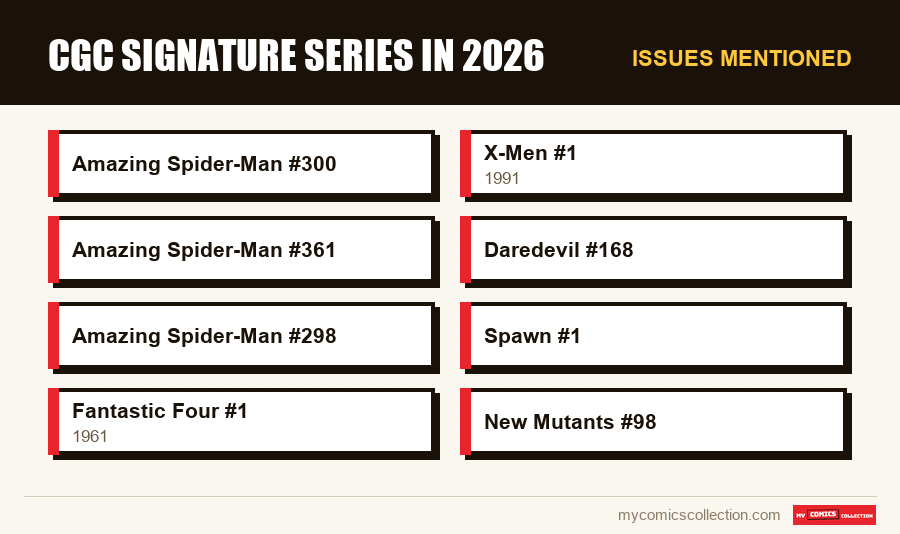
- Amazing Spider-Man #300 CGC 9.8 (standard): approximately $800-1,000 on eBay.com. CGC 9.8 SS McFarlane: $2,500-4,000. The premium is real and substantial.
- X-Men #1 (1991) CGC 9.8 (standard) : approximately $60-90. CGC 9.8 SS Jim Lee: $300-600. The premium is proportionally even stronger.
- Amazing Spider-Man #361 CGC 9.8 (standard) : approximately $200-300. CGC 9.8 SS Mark Bagley: $350-500. The premium is more modest because Bagley is less in-demand than McFarlane.
- A filler run modern issue CGC 9.8 (standard) : $20-40. CGC 9.8 SS minor artist: often less than the standard because the market is illiquid.
These figures clearly show that the Signature Series premium correlates with demand for the signing artist, not simply the presence of a signature.
Catalog your CGC Signature Series with precision
Record every detail of your CGC comics, label, grade, signing artist, certification date, and track their valuation, updated daily, with My Comics Collection.
Free 7-day trial, No commitmentWhich artists actually drive prices up in 2026?
This is the central question. The value of a CGC Signature Series is primarily determined by demand for the artist, not by the rarity of the signature itself. Here are the categories you need to know:
The legends, maximum and guaranteed value
These artists generate systematic premiums, regardless of the comic and its condition:
- Stan Lee (posthumous): Stan Lee signatures authenticated via CGC Signature Series before his death in November 2018 are extremely rare and highly valuable. Any SS Stan Lee comic is a legacy collection piece.
- Todd McFarlane: Creator of Spawn, iconic Spider-Man run. His signature generates 200 to 400% premiums on the ASM issues he drew.
- Jim Lee: Co-artist of the best-selling X-Men of all time. Very strong premiums on X-Men #1 (1991) and issues from his run.
- Frank Miller: Author of Born Again (Daredevil), The Dark Knight Returns (Batman). Excellent premiums on these key issues.
- Neal Adams: Bronze Age master. Aging artist, signatures increasingly rare. Very strong legacy value.
Top-tier artists, solid premiums
- J. Scott Campbell: Highly sought-after for feminine covers and variants. His signature on his own covers generates significant premiums.
- John Romita Sr.: Marvel legend, aging artist. Rare and valuable signature on classic ASM issues.
- George Pérez (posthumous): As with Stan Lee, SS copies authenticated during his lifetime are rare pieces.
- Peach Momoko: Rising artist in high demand from the new generation of collectors. Her variant covers are highly prized.
- Skottie Young: Very popular for baby variant covers. Very loyal collector base.
Artists to avoid for financial value
Lesser-known artists in the broader collecting market may sign comics of remarkable quality, but if their name doesn't generate demand among buyers, the premium will be zero or negative. The simple rule: before committing to a Signature Series certification, check recent sales on eBay.com by searching "CGC SS [artist name]" to see if the market is active.
Collecting this series?
Track what you own, what you are missing and what your collection is worth. 7 day trial.
Start my trial →When the CGC Signature Series is truly worth it
Now that you know the costs and dynamics, here are the situations where the Signature Series is a smart decision:
The artist signs THE comic they created or drew
The logic is simple: McFarlane signing Amazing Spider-Man #300, Jim Lee signing X-Men #1, Frank Miller signing Daredevil #168. The signature is consistent with the comic, which the market values highly. An "incongruous" signature (an artist signing an issue unrelated to their work) generates a much smaller premium.
The comic is in 9.6 or 9.8 condition
CGC Signature Series on a comic in 8.0 or 8.5 condition is rarely profitable. The strongest premiums apply to copies in excellent condition. If your comic can't get a 9.6 or 9.8, think twice before investing in the SS process.
The artist is elderly or signatures are becoming scarce
Signatures from aging artists or those whose health limits their convention appearances become increasingly rare over time. Neal Adams, John Romita Sr., John Buscema (before his death) are perfect examples. The growing scarcity of these signatures mechanically drives their value up.
You have access to a CGC witnessing agent at the convention
If you're already attending San Diego Comic-Con or New York Comic-Con anyway, and your target artist is present, the marginal cost of the CGC SS is reduced (you save the convention ticket). This is the context where the cost/benefit ratio is most favorable.
When the CGC Signature Series is a waste of money
Let's also be clear about situations where the process makes no economic sense:
- Common modern comics: An issue printed in 100,000 copies, even signed and certified, won't generate a significant premium. The market is saturated with them.
- For personal collection only: If you never plan to resell, a simple non-witnessed autograph is more than enough. No need to spend $150-300 on encapsulation you'll never monetize.
- Artist without an active collector community: Always check recent CGC SS sales for the artist before committing. If no sales appear, the market doesn't exist yet.
- Insufficient comic condition: Investing in an SS on a comic that will get a 7.5 or 8.0 is generally a poor financial decision.
Practical tip: Before any convention, prepare your "hit list" of comics to get signed and identify in advance which artists will be present. Check the CGC website to see if the convention has witnessing agents. Bring your comics in protective sleeves to avoid any damage while waiting.
Priority artists to target in 2026
Based on market trends and convention news, here are the artists to watch particularly closely this year for high-potential CGC Signature Series:
Todd McFarlane remains essential. His convention appearances are increasingly rare, and SS signatures on Amazing Spider-Man #298-328 and Spawn #1 maintain very solid premiums. If you get the chance to meet him, don't pass it up.
Jim Lee is also a safe bet, particularly on X-Men #1-3 (1991) and issues from his run. With his position at DC Comics, his appearances remain regular, but SS copies are in high demand.
John Romita Sr. is the artist whose signatures are most valuable and whose age makes future appearances increasingly uncertain. Any opportunity to get a John Romita Sr. SS certified on Silver Age or Bronze Age Amazing Spider-Man issues should be seized.
Peach Momoko represents a different bet: a new-generation artist, in high demand, with an extremely loyal international fan base. Her variant covers in SS are very liquid on the secondary market.
For comics linked to MCU Phase 6 adaptations, artists associated with first appearances of upcoming characters can also generate growing interest. Check our article on rare comics and their current values to identify the relevant issues.
CGC Signature Series and European collections: specific constraints
For European collectors, the CGC Signature Series presents particular constraints that need to be anticipated:
CGC-authorized conventions in Europe are rare. Most witnessing agents operate at major American conventions. This means that for a European collector, accessing an SS at a convention often requires traveling to the United States or working with intermediaries.
"Rep submission" services exist: CGC-authorized agents who attend conventions on your behalf, get your comics signed, and submit them to the CGC process. This solution has a cost but can be worthwhile if you cannot travel.
Customs is also a consideration: shipping comics to the United States for CGC certification involves potential customs fees on return. Do your research before sending high-value comics.
To learn more about grading in general, check out our complete guide to comic grading and our article on how CGC grading works.
FAQ, CGC Signature Series
Your CGC collection tracked and valued
Record your CGC-graded comics with all their details, label, grade, signing artist, and follow the history of your collection's value.
Free 7-day trial, No commitment