There is no single price: the value of an inherited collection depends mostly on a few key issues (first issues, first appearances) and their condition, far more than on the number of copies. Do not sell anything before cataloguing everything, set aside the #1 issues and first appearances, then compare real sales piece by piece.
⚠️ For informational purposes only: This information is provided for educational purposes only. My Comics Collection is not an investment advisor. Values vary with condition, scarcity and market trends. Always check recent eBay and GoCollect sales before any buying decision.
A parent passes away and leaves behind boxes full of comics. Hundreds, sometimes thousands of issues carefully protected in plastic sleeves, organized by title and number. You don't know where to start. You don't know if it's worth $50 or $50,000. And deep down, you're not sure you want to sell everything: some issues carry memories.
This guide is for you. It's not for seasoned collectors: it's for those who discover the comics world through inheritance and want to make the right decisions without getting taken.
First step: don't sell anything before you've cataloged everything
This is the number-one mistake heirs make. Rushed to settle an estate or empty a house, they accept the first offer from a scrap dealer or comic shop proposing "$100 for the whole lot." That offer is almost always far below the collection's real value.
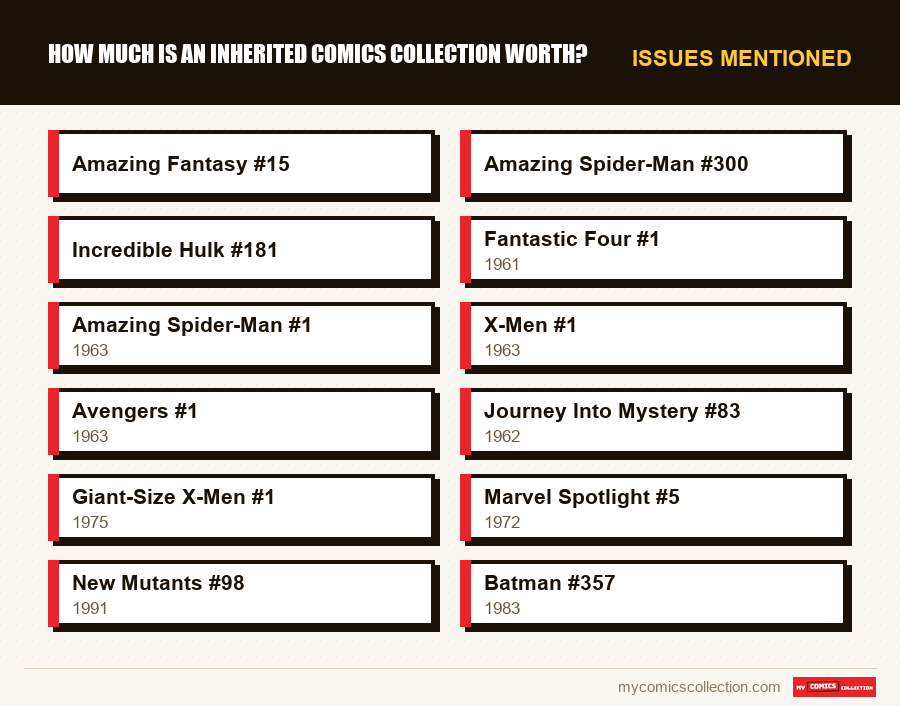
Take your time:days, even weeks for a significant collection: to inventory what you have. A single valuable comic can be worth more than all the others combined. An Amazing Fantasy #15 (first appearance of Spider-Man), an Amazing Spider-Man #300 (first appearance of Venom) or an Incredible Hulk #181 (first appearance of Wolverine) can each be worth several hundred to several thousand dollars.
Absolute rule: Don't throw anything away, even comics that seem worthless. An issue you think is ordinary could be a "key issue" actively hunted by thousands of collectors. Doubt should always benefit the comic.
How to sort and organize an inherited collection
Before talking value, you need to bring order. Here's a simple, effective method to tackle any collection, regardless of size.
Separate by publisher
Marvel, DC, Image, Dark Horse, Independents. Marvel and DC Silver Age (1956-1969) and Bronze Age (1970-1985) comics are generally the most valuable. 1990s Image comics deserve specific attention for a few key titles.
Spot the #1 issues
A series' first issues tend to be more sought-after. Set them aside systematically for individual examination. No guarantee of high value, but a good starting indicator.
Identify first appearances
This is where the real treasures live. A "first appearance" of a popular character is almost always a valuable key issue. Resources like Comic Book Herald or the My Comics Collection app list the most important first appearances.
Evaluate condition
Condition often matters more than the issue itself. A comic in Near Mint can be worth 10x more than the same issue in Poor. Handle comics with cotton gloves, flat, without folding pages.
The comics that actually hold value in 2026
Here are the broad families of comics with the most market value today. If you find these titles in the collection, dig deeper first.
Marvel Golden Age and Silver Age (before 1970)
Fantastic Four #1 (1961), Amazing Fantasy #15 (1962), Amazing Spider-Man #1 (1963), X-Men #1 (1963), Avengers #1 (1963), Journey Into Mystery #83 (first appearance of Thor, 1962). These issues can be worth anywhere from a few hundred to tens of thousands of dollars depending on condition. Even in mediocre shape, they have value.
Bronze Age Marvel (1970-1985)
Giant-Size X-Men #1 (1975, first X-Men appearance of Wolverine), Incredible Hulk #181 (full first appearance of Wolverine, 1974), Marvel Spotlight #5 (first appearance of Ghost Rider, 1972). More affordable than Silver Age but values have risen significantly in recent years.
Key Copper Age (1985-1992)
Amazing Spider-Man #300 (first appearance of Venom, 1988), New Mutants #98 (first appearance of Deadpool, 1991), Batman #357 (first appearance of Jason Todd, 1983), Crisis on Infinite Earths #7 (death of Supergirl, 1986). This period produced many key issues whose value ties directly to film adaptations.
Quick value markers
- Before 1960: extremely rare, can be worth thousands even in poor condition
- 1960-1969 (Silver Age): key issues range $550 to $55,000
- 1970-1984 (Bronze Age): key issues $110 to $5,500 depending on the character
- 1985-1995 (Copper Age): high variance, from $0 to $3,300
- After 1995: generally little value except notable exceptions
Collecting this series?
Track what you own, what you are missing and what your collection is worth. 7 day trial.
Start my trial →How to estimate value online without being an expert
You don't need to be an expert to do a first pass. The internet gives you powerful free tools.
eBay: completed listings: Search the title and issue number, then filter to "Sold Items." You'll see the actual prices buyers agreed to pay. That's the most reliable data because it reflects the real market, not hoped-for prices.
GoCollect: This site aggregates CGC sales data to give you value by grade. Ideal for already-graded comics found in the collection.
Heritage Auctions: The best-known comics-specific auction house. Its past sales database is a reference for rare pieces.
My Comics Collection: Our app lets you photograph or scan your comic, identify it automatically and get a value estimate based on current eBay listings. Ideal for quickly cataloging a large collection.
Catalog and evaluate your inherited collection for free
Scan their barcodes or search them by series and issue number: My Comics Collection finds them and gives you their current value based on current eBay listings. 7 days free.
🚀 Start 7-day free trialNo charge during trial · Cancel anytime
Keep or sell: how to make the right call
This is often the hardest question because it mixes emotion and finance. Here's a way to approach it methodically, without guilt.
What sentimental value can't tell you
An object's market value is independent of what it means to you. A comic can be the most precious memory you have of a person and be worth $5 on eBay, or be worth $2,200 and mean nothing to you emotionally. Separate the two dimensions before deciding.
The emotional sorting strategy
Among all the comics in the collection, some probably have a specific story. Maybe your parent read one to you as a child. Maybe there's a handwritten dedication inside. Isolate these comics immediately and never put them in the "to sell" pile, whatever their market value.
What to sell first
Comics from the 1990-2005 period published in huge print runs with no particular connection to a major character can be sold without regret. They generally have low market value and take up a lot of space. Focus your energy on the genuinely valuable pieces.
Practical tip: Before selling, photograph the entire collection. That way you build a digital "memory album" you'll always have, even if you part with the paper originals.
Classic mistakes inherited-collection heirs make
These mistakes come up constantly. Avoiding them can save you hundreds or thousands of dollars.
- Accepting the first buyback offer without comparing. Comic shops buy at 30 to 50% of market value. That's their business model, normal, but know what you're doing.
- Selling as a lot without separating the valuable pieces. If your lot contains an Amazing Spider-Man #300 and 200 worthless comics, don't sell it all together. Sell the valuable pieces separately to maximize their price.
- Neglecting condition during sorting. Stacking comics on the floor, piling them carelessly, exposing them to direct light or humidity: a few hours of careless handling can irreversibly damage a copy worth several hundred dollars.
- Confusing asking price with real price. On eBay, a seller can list a comic at $550 when it actually sells for $90. Always base decisions on completed sales, never active listings.
- Ignoring taxes on significant sales. If you sell a collection for several thousand dollars, check the tax implications. Collectible sales gains are subject to taxation above certain thresholds in most countries.
Frequently asked questions
Discover your collection's real value in 5 minutes
My Comics Collection turns any stack of comics into a valued inventory. Identify your valuable pieces, get a fair estimate and finally make the right decisions about your inheritance.
🚀 Start free7-day free trial · No commitment