Batman #1, published in spring 1940 by DC Comics, is one of the most sought-after comics in the world. Not simply because it is the first solo series dedicated to the Dark Knight, but because its pages contain an absolutely unique concentration of key issues: the very first appearance of the Joker and the first appearance of Catwoman, two of the most iconic characters in…
For reference only: This information is provided for informational purposes only. My Comics Collection is not an investment advisor. Prices vary depending on condition, rarity, and market trends.
Batman #1, published in spring 1940 by DC Comics, is one of the most sought-after comics in the world. Not simply because it is the first solo series dedicated to the Dark Knight, but because its pages contain an absolutely unique concentration of key issues: the very first appearance of the Joker and the first appearance of Catwoman, two of the most iconic characters in all of modern popular culture. Owning this copy means holding a piece of comic book history that no amount of money can recreate.
In 2026, Batman #1 prices continue to reach dizzying heights at major auction sales. Whether you own a copy or are considering acquiring one, this guide gives you all the keys to understanding its real value, navigating the different grades, and avoiding the most common pitfalls in this ultra-competitive market.
The story behind Batman #1: why this issue is an absolute Holy Grail
To understand the value of Batman #1, you need to place its publication in context. In 1939, Bob Kane and Bill Finger created Batman in the pages of Detective Comics #27. The character was an instant success and quickly got his own series. Batman #1 was released in spring 1940, with an iconic cover showing Batman and Robin in flight.
But what makes this issue truly exceptional is its interior content. The Joker, created by Bob Kane, Bill Finger, and Jerry Robinson, makes his debut in this very issue, and not in just one story, but in two separate tales. This editorial decision transforms Batman #1 into a founding document of the Batman mythos as we know it today. The Joker, a character who has become as famous as Batman himself thanks to film adaptations (Jack Nicholson in 1989, Heath Ledger in 2008, Joaquin Phoenix in 2019), finds his roots here.
The same issue introduces "The Cat," a character who would become Catwoman, another pillar of the Batman universe. A double key issue this powerful in a single Golden Age issue simply does not exist anywhere else in the DC universe. That is why Batman #1 is consistently ranked among the ten most valuable comics ever published.
Double key issue: Batman #1 (1940) contains both the 1st appearance of the Joker (in 2 stories) and the 1st appearance of Catwoman. No other DC Golden Age issue concentrates this much historical value under a single cover.
Current CGC prices for Batman #1 in 2026
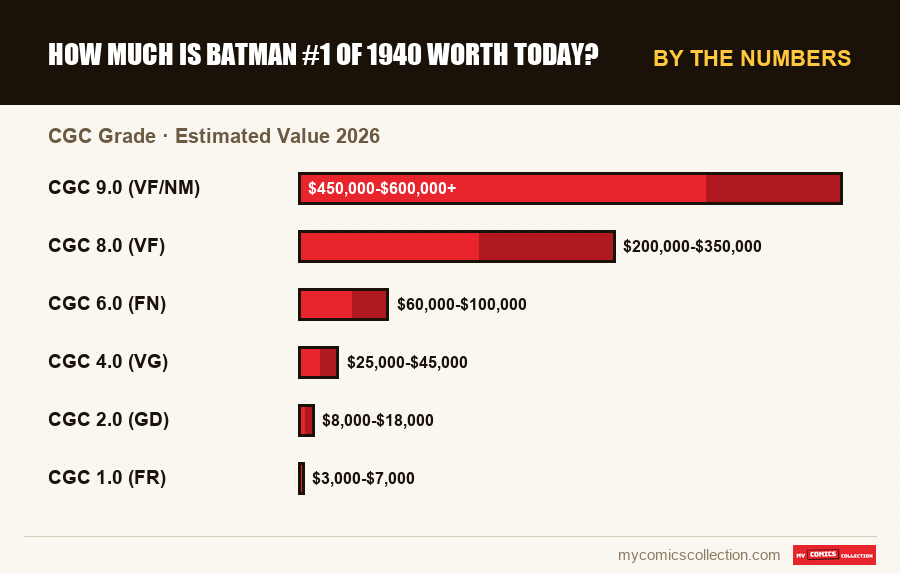
The high-value comic market today operates almost exclusively around the CGC (Certified Guaranty Company) or CBCS grading system. These independent organizations assign a grade from 0.5 to 10.0 to each submitted copy after a thorough examination of its condition. For Batman #1, values vary considerably depending on this grade.
| CGC Grade | Condition | Estimated Value 2026 |
|---|---|---|
| CGC 9.0 (VF/NM) | Very Fine / Near Mint | $450,000-$600,000+ |
| CGC 8.0 (VF) | Very Fine | $200,000-$350,000 |
| CGC 6.0 (FN) | Fine | $60,000-$100,000 |
| CGC 4.0 (VG) | Very Good | $25,000-$45,000 |
| CGC 2.0 (GD) | Good | $8,000-$18,000 |
| CGC 1.0 (FR) | Fair | $3,000-$7,000 |
These ranges are indicative and can be exceeded during auctions with heavy competition between buyers. High-grade copies (CGC 8.0 and above) are so rare that a single sale can set the benchmark for years and push estimates upward.
It should be noted that restored copies (marked "Restored" or "R" by CGC) are worth significantly less, sometimes 50 to 70% less than an unrestored copy of similar visual appearance. Restoration, even when done professionally, diminishes the document's authenticity and therefore its value in the eyes of serious collectors.
Record sales and market milestones
The sales history of Batman #1 is marked by records that illustrate the growing appetite for top-tier Golden Age comics. Heritage Auctions, the largest auction house specializing in comics in the United States, has recorded several historic sales for this issue.
In 2021, a CGC 9.4 copy, one of the few near-perfect copies in existence, sold for over $2.2 million, setting a record for this title at the time. This sale confirmed what observers had been anticipating for years: Batman #1 has entered the category of ultra-high-value alternative investments, on par with masterpiece paintings or exceptional collector's watches.
Between 2019 and 2026, the average price of CGC 6.0 copies has increased by over 180%, according to consolidated data from the leading auction houses. This steady growth, even during periods of economic turbulence, speaks to the resilience and structural demand for this title.
Factors driving the price up
Several elements contribute to the continued appreciation of Batman #1 on the market:
- Ongoing film and TV adaptations: Every new Batman movie or television project reignites public interest in the original comics and pushes prices upward.
- Absolute rarity: Unlike comics from the 1980s and 1990s that were printed in hundreds of thousands of copies, Golden Age print runs were modest, and the vast majority of copies have been lost, destroyed, or poorly preserved over the decades.
- Internationalization of buyers: Asian and European collectors are now a major presence on the market, considerably broadening the base of potential buyers for exceptional copies.
- Digitization and price transparency: Platforms like CGC Census now make it possible to know precisely how many copies exist per grade, making rarity quantifiable and therefore easier to value.
Track the value of your Golden Age Batman comics
My Comics Collection lets you track the real-time valuation of your DC collection, with personalized price alerts on your most valuable key issues.
Start for freeFree trial
How to authenticate a 1940 Batman #1
Authenticating a Batman #1 copy is an absolutely non-negotiable step before any transaction. At this price level, fakes, concealed restorations, and copies with overstated grades represent considerable financial risks. Here are the steps every serious collector should follow.
Verify the CGC or CBCS certification
A legitimate copy sold at a high price must be encapsulated by CGC or CBCS. Verify the certificate number directly on the CGC website (cgccomics.com) or CBCS to confirm the authenticity of the slab and the assigned grade.
Inspect the paper and staples
For ungraded copies, an expert examines the color and texture of the paper (which must be consistent with 1940s printing processes), the natural oxidation of the original staples, and the absence of chemical or physical restoration.
Bring in an independent expert
For transactions above $10,000, it is strongly recommended to hire an independent expert specializing in Golden Age comics, separate from the seller. Reputable auction houses like Heritage Auctions also offer authentication assistance.
Verify the ownership history (provenance)
Documented provenance, who owned the copy, when, with what proof, adds significant value and reassures buyers. A solid provenance can increase the price by 10 to 20% compared to a similar copy without history.
Where to buy and sell a 1940 Batman #1
The high-value Golden Age comic market is relatively concentrated around a few major players that have the expertise, clientele, and transparency needed for transactions of this scale.
Specialized auction houses
Heritage Auctions (Dallas, Texas) is the absolute benchmark of the American market. Their Golden Age comic auctions are scheduled several times a year and attract buyers from around the world. The seller's commission is typically 15 to 20%, but the visibility and potential selling price easily justify this cost for exceptional copies.
ComicConnect and ComicLink are two other well-known platforms that regularly host online auctions for CGC-certified comics. Their commissions are slightly lower than Heritage's.
Direct sales between collectors
eBay remains an option for lower-value copies (CGC 1.0 to 3.0), but for high-quality copies, the risks associated with a general marketplace are too significant. Specialized forums like CGCComics.com or MyComicShop offer a more targeted community, but transaction volumes remain limited for very high-value items.
Batman #1 as a collectible asset: 2026 outlook
The question every collector asks is simple: will Batman #1 continue to appreciate? Without playing fortune teller, several structural trends support sustained long-term demand.
First, supply is fundamentally limited. Unlike stocks or bonds, you cannot "print" new Batman #1 copies. Every passing year sees copies disappear or deteriorate further, mechanically reducing the available supply for buyers. Second, Batman's worldwide fame shows no sign of weakening. Recent adaptations have expanded his audience to millions of potential new fans.
Third, demographics favor the market: a generation of collectors who grew up in the 1980s and 1990s with Tim Burton's Batman films has now reached financial maturity and has sufficient income to afford Golden Age pieces that were out of reach in their youth.
Key takeaways on Batman #1 (1940)
- 1st appearance of the Joker (two stories) and Catwoman in the same issue
- Published spring 1940, Golden Age format, 96 pages
- Approximately 100 to 200 known copies worldwide
- CGC 9.0: estimated value over $500,000 in 2026
- CGC/CBCS authentication mandatory for any serious transaction
- Restored copies: value reduced by 50 to 70% compared to unrestored
FAQ: Batman #1 (1940), your most frequently asked questions
Your DC collection valued in real time
Catalog your Golden Age Batman comics, track their value day by day, and get alerts when the market moves. My Comics Collection does all that for you, free to start.
Try for freeOver 15,000 collectors trust My Comics Collection