There is no villain more iconic than the Joker. Across more than 80 years of publication, he's been the 1940s prankster clown, the 1970s psychotic criminal, the modern-era nihilist philosopher, and the universal cultural symbol that Todd Phillips's films catapulted to the top of global box office. Each incarnation left its mark on comics, and a handful of issues concentrate the essence of this entire collection.
There is no villain more iconic than the Joker. Across more than 80 years of publication, he's been the 1940s prankster clown, the 1970s psychotic criminal, the modern-era nihilist philosopher, and the universal cultural symbol that Todd Phillips's films catapulted to the top of global box office. Each of these incarnations left its mark on comics, and certain issues alone concentrate most of the value, rarity and meaning this collection can offer.
This guide lists the 10 absolutely essential Joker key issues, from Batman #1 (1940) to modern stories like Three Jokers. Each issue is analyzed for what it represents narratively, for its rarity, its current grades and its appreciation potential in a market continuously energized by the Clown Prince of Crime's film adaptations.
The Joker market is among the most solid in collectible comics. Unlike many characters whose demand is tied to MCU/DCU announcements, the Joker enjoys permanent cultural popularity that supports prices even without current news.
1. Batman #1 (1940). The Joker arrives on the scene
Batman #1, published in spring 1940 by Bob Kane, Bill Finger and Jerry Robinson, is the most important issue in the entire Joker collection, and one of the most valuable comics in the world across all categories. This issue contains not only the first appearance of the Joker but also that of the Penguin: two major Batman villains introduced simultaneously in the first solo series dedicated to the Dark Knight.
The numbers are staggering. In CGC 9.4, Batman #1 has surpassed $2.2 million at auction: an absolute record for a Golden Age DC comic. In CGC 6.0, auctions still reach $150,000 to $300,000. Even a CGC 3.0 copy (reader grade, cover present) is worth $30,000 to $60,000. For most collectors this issue remains out of reach as a direct purchase, but it stands as the inescapable reference point for any Joker key-issue conversation.
Restoration alert: Batman #1 is one of the most frequently restored comics on the market. Before any purchase, demand a CGC or CBCS certification clearly indicating no restoration (blue label). A restored copy is worth 50-80% less than an unrestored copy at the same grade.
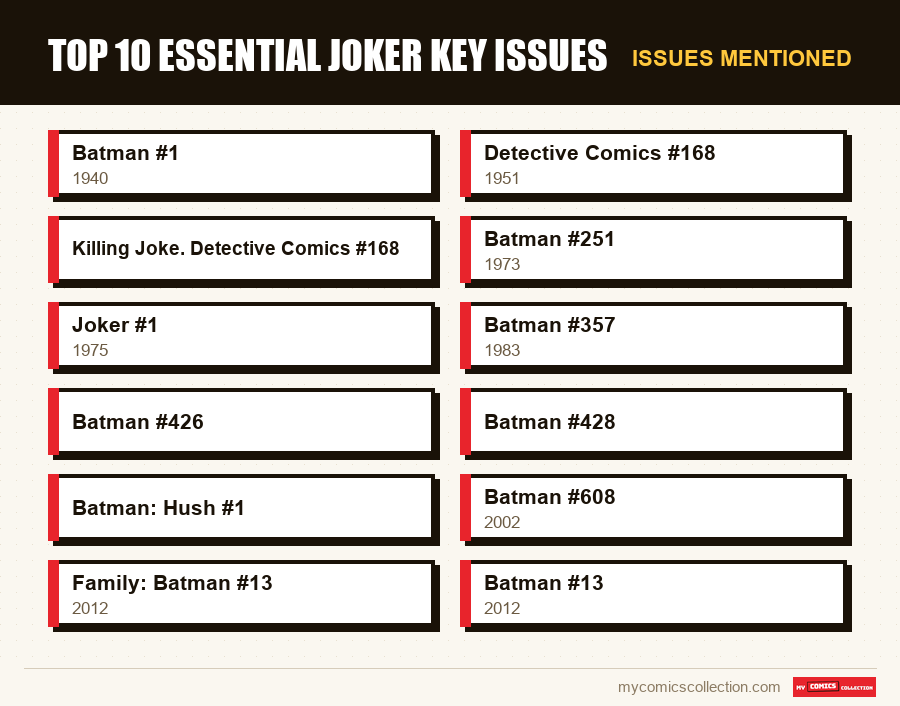
2. Detective Comics #168 (1951). The Red Hood origin of the Joker
Detective Comics #168 is a foundational issue in Joker mythology: it introduces for the first time the character's "Red Hood" origin. According to this story, the Joker was once an ordinary criminal known as "Red Hood" who fell into a vat of chemicals during a confrontation with Batman: bleaching his skin white, his lips red and his hair green, transforming him into the Joker.
This origin story has been revisited, reinterpreted and reimagined dozens of times over the following decades, notably in Alan Moore's The Killing Joke. Detective Comics #168 is therefore the narrative anchor of all Joker mythology. In CGC 9.0 it trades around $5,000 to $10,000. Mid-grade copies (CGC 4.0-5.0) remain between $500 and $1,500: more accessible for collectors who want to own this historic issue.
3. Batman #251 (1973): O'Neil reinvents the Joker as a lethal threat
Batman #251, featuring Neal Adams's legendary cover and Dennis O'Neil's script, marks the Joker's return as a genuinely dangerous criminal after two decades of comical interpretation inherited from the 1960s TV show. This issue, often titled "The Joker's Five-Way Revenge", shows a Joker coldly killing his former accomplices one by one. It's the rehabilitation of the character as a deadly force of chaos.
Neal Adams's cover (Joker with a spray can) is one of the most reproduced and collected Bronze Age DC covers. In CGC 9.8 this issue exceeds $2,000. In 9.4 it sits around $500 to $800. Its popularity with Bronze Age fans and Neal Adams enthusiasts guarantees constant and solid demand.
Note on grade values: The values in this article reflect observed market trends. Collectible comic prices fluctuate with market conditions and availability. Always consult recent sales on Heritage Auctions, ComicLink or GoCollect before any purchase.
4. The Joker #1 (1975). The Joker's first solo series
In 1975, DC Comics took a daring bet: give the Joker his own monthly series. The Joker #1 (1975) is therefore the character's first appearance in a series entirely dedicated to him: an unprecedented editorial event for a villain. The series would only run for 9 issues, but this first issue concentrates all the "first issue" premium collectors look for.
In CGC 9.8, The Joker #1 (1975) trades between $400 and $800. In 9.4 it drops to $100-200. Its relative accessibility makes it an excellent entry point for collectors who want to add a historic first issue to their Joker collection without spending extravagant sums. Ernie Chan's cover is immediately recognizable and very appreciated by DC Bronze Age fans.
Build your complete Joker checklist
Track every Joker key issue, note their condition, CGC grade and estimated value with My Comics Collection.
Create your Joker checklist →7-day trial · Instant access
5. Batman: The Killing Joke (1988). The absolute masterpiece
Batman: The Killing Joke by Alan Moore and Brian Bolland (1988) is probably the most read, most cited and most influential Joker comic in the character's history. This prestige one-shot explores the Joker's origin in an ambiguous and destabilizing way, drags Barbara Gordon (Batgirl) into an irreversible tragedy, and poses this fundamental philosophical question: is a single bad day enough to transform an ordinary man into a monster?
This issue directly influenced the script of Nolan's Batman films and Joaquin Phoenix's Joker. In first edition (1988) CGC 9.8, it trades between $150 and $400. The numerous reprints have no collector value. Make sure to acquire the first edition by checking the ISBN and the indicia on the inside pages.
Collecting this series?
Track what you own, what you are missing and what your collection is worth. 7 day trial.
Start my trial →6. Batman #357 (1983): Birth of Jason Todd and the Joker context
Batman #357 introduces Jason Todd, the second Robin, whose future death at the Joker's hands in "A Death in the Family" (Batman #426-429) would become one of the most striking moments in all of American comics. This issue is therefore indirectly a major Joker key issue: without Jason Todd, no hotline vote, no reader phone poll, no "Death in the Family". In CGC 9.8 it trades around $500 to $1,000.
For collectors who want to build a coherent Joker collection rather than simply accumulating first appearances, this issue is a strategic piece that tells the whole saga: the fatal relationship between the Joker and the Batman family.
7. Batman #426-429 (1988). A Death in the Family
The "A Death in the Family" saga (Batman #426-429, 1988-1989) is one of the most dramatic arcs in all DC history: the Joker kills Jason Todd (Robin II) with a crowbar before a helpless Batman. The final outcome was determined by a reader phone vote: one of the most controversial and memorable editorial initiatives in the American comic industry.
Batman #426 (first issue of the arc) in CGC 9.8 trades between $200 and $500. Batman #428 (Jason Todd's death) is particularly sought-after. These four issues form a coherent set collectors often try to reunite for the complete arc. Their popularity is sustained by constant references in Batman films, animated series and video games.
8. Batman: Hush #1 / Batman #608 (2002). The Joker in the modern saga
Batman #608 (2002), the first issue of the Hush saga by Jeph Loeb and Jim Lee, is one of the most collected modern-era Batman/Joker key issues. The Joker plays a central role in this labyrinthine story, and Jim Lee's artwork, among the finest of the Image Comics co-founder's entire career, has made every cover of the saga a collectible in its own right.
Batman #608 in CGC 9.8 sits between $150 and $350. The variant covers from this run are particularly appreciated. It's an ideal issue for collectors who want an important modern key issue at a reasonable price, with exceptional intrinsic artistic value.
9. Batman: Death of the Family: Batman #13 (2012)
Batman #13 (2012), the first issue of the "Death of the Family" arc by Scott Snyder and Greg Capullo, is one of the most important Joker key issues of the New 52. This arc reintroduces the Joker after he had himself had his own face cut off: a Faces of Death scene that mainstream press covered. The Joker returns with his face reattached by stitches in a horror spectacle that left its mark.
This issue is still very accessible in Near Mint condition (around $20 to $50) but Joker Face variant covers and CGC 9.8 copies have exceeded $150. It's a high-potential modern key issue for collectors anticipating a revaluation of the New 52 in coming years: now that James Gunn's DCU is restarting on entirely new foundations.
10. Batman: Three Jokers #1 (2020). The ultra-modern era
Batman: Three Jokers #1 (2020), by Geoff Johns and artist Jason Fabok, is the most recent Joker key issue on this list. Revealing the existence of three distinct Jokers (the Clown, the Criminal and the Comedian) this 3-issue maxiseries was one of the most anticipated DC publications of 2020. Jason Fabok's 1:25 and 1:100 variants are particularly collected.
The standard edition remains accessible under $20, but rare variants are already reaching $200 to $500 on the secondary market. This issue benefits from a dedicated fanbase and Geoff Johns's reputation as architect of some of DC's best contemporary sagas. For collectors oriented toward the modern market, it's the most strategic Joker issue of the decade.
Collection tip: If you're starting a Joker collection, begin with The Killing Joke (1988 first edition), The Joker #1 (1975) and Batman #251 (1973). These three issues give you exceptional narrative and historical coverage for a total budget under $1,000.
The film effect: how Joker movies transform the market
Todd Phillips's films with Joaquin Phoenix have produced an effect similar to the MCU effect on Marvel comics: each announcement, each trailer, each theatrical release generates a search spike on Joker key issues. Joker (2019) notably exploded demand for Batman #1 (1940), The Killing Joke and Batman #251. Joker: Folie à Deux (2024) reactivated interest in issues featuring the Joker/Harley Quinn duo, notably Batman: Mad Love.
In James Gunn's DCU, the Joker hasn't yet been announced: which means his future integration into this new universe could trigger another massive demand spike on historic key issues. Collectors who position themselves now, before any official announcement, will benefit from the best possible entry price.
FAQ: Your questions about Joker key issues
Track your Batman/Joker key issues
Organize your collection, follow price evolution and never miss a market opportunity with My Comics Collection.
Start for free →7-day trial, cancel anytime