Since his creation in 1939 by Bob Kane and Bill Finger , Batman has become one of the most iconic characters in comic book history. The Dark Knight of Gotham City has spanned eight decades of shadowy storytelling, unforgettable villains, and story arcs that redefined what a superhero could be.
Since his creation in 1939 by Bob Kane and Bill Finger , Batman has become one of the most iconic characters in comic book history. The Dark Knight of Gotham City has spanned eight decades of shadowy storytelling, unforgettable villains, and story arcs that redefined what a superhero could be. From the yellowed pages of the Golden Age to the modern graphic novels of Frank Miller and Jeph Loeb, the Batman franchise has produced some of the most valuable and sought-after key issues on the entire comic market.
This guide lists the 10 essential Batman key issues every serious collector should know, with their historical context, their importance in the character's mythology, and their estimated value by CGC grade. Whether you're starting a DC collection or completing an ambitious run, these issues are your absolute priorities.
Batman in comic book history: an unmatched franchise
The Batman franchise at DC Comics is one of the richest collectible universes out there, with continuous publication since 1939:
- Detective Comics (1937-present): the series where Batman made his debut, still running today with more than 1,000 issues
- Batman Vol. 1 (1940-2011): the main solo series, 713 issues, containing the most defining story arcs in the mythology
- Batman Vol. 2 / New 52 (2011-2016): the Scott Snyder and Greg Capullo reboot, with major modern arcs
- Batman Vol. 3 / Rebirth (2016-present): the current continuity by Tom King and then James Tynion IV
- Legends of the Dark Knight (1989-2007): out-of-continuity stories exploring Batman's early years
- Batman: The Dark Knight , Batman Eternal , Batman and Robin: the major parallel series
Collecting the full run of Detective Comics or Batman Vol. 1 is one of the most ambitious projects in all of comic book collecting. Use the Collection tracking feature in My Comics Collection to map your progress and identify every missing issue.
Top 10 Batman key issues
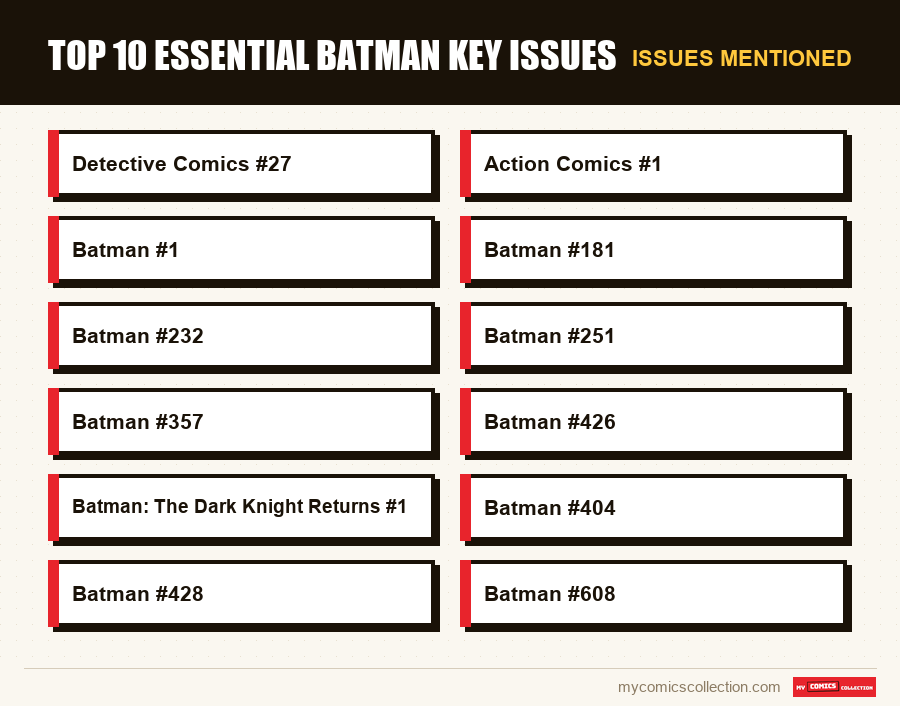
Here are the ten absolutely essential issues for any Batman collector, ranked by historical importance and current value.
Detective Comics #27
Detective Comics #27 is the absolute founding issue of the entire Batman mythology. This is where Bob Kane and Bill Finger introduce Batman / Bruce Wayne for the first time: the orphaned billionaire who devotes his life to fighting crime dressed as a bat. This issue is the starting point of a franchise that would last nearly a century, producing hundreds of comics, TV shows, blockbuster films and worldwide merchandising. As the first Golden Age DC flagship, it holds a place equivalent to Action Comics #1 in the history of American comics. The rarity of high-grade copies after more than 85 years makes it one of the most coveted pieces on the global market.
Batman #1
Batman #1 launches the solo series dedicated to Batman and simultaneously introduces two of the most iconic villains in comic history: the Joker and Catwoman . The Joker, a criminal clown with a permanent grin and a terrifying psychology, would become the most famous supervillain of all time: rivaling Batman himself in popularity. Catwoman / Selina Kyle, an ambiguous thief with a tense and complex relationship with the Dark Knight, is one of the first supervillainesses in comic history, predating even the concept of a superheroine. An issue of absolute historical importance whose value can only keep climbing over the decades.
Batman #181
Batman #181 introduces Poison Ivy / Pamela Isley, the seductive botanist whose pheromone powers and control over plants make her one of the most fascinating villains in the Batman universe. Created by Robert Kanigher and Sheldon Moldoff, she represents a threat that blends seduction with natural danger: a radically different approach from the supervillains of her era. Poison Ivy has evolved over the decades into one of DC's most complex female characters, oscillating between irredeemable villain and anti-heroine championing nature. Her on-screen adaptations: notably in Batman & Robin (1997) with Uma Thurman and in the animated series: have significantly boosted her popularity and the value of this key issue.
Batman #232
Batman #232 is the fruit of the legendary Denny O'Neil and Neal Adams run that radically modernized Batman by stripping away the campy humor of the 1960s and restoring his dark, near-detective nature. This issue introduces Ra's al Ghul, the immortal terrorist leader of the League of Assassins, whose quest to "purify" the planet through mass extermination makes him a morally ambiguous antagonist like no other. The idea of a villain who shares some values with Batman but pushes the logic into totalitarian horror deeply enriched the character's mythology. Ra's al Ghul is also the father of Talia al Ghul: the future mother of Damian Wayne: a significant narrative legacy. This Adams/O'Neil run is considered one of the most important in all of Batman history.
Batman #251
Batman #251 is universally recognized as one of the most important Batman comics of the 1970s and features one of the most iconic covers by Neal Adams. The story "The Joker's Five-Way Revenge" redefines the Joker by abandoning the harmless comic character of the 1960s and restoring his original dangerous, nihilistic, unpredictable-murderer persona. This reinterpretation by Denny O'Neil is the source of every modern version of the character: from Alan Moore's The Killing Joke to Christopher Nolan's The Dark Knight. The cover showing the Joker with a fishing rod and a dead fish has become one of the most reproduced and cited images in DC Comics history. An absolute Bronze Age must-have.
Batman #357
Batman #357 introduces Jason Todd, the second Robin who succeeds Dick Grayson (who becomes Nightwing) as Batman's partner. This tragically fated character is one of the most important in Batman mythology: he will be murdered by the Joker in the Death in the Family arc (Batman #426-429), his death decided by a reader vote. Years later he will return as Red Hood, a dark anti-hero carrying the name of the Joker's original alias. This cycle of death and resurrection makes him one of DC's most complex characters, generating countless stories and adaptations. Jason Todd's first appearance is a solid Copper Age key issue whose value remains supported by the character's enduring popularity.
Batman: The Dark Knight Returns #1
Batman: The Dark Knight Returns #1 by Frank Miller is one of the most influential comics ever published, and it redefined the cultural perception of Batman forever. Published as a 4-issue miniseries, this arc imagines a 55-year-old Bruce Wayne coming out of retirement in a dystopian future Gotham to confront new threats and a Superman reduced to a tool of the U.S. government. Miller's dark, expressionist graphic style (combined with a fragmented, TV-like narrative) set the template for the "mature" superhero that would influence generations of creators. Without this issue, the Batman films of Tim Burton, Christopher Nolan and Zack Snyder would not exist as we know them. A foundational pillar for any serious DC collection.
Batman #404
Batman #404 marks the start of the Batman: Year One arc (Batman #404-407), written by Frank Miller and drawn by David Mazzucchelli. This arc tells, in parallel, Batman's first year as a masked vigilante and James Gordon's early days as an honest cop in a corrupt city. Mazzucchelli's realistic, journalistic art combined with Miller's writing gives this origin story a credibility and weight without precedent. Year One served as the direct basis for Christopher Nolan's Batman Begins (2005), and remains the go-to arc for anyone wanting to understand the character's essence. A key issue that's both affordable and foundational: the perfect entry point for a serious Batman collection.
Batman #428
Batman #428 is one of the most striking moments in American comics history: it concludes the A Death in the Family arc with the death of Jason Todd / Robin at the hands of the Joker. What makes this issue historically unique is the method that led to the decision: DC Comics organized a phone vote allowing readers to decide whether Jason Todd would live or die. More than 10,000 calls were placed, and death won by just 72 votes. This unprecedented editor-reader interaction remains a unique moment in comic book history. Jason Todd's death haunted Batman mythology for decades and still defines Bruce Wayne's relationship with his sidekicks to this day. A key issue with immense emotional weight.
Batman #608
Batman #608 kicks off the Hush arc (Batman #608-619) written by Jeph Loeb with artwork by Jim Lee. This collaboration between two medium legends produced one of the best-selling runs in Batman solo series history, reconciling the general public and long-time fans around a thriller involving practically the entire DC rogues' gallery. This issue introduces Thomas Elliot / Hush, Bruce Wayne's childhood friend turned masked antagonist, whose deeply personal motivations make him one of the most interesting Batman villains of the modern era. Jim Lee's stunning art set a new visual benchmark for the series. A very accessible Modern Age key issue that remains an ideal gateway for collectors.
Collecting this series?
Track what you own, what you are missing and what your collection is worth. 7 day trial.
Start my trial →Essential Batman story arcs
The Batman franchise has produced some of the most legendary story arcs in comic book history. These are the runs every serious collector should own to understand the Dark Knight in depth:
The Dark Knight Returns
Frank Miller's 1986 masterpiece that redefines Batman as an aging warrior fighting dystopia. The arc that permanently transformed the perception of the superhero in popular culture. Essential to any comic book library.
Batman: Year One
The definitive origin story by Frank Miller and David Mazzucchelli (1987). A sober, realistic and human narrative that directly inspired Batman Begins. The best introduction to Batman for any new reader.
The Killing Joke
The Alan Moore and Brian Bolland one-shot (1988) that explores the Joker's origin and paralyzes Barbara Gordon. One of the most cited and debated comics in history, mixing psychological horror and Greek tragedy.
Knightfall
The 1993 mega-arc where Bane breaks Batman's back, forcing Azrael to take his place. The arc that introduced Bane and redefined the character's physical and psychological limits. Source material for The Dark Knight Rises.
To track these arcs across multiple series and dozens of issues, use the Story Arcs feature in My Comics Collection, create your custom lists and follow your progression arc by arc.
How My Comics Collection handles your Batman collection
Collecting Batman is one of the most ambitious projects in DC Comics collecting. The multiplicity of series (Detective Comics , Batman Vol. 1 , Batman Vol. 2 , Batman and Robin , Legends of the Dark Knight...), the event crossovers (Knightfall , No Man's Land , Batman Eternal...) and the must-have one-shots (Killing Joke , Dark Knight Returns) make a Batman collection hard to organize without a dedicated tool.
My Comics Collection gives you a complete overview:
- Import every volume of the Batman franchise from a worldwide comics catalogue
- Identify the missing key issues with the Missing comics feature
- Create custom story-arc lists for multi-series crossovers like Knightfall or No Man's Land
- Manage your CGC-graded copies with grade and individual value
- Estimate the total value of your Batman collection with daily-updated valuation
- Track your most valuable key issues and their market fluctuations
FAQ: Batman key issues
Start managing your Batman collection
Track your key issues, organize your story arcs and estimate the value of your Batman run. 7-day free trial.
Start free 7-day trialNo commitment · Cancel anytime · Instant access