Detective Comics is the series that changed everything. Launched in 1937 by DC Comics, it literally gave the publisher its name: DC is the abbreviation for Detective Comics. But it's in 1939, with issue #27, that the series entered legend by introducing Batman, the masked detective created by Bob Kane and Bill Finger.
Detective Comics is the series that changed everything. Launched in 1937 by DC Comics, it literally gave the publisher its name: DC is the abbreviation for Detective Comics. But it's in 1939, with issue #27, that the series entered legend by introducing Batman, the masked detective created by Bob Kane and Bill Finger. Since then, Detective Comics has spanned 80 years of comic history: from the Golden Age to the Silver Age revolutions, through the modern runs of Scott Snyder , James Tynion IV and Ram V.
This guide ranks the 10 absolutely essential Detective Comics key issues for any collector passionate about Batman and the DC universe. Each issue comes with its historical context, its significance for Batman mythology, and its CGC grade value estimate.
The history of Detective Comics: a founding series
Before being Batman's home, Detective Comics was an anthology of crime stories. Issue #1 (1937) contains no superhero: only paper detectives in a pulp style characteristic of the era. Then came issue #27 in May 1939, and everything changed.
- Golden Age (1939-1956): from Batman's arrival to the departure of many golden-age heroes, the series covers the character's founding origins
- Silver Age (1956-1970): an era of zany sci-fi with Batman transformed into a space explorer, before the return to the classic "New Look" starting at #327
- Bronze and Modern Age (1970-2000): major runs with authors like Denny O'Neil and Neal Adams who redefined Batman as a dark character
- Rucka/Williams III Run: the Batwoman relaunch in Detective Comics, with memorable double-splash pages
- Snyder/Jock Run (2009-2011): considered one of the best modern Batman runs, with Dick Grayson as Batman
- Rebirth / Tynion IV (2016-2018): a detective team around Batman including Clayface and Cassandra Cain
Managing a complete Detective Comics run represents a collection of more than 1,000 issues. The Collection tracking feature in My Comics Collection lets you precisely map your owned copies and identify your gaps.
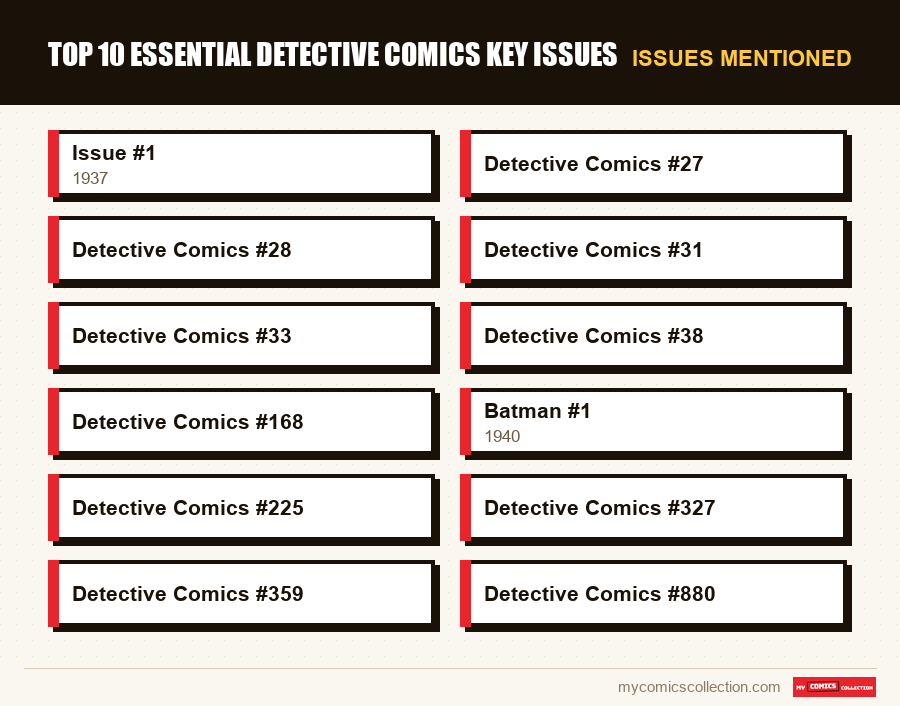
Top 10 Detective Comics key issues
Here are the ten absolutely essential issues from the Detective Comics series: from Golden Age origins to modern key issues.
Detective Comics #27
Detective Comics #27 is one of the most valuable and historic comics ever published. This issue introduces Batman / Bruce Wayne, the Dark Knight created by Bob Kane and Bill Finger, in an eight-page story titled "The Case of the Chemical Syndicate". The story, simple by modern standards, lays the groundwork for what would become one of the richest franchises in popular fiction history. Contrary to common belief, Batman doesn't yet use a firearm in this first issue: an editorial choice that would be briefly revised before becoming definitive. The absolute rarity of good-condition copies makes it one of the Holy Grails of worldwide comic collecting.
Detective Comics #28
Detective Comics #28 is the second issue featuring Batman, and represents immediate confirmation of the character in the series. At this early stage, the Dark Knight hadn't yet acquired all his iconic attributes (no sophisticated Batmobile, no Alfred) but the tone was set. This issue is among the key issues of the founding run that every Golden Age Batman collector seeks to complete the first appearances. In CGC 7.5, its extreme rarity grants it considerable value on the market.
Detective Comics #31
Detective Comics #31 is famous for its emblematic cover by Bob Kane, depicting Batman against a full moon in a gothic atmosphere that would define the character's aesthetic for decades to come. This issue also introduces Julie Madison, Bruce Wayne's first girlfriend in the comics. The cover is often reproduced and cited as one of the most important images of the Golden Age. For collectors specializing in Batman iconography, this issue is an absolute object of desire.
Detective Comics #33
Detective Comics #33 is the issue that gives Batman his soul. It's here that the origin of Bruce Wayne is told for the first time: young Bruce watches his parents, Thomas and Martha Wayne, shot down before his eyes by a robber, and swears to dedicate his life to the war on crime. This founding scene, reproduced and reinterpreted countless times since, is the emotional keystone of the entire Batman universe. To own this issue is to own the Dark Knight's psychological birth certificate.
Detective Comics #38
Detective Comics #38 introduces Robin / Dick Grayson, Batman's sidekick and one of the most important characters in the DC universe. A circus orphan whose acrobat parents were murdered, Dick Grayson is taken in by Bruce Wayne and becomes his masked partner. Adding Robin radically transforms the series by giving it a brighter and more accessible flavor. This issue is also important because it doubled Detective Comics sales by targeting a younger audience: an editorial marketing lesson that would influence the entire industry. Dick Grayson would later become Nightwing, then Batman himself for a time.
Detective Comics #168
Detective Comics #168 reveals for the first time the Joker's origin : the story of Red Hood, a criminal who falls into a vat of chemicals during a confrontation with Batman, emerging disfigured with white skin, green hair and a permanent grin. This origin, popularized much later by Alan Moore in The Killing Joke, is here presented for the first time. It's important to note that the Joker's first appearance is in Batman #1 (1940), but it's this Detective Comics issue that gives him his past. An essential Silver Age key issue for Joker collectors.
Detective Comics #225
Detective Comics #225 marks the first appearance of J'onn J'onzz / Martian Manhunter, one of the most powerful superheroes in DC Comics and founding member of the Justice League of America. Although this character is often overshadowed by Batman in collective memory linked to this series, his introduction in the context of 1950s sci-fi is representative of the era. The Martian Manhunter has an impressive combination of powers (super-strength, flight, invisibility, shapeshifting, telepathy) that makes him one of the DC universe's pillars. A Silver Age key issue with strong appreciation potential.
Detective Comics #327
Detective Comics #327 marks a major editorial turning point: the arrival of Julius Schwartz as editor and the start of Batman's "New Look". Gone are the zany sci-fi adventures (Batman on the Moon, Bat-Mite, Batwoman replacing Robin…): the Dark Knight regains an identity more consistent with his detective origins. This issue symbolizes a decisive editorial course change that would pave the way for the great 1970s reinterpretations. The yellow oval appears for the first time on Batman's costume in this issue.
Detective Comics #359
Detective Comics #359 introduces Batgirl / Barbara Gordon, Commissioner Gordon's daughter, who would become one of DC Comics' most important superheroines. Her creation was partly motivated by the 1960s Batman TV series, which wanted a strong female character. Barbara Gordon is today a multi-dimensional character: Batgirl, then Oracle (after her disability in The Killing Joke), then Batgirl again during the New 52 relaunch. This issue has seen its value considerably increase in recent years with the ongoing adaptation and the character's iconic status.
Detective Comics #880
Detective Comics #880 is the final issue of Scott Snyder's and Jock's legendary run on the series, with Dick Grayson in the Batman role. Its cover (the Joker seen through a plastic bag, menacing gaze, twisted smile) is considered one of the most striking covers of the 2010s. The closure of a 10-issue run (#871-881 with Francesco Francavilla alternating) that redefined what a Batman comic could be in terms of psychological tension and visual atmosphere. This modern key issue is accessible for collectors and has strong appreciation potential.
Collecting this series?
Track what you own, what you are missing and what your collection is worth. 7 day trial.
Start my trial →Essential Detective Comics story arcs
Beyond individual key issues, Detective Comics has produced story arcs and runs that rank among the best Batman stories ever told.
Golden Age Batman (Kane/Finger)
The founding issues #27 to #50 lay the groundwork for Batman mythology: origins, Robin, first villains. An essential run for understanding the character's roots in the 1930s-1940s pulp context.
Silver Age Batman
Between sci-fi and a return to roots with Julius Schwartz's "New Look", this period produces major key issues like #225 (Martian Manhunter) and #359 (Batgirl). An era that progressively redefines the series' tone.
Snyder/Jock Run (#871-881)
The reference modern run on Detective Comics, with Dick Grayson as Batman. Alternating between Jock's tense pages and Francesco Francavilla's gothic atmospheres, this run explores the links between Batman and the Joker with rare psychological intensity.
Rebirth, Tynion IV
The DC Rebirth relaunch entrusts Detective Comics to James Tynion IV with a detective team including Batwoman, Clayface, Orphan and Spoiler. A run appreciated for its supporting characters and unusual team dynamic in the Batman universe.
To organize your collection by arc across this 1,000+ issue series, use the Story Arcs feature in My Comics Collection which lets you create custom lists and track your progress.
How My Comics Collection handles your Detective Comics run
Collecting Detective Comics is a significant challenge: with more than 1,000 issues published since 1937, it's one of the longest series in American comic history. Between extremely rare Golden Age issues, Silver Age key issues and modern runs, management without a dedicated tool quickly becomes complex.
- Import the complete Detective Comics run from the catalogue and mark your owned copies issue by issue
- Identify your missing key issues with the Missing comics feature
- Manage your Golden Age CGC-graded copies with grade and individual value
- Estimate the total value of your DC collection with daily-updated valuation
- Create story-arc lists to methodically complete the Snyder or Tynion IV runs
- Share your collection with other DC collectors and find missing issues
FAQ: Detective Comics key issues
Start managing your Detective Comics collection
Track your Batman key issues, organize your story arcs and estimate the value of your run. 7-day free trial.
Start free 7-day trialNo commitment · Cancel anytime · Instant access