
Comics grading, having your copies evaluated and encapsulated by a certifying body like CGC or CBCS, has become essential for any serious collector. But outside the US, the process involves specifics American guides never cover: customs, import fees, international logistics, choosing between direct shipping or authorized dealer.
Comics grading, having your copies evaluated and encapsulated by a certifying body like CGC or CBCS, has become essential for any serious collector. But if you're shipping from outside the US, the process involves specifics American guides never cover: customs, import fees, international logistics, choosing between direct shipping or an authorized dealer. This 2026 guide gives you every concrete piece of information to grade your comics internationally without unpleasant surprises.
Financial warning: The CGC fees, customs costs and shipping costs mentioned in this article are indicative and may evolve. Always check official CGC fees and current customs regulations before shipping. This article does not constitute financial or legal advice.
Why grade your comics?
Before we dig into process details, let's recall why grading has become standard in the American comics collecting world. CGC (Certified Guaranty Company) has been the main certifying body since 2000. When CGC grades a comic, it evaluates it on a 0.5 to 10.0 scale based on condition, then encapsulates it in a sealed plastic slab with a label indicating the grade and bibliographic information.
Encapsulation guarantees three important things: comic authenticity (CGC verifies it's not counterfeit), condition grade (standardized and internationally recognized), and long-term preservation (the slab protects against dust, humidity and handling). On the secondary market, a CGC 9.8 graded comic consistently sells higher than a raw copy of equivalent quality, because the buyer benefits from third-party assurance.
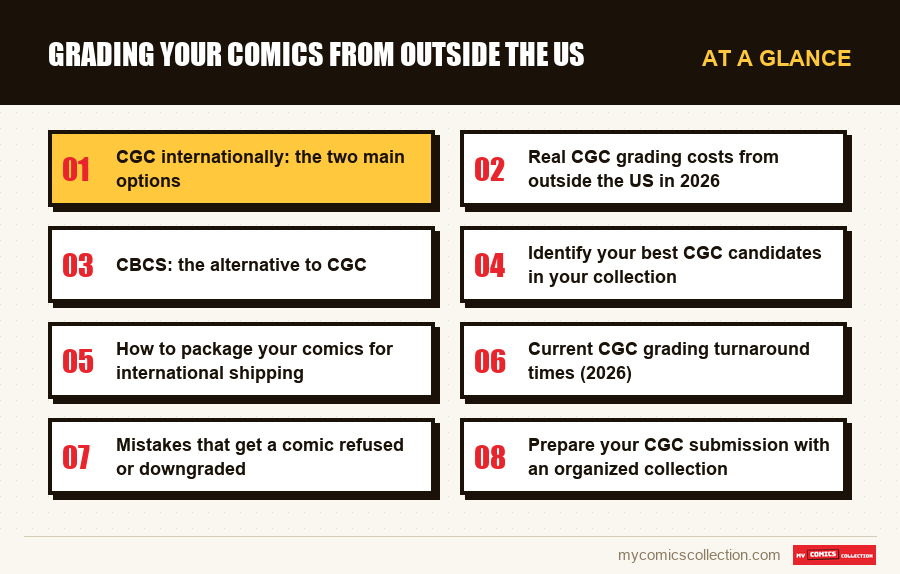
CGC internationally: the two main options
As an international collector, you essentially have two ways to get your comics graded by CGC.
Option 1: Direct CGC shipping to the United States
You create an account on the CGC site (cgccomics.com), fill out your submission form online, pack your comics per official instructions and ship the package directly to CGC headquarters in Florida. It's the most direct method, but it means handling every step alone: packaging, international shipping, customs declaration outbound and return, and insurance.
The main advantage is flexibility: you choose exactly the CGC service level you want, you track your submission in real time on the CGC site and there's no intermediary. The downside is logistical complexity and shipping costs that can be high for a small number of comics.
Option 2: Going through an authorized CGC dealer
CGC has a network of authorized dealers (CGC Authorized Dealers) around the world, with many in Europe and other regions. These dealers group submissions from several clients, which helps share shipping costs and sometimes unlocks bulk rates. They also handle customs formalities, significantly simplifying the process for collectors.
The authorized dealer takes a commission for this service, but the simplification they bring, and the reduction in per-comic shipping via grouping, can make this option more economical for a small number of copies. Verify the dealer's reputation before entrusting your comics: check reviews on forums like CGC Boards or dedicated Facebook groups.
Real CGC grading costs from outside the US in 2026
Total CGC grading cost from outside the US is made up of several elements to budget separately:
Cost breakdown (indicative 2026)
- CGC Economy fees (declared value up to $200): about $25 per comic
- CGC Standard fees: about $38 per comic
- CGC Express fees: about $75 per comic
- Outbound shipping (FedEx/UPS): $45 to $90 depending on weight and number of comics
- Return shipping (via CGC): $25 to $50 depending on weight
- Import VAT/taxes on return: varies by country (20% in EU, none in most US states)
- Potential customs duties: variable based on value and customs classification
For a concrete order of magnitude: if you send 5 comics at Economy level, CGC alone costs about $125. Add $55 outbound, $30 return, and count VAT/taxes on declared slab value on return. Total cost can easily reach $220 to $275 for 5 comics, or $45 to $55 per copy. This calculation clearly shows grading is only profitable for comics whose graded value justifies the investment.
CBCS: the alternative to CGC
CGC isn't the only certifying body. CBCS (Comics Book Certification Service) is its main competitor. CBCS offers similar grades, comparable encapsulation quality and slightly different pricing. On the secondary market, CBCS-graded comics are well recognized: even if CGC remains the dominant reference, particularly for high-value key issues where buyers often prefer the CGC brand.
CBCS can be an interesting alternative if CGC turnarounds are particularly long or if you find an authorized CBCS dealer offering better logistics from your region. For high-value comics, CGC remains the most universally accepted reference on the international market.
Identify your best CGC candidates in your collection
Before submitting to CGC, catalog your collection in My Comics Collection to identify best-condition copies, estimate potential graded value and prioritize your submissions.
7-day free trial, no commitmentHow to package your comics for international shipping
Packaging is where many collectors make mistakes that can be very expensive. A comic damaged in transit won't be covered by CGC and will receive a much lower grade than deserved. Here's the recommended packaging method for international shipping:
Protect each comic individually
Slide each comic into a Mylar sleeve (preferred) or polyethylene with a rigid backing board sized to the comic (current size, silver size or golden size depending on the issue). The backing board must be in the sleeve behind the comic.
Build packets of 5 to 10 comics
Stack the comics (maximum 10-15 per packet) between two thick corrugated cardboard sheets cut to size. Secure with paper tape (not sticky on the sleeves). Each packet should be rigid and not let the comics shift.
Insert into a double-wall box
Use a solid double-wall box, slightly larger than your comic packets. Place a layer of polyethylene foam or bubble wrap at the bottom, set your packets down, and fill all empty spaces with foam or crumpled kraft paper. No voids should remain: any movement during transport can damage corners.
Close and label the package
Seal the box with several layers of packing tape on every seam. Print your CGC submission confirmation and place it inside the package. Add the CN22 or CN23 customs declaration form on the outside with exact content description and declared value.
Insure the package
Declare the real value of the comics with your carrier (FedEx, UPS or DHL are recommended) and get appropriate ad valorem insurance. In case of loss or damage, insufficient insurance can leave you without recourse for high-value comics.
Collecting this series?
Track what you own, what you are missing and what your collection is worth. 7 day trial.
Start my trial →Current CGC grading turnaround times (2026)
CGC turnaround times have been one of collectors' biggest frustrations in recent years. After historic peaks during the COVID period, turnarounds have gradually stabilized but remain significant. In 2026, here are indicative turnarounds by service level:
- Economy ($25/comic, declared value up to $200): 60 to 180 working days
- Standard ($38/comic): 45 to 90 working days
- Express ($75/comic): 20 to 40 working days
- WalkThrough ($200/comic): a few days at CGC events
Add to these turnarounds the international shipping time (1 to 2 weeks outbound, 1 to 2 weeks return) and any customs delays on return. Economy grading from outside the US can therefore take 3 to 7 months total. These turnarounds are indicative and can change based on CGC activity: always check current turnarounds on the official site before submitting.
Mistakes that get a comic refused or downgraded
Certain situations can lead CGC to refuse a submission or assign a much lower grade than expected. Here are the most frequent mistakes to avoid:
- Undeclared pressing: if your comic has undergone pressing (thermal treatment to reduce defect folds), it's not disqualifying per se, but CGC can detect it. Pressing doesn't invalidate a comic but can affect the grade if detected after a grade was already assigned.
- Hidden restoration: any restoration (page replacement, staple retouching, aggressive chemical cleaning) will be detected by CGC experts and result in a purple "Restored" label, which collapses market value.
- Comics too damaged to be graded: comics with major structural defects (missing pages, completely detached cover, active mold damage) may be refused for encapsulation.
- Non-original comics: reprints (reissues) not identified as such will be marked "Reprint" by CGC, which can surprise if you thought you had an original.
- Submission without inner form: forgetting to include the printed submission form inside the package is a frequent mistake that delays processing.
When is grading really worth it?
The fundamental question is profitability. For a comic whose raw value is $33, spending $45 to $55 in grading fees makes no economic sense. Grading is profitable in specific situations:
- High-value key issues: a copy worth $330 raw can reach $550-880 in CGC 9.8, amply justifying the investment.
- Comics in very good condition: grading is particularly profitable for copies close to NM (Near Mint) or Mint, where the value difference between a CGC 9.2 and a CGC 9.8 is greatest.
- For international online sales: a CGC-graded comic attracts a much broader buyer audience on eBay US or Heritage Auctions, which can justify grading even for intermediate-value pieces.
- For long-term preservation: if you don't plan to sell but want to guarantee preservation of your most valuable pieces, CGC encapsulation offers superior protection over any other method.
Practical rule: Before sending a comic to CGC, make sure its potential graded value is at least 2 to 3 times the total grading costs (CGC + shipping + customs). Below that ratio, the operation isn't financially worth it: though it can still be justified for preservation or certification reasons.
FAQ, Grading your comics from outside the US
Prepare your CGC submission with an organized collection
My Comics Collection lets you sort your collection, identify best-condition copies and prepare your CGC submission list in a few clicks.
7-day free trial, no commitment