A CGC reholder transfers an already-graded comic into a new slab without touching the certified grade. Official 2026 cost: $20 to $25 per comic ($40 for high declared value), turnaround 1 to 2 months. Main use cases: a scratched, cracked, or yellowing case, or migrating to the latest generation of holder.
CGC's reholder service is one of the most misunderstood in the catalog. Unlike a crossover (CBCS to CGC or vice versa), a regrade (a full re-evaluation of the grade), or a press+grade (physical work on the comic before grading), a reholder is limited to swapping the case. The grade certified at the time of the first evaluation is carried over as-is onto the new slab, with no in-depth quality check on the comic's condition. That distinction makes it a technical service, to be used when the container is the problem but the contents remain intact.
Three situations justify a reholder in 2026. The first: a physically degraded case (a shipping crack, a deep scratch in the well that makes the label unreadable, a peeling inner-well label). The second: a comic graded before 2007 in an older holder known as the "old label," which buyers now perceive as devalued on the secondary market. The third: a shift in collection strategy: for example, moving from a yellow Signature Series label to a blue label after a signature is challenged, or re-encapsulating a vintage comic submitted in a first-generation holder into the current ultrasonically sealed slab. The rest of this article breaks down each of these cases with official pricing, real-world turnaround times, pitfalls to avoid, and the economic trade-offs based on the value of the book.
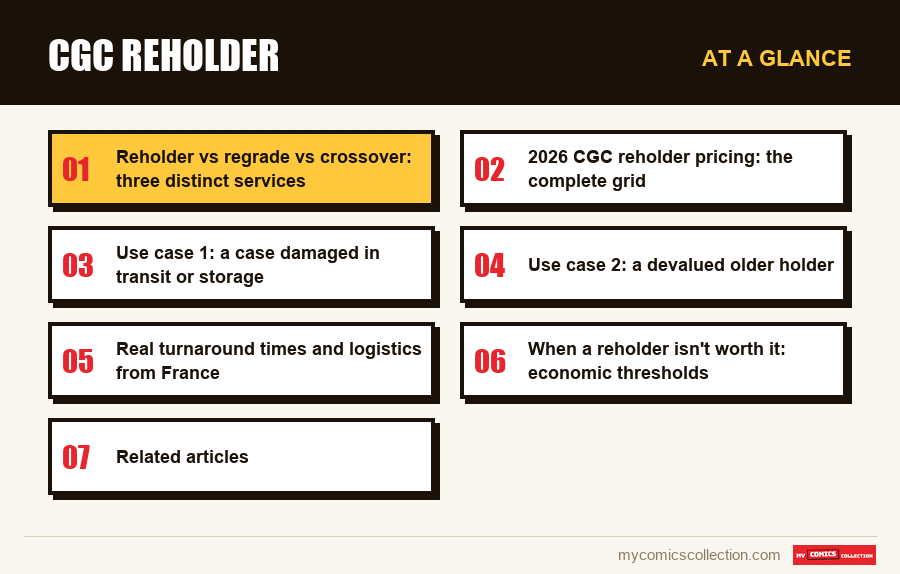
Reholder vs regrade vs crossover: three distinct services
The most common confusion concerns the difference between reholder, regrade, and crossover. All three share the trait of revisiting an already-certified comic, but their purposes and costs diverge radically. The reholder, at $20-25 per comic in 2026, is purely mechanical: CGC opens the existing case, removes the comic in its inner well, moves it into a new holder with a fresh label showing the same grade, and seals it ultrasonically. No grader re-evaluates the comic. The certification number (cert number) changes, but the grade carried over stays identical to the previous one.
A regrade, by contrast, is a full re-evaluation, billed at the standard submission tier ($28 Modern, $35 Economy, $65 Standard, $130 Express depending on declared value). The comic goes through the entire grading chain, with graders, quality control, and a possible upgrade or downgrade. It's the service to choose when you believe the comic deserves better than its current grade (say, a 9.4 you think is undervalued at 9.6), or conversely when you fear a downgrade if a defect is detected after the fact. A regrade opens a risk: the grade can drop, which destroys the comic's value. Statistically, across regrades documented in 2025 on specialist forums, roughly 35% earn a half-point upgrade, 50% keep the original grade, and 15% take a downgrade.
The crossover, finally, is used to transfer a comic graded by a competitor (CBCS, PGX, EGS) into a CGC holder. Cost: standard submission tier + $10 crossover fee. The resulting CGC grade is independent of the competitor's original grade: a CBCS 9.8 can come back CGC 9.6 or CGC 9.8 depending on each house's standards. To understand the standards gap between the three major graders, the CGC vs CBCS vs PGX guide details the statistical differences observed.
Quick reference table to decide: reholder at $20-25 if the case is damaged but the grade is fine; regrade at $28-130 if you're contesting the assigned grade; crossover at $38-140 if you own a comic in a competitor's holder. These three services aren't interchangeable: a CGC 9.6 in a scratched case that you want bumped to 9.8 needs a regrade, not a reholder. A reholder won't touch the grade, even if a fresh pass could theoretically allow an upgrade.
2026 CGC reholder pricing: the complete grid
The 2026 reholder pricing grid distinguishes several cases based on the comic's declared value and the type of label. For a standard comic (blue Universal label) with a declared value up to $400, the reholder rate is $20 per comic. Above $400 and up to $1,000 in declared value, the rate rises to $25. Between $1,000 and $3,000, the reholder service jumps to $40 per comic. Above $3,000, the rate is $75 and may require routing through an equivalent Express service. These rates are independent of the original tier used at first submission.
The reholder is billed on top of return shipping ($28 for a standard parcel to France via UPS, $60 for insured express). On the outbound side from France, budget $15 to $35 depending on the carrier you choose (Chronopost International, UPS Saver, FedEx Economy). For a comic with $600 in declared value, the total cost of a reholder therefore works out to $25 + $28 + $25 outbound shipping = roughly $78, before any supplemental insurance.
Special labels generate surcharges. Reholding a yellow Signature Series label costs $25 minimum regardless of the value threshold, because CGC has to verify the authenticity of the signature and its consistency with the Signature Series registry. A green Qualified label (with restoration or a flagged defect) runs $25 to $40. A purple Restored label cannot be reholdered without a fresh evaluation of the restoration: CGC requires routing through the Restoration Check tier at an extra $30.
Special case of upgrading to the new ultrasonically sealed slab (UltraSonic Seal Technology, rolled out by CGC starting in 2018): the reholder allows an older comic to migrate to this new format for $20-25, with no additional fees. Moving from a pre-2018 holder to the UltraSonic holder has become a resale argument on the secondary market, with some buyers offering a 10-15% premium for an UltraSonic slab compared to an identical older "screw" holder. For a breakdown of the standard submission tiers, the CGC service tiers and pricing guide covers the entire grid.
Use case 1: a case damaged in transit or storage
The first case justifying a reholder is physical damage to the case. Three types of damage come up most often: a shell crack, a deep scratch in the well (front or back), and a peeling inner-well label. A crack usually results from a drop, an impact in transit, or prolonged lateral pressure. CGC guarantees the holder's seal as long as no crack runs through the shell; a superficial, non-through crack doesn't compromise preservation, but it hurts perceived value at resale. On the market, a cracked slab takes a 20-40% discount compared to an identical slab in good condition, even if the comic inside is intact.
A worked example: an Amazing Spider-Man #300 CGC 9.8 with a market value of $800, in a case with a lateral crack at the well, typically resells for between $500 and $640: a loss of $160 to $300 attributable solely to the container. A reholder at $78 all in (service + round-trip shipping) restores the original value and generates a net return of $80 to $220 on the operation. The reholder pays off clearly as soon as the observed discount exceeds $100, which is to say for any comic worth more than $250-300.
A deep scratch in the well is the second scenario. A superficial scratch (visible only under certain lighting angles) doesn't affect value. A deep scratch that crosses the comic's cover or prevents a clean read of the label, however, is treated as a presentation defect. Serious eBay sellers now explicitly note "well minor scratches" or "well heavy scratches" in their listings, and buyers adjust their offers accordingly. For comics above $500 in value, a preventive reholder before listing is consistently worthwhile.
A peeling inner-well label (the small printed label set inside the well, above the comic) is rarer but critical. This label carries the grade, the certification number, the evaluation date, and the grader's notes. If it peels off or shifts, the comic becomes technically unidentifiable out of context, and some auction platforms refuse to list it. The reholder becomes mandatory in this case, with no economical alternative.
Use case 2: a devalued older holder
CGC has evolved its holder design across four major generations since 2000. The first-generation holder (2000-2007), nicknamed the "old label" by collectors, had a less legible label, a thinner well, and a screw cap. The second-generation holder (2007-2018) introduced today's format with a solid shell and a wider label. The UltraSonic Seal holder (2018-present) replaced the screw system with an ultrasonic weld, eliminating the risk of fraudulent opening. The fourth-generation holder (2022+) incorporates an anti-counterfeit holographic label.
On the secondary market, these holder generations aren't worth the same at an equivalent grade. An X-Men #1 (1963) CGC 8.0 in a 2003 old label typically sells 10-20% below the same comic in a 2024 UltraSonic holder. The reason is twofold: perceived risk of fraudulent opening on the older screw holders, and an aesthetic preference among newer collectors for the modern format. For a comic worth $4,000 in an old label, the discount represents $400 to $800. A reholder at $25 + shipping (about $80 total) generates a net return of between $320 and $720.
Reholding into the latest generation is especially called for ahead of an auction at Heritage Auctions, ComicConnect, or ComicLink. The estimators at these houses systematically apply a discount to older holders in their catalogs, and that discount is generally higher than the cost of the reholder. For a collector preparing to sell a vintage lot (Silver Age or Bronze Age in old labels), reholding the pieces above $1,000 beforehand is a financially rational move. To understand which comics warrant maximum presentation effort, the article CGC comics: vintage vs modern details strategies by segment.
A word of caution: a reholder does not fix a grade. A comic graded CGC 7.5 in a 2004 old label will come back CGC 7.5 in the new holder, even if grading standards have shifted slightly since. Collectors hoping for an upgrade via reholder have the wrong service: what they need is a regrade, with its associated risk. The reholder is purely cosmetic and structural.
Real turnaround times and logistics from France
CGC's official quoted turnaround for a reholder is 1 to 2 months (4 to 8 weeks) from when the parcel is received in Sarasota. Real-world data compiled over the last six months gives an effective average of 6.2 weeks, with spikes to 10 weeks during post-convention periods (San Diego Comic-Con, New York Comic-Con) that congest the pipeline. The reholder has no priority queue: it shares the encapsulation chain with new submissions.
On the logistics side from France, the full reholder process takes 10 to 14 weeks end-to-end. Breakdown: parcel prep and UPS Saver shipping (5 to 7 business days to Florida), processing in Sarasota (6 to 8 weeks), CGC standard return shipping (10 to 14 business days to France), and customs clearance (1 to 5 days depending on the entry customs office). Clearing French customs requires a precise value declaration to avoid an overstated 20% VAT on the declared value. For an $800 comic, that's $160 of VAT to settle on delivery if the value is poorly documented.
The workaround used by experienced French collectors is going through a CGC-authorized European dealer. Several intermediaries based in Belgium, the Netherlands, or Germany offer a consolidation service that pools shipping costs and simplifies customs clearance. Expect €15 to €30 in additional fees per comic, offset by $30 to $60 in savings on individual shipping. For a one-off submission of a $500 comic, the intermediary still pays off. Beyond 5 comics, the savings reach $200.
Tracking is available through the CGC Submission Manager portal. Each comic gets a submission number that lets you follow the stages: received, scheduled for grading (not applicable to a reholder), encapsulation, quality control, shipped. The step from "scheduled" to "encapsulation" takes the longest in a reholder (3 to 5 weeks on average). To verify the authenticity of a reholdered slab on arrival, the CGC lookup and verify certification tool lets you cross-check the new certification number against the official database.
Collecting this series?
Track what you own, what you are missing and what your collection is worth. 7 day trial.
Start my trial →When a reholder isn't worth it: economic thresholds
A reholder isn't always justified. For low-value modern comics (Amazing Spider-Man 2010-2020 in CGC 9.8 worth $80 to $150), the total cost of the operation ($78 minimum) absorbs almost the entire presentation premium gained. On a slab worth $100 with a scratched case taking a 20% discount, the loss is $20: well below the cost of the reholder. Better to accept the discount or keep the comic in your collection without selling it.
The approximate break-even point sits around $250 to $300 in market value for light damage (a moderate well scratch, estimated 15-20% discount), and around $150 to $200 for critical damage (a crack, a peeled label, a 30-40% discount). Below those thresholds, the reholder is mainly a long-term preservation service, not an economic move. Some collectors still choose a reholder for sentimental reasons or for visual consistency in a presentation (a lot of comics from the same run displayed together).
The math changes for very high-value comics. For an Amazing Fantasy #15 CGC 4.5 worth $75,000 in a 2002 old label, the discount on the older-generation holder can reach 8-12% (i.e., $6,000 to $9,000). The reholder at $40-75 then becomes a negligible expense to recover $6,000 in value. On historically significant collectible comics, a preventive reholder before an estate transfer or a museum donation is a standard part of preserving the value of an asset.
A trap to watch: comics signed under a yellow Signature Series label. Reholding a Signature Series requires verifying the original signature against the CGC registry: if the signature was obtained under non-standard conditions (a post-witness signature, for example), CGC can refuse the reholder and reclassify the label as blue Universal with a note that the autograph is non-certified. This operation destroys a significant portion of the Signature Series premium. Before submitting a Signature Series for a reholder, confirming that the comic is properly listed in the registry via CGC Signature Series: is it worth it? is an elementary precaution. For broader investment trade-offs, the investing in comics guide covers break-even thresholds by segment.
FAQ: CGC reholder
Does a reholder change the comic's grade?
No, a reholder never touches the certified grade. The service consists solely of transferring an already-graded comic into a new case, with a fresh label reproducing exactly the same grade, the same page-quality note, and the same notes flagged on the original label. Only the certification number changes. No grader re-evaluates the comic during the reholder process: the operation is purely mechanical (opening the holder, transferring it into a new case, ultrasonic welding). To get a new grade, you have to order a regrade, billed at the standard submission tier ($28 to $130 depending on declared value), with the risk of seeing the grade drop. The reholder therefore remains a presentation and preservation service, never a tool for upgrading a grade.
How long does a reholder take for a French collector?
The total end-to-end turnaround from France runs between 10 and 14 weeks in 2026. Breakdown: 5 to 7 business days to ship the parcel to Sarasota via UPS Saver or Chronopost International, 6 to 8 weeks of processing at CGC (6.2 weeks effective average), 10 to 14 business days for the return to France with standard CGC shipping, and 1 to 5 days for customs clearance on arrival. Post-convention periods (August-September after San Diego, October-November after NYCC) add 2 to 3 weeks to the timeline. To speed things up, some European intermediaries based in Belgium or the Netherlands offer parcel consolidation that cuts the logistics time without changing CGC's internal turnaround.
Can a reholder move a comic from a yellow label to a blue label?
Yes, in the specific case where the collector wants to remove the Signature Series designation (yellow label) from a signed comic. CGC allows this operation under the name Label Conversion, billed at the standard reholder rate ($20 to $25). The comic comes back in a blue Universal label with a "witnessed signature, non-certified" note on the label. The signature stays visible on the comic but loses certified status, which removes the Signature Series premium (typically 20 to 50% of the value of the equivalent grade). The reverse operation (moving from blue to yellow) is not possible via reholder: you have to submit the comic to the full Signature Series program with a witnessed signing procedure. To understand the implications of the label, the CGC label colors article details each category.
Can you reholder a comic graded by CBCS or PGX?
No, the reholder is a CGC-internal service. A comic graded by CBCS or PGX has to go through a crossover to enter a CGC holder. The crossover is billed at the standard submission tier ($28 to $130 depending on value) plus a $10 crossover fee. Unlike a reholder, a crossover involves a full re-evaluation of the grade by CGC graders, so the comic can come back with a different grade (typically 0.5 point lower on average than the original CBCS grade, according to public statistical comparisons). Collectors who want only to change the case without risking a downgrade stay within the original CGC ecosystem. The comparison of the three major graders details the standards gaps.
What is the value threshold below which a reholder is no longer worth it?
The break-even point depends on the type of damage. For a lightly scratched case (a 15-20% market discount), the reholder pays off above $250-300 in market value. For a cracked case or one with a peeled inner-well label (a 30-40% discount), the threshold drops to $150-200. Below that, the total cost of the reholder ($78 minimum all in) absorbs most or all of the presentation premium recovered. For a modern Amazing Spider-Man in CGC 9.8 worth $100 with a scratched case, accepting the $20 discount or keeping the comic in your collection without reselling remains more rational. The math flips for comics above $1,000, where the reholder is a marginal expense relative to the value gain restored.
Related articles
- CGC service tiers and pricing explained
- CGC vs CBCS vs PGX: detailed comparison
- CGC label colors: the meaning of each label
- CGC comic pressing: when is it useful?
- CGC lookup and verify certification