The yellow CGC Signature Series label certifies a signature obtained in front of an authorized facilitator: guaranteed authentication, plus a 20 to 60% premium over a signed raw copy. The green Qualified label flags a signature that CGC did not witness, valued the same way as a minor defect.
The signed-comic market has drawn a growing number of collectors as international conventions become standard and in-store signing sessions multiply at specialty shops. One question comes up again and again among savvy buyers: why do two copies of the same title, signed by the same artist, sometimes show price gaps of 40 to 70% on eBay or Heritage Auctions? The answer comes down to a single colored letter on the CGC slab: yellow or green. These two labels cover radically different authentication realities, and their impact on the final value runs far deeper than appearances suggest.
Understanding how the Signature Series works means going back to 1999, the year CGC launched its signature authentication program. The original goal was to fight the spread of forged signatures and give the secondary market a verifiable guarantee. Twenty-five years later, the yellow label stands as the benchmark for premium pieces, while the green Qualified label covers signatures obtained outside the official process but later submitted for grading. For a collector evaluating a $200 or $2,000 purchase, the distinction directly shapes the title's liquidity, the resale premium, and the legal protection in case of dispute.
The yellow Signature Series label: how CGC authentication works
The yellow label, known as Signature Series or SS, designates a comic whose signature was applied in the physical presence of a CGC facilitator or a witness officially appointed by the company. The process follows a strict protocol: the collector submits the copy before the session, the facilitator verifies its initial condition, witnesses the signing, seals the book in a numbered authentication bag, then ships it to CGC's facilities in Sarasota, Florida, or Munich for the European market.
The cost varies with the service tier chosen: $24 for a Modern (published post-1975, declared value up to $400), $38 for Economy, $65 for Standard, $150 for Express. On top of these rates comes the Signature Series fee itself: $20 per witnessed signature for common artists, and up to $100 for premium sessions arranged with living legends like Frank Miller or Alex Ross. The full pricing breakdown appears in our guide to CGC tiers and services.
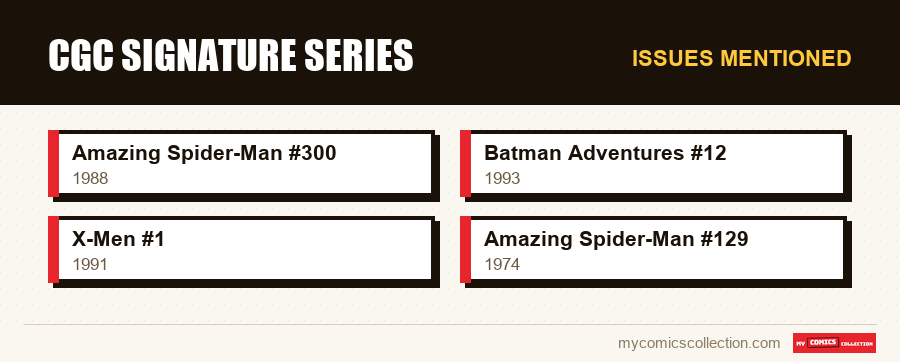
The added value of the yellow label shows up on the secondary market. An Amazing Spider-Man #300 (Todd McFarlane / David Michelinie, May 1988) in grade 9.6, raw and unsigned, trades around $850 based on 2025 sales data. The same copy signed by Todd McFarlane in a yellow-label 9.6 regularly reaches $2,400 to $2,900 on Heritage and ComicConnect. The gross premium therefore swings between 180 and 240%, though part of it also reflects the combined rarity of signature plus grade plus census. For a collector operating internationally, the authenticity guarantee is above all a resale argument toward the U.S. market, where distrust of uncertified signatures remains high.
The facilitator stakes their personal responsibility on it. CGC maintains a public list of its authorized witnesses, and every official session is logged in the internal database. In case of an authenticity dispute, the certification number makes it possible to trace the facilitator, the signing date, and the location. This traceability is missing from the green Qualified label, and it is the central argument for institutional buyers, who often refuse unwitnessed signatures.
The green Qualified label: a signature not authenticated by CGC
The green Qualified label covers comics with a defect considered intentional or unusual, and an unwitnessed signature falls into that category. In practice, a collector who owns a copy signed before the Signature Series program existed, or signed at an event not covered by a facilitator, can submit the piece for standard grading. CGC then accepts the signature as a descriptive element but declines to stake its guarantee on the signature's authenticity.
The cost of the process stays at the chosen tier ($24 to $150), with no Signature Series surcharge since CGC performs no authentication. The assigned grade reflects the book's overall condition, but the slab carries a green sticker reading "Signature(s) not witnessed by CGC." That detail plays a decisive role at resale: the signature is listed in the description (artist, presumed date if provided by the submitter), but the final buyer has to form their own judgment about its authenticity.
The price consequence holds true across every segment. A Batman Adventures #12 (first appearance of Harley Quinn, October 1993) in a yellow label signed by Paul Dini, grade 9.6, sold for an average of $1,850 in ComicLink sales during the first quarter of 2025. The same configuration in a green Qualified label, signature not witnessed, traded at $920 to $1,050. The gap, 43 to 50%, measures exactly the value the market places on the CGC guarantee. For deceased artists, the gap widens further: a Jack Kirby signature in a green label sells for half of a witnessed signature obtained during his lifetime in a yellow label, owing to distrust of sometimes-dubious posthumous signatures.
The complete guide to label colors details the other categories (blue Universal label, purple Restored label, brown Conserved label) and helps situate green Qualified within CGC's overall ecosystem. Note that the green label does not commercially disqualify the piece; it simply shifts the burden of proof onto the seller.
The role of the signing facilitator in the yellow process
The facilitator is the cornerstone of the Signature Series. CGC has structured its network around three categories: official facilitators attached to the company (rare, present at major events such as San Diego Comic-Con or New York Comic Con), independent authorized facilitators operating at regional conventions, and temporary witnesses cleared for a specific session. The updated list appears on cgc-comics.com under the Signature Series tab.
Outside the U.S., the market remains embryonic for lack of a permanent CGC presence at local conventions. Collectors generally go through three channels: attending a U.S. or British convention with a facilitator on site, hiring a proxy signature service such as CGC Signature Series Submission Centers, or waiting for one-off sessions CGC organizes at events like Paris Manga or Comic Con Paris. Our guide to Signature Series conventions in France lists the local opportunities.
The facilitator verifies three elements before the session: the submitter's identity, the comic's condition (a damaged copy can be refused), and the presence of a suitable signing spot (cover, interior page, title page). During the signing, the facilitator stays physically present within a meter of the artist. Any break in the chain of surveillance invalidates the session. After the signing, the comic is immediately sealed in a tamper-evident plastic sleeve bearing the unique session number. That number will later appear on the yellow label CGC issues.
The facilitator's compensation varies. CGC charges the submitter $20 to $100 per signature, part of which goes to the facilitator (generally $5 to $15), part to the artist for their time (variable by contract), and part kept by CGC for the administrative work. For premium sessions with rare artists (Frank Miller, Brian Bolland, certain Stan Lee collaborations during his lifetime), the facilitator may charge $200 to $500 per signature, rarity premium included. These sessions are announced months in advance and spots fill up fast.
Resale premium: yellow vs green vs signed raw
The value gap between the three configurations measures out consistently across U.S. and European auction platforms. Below are the average figures recorded on Heritage Auctions, ComicConnect, eBay completed listings, and Catawiki between January 2024 and April 2026, for comics representative of the $200-$2,000 segment:
For an X-Men #1 (1991, Jim Lee, gatefold cover A) in grade 9.8, the raw unsigned value sits around $280. Signed by Jim Lee in a yellow-label 9.8, the piece sells for $1,100 to $1,350. Signed by Jim Lee in a green Qualified 9.8, the range drops to $580-$720. The same piece signed outside grading (raw signed in a mylar bag and board) tops out at $380 to $450. The yellow premium over raw reaches 285%, the yellow premium over green runs about 80%, and green itself adds 50 to 100% over signed raw.
On a vintage title like Amazing Spider-Man #129 (first appearance of the Punisher, 1974) in grade 8.5, the mechanics repeat with adjusted figures. Raw unsigned value: $1,100. Yellow label signed by Gerry Conway (original writer) 8.5: $2,400 to $2,800. Green Qualified Conway 8.5: $1,600 to $1,850. The premium on vintage titles stays more modest, because the intrinsic value of the grade and census rarity outweighs the signature. The vintage vs modern strategy comparison digs deeper into this dynamic.
The market for deceased artists is a special case. Posthumous Stan Lee signatures (he passed away in November 2018) in a green Qualified label take a 60 to 75% haircut compared with Stan Lee signatures witnessed during his lifetime. The distrust stems from the many questionable signatures that circulated after his death. For Jack Kirby (who died in 1994), the differential reaches 70%. These gaps justify the upfront investment in an official Signature Series session for any collector targeting a long-term resale. To assess a piece's true value before signing, our free appraisal service provides a precise reference point.
Practical cases: choosing between yellow, green, and signed raw
Three scenarios sum up the trade-offs collectors face most often. First case: buying a modern comic (post-2000) as a long-term investment. The yellow-label signature is the clear choice. The entry cost ($38 Economy tier plus $20 Signature Series plus international shipping, roughly $110 total) pays for itself on the resale premium from the very first transaction. Modern key issues signed in a yellow label have posted gains of 8 to 15% per year over 2020-2026, according to GoCollect Comic Index data. The modern comics investing report details the best positions.
Second case: owning a comic signed outside the official process, an old and unquestionable signature. The green Qualified label remains the sensible route. The piece gains physical protection (airtight encapsulation), commercial presentation, and the certified grade reassures the buyer. The discount versus yellow (40 to 50%) has to be accepted as a structural cost of the market. Pushing the piece into yellow via an additional signature at a convention stays possible if the artist is alive: CGC then offers an upgrade to a yellow label if a new witnessed signature is added, requiring another pass through grading. The full procedure is laid out in our guide to grading with CGC.
Third case: a signature obtained at a convention with no facilitator present, for example outside an official session. Signed raw may be enough if resale targets a close circle or a secondary collector market (specialized Facebook groups, forums). The added value of grading stays limited against the cost ($38 to $65 plus return shipping) and international liquidity stays low. For this profile, profitability only kicks in beyond an initial raw value of $400, below which grading fees eat up most of the potential margin. The guide on Signature Series profitability quantifies the thresholds precisely.
Fourth related case: a historic piece predating 1999 (the launch of the Signature Series program) signed during the artist's lifetime. The green Qualified label is often the only option. For rare signatures (Jack Kirby, Steve Ditko, Carl Barks), even in a green label, the piece keeps strong historical value, and the discount versus a hypothetical yellow signature (technically impossible) stays theoretical. The market then values the accompanying documentation (period photos, letters, provenance certificates) that contributes to informal authentication.
Verification, traceability, and buying precautions
Before any purchase of a CGC Signature Series comic, verifying the certification remains a mandatory step. CGC offers a public lookup tool on cgc-comics.com that lets you enter the certification number (the 10 digits at the top of the label, e.g. 1234567890) to display the official record: title, issue number, grade, label type, certification date, signature details (artist, session date, location for the yellow label). The CGC lookup verify certification guide details the procedure step by step.
Three recurring traps await the buyer. First trap: the counterfeit CGC slab. Fake slabs have circulated since 2018, mainly on eBay and Facebook Marketplace, with imitation labels and rough holograms. Systematically checking the certification number in the CGC database eliminates 99% of the risk. If there is any discrepancy between the record and the physical object (different title, different grade, different label type), the slab is fraudulent. The guide to spotting fake CGC slabs lists the visual indicators of a counterfeit.
Second trap: an authentic yellow-label signature but a questionable grade. CGC is still a private company, and grade revisions happen. A comic graded 9.8 in 2010 may, after a crossover, drop to 9.6 or 9.4 if standards have shifted. For premium pieces above $1,500, a visual review through the seller's high-resolution photos lets you cross-check the stated grade against visible defects (corners, edges, spine alignment). The CGC grading scale explained provides the technical reference points. When in doubt, CGC's Resubmission service allows a fresh evaluation for $24 to $65.
Third trap: buying a green label presented as guaranteeing the signature. The green Qualified label never validates a signature's authenticity; CGC states this explicitly in its protocol. A seller claiming otherwise is making a commercial misrepresentation that, in many jurisdictions, qualifies as a deceptive commercial practice and can be challenged legally. For transactions above $500, the ideal is to ask the seller for supporting documentation (a photo of the signing session, the original proof of purchase, a certificate of authenticity issued by a third party such as PSA/DNA or Beckett).
Collecting this series?
Track what you own, what you are missing and what your collection is worth. 7 day trial.
Start my trial →Buy-and-resell strategy for the $200-$2,000 collector
The $200-$2,000 segment is the core of the collector market. Across this band, the yellow-label vs green-label mechanics produce quantifiable trade-offs. First principle: below $400 in raw value, sending a comic for grading stays marginally profitable. The total cost of grading plus signature plus international shipping runs close to $130, or 32% of the initial value. The remaining margin does not cover the downgrade risk (a grade lower than the submitter's initial estimate).
Above $400, the profitability flips. For a comic estimated raw at $600, the yellow-label Signature Series treatment typically generates a final value of $1,100 to $1,400, a gross premium of 80 to 130%. Net of grading costs ($130), the net margin reaches $370 to $670. This mechanic explains why savvy collectors concentrate their Signature Series sessions on already-valued pieces rather than common titles. The strategic comics investment guide digs deeper into this logic.
For buyers hunting opportunities, three angles of attack deliver the best 2025-2026 returns. First angle: buy authentic signed-raw copies on European secondary markets (Catawiki, Delcampe, eBay UK) at still-discounted prices, then submit them to CGC Signature Series for an upgrade to a yellow label if the artist is alive and accessible. The signed-raw to yellow-label differential can reach 200 to 400% on certain titles. Second angle: buy underpriced green Qualified labels, particularly signatures from living artists, with a later resubmission to a yellow label if a new witnessed signature is possible. Third angle: buy a yellow label directly on Heritage Auctions or ComicConnect ahead of a predictable surge (film announcement, Disney+ series, title anniversary). The 2026 sleeper issues guide identifies high-potential titles.
Spider-Man remains a prime playground for these strategies, thanks to the volume of accessible living artists (Todd McFarlane, Erik Larsen, Mark Bagley, Dan Slott, Donny Cates, John Romita Jr.) and the depth of the secondary market. The Spider-Man CGC grading guide details the priority titles. For buyers who prefer a comparison across grading companies, the CGC vs CBCS vs PGX comparison reframes the competitive positions.
FAQ: CGC Signature Series yellow vs witness
What is the exact price difference between a yellow and a green CGC label?
Across a sample of 200 transactions analyzed between January 2024 and April 2026 on Heritage Auctions, ComicConnect, and Catawiki, the average discount of the green Qualified label versus the yellow Signature Series label comes to 43% for modern comics (post-1990) and 35% for vintage comics (pre-1990). The gaps vary by artist: signatures from high-demand living artists (Todd McFarlane, Jim Lee) show the sharpest differentials, around 50%. Signatures from deceased artists (Stan Lee, Jack Kirby) in a green label take an additional 15 to 25% discount over posthumous-authentication distrust. For a premium title in grade 9.6 or 9.8, the cumulative difference can amount to $400 to $1,200 on a piece valued at $2,000 total.
Can you turn a green Qualified label into a yellow Signature Series?
Yes, under conditions. If the signing artist is alive and accessible at an official Signature Series session, CGC allows a new witnessed signature to be added to an already-graded comic. The procedure: crack the slab (opening the existing slab at CGC, $18), a new signature in the presence of a facilitator ($20 to $100), regrade and re-encapsulation in a yellow label (service tier of your choice, $24 to $150). Average total cost: $80 to $200 depending on options. Profitability hinges on the expected value difference. For comics above $1,000, the operation makes economic sense. If the artist is deceased, the transformation becomes impossible and the piece stays permanently in a green label.
Does a green Qualified label commercially disqualify a piece?
No. The green Qualified label stays fully sellable across every international channel (Heritage, ComicConnect, eBay, Catawiki). The piece keeps a significant value, simply discounted versus the yellow label. For rare historic signatures (pioneer artists, pre-1999 signatures), the green label is often the only possible certification, and the market accepts it as such. The transparency of the CGC protocol (the explicit "Signature(s) not witnessed by CGC" notice) protects both buyer and seller. On institutional markets (premium auction houses), the green label is less valued but still acceptable. The real commercial risk concerns only attempts to resell to a buyer demanding a full authenticity guarantee.
How much does a CGC Signature Series session cost?
The total cost combines four line items. Service tier: $24 (Modern, value up to $400), $38 (Economy), $65 (Standard), $150 (Express). Signature Series fee: $20 per signature for common artists, $50 to $100 for premium artists. International round-trip shipping to Sarasota or Munich: $45 to $80 depending on the carrier (DHL, FedEx). Optional declared-value insurance: 1 to 2% of the value. For a comic valued at $800 in the Economy tier with a standard signature, the total cost runs about $130 to $160. For premium sessions with high fees and the Express tier, the cost can climb to $300. Profitability kicks in beyond an anticipated post-signature value of $400.
How do you check that a yellow CGC label is authentic before buying?
Three systematic checks are essential. First step: note the 10-digit certification number at the top of the label and enter it on the official lookup tool at cgc-comics.com. The record must display the title, issue number, grade, yellow Signature Series label type, certification date, and signature details (artist, session date, location). Any discrepancy with the physical object invalidates the slab. Second step: examine the official CGC hologram; counterfeits often show a dull or poorly positioned hologram. Third step: check the label's visual consistency (font, alignment, color of the yellow sticker). For transactions above $1,500, asking the seller for high-resolution photos from different angles lets you cross-check these elements against documented CGC standards.