The CGC Purple Label (Restored) flags that a restoration intervention was detected and documented. The resale discount runs from 50 to 80% versus a Universal Blue of equivalent grade, depending on the type (Slight, Moderate, Extensive) and the nature (color touch, tear seal, piece replacement). A strategic buy only, to fill out a run or for heritage preservation.
The CGC purple label is arguably the least loved color on the secondary market for graded comics. When a collector cracks open the box, slides out the slab and reads the "Restored" banner across the top of the case, it's rarely good news. The reason: the market applies a brutal discount that can turn a $2,000 investment into a $400 resale. Yet understanding how the Purple Label works isn't just a matter of suspicion. It's a decision-making tool: for buying heritage pieces at an accessible price, for not sending comics to grading that will come back Purple with no economic upside, and for spotting a restored comic before an unscrupulous seller presents it as untouched.
This article breaks down CGC's classification of restorations into three types (A, B, C by extent), runs through the eight most common restoration techniques (color touch, tear seal, piece replacement, and more), puts numbers on the market discount observed for each grade + restoration-type combination on Marvel and DC key issues, and closes with a buy / sell / don't-grade strategy for the experienced collector. All the figures draw on Heritage Auctions, ComicLink and eBay completed sales, plus the public CGC Census statistics for 2024-2025. The goal: arm you so you never again get blindsided by a Purple Label, and so you know when a Purple is an opportunity rather than a trap.
What the CGC Purple Label is and why it exists
The Purple Label is one of the five color codes CGC uses to classify a graded comic. The top banner of the slab reads "Restored," followed by the numeric grade in the form "Apparent 8.5" or "Apparent 9.0." The "Apparent" qualifier is crucial: it indicates that the visible grade reflects the comic's appearance after restoration, not its original pre-intervention condition. Without the restoration, the comic would likely have graded lower: sometimes 2 to 4 grade points below.
CGC's stated goal in creating this category in 2000, at the launch of the service, was to bring full transparency to the market. Before CGC, the vintage comic market suffered from hidden restorations sold as untouched comics, with enormous price gaps. The Purple Label forced an official distinction and enabled the emergence of a sub-market for restored comics, with its own comparables and its own liquidity. The full history of how the CGC system was born is covered in grading your comics with CGC, the complete guide.
Technically, the Purple Label applies as soon as an intervention "improves" the comic's appearance beyond its natural state. The difference with Conserved Blue (the conservation label introduced in 2021) is one of definition: conservation stabilizes without altering appearance, restoration alters to improve. A dry cleaning that removes grime is conservation. A color touch that masks a defect is restoration. Filling a tear with paper is restoration. Removing tape without masking is conservation. The line isn't always clean, and CGC decides case by case according to documented protocols.
The 2024 CGC census indicates that the Purple Label accounts for roughly 2.8% of all comics graded since 2000: about 320,000 slabs out of 11.3 million. That low share explains the reduced liquidity: there's little supply and little demand, and every transaction is negotiated against rarer comparables. For Silver Age (1956-1970) and Bronze Age (1970-1985) key issues, the proportion climbs to 7-12% depending on the title, because vintage comics had more reasons to be restored. For Modern Age comics (post-1985), Purple drops below 1%. The full breakdown of label colors is in CGC label colors: what they mean.
The three restoration types: Slight, Moderate, Extensive
CGC classifies every Purple Label comic by one of three levels of restoration extent, which drives the discount the market applies. This classification appears on the label after the word "Restored," and any serious buyer reads it before even looking at the numeric grade.
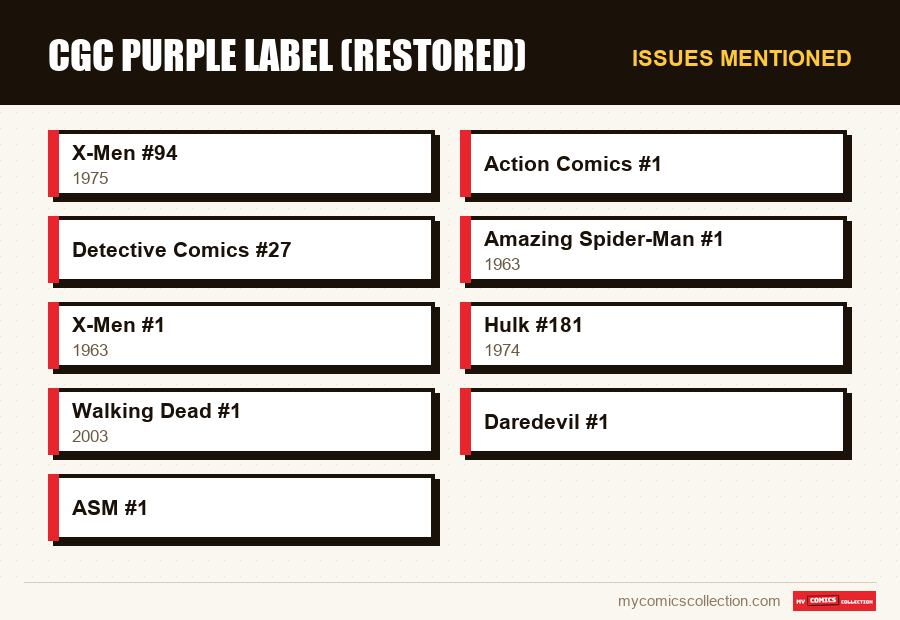
The Slight (S) level covers light restorations, generally invisible to the naked eye without a loupe or UV lamp. What falls into this category: a spot color touch of less than 1 cm² on the cover, a tear seal under 0.5 cm, a staple reinforcement without replacement, the partial removal of a price sticker with slight paper residue. The apparent grade stays close to what the Universal grade would have been, typically with a gap of 0.5 to 1.0 point. On the market, a Slight generates the least aggressive discount on the Purple spectrum, around 50 to 60% vs an equivalent Universal Blue. For an X-Men #94 (1975) in CGC 9.0 Universal Blue at $3,200, a Slight 9.0 trades between $1,200 and $1,600.
The Moderate (M) level groups significant but surface-limited restorations. Criteria: color touch between 1 and 5 cm² cumulative on the cover, filling of small holes under 0.5 cm each, a tear seal between 0.5 and 2 cm, replacement of one staple with a period staple, removal of pen writing with slight bleaching. The apparent grade often overstates the real condition by 1.5 to 2.5 points. The market discount climbs to 65-75% vs Universal Blue. The same X-Men #94 9.0 Moderate falls to $700-$1,000.
The Extensive (E) level covers massive restorations that fundamentally alter the comic. Typical cases: full repainting of a cover area larger than 5 cm², filling of missing or partially destroyed pages with backing paper, replacement of the cover with one from another copy (cover replacement), general recoloring of the spine to mask fading. The apparent grade can overstate the real condition by 3 to 5 points: a comic graded Apparent 9.0 Extensive could have been a 5.0 or 6.0 Universal without intervention. The discount exceeds 75-85%. The X-Men #94 9.0 Extensive drops below $500, sometimes $350-$450 depending on the quality of the restoration work and the rarity of the title.
There's an important nuance for documented professional restorations (Susan Cicconi, Matt Nelson, and others). CGC sometimes notes the restorer's name on the label, and some collectors pay a slight premium for restorations executed by recognized names: without, however, reversing the overall discount logic. To understand how the grade itself affects value, see the CGC grading scale explained.
The eight most common restoration techniques
CGC records on the label the exact nature of the interventions it detects. Knowing the eight main techniques lets you anticipate the risk profile before buying. Each technique carries its own weight in the overall discount, and some combinations stack the penalties.
First: Color Touch. Color retouching applied to the cover to mask a white spread, a scratch, or color loss from rubbing. Tools used by restorers: watercolor pencils, acrylic inks, markers. CGC detects it via UV examination and microscope, because modern pigments differ from period printing inks. It's the most frequent restoration, present on roughly 55% of Purple Labels.
Second: Tear Seal. Repair of a tear with glue or clear resin. The original tear remains visible under raking light, but the mechanical strength is restored. Tear seal is often combined with a color touch to mask the join. Present on roughly 30% of Purples.
Third: Piece Replacement. Replacement of a missing part (corner, edge, page fragment) with period paper or reconstituted paper hand-painted to match the artwork. It's a heavy restoration, classed Moderate or Extensive depending on the surface area. Cost of professional execution: $200 to $1,500 depending on size and complexity. Present on roughly 12% of Purples.
Fourth: Spine Roll Correction. Flattening of a rolled or creased spine through controlled humidification and pressing. This isn't standard CGC pressing, because it permanently alters the spine's structure. Present on roughly 18% of Purples, often combined with other interventions.
Fifth: Staple Replacement. Replacement of the original staples (often rusted) with period or modern staples. The label notes "Original Staples Replaced" or "Reinforced Staples." Present on 15% of Purples, more common on Golden Age and Silver Age books.
Sixth: Cleaning with Solvent. Chemical cleaning of the cover to remove deep grime, surface mildew, or coffee/water marks. Unlike dry cleaning (which stays Conserved), the solvent penetrates the paper fibers and alters its structure. Present on 8% of Purples.
Seventh: Cover Trim. A slight recut of a frayed edge to restore a clean line. A common practice on Silver Age books whose edges were fragile. Detected by CGC by measuring against period standard dimensions. Present on 7% of Purples. For internal CGC pressing, see CGC pressing comics: when it's worth it.
Eighth: Married Cover. Combining the cover of one copy with the interior of another. It's the most morally contested restoration, because it assembles two distinct comics to present a single "better" one. Always classed Extensive. Discount reaching 85-90%. Present on fewer than 3% of Purples, but almost always on very rare Golden Age books (Action Comics #1, Detective Comics #27).
The discount in numbers, by grade and type, on key issues
The Purple Label discount varies not only by extent (S, M, E) but also by title, target grade and current market dynamics. An indicative grid on Marvel and DC key issues from 2024-2025 sales gives a baseline.
Amazing Spider-Man #1 (1963). Universal Blue 4.0 at $32,000 (Heritage 2024 median). Slight 4.0 at $14,500-$17,000 (47-55% discount). Moderate 4.0 at $9,500-$12,000 (63-70% discount). Extensive 4.0 at $5,000-$7,500 (77-84% discount). At 8.0 Universal Blue, the comic rises to $138,000. The same 8.0 Slight falls to $58,000-$72,000, Moderate to $38,000-$50,000, Extensive to $18,000-$28,000.
X-Men #1 (1963). Universal Blue 6.0 at $18,500. Slight 6.0 at $8,200-$10,500 (43-56% discount). Moderate 6.0 at $5,500-$7,500 (60-70% discount). Extensive 6.0 at $3,000-$4,200 (77-84% discount). The X-Men #1 market saw the discount compress in 2024 with Marvel's film-relaunch effect, but the Purple vs Blue gap remains structurally high.
Hulk #181 (1974). Universal Blue 9.0 at $11,000 (GoCollect 2024 median). Slight 9.0 at $5,200-$6,500 (41-53% discount). Moderate 9.0 at $3,500-$4,500 (59-68% discount). Extensive 9.0 at $1,800-$2,500 (77-84% discount). For grading Spider-Man through CGC, the gaps are similar on the Spider-Man keys.
Walking Dead #1 (2003). Universal Blue 9.8 at $2,200. Purple is rare on this Modern Age book, but when it does exist: Slight 9.8 at $1,000-$1,300 (41-55% discount), Moderate 9.8 at $650-$900 (59-70% discount), Extensive 9.8 at $300-$450 (80-86% discount). The Modern Age applies slightly steeper discounts in percentage terms because untouched copies are plentiful.
Action Comics #1 (1938). A category of its own. Universal Blue 6.0 at $3.2 million (Heritage 2024 sale). Slight 6.0 at $1.4-$1.8 million (44-56% discount). Moderate 6.0 at $900,000-$1.2 million (63-72% discount). Extensive 6.0 at $450,000-$700,000 (78-86% discount). At these price levels, the slightest restoration nuance represents hundreds of thousands of dollars, and every sale is a market event.
For free estimates on your own collection, the free estimate tool pulls in current eBay listings automatically. The overview of the most valuable comics is in the most expensive comics 2026.
Spotting a restoration before buying or before grading
Identifying a hidden restoration before buying avoids the nasty surprise of a Purple Label after sending the book to CGC. The professional method combines visual inspection, a UV lamp, a 10x loupe at minimum, and high-resolution photographic analysis. For a collector who wants to avoid paying $75-$150 in grading fees only to discover a Purple, these upfront checks pay for themselves.
First point: the UV examination. A UV lamp at 365 nm wavelength ($20-$40 on Amazon) reveals the modern pigments used in color touch, which fluoresce differently from period printing inks. Retouches show up as black or bluish zones on the cover, where intact paper fluoresces uniformly. This technique detects 70-80% of Slight color touches and nearly all Moderate ones.
Second point: the 10x loupe and raking light. Holding the comic under oblique light brings out variations in paper texture. A restored area often shows a different roughness from the original paper. The loupe reveals fibers added in fills and brush traces in color touches. For a tear seal, the glue join leaves a shiny line that doesn't exist on an unrepaired tear.
Third point: weighing. A scale accurate to 0.01 g lets you compare the comic's weight to a reference copy. Restorations involving piece replacement add paper, which changes the weight by a few tenths of a gram. A standard Hulk #181 weighs 47-49 g. A copy at 52 g has probably received a fill or a cover trim with re-mounting.
Fourth point: analyzing the seller's photos. Ask for high-resolution photos (minimum 3,000 px on the long side) of every corner, the spine, and the cover in direct natural light AND in raking light. An honest seller provides this documentation. A seller who refuses, or who only sends low-resolution flatbed scans, raises a red flag. For remote purchases, see the method in spotting fake CGC slabs.
Fifth point: the comic's history. If the seller states "fresh from collection" or "untouched since 1975," the probability of restoration drops. If the comic has passed through several documented hands, or if it comes from a collection known for its restorations (some American collections from the 1980s were heavily restored by dealers), the probability rises. Heritage traceability and the CGC Registry help reconstruct the history for major pieces.
Collecting this series?
Track what you own, what you are missing and what your collection is worth. 7 day trial.
Start my trial →Buy / sell / don't-grade strategy for the Purple Label
Owning or considering acquiring a Purple Label comic calls for a strategy distinct from Universal Blue. Three main scenarios guide the decision.
Scenario 1: a strategic Purple Label purchase. Justified in three cases. First: completing a run for reading. An X-Men #94 Purple at $1,200 lets you own a key issue at an accessible cost, while possibly waiting to upgrade to Universal. Second: heritage preservation of a rare comic where the Universal is out of reach. Action Comics #1 Universal at $3.2 million, but Slight 6.0 at $1.5 million, remains a more accessible investment with real liquidity in the affluent collector market. Third: buying a filler piece for a cataloged collection. A Daredevil #1 Slight 7.0 at $4,500 can complete a collection while you wait to sell other pieces.
Scenario 2: selling a Purple Label you already had graded. The strategy is to maximize value in a difficult market. Key steps. Document the label precisely (S, M, E) and the noted interventions. List on platforms targeting sophisticated buyers (Heritage Auctions, ComicLink, specialized retailers) rather than generalist eBay, where Purple is poorly understood. Provide high-resolution photos of the label and the comic. Plan for a sales window of 45 to 120 days, sometimes longer for Extensive books. Accept that a gradual price reduction will be necessary. The resale value can be folded into your tracking via CGC lookup verification.
Scenario 3: preventive non-grading. If you own a comic you suspect is restored, the worst decision is sending it to CGC without pre-checking. The Purple Label is permanent and deepens the discount by adding official transparency to the visual penalty. Three preferable options. Option A: have the comic appraised by a recognized dealer (specialized retailers can offer opinions). Option B: sell it raw "as-is" without grading, honestly flagging the restoration doubt. The discount will be real, but the expert buyer will take the risk. Option C: submit for CGC Conserved Blue if the restoration is in fact treatable conservation. This nuance is covered in CGC label colors: what they mean.
A fourth option exists for Silver Age key issues: send the book to a professional restorer to partially "de-restore" it: remove an old intervention to stabilize the comic and then attempt a Conserved Blue. This strategy is costly ($1,000 to $5,000 in reverse restoration) and risky, but it can recover tens of thousands of dollars on very high-value pieces. Reserve it for comics valued above $50,000.
Long-term investment in Purple Label follows the inverse dynamic of Universal Blue. Purples benefit less from the overall rise in the vintage comic market, because the structural discount caps appreciation. Over 2015-2025, Silver Age Universal Blue appreciated 280% on average, Purple Label only 95%. That gap widens further for Modern Age books. The investment strategy is in investing in comics, a strategic guide and modern comics 2020-2026.
FAQ: CGC Purple Label restoration
What average discount applies to a CGC Purple Label versus a Universal Blue?
The average Purple Label discount sits between 50 and 80% versus a Universal Blue of equivalent numeric grade, with significant variation depending on the extent of the restoration. A Slight (light restoration) generates a 40-60% discount. A Moderate (significant restoration) runs 60-75%. An Extensive (massive restoration) reaches 75-90%. On vintage key issues (Silver Age, Bronze Age), the market is slightly more forgiving than for Modern Age, because restored comics are sometimes the only way to access rare pieces. For an X-Men #94 9.0 Universal Blue at $3,200, the Slight falls to $1,200-$1,600, the Moderate to $700-$1,000, the Extensive below $500. This grid shifts with the market: since 2020, discounts have widened with the arrival of high-resolution scanners that make restorations visible.
How do you tell a Restored Purple from a Conserved Blue at CGC?
The distinction comes down to the intent of the intervention. Conserved Blue covers operations that stabilize the comic without altering its appearance: dry cleaning, tape removal without masking, paper deacidification, reinforcing an existing tear without concealment. Restored Purple covers operations that improve appearance beyond the natural state: color touch, filling of losses (piece replacement), masked visible repair (tear seal with color touch), replacement of pages or staples. The line isn't always clean. CGC decides according to its internal protocols. The financial impact differs radically: Conserved generates a 15-30% discount, Restored generates 50-80%. If an intervention is ambiguous, contacting CGC before submission can avoid an unexpected Purple designation.
Can a CGC Purple Label comic be upgraded or cracked out to make it Blue?
No, not legitimately. The documented restoration doesn't disappear. If you crack the case (break the slab) and resubmit the comic to CGC, the inspection protocols will detect the restoration and the comic will come back Purple. Trying to mask the restoration constitutes fraud. A risky and costly strategy exists for very high-value pieces: bring in a professional restorer to remove or stabilize the old restoration, then aim for a Conserved Blue. This operation costs $1,000 to $5,000 depending on the work, and the result isn't guaranteed. Reserve it for comics above $50,000 in potential value. For modest comics, Purple is permanent. See the details in the crack-case section.
Which restoration types are the most penalizing for the discount?
Restorations that alter the structure or material integrity of the comic generate the steepest discounts. Piece replacement (filling losses with added paper) systematically drops the comic into the Moderate or Extensive category. A married cover (joining one copy's cover with another's interior) is always classed Extensive and applies an 85-90% discount. Aggressive cover trim is poorly received. By contrast, a spot Slight Color Touch on a non-key area of the cover can generate a contained discount of 40-50%. A tear seal without an associated color touch also remains relatively well tolerated. Sophisticated buyers distinguish these nuances, and the label records the precise nature of the interventions, allowing fine valuation case by case.
Should you buy a Purple Label on a key issue or wait for a Universal Blue?
The answer depends on budget, holding horizon and collecting goals. For a collector who wants to own a key issue out of reach in Universal Blue (Action Comics #1, ASM #1, Detective Comics #27), a Purple Label is sometimes the only realistic point of entry. The discount allows acquiring a historic piece at 30-50% of the Universal price, with lower long-term appreciation but a presence in the collection. For an investor aiming to resell, the Purple Label is rarely profitable: the initial discount and the reduced liquidity limit margins. For a reader who wants access to the narrative material of a key issue, Purple offers very favorable value for money. The decision ultimately comes down to profile: heritage collector yes, investor no, reader yes.
Related articles
- CGC label colors: what they mean
- The CGC grading scale explained
- CGC vs CBCS vs PGX: a comparison
- CGC pressing comics: when it's worth it
- Undervalued comics 2026: sleeper issues