A second printing is a reprint decided in a rush when the first printing sold out faster than expected. It is recognized by a printing notice added on an interior page or in the indicia, often by a retouched or entirely redrawn cover, and sometimes by a distinct order code. Its market value is almost always far below that of the first printing, but the statement "a second printing is worth nothing" is false: it confuses two opposite situations. On a title with a very large initial print run, reprints circulate in the tens of thousands and will never become scarce. On an obscure title whose first printing sold a few thousand copies, the second printing also remains scarce in absolute terms, and inherits part of the demand. The criterion is not the printing number, it is the number of copies that exist.
Few sentences are as widespread and as poorly understood, in the collector's vocabulary, as "it's a second printing, it's worth nothing." It mostly serves to dispatch a question instead of answering it. It does have a grain of truth: the vast majority of reprints have never gained value and never will. The problem is that this majority says nothing about the minority, and that the boundary between the two does not run where you imagine.
To see clearly, you must reason not on the printing number but on what happened at the press. A second printing is not a quality category, it is the trace of a commercial accident: the publisher had misjudged demand, the presses were restarted, an additional object entered circulation. Depending on the scale of that accident, this object is a pointless surplus or a piece that matters. This article explains why reprints exist, what they reveal about the first printing, how to identify them, what separates them from a facsimile, and under what conditions one of them can be worth something. It stays frank about the rest: in most cases, you are holding a good reading copy and nothing more.
Why a publisher restarts the presses
The comics distribution circuit runs on firm orders. Retailers order weeks before release, the publisher adds up, prints accordingly and ships. This system avoids unsold stock, but leaves no margin when the public turns up in unexpected numbers: if an issue sells out in three days, the missing copies cannot appear by magic on the shelves. The only way out is a new printing.
This moment has a name in publishers' communications, "rushed back to print," and it is much more frequent than people think: at an independent publisher like Image Comics, these announcements follow one another almost every week. A dated example: on February 18, 2026, the publisher announces that White Sky #1, written by William Harms and drawn by JP Mavinga, sold out at the distributor level on its very release day, and that a second printing was due to reach stores on March 18, 2026. On September 30, 2026, same scenario for The Last Driver #2, with a second printing scheduled for October 28. A detail that will matter later: this reprint does not reuse the original cover, it receives an entirely new illustration signed by the series' artist, built as a tribute to a console cartridge.
The phenomenon does not spare massive hits. In August 2026, D'Orc #1, released in February of the same year, was headed for its seventh printing, scheduled for September 9, 2026, the publisher citing continuous restock requests from retailers. Along the same lines, Ben 10 #1 went through four printings in three months. In other words: the second printing is not a rare accident reserved for historic phenomena, it is a routine management tool. This banality is the first reason most reprints are worth little, but it does not explain the exceptions.
What a second printing says about the first
Here is the reasoning that the "it's worth nothing" formula prevents. The existence of a second printing is information about the first, and it is favorable information.
When a publisher restarts its presses, it publicly certifies two things. First, that the first printing was insufficient, therefore that its quantity is below the observed demand. Second, that this demand was strong enough to justify an additional printing cost, a schedule renegotiation and a new shipment. A publisher does not do this out of courtesy.
Applied to buying, this reasoning reverses the usual reflex. A collector who learns that a recent issue is going to a second printing has learned, at the same time, that the first printing of that issue is now fixed at a quantity below the level of demand. That is exactly the configuration that creates value. The second printing, for its part, is the publisher's response to this tension: it eases the pressure, and that is why it captures far less of it.
Saga #1 provides the now-classic illustration. The issue sold out even before its March 14, 2012 release date. A second printing was scheduled for April 11, which sold out in turn, followed by a third printing on April 25. In all, five successive printings, and more than 70,000 copies sold across all printings by August of the same year. Five printings is a spectacular demand signal; it is also, mechanically, five generations of objects of which four will never be the first printing. Retain the formulation: a second printing is a good indicator and a bad investment.
Recognizing a later printing without mistakes
Identification rests on a simple principle: a publisher has no interest in passing a reprint off as an original, and every interest in its being recognizable. The markers therefore almost always exist, but they are not in the same place depending on the publisher and the era.
The case of Teenage Mutant Ninja Turtles #1 is illuminating because the publisher still documents its own printings today. The May 1984 first printing carries no printing notice. The second is signaled by a notice in the upper left corner of the inside front cover, and by a different advertisement on the back cover. At the third, it is the indicia itself that changes: it gives the studio's new address, in Sharon, Connecticut. Three printings, three markers in three different places, only one of which concerns the indicia. The lesson of method is there: do not look for a single marker, look for a divergence. Four families of clues deserve systematic checking.
The printing notice, wherever it is
It can appear in the indicia, at the bottom of the first interior page, on the inside front cover, or even on the cover itself as a sticker. The wording is explicit in the modern era: "Second Printing," "Third Printing," sometimes followed by a month. The total absence of a notice is an argument in favor of the first printing, never proof on its own.
The cover gap
Three situations to distinguish. An identical cover, and only the notice settles it. A recolored cover, a background that changes tint or a logo in another ink, and the gap jumps out as soon as you have a point of comparison. Or an entirely new cover, commissioned for the reprint, which makes the second printing a visually distinct object.
The barcode area and order codes
A reprint enters the circuit with its own order code, distinct from that of the initial release. On some issues, the barcode area also differs, by addition, displacement or modification of the block. It is a secondary clue but easy to check on a sharp photograph.
The material of the object
Paper, whiteness, gloss, ink quality. A reprint printed years later on a more modern stock gives itself away to the touch and in the light, even when the image is faithful. It is the clue hardest to judge from a distance, and the most decisive in hand.
One last point concerns fraud and not error. On old titles where the printing notice is the only marker, authentic copies of second or third printings have had that notice chemically erased in order to be passed off as first printings. It is documented on Teenage Mutant Ninja Turtles #1, whose printing history is detailed elsewhere. Practical consequence: when the entire value gap rests on one line of text, the absence of that line is verified by careful examination of the area, it is not simply observed.
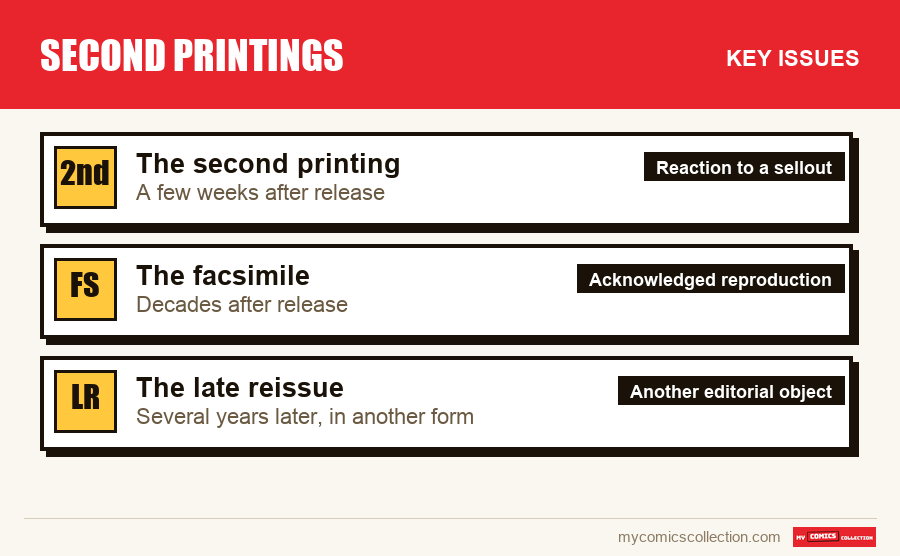
The three objects that get confused
A good part of the misunderstandings comes from floating vocabulary. "Reprint" commonly designates three objects that have neither the same manufacture, nor the same status, nor the same market.
The second printing
Decided in a rush, printed while the series is ongoing, distributed in the same circuit and to the same readers. It belongs to the title's commercial life. It remains contemporary with the work, which is its specificity: it was made because the public was already there.
The facsimile
A modern reproduction of an issue that has become inaccessible, published long after, often down to the period ads. The intent is not commercial in the sense of a stockout: it is heritage-minded and educational. Nothing in it signals market tension at the original release, since that release closed long ago.
The late reissue
Collections, omnibuses, reduced-price reissues, editions for another market or another language. The content is taken up, the object is different, and nobody claims it is the original issue. Its function is reading and access to the story.
The confusion has a concrete cost. A 1984 second printing and a 2019 facsimile are both "reprints," but the first is a period object printed in a few thousand copies, the second a book printed in comfortable quantity for anyone who simply wanted to read. Lumping them together guarantees a valuation error in one direction or the other. The split between first printing and reprint is the subject of a separate guide.
When a second printing is truly worth something
Let us move on to the part the dismissive formula makes you miss. Four conditions, cumulative, make a reprint stand out. None is about the printing number.
First condition: the absolute quantity stays low. It is the most important and the most often neglected. The second printing of Teenage Mutant Ninja Turtles #1, in June 1984, follows a first printing of about 3,275 copies and was itself estimated at only a few thousand copies. Its third printing, in February 1985, climbs to about 35,000 copies, which completely changes its situation. Compare with a successful modern title: the first printing of Absolute Batman #1 was printed at about 250,000 copies in October 2024, and the title went through eight printings in eleven months, for a total across all printings approaching 400,000 copies by the end of 2024. In one case, a four-figure second printing. In the other, five-figure reprints. The printing number is the same, the objects have nothing in common.
Second condition: the first printing has become unreachable. When it exists in such a small quantity that it only circulates at exceptional sales, demand has nowhere to land: it drops a notch and shifts to the next printing, which has become the oldest copy really accessible. This shift presupposes an issue with heavy weight, a major first appearance, an emblematic cover or a founding episode. Without that weight, there is no demand to shift.
Third condition: the reprint is a visually distinct object. It is the most modern configuration. When the publisher uses a second printing to commission an entirely new cover, it does not make a copy but a second object. The second printing of The Last Driver #2, announced on September 30, 2026 for an October 28 release, is of this kind: an unpublished illustration that exists on no other copy, and whose print run is by construction below that of the main cover.
Fourth condition: the reprint has a documentary function. Some later printings do not merely reuse the image, they change the register, for example by going black and white. They then tell the title's editorial history instead of duplicating it. The black-and-white printings of Absolute Batman #1 enter the issue's sales figures as a separate edition, which says well enough that they were bought for themselves.
Put these four conditions end to end and the portrait of the second printing that matters emerges: few in number, attached to an issue many people want, hard to replace with the first printing, with a visual identity of its own. This combination is rare, and that is why the counterexamples are rare, not because the principle would be false.
Why the majority never gains value
Honesty now requires the flip side. If you own a second printing released in recent years, the strongest probability, by far, is that it will never be worth appreciably more than its cover price.
Three reasons add up. The first is quantitative: a publisher that reprints does not reprint timidly, it covers the announced restocks. Absolute Batman #1's figures show it, later printings there represent a substantial share of the total sold. An object produced in large quantity to meet demand exactly will not know a shortage afterward.
The second is behavioral. The second printing is bought by readers who missed the first pass, therefore by people who want to read: these copies are opened, carried, lent. But since they are numerous, this wear creates no exploitable scarcity and fine copies remain available.
The third is structural. The hierarchy by age has been stable for decades because it is not a matter of taste: the first printing is the only copy that was physically present when the work entered the world, and no reprint can acquire that precedence after the fact.
The second printing therefore remains an excellent purchase, for reasons other than gain: it gives access to a sought-after story at a reasonable price, it lets you read without handling a fragile copy, and it fills a slot while waiting for better. These uses do not need to be disguised as an investment. The more general question of print run volume and its effects is covered separately.
How grading services tell them apart
Having a copy certified answers two questions at once: its condition, and its exact identity. The second matters as much as the first as soon as an issue exists in several printing generations. An encapsulated copy is cataloged with a designation that goes beyond the title and number pair: the printing number appears in the piece's heading, before the grade. It is this naming discipline that lets the market treat the generations of the same issue separately, instead of drowning them in a meaningless average.
The limit of the exercise deserves to be understood. A grading service records, it does not guess. If the object carries a marker, the designation is clean; if it carries none because the publisher of the time did not print one, it rests on material expertise and keeps a share of judgment. The oldest certified copies are moreover less explicit than recent ones, which creates a real difficulty at resale: two pieces of the same issue can be described with different levels of precision without either being wrong.
One last safeguard is needed on population reports. CGC says so in the presentation of its census: the reports reflect only the quantities already graded by the company and are not an indicator of value or scarcity. A little-represented second printing is therefore not necessarily scarce, it may simply interest nobody enough to be sent for grading. A low measured population signals a scarce piece just as much as a neglected one.
What to record, and when
On the collection side, all this boils down to a data-entry discipline. The printing number is perishable information: you know it with certainty on the day of purchase, because you hold the object and have read the notice. Three years later, facing a pile, you will no longer be able to tell from memory the issue bought at release from the one bought on restock.
Four fields are enough, to fill in the same day: the printing number, written and not inferred; the identification of the cover, since a second printing may have one that exists nowhere else; the exact location of the printing marker, which will keep you from reopening the copy at every question; and the date of entry into the collection, the only proof of precedence you manufacture yourself. In the app, this information is entered at the copy level and not the series level, which lets you hold two generations of the same issue without creating a phantom duplicate.
The final rule is short. A second printing bought at the price of a second printing is a good purchase. Paid at the price of a first printing, it is a dead loss. Sold at the price of waste when it met the four conditions mentioned above, it is a gift to the buyer. The three mistakes come from the same cause: having believed that the printing number was enough to conclude. The rush-reprint reflex is a market datum, not a verdict of value.