
The booklet published in 1992 which depicts the death of a major hero went off the shelves in a few hours, and the publisher responded with reprints launched immediately: a second printing, then a third, in a few weeks. These reprints are not reissues made long after the fact, they are contemporary prints of the event. Result: on the second-hand market, a second or third edition copy looks exactly like the first (same cover date, same content, same team) and is only distinguished by a discreet mention. On August 29, 2026, out of 141 unverified listings found at once, asking prices ranged from $0.99 to $705.00 for a median of $15.95; among the five cheapest proposals, four explicitly announced a later draw. The practical rule can be summed up in one sentence: on a number that has become famous overnight, assume a reprint until proof to the contrary is before your eyes.
There is a category of issues that the market can never quite get right, and it's not the most obscure: it's the ones that have been in demand too much, too quickly. The 1992 booklet in question here belongs to this category. It tells of the death of a central character in a major series, the information went beyond the usual readership of comics, and the stores saw the arrival of buyers who never entered a comic book store. The printed stock had been calibrated for normal printing. He disappeared during the day. The publisher then found himself faced with a decision which, for him, was not complicated: to reprint, immediately.
It is this gesture (the emergency reprinting, decided in a few days and delivered in a few weeks) which still structures the market for this issue today. Not the death told in the pages, not the cover, not the initial print run: the speed with which the publisher put copies back into circulation. This article therefore does not talk about the history or its scope. He talks about an identification problem which arises directly from this simultaneity, and which decides what you pay.
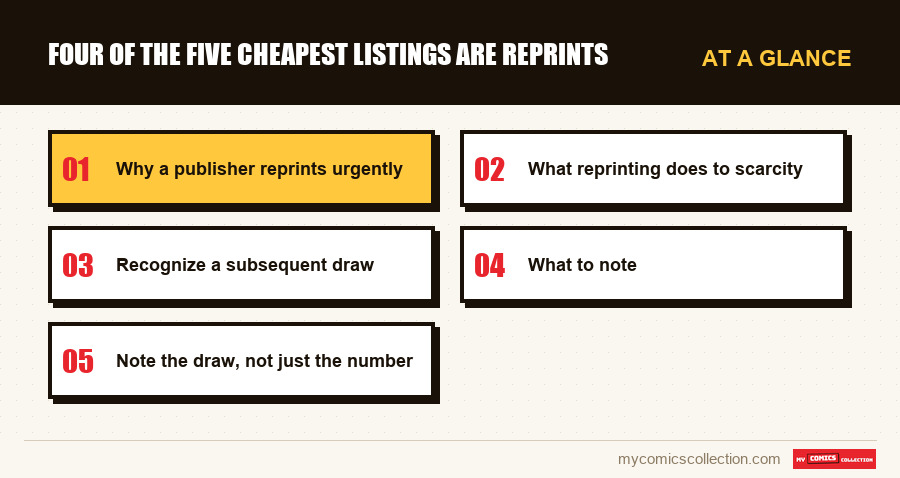
Why a publisher reprints urgently
From the collector's perspective, an express reprint looks like a betrayal: the publisher has just created a rarity and diluted it himself three weeks later. Seen from the editor, it's the opposite of a dilemma. A stock shortage is not a success, it is a shortfall that is counted in real time. Every bookseller who calls to recommend and is told "there are no more" is a lost sale, definitively, because the curious buyer who heard about the event on the radio or in a newspaper will not come back six months later. His attention window is short. If we don't sell him the item that week, we'll never sell it to him.
To this calculation is added a second argument, more rarely formulated but just as decisive. If the publisher refuses to reprint, the demand does not disappear: it shifts to the second-hand market. Copies already sold are immediately resold, at prices that no longer have anything to do with the cover price, and the entirety of this margin goes to third parties: resellers, stores that have kept stock, opportunistic individuals. The publisher then watches its own product generate money that it does not receive. Reprinting means recovering part of this flow and bringing it back into the official circuit, at the cover price. Economically, hesitating would be absurd.
To this must be added a calendar constraint that the collector has no reason to know. A booklet distribution chain operates on firm orders placed several weeks in advance: by the time the event becomes public, the quantity of the first print run is already printed, already shipped, already on the shelves. There is no mechanism to increase it retroactively. The only adjustable variable is the launch of an additional print, and the only question that arises then is that of the delay. Three weeks for a second print run is short in absolute terms; it is also the time it takes for an object to stop being unobtainable and once again becomes an ordinary booklet stacked on a counter.
What the publisher optimizes, in short, is not the long-term rarity of a collector's item: it is the service rate of a week of sales. The two objectives are frankly contradictory, and the second always wins, because it is quantified immediately while the first concerns no one at the time of the decision.
What reprinting does to scarcity
The paradox is clear: exhaustion in a few hours is precisely what created value, and reprinting is precisely what destroys it. Not because the new copies are of poor quality, but because they are, from the point of view of the eager buyer, exactly the same object. The content is identical. The cover is identical. The name of the creative team is the same. The date shown on the cover is identical, since a reprint uses the model of the first. In other words, everything that makes the number desirable has been duplicated, except for one thing: membership in the initial drawing.
The first draw
This is the only batch printed before the event was known to the general public, therefore the only one calibrated to normal orders from booksellers. Its quantity was fixed before the runaway. This is what makes it structurally a minority in the offer available today.
The second draw
Launched to put out of stock, it arrives a few weeks after the first. It has the same cover date and the same content, and is generally indicated by a notice printed somewhere on the cover or in the legal notices.
The third draw
He indicates that the demand was still not absorbed after the second. This is the sign of a phenomenon that lasted several weeks. On the current market, these copies are among the cheapest proposals.
What does not change from one print to another
Nothing that is visible from a distance. A cover photograph taken from the front, an ad title, a quick description: none of these elements allows us to decide. That's the difficulty of the subject.
We must carefully assess what this simultaneity implies. A reissue made ten or twenty years later, in another format, with another model and another pagination, fools no one: it is immediately visible. A reprint produced three weeks after the first, on the same presses, with the same file, is not visible. It wasn't even designed to stand out: its raison d'être was to serve the same demand, as quickly as possible. The statement that differentiates it was added as an editorial correction, not out of concern to protect a collecting market that did not yet exist when the decision was made.
A point of vocabulary which avoids many misunderstandings: “reprint” does not mean “facsimile”, and does not mean “counterfeit”. A second print is an official, authorized product, sold in stores at the cover price upon release. There's nothing questionable about owning one, and nothing dishonest about selling one: as long as you describe it as such.
The problem is therefore not the reprint itself, but the omission. An advertisement that does not mention the print run is not necessarily misleading: in many cases, the seller himself is unaware of the distinction, because he inherited the box or is clearing out an attic. This is precisely why the verification must be carried out by the buyer.
Collecting this series?
Track what you own, what you are missing and what your collection is worth. 7 day trial.
Start my trial →Recognize a subsequent draw
Look for the printed notice
A reprint almost always carries an explicit indication of its rank, in small characters. It can be found on the cover or in the legal notice block inside. This is the most reliable proof, and it is the one that you should ask for a photo of before buying.
Do not trust the cover date
It is reproduced identically from one print to the next. A copy printed in 1993 may perfectly display the same date as a copy printed in the first printing. The date therefore proves nothing at all, and believing the opposite is the most common error on this number.
Observe the colors of the logo
On some reprints, a graphic element of the cover, often the logo, is printed in a different shade from that of the first print. It's a useful clue, but only a clue: the light in an ad photo can completely distort the reading of a color.
Beware of the original packaging
This issue has circulated a lot in sealed packaging, which prevents it from being opened to check the inside notes. Closed packaging is not a guarantee of printing: it can protect a first as well as a third printing.
Check catalog reference
The catalog records successive print runs as separate entries. Comparing what you have in front of you with the corresponding sheet is the most sober way to decide, without depending on the good faith of an ad description.
Read the title of the ad until the end
Many sellers honestly indicate “2nd print” or “3rd print” in the title, sometimes at the end of the line, where the eye does not go. Quick reading causes information to be missed even though it was displayed.
What to note
The bottom of the range is occupied by redraws, and this is no coincidence. As of the August 29, 2026 statement, the five cheapest offers included one copy listed at $0.99, a second print at $1.95, and three third prints at $2.09, 2.50 and $2.99. Four of these five announcements therefore explicitly said that it was a later print run. This detail is more instructive than any average: when you see a very low offer on this number, the most economical hypothesis is not "good deal", it is "correctly described reprint".
The two ad populations do not say the same thing. On the same day, 141 unverified listings ranged from $0.99 to $705.00, with a median of $15.95, while 8 verified listings ranged from $65.00 to $700.00 for a median of $156.50. The difference between these two medians does not measure a superior quality of conservation in itself: it mainly reflects that going through an independent verification applies in practice to copies which the seller thinks justify the approach. The unverified pool mixes everything up: prints, reports, presentations.
Eight verified ads is a low number, and it must be said. On a sample of this size, the median is a crude indication and the maximum is almost worthless as a benchmark. An isolated point at $700.00 reflects a seller's hope, not an observed level. The same caution applies to the maximum of $705.00 noted on the unverified side. All of these amounts are asking prices on August 29, 2026, not completed transactions: no one has demonstrated that a buyer accepted them.
The redraw presumption should be your default position. On a booklet that became famous overnight and was immediately reprinted, the first print run is mechanically a minority in the available supply: its quantity was stopped before the runaway, that of the following print runs was calibrated during. Thirty years later, the supply in circulation reflects this asymmetry. Considering that an undocumented copy is a first printing amounts to betting against the very structure of the stock.
The burden of proof lies with the seller, but verification is up to you. A silent announcement about the draw is not a dishonest announcement, and it is perfectly legitimate to ask for a clear photograph of the legal notices before committing. A serious seller will provide it without difficulty. A refusal, an evasive response or a referral to the existing cover photo are in themselves information: they tell you that you will buy without knowing.
No, absolutely not. It is an official product, printed and distributed by the publisher, sold in stores at the cover price at the time of its release. The only difference with the first print is its rank in the succession of prints. To confuse it with a counterfeit is an error of judgment; confusing it with a first print when paying is another, more costly one.
Open it and read the legal notice block, generally located at the beginning of the booklet. A reprint most often carries an indication of its rank. Also look at the cover in bright light, looking for any small print. If you can't find anything, compare the catalog sheet with what you have on hand rather than jumping to conclusions too quickly.
Because the ads do not all relate to the same subject, even though they appear to relate to the same thing. An identical title can designate a first print, a second or a third, in very variable presentations and conditions. The dispersion observed on August 29, 2026, from $0.99 to $705.00 on 141 unverified advertisements, first measures this heterogeneity: not a disagreement between sellers on the value of the same good.
It entirely depends on what you're looking for. To read the episode, the content is the same and a reprint does the job perfectly, often for a few dollars. To build a documented collection where the edition rank counts, you must, on the contrary, know what you are buying and note it. The bad scenario is not to buy a reprint: it is to buy one while thinking you are buying something else.
No, and that is precisely the trap of this issue. The reprints reproduce the original model, date included. A copy released from the presses in 1993 can therefore display exactly the same date as a copy of the initial print run. The cover date identifies the publication, not the printing: only an explicit mention of the edition is authentic.
Note the draw, not just the number
On a booklet reprinted in a hurry, the information that counts is not in the number but in the edition rank, and this is exactly the information that we forget to record at the time of purchase, then which we no longer find years later. My Comics Collection allows you to maintain this precision per copy, with your own notes and photos, so that your collection remains readable even when two objects look exactly the same.