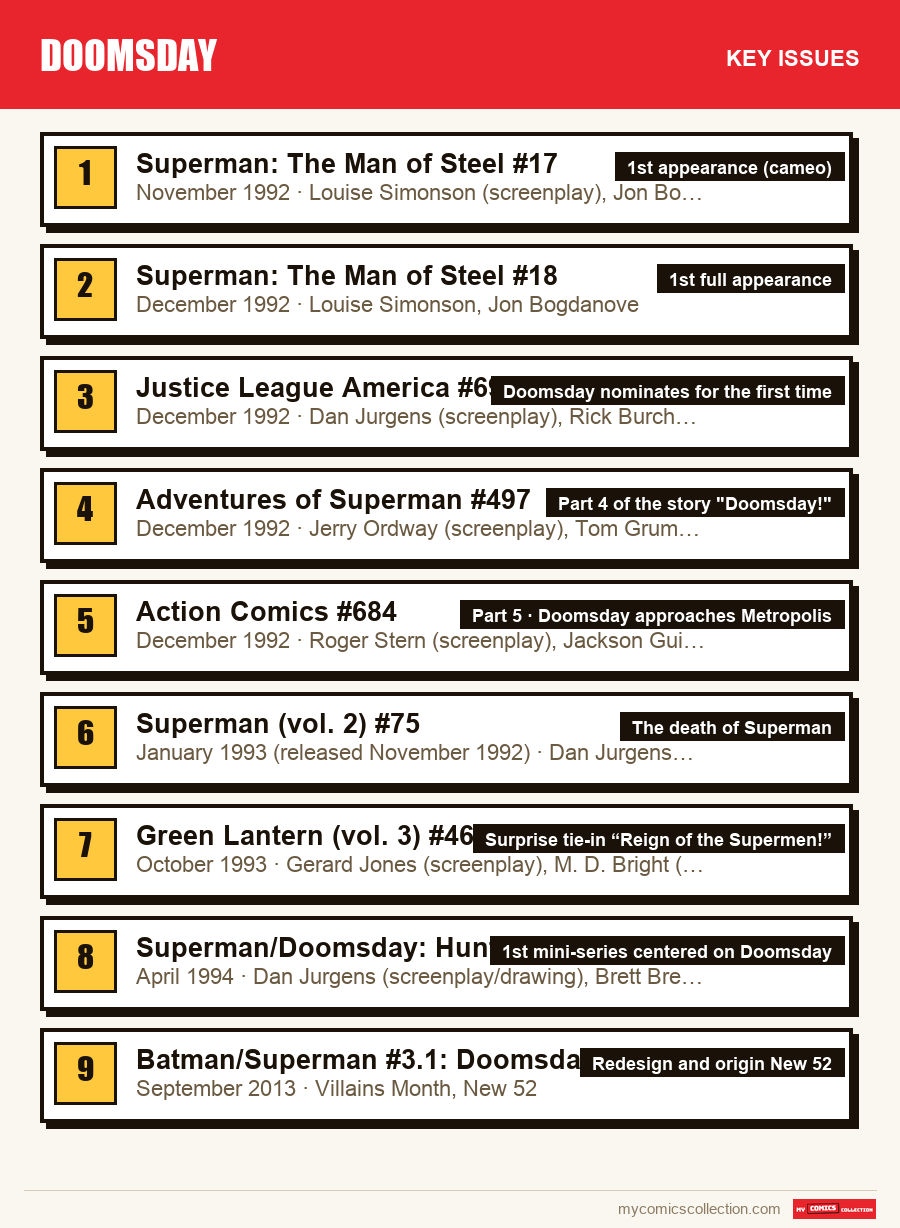
The key issues of Doomsday begin with his very first appearance, a cameo in Superman: The Man of Steel #17 (November 1992), followed by his first full appearance in #18 the following month. The absolute top of the rating remains Superman (vol. 2) #75 (January 1993), the issue of the death of Superman, with a circulation of more than six million copies and available in several collector's editions (Platinum, polybag Memorial) whose values vary enormously depending on the condition and the version.
Few supporting characters in the DC Universe have had as meteoric a rise as Doomsday. Designed in 1991 by a team bringing together Dan Jurgens, Jerry Ordway, Louise Simonson, Roger Stern and inker Brett Breeding, this initially nameless Kryptonian killer simply had to fulfill a specific function in Mike Carlin's editorial planning: to offer Superman an adversary capable of defeating him physically, without magical artifice or kryptonite. The anecdote is now famous among knowledgeable collectors: on the editorial planning board, Carlin had scribbled "doomsday for Superman" to designate the deadline for a future confrontation. The word stuck, and the monster inherited the name.
What was supposed to remain a one-off editorial event became in a few weeks one of the biggest commercial phenomena in the history of American comic books. Between November 1992 and January 1993, Doomsday went through six different monthly series, multiplying cameos and fights, before causing the death, temporary but resounding, of Superman. This editorial density explains why Doomsday's rating is not based on a single mythical number, but on a veritable constellation of keys: some obvious and already well documented, others more discreet and undervalued by the current market.
This article focuses exclusively on the identification and evaluation of these key issues: publication dates, precise editorial context, printing particularities and market rating status for each. For the complete narrative history of the character (his Kryptonian origin, his multiple resurrections, his journey in the post-New 52 runs) our file history of Doomsday in the comics covers this biographical angle in detail; the two articles complement each other without overlapping.
How Doomsday Invaded Six Superman Titles in a Few Weeks
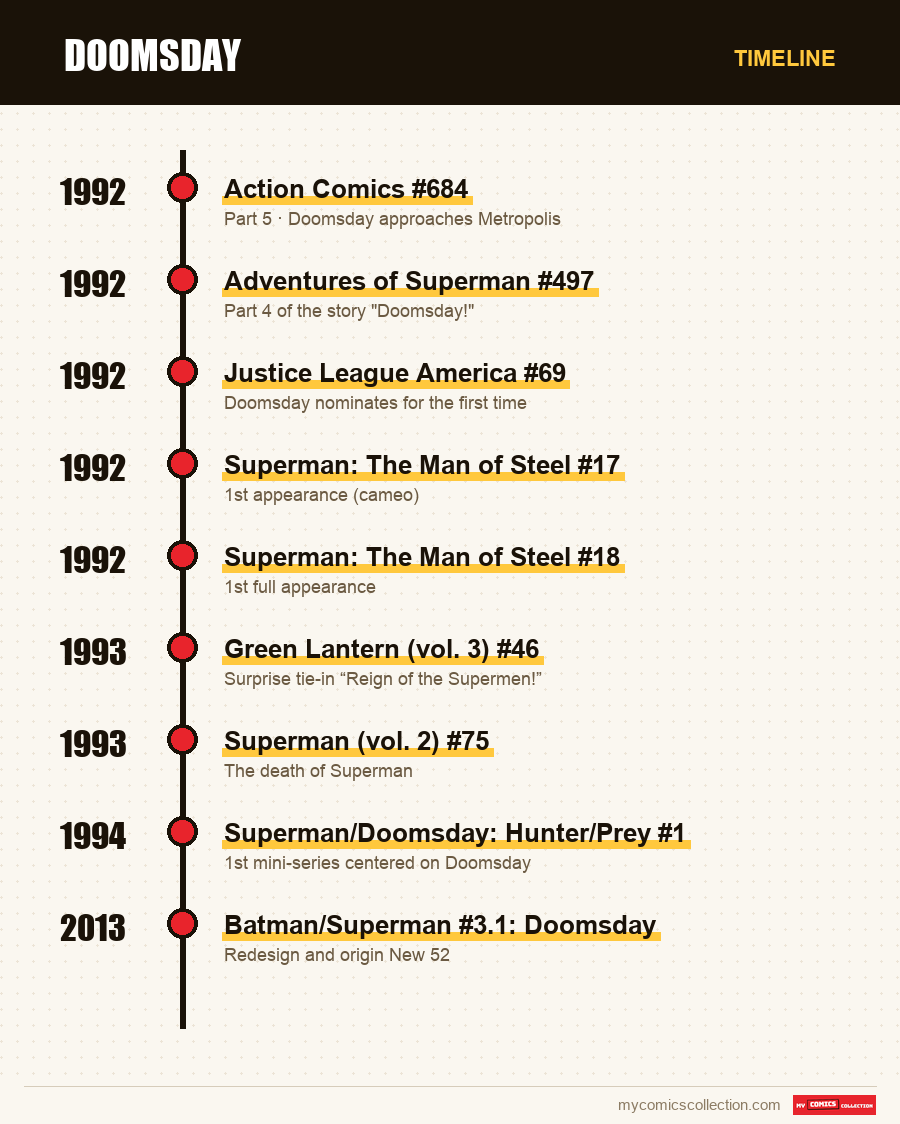
DC Comics was practicing "triangle" numbering at the time, a sequencing system that required the four monthly Superman series -Action Comics , Adventures of Superman , Superman (vol. 2) and Superman: The Man of Steel- to take turns each week to tell a single continuous story. Doomsday exploits this system at full speed: his awakening, his hunt, his arrival in Metropolis and his final duel with the Man of Steel unfold over seven consecutive parts published in barely two months, with additional forays into Justice League America and Green Lantern. Understanding this editorial mechanic is essential to correctly identifying key issues: unlike many characters whose first appearance is in a single issue, that of Doomsday is broken down into several distinct stages, each having its own collectible value.
Superman: The Man of Steel #17
This is where it all begins, but discreetly: in the last pages, a gigantic, clawed arm frees itself from a buried restraining capsule, without the monster being shown in full or named yet. This cameo precedes the full appearance of #18 by only one month, making it an issue often overlooked by beginning collectors who focus on "the first appearance" in the broad sense without distinguishing the two times. Purists in the key market, however, consider this distinction to be fundamental, exactly as for other first appearances split into cameos and then full reveals.
Superman: The Man of Steel #18
The absolute reference number for anyone looking for "the" first appearance of Doomsday. The monster is shown here in full for the first time, breaking his chains and directly confronting Superman without anything being able to slow him down. It is this number, and not #17, which serves as the anchor point for almost all rating guides and character sheets, including graders who officially identify it as the "1st full appearance" on CGC labels.
Justice League America #69
Doomsday humiliates the entire Justice League here, one arm tied behind his back, before continuing his journey towards Metropolis. It is in these pages that Booster Gold, stunned by the power of the creature, launches the sentence which will give the monster its definitive name: "It's as if Doomsday had arrived." The number is therefore the textual birth point of the character's name, a detail that many general information sheets omit although it is decisive for collectors who are looking for the exact origin of the name, distinct from the physical appearance itself.
Adventures of Superman #497
Fourth chapter of the “Doomsday!” arc, this issue features Superman supported by Maxima facing an adversary that the Justice League has just fled. This is one of the pivotal chapters that builds tension before the monster's arrival in Metropolis, and it remains sought after by readers who piece together the entire sequence of the seven parts in the original reading order rather than just the first appearance numbers.
Action Comics #684
Fifth part of the saga, this issue sees Superman desperately trying to prevent Doomsday from reaching the heart of Metropolis, in direct continuation of #74 of Superman vol. 2. The confrontation gains even more intensity and directly prepares for the final duel of #75. As with Adventures of Superman #497, its value remains primarily linked to the complete reconstruction of the event rather than to first appearance status.
Superman (vol. 2) #75
The best-selling and most publicized issue in the history of the American comic book of the modern era: more than six million copies sold, around 30 million dollars in revenue from the first day, press coverage right up until Newsweek and People. Doomsday only appears in the final fight, but it is this issue that definitively seals his status as Superman's killer in popular culture. The massive print run of the standard edition means that the raw issue is not a rarity in itself; It’s the special editions that make all the difference in terms of price.
Two variants dominate the collector's market: the Platinum Edition, an estimated edition of 10,000 numbered copies offered to resellers as a thank you, recognizable by its black polybag with silver Superman logo and its number visible through a window on the back; and the Direct Market Memorial Collector's Edition, sold sealed in a black polybag containing collectible card, poster, stamp sheet, Daily Planet obituaries and black armband. Opening this polybag causes the value to drop drastically in the eyes of specialist collectors.
Green Lantern (vol. 3) #46
This issue occupies a special place in the saga: published without prior solicitation at the time of its release, it took distributors and independent libraries by surprise, selling out almost immediately and becoming one of the most sought-after restocking issues of the year 1993. Hal Jordan confronts Mongul in Engine City while a weakened Superman tries to neutralize Cyborg Superman, one of the four claimants to the legacy of the Man of Steel after the latter's death. The issue also lays the narrative foundation for the "Emerald Twilight" arc which will follow shortly after.
Superman/Doomsday: Hunter/Prey #1
First issue of the very first mini-series to place Doomsday at the center of the story, in prestige format (hardcover, glossy paper). The story explores for the first time the monster's past, his awakening after being propelled into space by Cyborg Superman, and the unprecedented confrontation between him and Darkseid himself on Apokolips: a fight where even the tyrant's Omega rays prove insufficient. This is the foundational number for anyone specifically collecting the character's solo appearances rather than his cameos in classic Superman titles.
Batman/Superman #3.1: Doomsday
Published as part of the New 52's "Villains Month" event, this issue offers a more alien and more monstrous redesign of the character, accompanied by a revisited origin: Doomsday would have already attacked Krypton during the lifetime of Lara, Superman's mother, before being defeated by Colonel Zod and banished to the Phantom Zone. This is the obligatory entry point for collectors who specifically follow the different editorial reinterpretations of the character throughout the DC reboots, in addition to the founding issues of 1992.
Collecting this series?
Track what you own, what you are missing and what your collection is worth. 7 day trial.
Start my trial →The impact of adaptations on the rating
Unlike characters who benefit from regular media exposure via animated series or video games, Doomsday has only seen a limited number of major live-action adaptations, which mechanically limits peaks in demand on its collectible market compared to figures like Venom or the Joker. The most notable remains its appearance in Batman v Superman: Dawn of Justice (2016), where the character is played in motion capture by Robin Atkin Downes in a very different design from that of 1992, more inspired by a mutant Kryptonian entity than the original spiked monster. This adaptation generated a temporary revival of interest in the founding issues of 1992, without however causing a lasting surge comparable to that observed on other keys during cinema releases, in part because the design of the film visually moves away from the character in the comics.
The character also featured in season 8 of Smallville (2008), where the character of Davis Bloome transforms into Doomsday, as well as in the series Krypton (2018-2019) and more recently in the Bizarro/Doomsday arc of Superman & Lois (from season 3). These television adaptations reach a more confidential audience than the big screen and have had a measurable but limited effect on the rating of the original comics. For collectors, the lesson is clear: the value of key issues of Doomsday rests above all on its historical status as "Superman killer" and on the rarity specific to each edition, much more than on a calendar of cinema releases as may be the case for other recently adapted characters.
Buying guide
- Always distinguish #17 from #18 of Man of Steel. #17 only shows an arm in a broken capsule; It's a cameo, not a full appearance. Don't pay the price of a "1st full appearance" for a copy of #17 poorly labeled by a lax seller.
- Check the barcode to identify the newsstand or direct edition. On DC comics from the early 1990s, the edition intended for newsstands (newsstand) carries a full UPC code, while the edition reserved for specialized stores (direct market) displays the DC "diamond" logo instead. Newsstand prints from this period are generally rarer in very high grade.
- On Superman #75, never confuse the prints. Reprints (2nd and 3rd printings) show variations or deletion of the UPC code on the cover; they can also be recognized by different inking details and are worth a fraction of the first print.
- On polybag editions, an intact seal is non-negotiable. An opened Memorial Edition polybag loses most of its collectible premium, even if its contents (card, poster, armband) are complete and in perfect condition.
- Authenticate the Platinum Edition by its number visible on the back. The circulation being estimated at 10,000 numbered copies, a copy without a legible numbering window or with an obviously replaced polybag should arouse distrust.
- Don't overlook Green Lantern #46. Its rapid out of stock in 1993 makes it a relatively undervalued key to the current market compared to the Superman titles of the same saga, while its rarity documented at the time is real.
- Inspect the corners and spine on the prestige format of Hunter/Prey #1. The glossy paper and glued square back of this type of publication mark more easily than traditional stapling; high grades are proportionally less common there.
- Always compare a 9.8 to a 9.6 before buying at the top of the market. The difference in premium between these two grades may be disproportionate to the difference in real condition perceptible to the naked eye; our guide CGC 9 vs 9.8 details the criteria which separate these levels.
- Use an estimator based on actual sales before any offer. The prices displayed by certain private sellers sometimes remain disconnected from the actual market; always cross-reference several sources before settling on a key number.
- List your collection as you acquire it. On a saga as fragmented as that of Doomsday, it is easy to duplicate a purchase or forget an intermediate chapter; L'collection management application allows you to track precisely which numbers in the "Doomsday!" still missing from your run.
Beyond these practical benchmarks, we must keep in mind that the rating of Doomsday remains structurally linked to that of Superman: peaks in demand generally follow round anniversaries of the 1992-1993 saga, full-length reissues, or announcements of new DC projects involving the character. To delve deeper into the creature's complete narrative journey, from its creation on Krypton by the scientist Bertron to its multiple post-2000 resurrections, the information sheet Doomsday of the site brings together all of his notable appearances, while our file history of Doomsday in the comics retraces this editorial trajectory year by year. This guide, for its part, voluntarily remains focused on the identification and evaluation of the numbers to have for those building a collection focused on value rather than on the story alone.