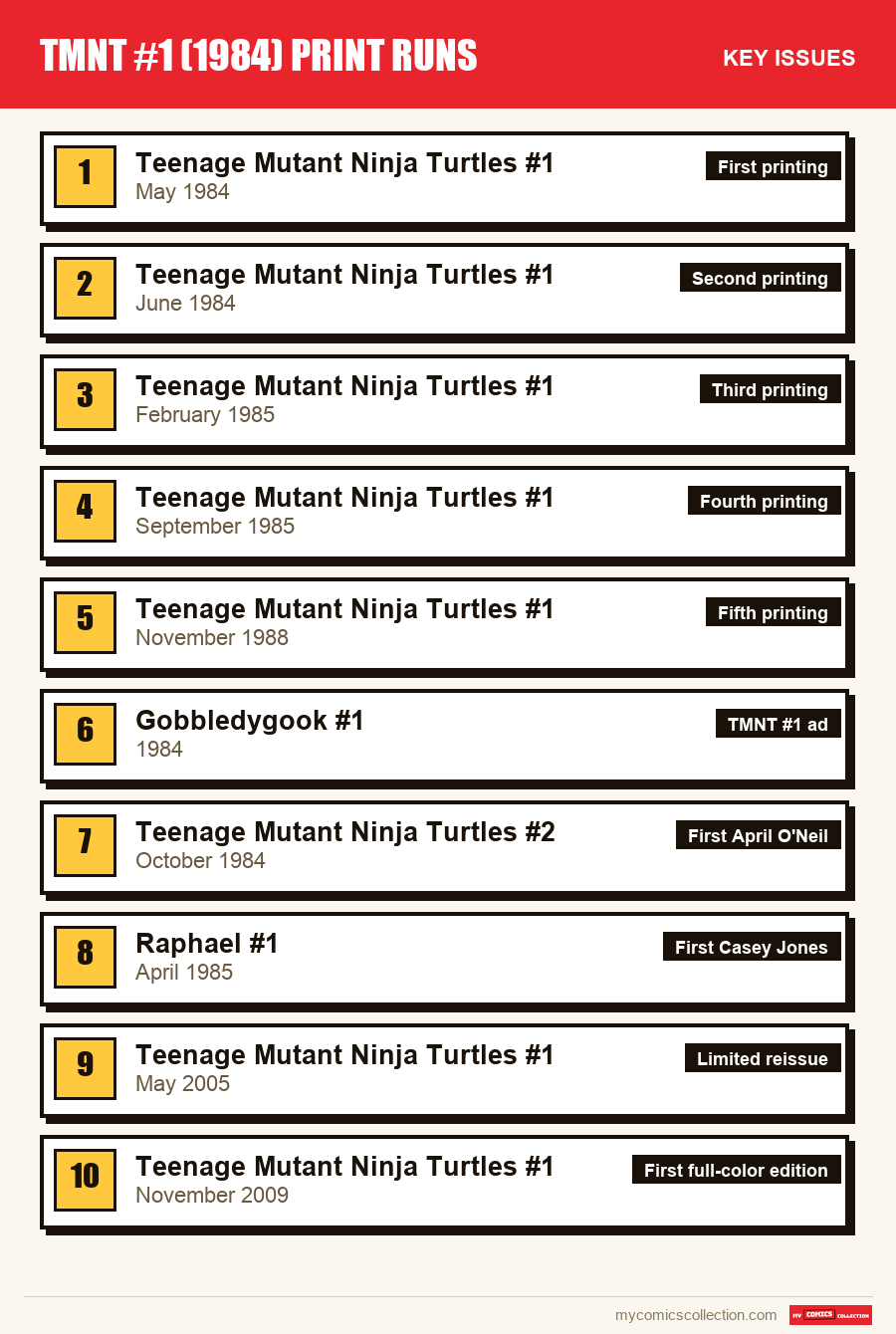
Teenage Mutant Ninja Turtles #1 (Mirage Studios, May 1984) exists in several very distinct editions: a first edition of approximately 3,275 copies (the absolute Holy Grail, record at $250,000 in CGC 9.8), a second edition of June 1984 of approximately 6,000-6,250 copies, a third edition of February 1985, a recognizable edition of 35,000 copies. to its additional bloodstains in the "Turtles" lettering, then fourth and fifth color printings published in 1985 and 1988 in standard comic format. Each print is distinguished by a mention (or its absence) on the inside page, the shade of red on the cover and the advertising content on the back cover.
There are few examples in the history of independent comic books as spectacular as that of Teenage Mutant Ninja Turtles #1. A black and white fanzine cobbled together on a kitchen table in New Hampshire, financed by a tax refund and a family loan, has become in forty years one of the most sought-after comics on the market, with a record sale of $250,000 for a copy in almost perfect condition. But what makes TMNT #1 truly fascinating for a collector is not only its rarity: it is the succession of prints that followed one another between 1984 and 1992, each with its own characteristics, its own print run and its own rating.
Understanding this history of printings is essential before buying, selling, or simply evaluating a copy of TMNT #1. The difference in value between a first print and a third print can be in the tens of thousands of dollars for the same apparent state of conservation, and counterfeits, which are unfortunately frequent on this specific title, make knowledge of the identification details absolutely necessary.
This article retraces, print by print, the complete editorial history of Teenage Mutant Ninja Turtles #1, the elements that allow each version to be distinguished, the impact of TV and cinema adaptations on the price of the original comic, and the pitfalls to avoid for any collector who wishes to invest in this seminal title.
From Gobbledygook to Mirage Studios: the improbable birth of a phenomenon
The story begins with an evening of brainstorming between two young designers, Kevin Eastman and Peter Laird, who then share a modest apartment. Eastman sketches for laughs a turtle equipped with nunchucks; Laird finds the idea of a ninja as slow as a turtle hilarious. From this gag a complete concept is born: four mutant turtle brothers, each armed differently, trained by a rat sensei named Splinter. The title is initially intended to be an assumed parody of Daredevil, Frank Miller's Ronin and the New Mutants: a pastiche of comics that they read and loved.
Even before TMNT #1, Eastman and Laird had produced two experimental fanzines called Gobbledygook, photocopied on 8.5 x 14 inch machine paper and assembled by hand, in an edition of around fifty or even a hundred copies. These quasi-artisanal prototypes, now valued at several thousand dollars when authenticated, did not actually contain any Turtles story: they carried an ad announcing TMNT #1 and the first appearance of the Fugitoid.
To finance the printing of the real number 1, the duo mobilized a tax refund and a loan granted by Eastman's uncle. They founded Mirage Studios: an ironic name since there was, in Eastman's own words, "no real studio, just kitchen tables and sofas with drawing boards on their knees." The comic is printed in black and white, in oversize (magazine) format, on cheap newsprint using offset printing. It was first introduced to the public in May 1984, at a comic book convention in Portsmouth, New Hampshire.
The success was immediate and totally disproportionate to the initial ambitions of the project. The original print run, estimated at approximately 3,275 copies (sometimes rounded to 3,000 in old quotation guides, not counting reserve copies for breakage), sold out in a few weeks. Word of mouth in the independent comic shop circuit pushes the resale price to fifty times the original cover price, an extremely rare phenomenon for a first issue self-published by two unknown people.
The first print: the holy grail of the independent comics collector
The first printing of TMNT #1 is today considered one of the most important key comics of the post-Silver Age, alongside titles like Cerebus #1 or Elfquest #1 in the category of founding independent publications. Its extreme rarity (less than 1,000 copies recorded in the CGC in all conditions over more than forty years of circulation) makes it a special asset in the world of American comics.
The criteria for identifying the true first draw are precise and must be systematically verified:
- No mention of printing appears on the inside page (unlike the following printings which explicitly indicate "Second Printing" or "Third Printing").
- The inside back cover carries an advertisement for Gobbledygook fanzines, specific to the first printing.
- The red on the cover is the strongest shade of the first three prints; the second print is slightly lighter, and the third clearly more pink.
- The paper is cheap newsprint and ages with a characteristic yellowing: a counterfeit printed on white paper should immediately arouse suspicion.
In terms of ratings, this first draw had a spectacular trajectory. A collector's guide from the late 1980s already valued it at around $160 in Near Mint, a considerable sum for the time considering the original cover price of $1.50. The market has only accelerated since: in September 2021, a copy certified CGC 9.8 (the maximum rating generally observed on this title) sold for $245,000, a record immediately broken in January 2022 by another auction sale at $250,000. A few months earlier, in April 2021, a CGC 9.6 Signature Series copy signed by Eastman and Laird had already reached $88,000, illustrating the premium that the market places on copies autographed by the creators themselves.
The CGC census gives a precise idea of the rarity in very high conservation: out of approximately 911 to 962 copies of the first print submitted for certification over the years, only around thirty copies obtained the perfect score 9.8, all variants combined (universal, qualified, or Signature Series). It is this extreme rarity at the top of the grade, combined with the historical importance of the title as the starting point of a global franchise, which explains six-figure auctions.
The second print: June 1984, a relative but real rarity
Faced with demand, Mirage Studios relaunched printing the following month. The second printing, dated June 1984, is unambiguously recognizable thanks to the explicit mention “Second Printing / June 1984” printed on the inside page: unlike the first printing, which is completely silent on this point. The advertising on the back cover also changes: it no longer refers to Gobbledygook but to iron-on T-shirts, a simple but reliable detail to decide between the two versions when a copy is missing its legal notices page.
The circulation of this second printing is estimated between 6,000 and 6,250 copies, approximately double the first printing, but remains very modest compared to subsequent printings. Its cover color is described as slightly lighter than the very saturated color of the first printing: a shade sometimes difficult to judge with the naked eye without a comparison copy, which makes the printed statement much more reliable than visual analysis of the shade.
In terms of the CGC census, around 511 copies of the second printing were recorded at the end of 2020, with only nine copies in grade 9.8: a rarity at the top of the grade almost comparable to that of the first printing, which explains why the second printing also increases in value as the first becomes out of reach for a large part of collectors. Specialized guides also note that this second printing tends structurally to approach the price of the first as the latter becomes rarer on the open market.
The third draw: the most accessible entry point to the original title
It was with the third printing, dated February 1985, that Mirage Studios truly responded to the explosion in demand. The print run then increased to around 35,000 copies, more than ten times the original print run: a shift that fundamentally changed the situation for collectors on a more limited budget.
This third printing also bears the explicit mention “Third Printing / February 1985” on the inside page, but its most reliable and most cited identification by specialists remains visual: the cover has a significantly more pinkish and faded tint than the first two printings, and above all, the lettering of the title “Turtles” has additional bloodstains compared to the previous printings: a retouching detail which allows rapid identification even without consulting the inside page.
Thanks to its significantly larger print run, the third print run now constitutes the most accessible version for anyone who wants to own a vintage TMNT #1 without aiming for the heights of the first print run. Even at this level of relative rarity, listing guides as of late 2020 were already reporting sales of at least $400 for copies in intermediate condition, proof that even the most current printing of the title retains significant collectible value-far, admittedly, from the six-figure highs of the first printing, but well above the original cover price.
The following prints: from fanzines to large format comic books
The story of draws doesn't end at the third. In September 1985, a fourth printing abandoned the oversized black and white format in favor of a standard comic-book format, with an entirely color cover: a radical change which accompanied the rise in commercial power of the character. This edition, produced in approximately 60,000 copies, includes five bonus pages of concept illustrations, offering readers a glimpse of the visual development of the characters.
A fifth printing followed in November 1988, with a sepia-tinted cover and revised lettering; it also includes a companion story titled “Not One Word.” This print run coincides with the explosion of the franchise on television and in toy shelves, the effect of which on notoriety, and therefore on demand for the original comics, was considerable, as detailed below.
Finally, Mirage Studios published in August 1992 a deluxe edition, hardback and in oversized format, limited to 500 copies, with an introduction signed by science fiction writer Harlan Ellison and a sepia interior treatment. This luxury edition, on the border between collector's reprint and commemorative object, closes the cycle of historical reissues of the founding issue before the title subsequently undergoes multiple republications in other formats (complete, modern color editions, etc.) which go beyond the strict framework of the "history of prints" of the original 1984 comic.
The impact of adaptations on the rating of the original comic
If TMNT #1 could have remained a niche item reserved for fans of independent comics, it was the media trajectory of the franchise that transformed the first printing into a six-figure collector's item. The animated television series, the first five episodes of which were broadcast in syndication in late December 1987 before a full daily broadcast beginning in October 1988, propelled the characters into mainstream popular culture at lightning speed.
The range of figurines launched by Playmates Toys in the summer of 1988 accompanied this success and quickly exceeded it: demand was such that Playmates initially struggled to keep up with the pace of production. The figures from the time give the measure of the phenomenon: the franchise generated 175 million dollars in sales of derivative products in 1988, then 350 million in 1989. In 1990, the global toy market share occupied by the Ninja Turtles reached 400 million dollars out of a total market of 680 million, or more than two thirds of the sector. The animated series simultaneously became the most watched program in the United States between 1989 and 1991, broadcast on more than 125 television channels around the world.
This cultural wave reached its peak with the theatrical release, in 1990, of the first live-action feature film, which mixed elements borrowed from both the cartoon and the original comic book by Eastman and Laird. By May 1990, domestic retail revenues generated by the franchise reached $650 million.
It is this mass phenomenon, entirely subsequent to the confidential publication of the comic in 1984, which explains the current dynamic of the rating: each generation of fans who discover the Ninja Turtles via the cartoon, the 1990 film, the following series (2003, 2012, 2014, then more recent productions) ultimately returns to the founding artifact: a black and white fanzine with a print run of only 3,275 copies. This convergence between extreme rarity and mass notoriety is precisely what allowed the first print to cross the symbolic threshold of $200,000 at auction.
Collecting this series?
Track what you own, what you are missing and what your collection is worth. 7 day trial.
Start my trial →Buying guide: how to approach a #1 TMNT on the market
Buying a copy of Teenage Mutant Ninja Turtles #1 requires particular vigilance, both on the identification of the print and on the authenticity of the copy itself, this title being one of the most frequently counterfeited on the independent comic market.
- Systematically check the inside page: the absence of a printing notice indicates a potential first printing, but should be cross-referenced with the Gobbledygook advertisement on the inside back cover: a copy without a printing notice AND without this advertising should be viewed with suspicion.
- Be wary of erased or “bleached” draw notices: counterfeiters have chemically removed the words “Second Printing” or “Third Printing” from authentic copies to pass them off as first printings; an examination under UV light or by a knowledgeable expert generally makes it possible to detect these alterations.
- Check the weight and texture of the paper: the first three prints are printed on cheap newsprint which yellows over time; a copy on smooth white paper claiming to be a first or second printing is almost certainly a complete counterfeit.
- Look for the extra blood detail in “Turtles” to confirm a third print, in addition to the printed notice: this visual cue remains the quickest to check on an ad photo.
- Choose an existing CGC or CBCS certification on copies of significant value (first and second printings in particular): given the sums involved and the prevalence of counterfeits, a raw copy of uncertain provenance carries a financial risk disproportionate to the savings made on certification costs.
- Compare prints before setting a budget: a third print in good condition allows you to own an authentic piece of the title's history for a fraction of the price of a first print, a relevant option for a collector who wants an exhibition copy rather than a pure investment.
- Consider the “Signature Series” premium for examples signed by Kevin Eastman and/or Peter Laird, which historically trade at a significantly higher price level than an equivalent unsigned example, as illustrated by the $88,000 sale of a CGC 9.6 Signature Series in 2021.
Before any purchase or sale, it remains essential to compare your copy with recent actual sales rather than old quotation guides, as the volatility of this security has been high since 2020. An estimation tool based on transactions actually concluded makes it possible to obtain a realistic range rather than a theoretical value disconnected from the current market.
Key issues to know
Teenage Mutant Ninja Turtles #1
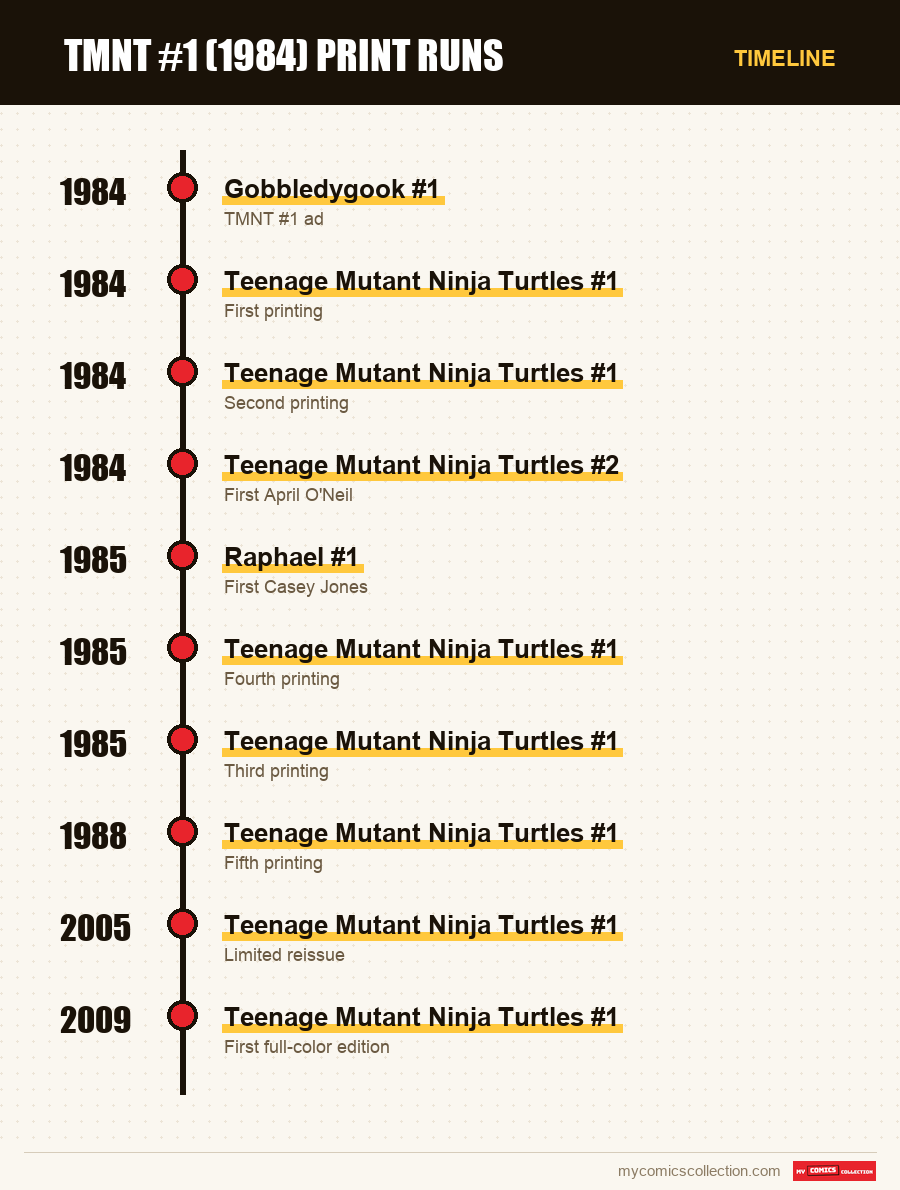
Unveiled in May 1984 at a convention in Portsmouth, New Hampshire, the very first printing ran to roughly 3,275 copies in an oversized black-and-white magazine format. There is no printing notation inside the front cover, and the inside back cover carries an ad for the two Gobbledygook zines. This is the version forgers target: stark white interior pages, instead of the original off-white newsprint, give a fake away.
Teenage Mutant Ninja Turtles #1
With the first run sold out within weeks, Mirage Studios went back to press in June 1984 for roughly 6,000 more copies, keeping the oversized format and the same cover. The printing notation sits at the top left of the inside front cover, beneath the thanks to Quentin Eastman, and the Gobbledygook ad gives way to an offer for TMNT t-shirt iron-ons. That notation is exactly what some forgers bleach out.
Teenage Mutant Ninja Turtles #1
Dated February 1985, this third trip to press answered the flood of retailer orders that arrived early that year. It keeps the oversized format and cover of the first two, with the printing notation inside, but the Mirage Studios address in the indicia moves from Dover, New Hampshire, to Sharon, Connecticut. Far more common than its predecessors, it is often a collector's first vintage copy.
Teenage Mutant Ninja Turtles #1
In September 1985 the fourth printing broke with the first three, the only ones to use the oversized format and original cover: it sports a new cover by Eastman and Laird. It also adds five pages of early sketches and period ads. A valuable record of how the Turtles' look took shape, and easier to find than the 1984 printings.
Teenage Mutant Ninja Turtles #1
Dated November 1988, the fifth printing arrived just as the cartoon and toy line were making the Turtles household names. It adds a short Eric Talbot story, "Not One Word!", in which Donatello ends up dyed pink after falling into a vat, and the lettering was redone by Steve Lavigne. It is the only one of the five vintage printings to include a new story.
Gobbledygook #1
Mirage Studios' first publication, released in 1984, this zine contains no Turtles story: it introduces the Fugitoid and carries an ad for Teenage Mutant Ninja Turtles #1. Some guides list it as the Turtles' first appearance for that reason, but Mirage has always held that TMNT #1 is their true debut. Genuine copies remain highly sought after for their place in the book's family tree.
Teenage Mutant Ninja Turtles #2
The second issue, dated October 1984, introduces April O'Neil, scientist Baxter Stockman and his Mouser robots. It too went back to press several times: the third printing, dated October 1986, adds a short story by Fred Hembeck. As with issue 1, pinning down the printing comes before any assessment of condition.
Raphael #1
This April 1985 one-shot, with a Kevin Eastman cover, was the first title devoted to a single Turtle and marks the debut of Casey Jones. Like the founding issue, it got a second printing, dated November 1987, which adds the short story "Fun with Guns". The April 1985 printing remains the reference copy for Casey's first appearance.
Teenage Mutant Ninja Turtles #1
May 2005 saw a reissue limited to 3,000 copies, handed out at a small-press festival held at a convention. Peter Laird scanned the original inked pages and redid the tones and lettering on a computer, under a new cover of his own. Its print run is close to the first printing's, but it has nothing to do with the 1984 book: the date and cover tell them apart at once.
Teenage Mutant Ninja Turtles #1
For the Turtles' 25th anniversary, Mirage Studios published in November 2009 the first fully colored edition of the founding issue, with colors by Steve Lavigne. Six months earlier, in May 2009, a black-and-white reprint had already been given away free as part of the same celebration. Two late milestones that close the book's story at its original publisher.