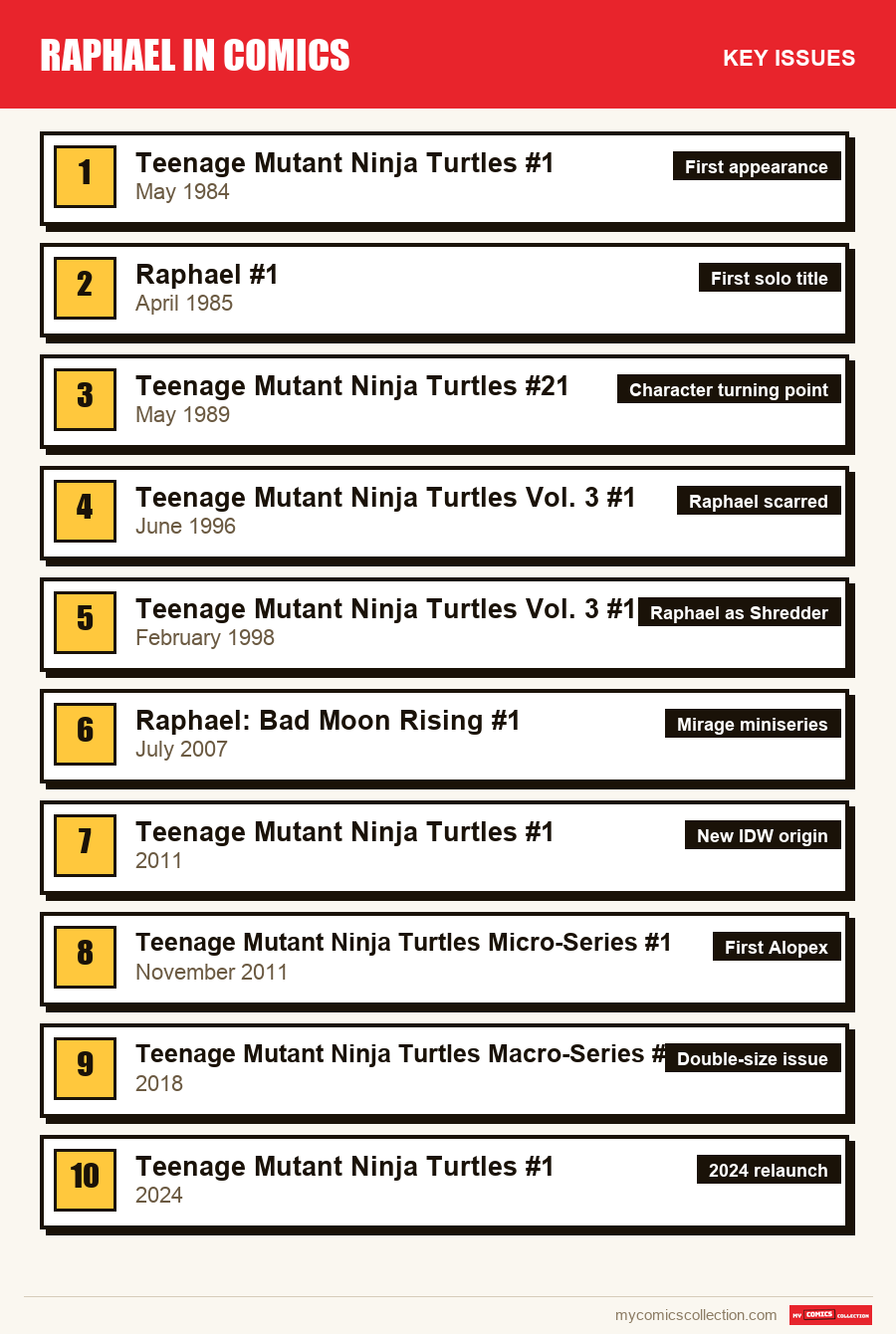
Raphael makes his very first appearance in Teenage Mutant Ninja Turtles #1, published in black and white by Mirage Studios in May 1984 (original print run estimated at 3,275 copies). He got his own one-shot in 1985, Raphael #1, which introduces another pillar of the franchise, Casey Jones. High-grade copies of these two comics remain among the most sought-after keys to American independent comics of the 1980s, with CGC 9.8 sales exceeding $250,000 for the very first issue.
On the shelves of a comic shop or in the windows of a convention, Raphael can be recognized at a glance: red bandana, double sai on his belt, sullen look. But before becoming one of the four most reproduced faces of global pop culture, Raphael was born on a drawing board in Northampton, Massachusetts, under the joint work of two young illustrators without much means, Kevin Eastman and Peter Laird. His editorial story is a textbook case: that of a secondary character in a photocopied one-shot who becomes, forty years later, the hero of an animated blockbuster grossing more than $180 million in revenue.
This article traces Raphael's journey through comics, from the very first pages of Mirage Studios to the contemporary IDW series, including the adaptations that shaped his image among the general public. It also details what distinguishes the different mintages of the key issues, an essential point for anyone considering investing in these coins, as well as the rarity and grade benchmarks publicly available to collectors.
At the origins: Raphael and the birth of Mirage Studios (1984)
Raphael first appears in Teenage Mutant Ninja Turtles #1, a self-published comic by Kevin Eastman and Peter Laird under the Mirage Studios label. The issue was presented for the first time at a convention in Portsmouth, New Hampshire, in May 1984. It was an unusual format for the time: a black and white, large format magazine, printed on cheap newsprint, initially intended as a one-off parody mixing the codes of Daredevil by Frank Miller, New Mutants and of Cerebus by Dave Sim. The print run of this first issue remained extremely limited: around 3,275 copies according to the cross-references most commonly cited by market specialists.
In this founding story, the four turtle brothers, Raphael, Leonardo, Michelangelo and Donatello, are not yet distinguished by the color of their bandana: in black and white, such differentiation had no graphic use. Raphael already stands out, on the other hand, through his temperament: the most impulsive, the most quick to anger, the most inclined to act alone in the face of Leonardo's authority. It is this character trait, more than the color of an accessory, which makes him the most complex character of the quartet from the first pages.
A success that goes beyond the initial print run
The issue's surprise success with readers and independent comic book retailers quickly sold out the first printing. A second printing followed in June 1984, with an estimated print run of between 6,000 and 6,250 copies, recognizable by the words "Second Printing / June 1984" printed on the inside cover and a slightly lighter shade of red on the cover illustration. A third printing, dated February 1985, followed with a significantly larger circulation, of around 35,000 copies, proof of the title's growing popularity in barely a year.
These three prints are distinguishable to the naked eye for an informed collector: in addition to the notice printed inside, the shade of red on the cover becomes lighter from one print to the next, and the number of drops of blood visible in the second "T" of the word "Turtles" goes from a single spot on the first two prints to four distinct spots on the third. The mailing address on the inside of the covers also changes: a post office box in Dover, New Hampshire, for the first two printings, versus a post office box in Sharon, Connecticut, for the third. These details, seemingly innocuous, have a direct impact on the value of a copy, the first print being by far the most sought after.
The relative rarity of this first printing can also be seen in the evolution of the CGC census over the years. At the beginning of October 2016, CGC listed around 700 certified copies of the first printing, including only 24 in the best grade of 9.8. At the end of 2020, this census had increased to 962 certified copies, with 32 copies in 9.8. This progression illustrates a classic phenomenon of the vintage comic market: the more a title gains in notoriety, the more collectors have copies previously kept without certification certified, which mechanically increases the census without this reflecting an increase in the original print run, which remains frozen at around 3,275 copies for this very first print run in May 1984.
Raphael, central character of a mythology under construction
Within the quartet, Raphael quickly occupies a special place in the narrative economy of the Mirage series. Armed with two sai, a weapon less spectacular than Donatello's bô or Michelangelo's nunchaku but fearsomely effective in close combat, he embodies the tension between clan discipline and individual instinct. The screenwriters Eastman and Laird build around him a figure of a rebellious brother, often disagreeing with Leonardo on the strategy to adopt, which will become one of the most reused dramatic springs of the franchise in all its subsequent variations, from cartoons to films.
This narrative centrality quickly translates into editorial recognition: Raphael becomes the first of the four brothers to receive his own solo comic, a privilege which says a lot about the place he already occupied in the minds of his creators and their emerging readership.
Raphael #1 (1985): the first spin-off and the birth of Casey Jones
Published by Mirage Studios in 1985, Raphael #1 marks a double first in the franchise's editorial history: it is the very first spin-off dedicated to one of the four main characters, and it is also the first appearance of Casey Jones, the masked vigilante with the hockey stick who will become one of the Turtles' most popular recurring allies. The cover is by Kevin Eastman, with the story and interior design jointly by Eastman and Laird.
In terms of rarity, Raphael #1 is in a category of its own: the CGC censuses show a significantly smaller number of gradations than for issue #1 of the parent series, with only a few dozen copies listed in the very best grades (9.6 and 9.8), reflecting both a more modest circulation at the time and the intrinsic fragility of these publications on cheap newsprint, poorly preserved during the first years of their existence. The Overstreet guide has long placed the value of a copy in NM- (9.2) condition around $600, a benchmark which gives an idea of the order of magnitude for a copy in very good condition, knowing that copies certified in the very best grades trade significantly above this range during specialized auctions.
Why Raphael wears a red mask: a decision more arbitrary than we think
Contrary to popular belief, the color red never had a deep symbolic meaning in the original conception of the character. In the first Mirage comics in black and white, the four turtles wear an identical bandana, without chromatic distinction, since the medium did not require it. It was only at the end of the 1980s, when the license was declined by Playmates Toys for its range of figurines and by Archie Comics for the series Teenage Mutant Ninja Turtles Adventures, that distinct colors were assigned to each character in order to make them immediately identifiable on packaging or a comic strip.
Peter Laird himself confirmed, years later on his personal blog, that no in-depth discussion had gone into the choice of colors: the distribution was done in a largely arbitrary manner between the Playmates teams and those of Fred Wolf's animation studio, without any particular symbolic logic associated with Raphael and red. Period sketches even show that Donatello once wore orange and Michelangelo purple, before the colors were swapped and then fixed in the configuration we know today, red for Raphael, blue for Leonardo, orange for Michelangelo and purple for Donatello.
The impact of adaptations on the rating
Raphael's trajectory in comics cannot be read independently of the adaptations which have, in each decade, revived the general public's interest in the franchise and, by extension, in its founding comics.
The first live-action film, released in 1990, occupies a special place in this story: actor Josh Pais plays Raphael both in costume and in voice dubbing, which makes him the only actor in the original cast to have performed both roles for the same character. This film, like the animated series that preceded it at the end of the 1980s, permanently anchored the image of a sarcastic and brawling Raphael in the collective imagination, well beyond the initial readership of the Mirage comics.
More recently, the animated film Teenage Mutant Ninja Turtles: Mutant Mayhem, released in 2023 and distributed by Paramount, offered Raphael a new generation of fans: the character is voiced by Brady Noon. The film was a clear commercial success, with a total worldwide revenue of approximately $181.9 million for a production budget of $70 million, confirming that the franchise retains its power of attraction intact more than forty years after the release of the first Mirage comic.
This type of media event has a well-documented mechanical effect on the vintage comic market: each film or series release revives interest in the very first Mirage issues, which remain the absolute reference piece for any collector seeking to own the character's birth certificate. The sale of a copy of Teenage Mutant Ninja Turtles #1 certified CGC 9.8 for $264,000 at auction in February 2022 illustrates this market peak, while intermediate grade examples, around VF 8.0, were already trading for more than $16,000 at the end of 2020 according to census data available at that time.
The IDW era: Raphael in the 21st century
After several decades marked by different publishers and multiple relaunches, in 2011 the franchise found a new lasting editorial home at IDW Publishing. The ongoing series began in August 2011 with a creative team bringing together Kevin Eastman himself on the script and layout, Tom Waltz on writing, and Dan Duncan on drawing. This iteration becomes the longest in the editorial history of the franchise, with 150 issues published, including those by writer and artist Sophie Campbell from issue #101 in January 2020, with no renumbering; the series only restarted at #1 in 2024, with Jason Aaron.
In this IDW continuity, Raphael benefits from December 2011 (cover-dated November) in a new one-shot dedicated to him, part of a series of special issues devoted individually to each of the four turtles and allowing us to deepen their respective psychology aside from the main plot. These publications, much more recent and printed in quantities much higher than the Mirage comics of the 1980s, remain accessible today at modest prices for readers who wish to discover or complete the narrative arc of the character without aiming for the heritage investment represented by the very first issues.
Distinguishing a real first print: the pitfalls to be aware of
The American vintage comic market, and that of Mirage comics in particular, has its share of pitfalls for the unwary buyer. The draw of Teenage Mutant Ninja Turtles #1 being limited to approximately 3,275 copies for the first printing, compared to 35,000 for the third, the temptation to pass off a third printing as a first is real on the uncertified second-hand market. The verification marks, however, remain simple to apply: the edition notice inside the cover, the post office box indicated (Dover, New Hampshire, for the first two editions, versus Sharon, Connecticut, for the third), the number of bloodstains in the logo, and the exact shade of red on the cover.
For Raphael #1 (1985), the problem is different: there is no multiplicity of prints at this level of notoriety, but the rarity of very high grade copies requires particular vigilance regarding the state of conservation, these comics on newsprint having been printed without an organized collector's market at the time, and therefore rarely protected upon release. The CGC census of this issue remains significantly more restricted than that of issue #1 of the parent series: only a few dozen copies appear today in the cumulative notes 9.6 and 9.8, a figure which, compared to the original edition, is much more modest than that of the subsequent editions of Teenage Mutant Ninja Turtles #1, confirms that this spin-off deserves at least equal attention from serious collectors, even if it remains less known to the general public than the founding issue of 1984.
A final point of vigilance concerns the counterfeits and unauthorized reproductions which have been circulating for years on these two titles, driven by their high rating: the absence of CGC or CBCS certification, a paper that is too white for the advertised age, or a print that is too clear for an artisanal production from 1984-1985 should alert any buyer before a transaction involving a significant amount.
Collecting this series?
Track what you own, what you are missing and what your collection is worth. 7 day trial.
Start my trial →Buying guide: how to collect Raphael in comics
- Systematically check the draw before purchasing a Teenage Mutant Ninja Turtles #1: check the inside cover designation, PO box (Dover NH for 1st/2nd prints, Sharon CT for 3rd) and the number of bloodstains in the word "Turtles" rather than relying solely on the seller's posted price.
- Favor CGC certified copies for parts with a high financial stake: Given the fragile newsprint used by Mirage Studios in 1984-1985, the difference in value between an ungraded copy and a high-grade certified copy can be considerable.
- Don't neglect Raphael #1 (1985) for the benefit of the only TMNT #1: as the first spin-off of the franchise and first appearance of Casey Jones, this issue has a double historical key which justifies its status as a sought-after piece, despite lesser mainstream notoriety.
- Distinguish between Mirage comics from the 1980s and more recent IDW publications: the Raphael one-shots published by IDW since 2011 are abundant and affordable; they are suitable for reading or a thematic collection, not for a search for heritage rarity.
- Examine the condition of the staples and margins: Mirage Studios' large-format magazine format makes these comics particularly susceptible to corner creases and paper oxidation, two defects that weigh heavily in the final rating.
- Compare several sales made before settling on a price: the price of these comics fluctuates with the news of the franchise (film releases, series), an estimator based on real eBay sales remains the most reliable way to situate a copy in the current market.
- Keep an accurate inventory of your collection: to follow the evolution of your Mirage and IDW parts over time, including their certifications and their provenance, a dedicated application like the collection management application allows you to centralize this information rather than dispersing it between several invoices and screenshots.
Key issues to know
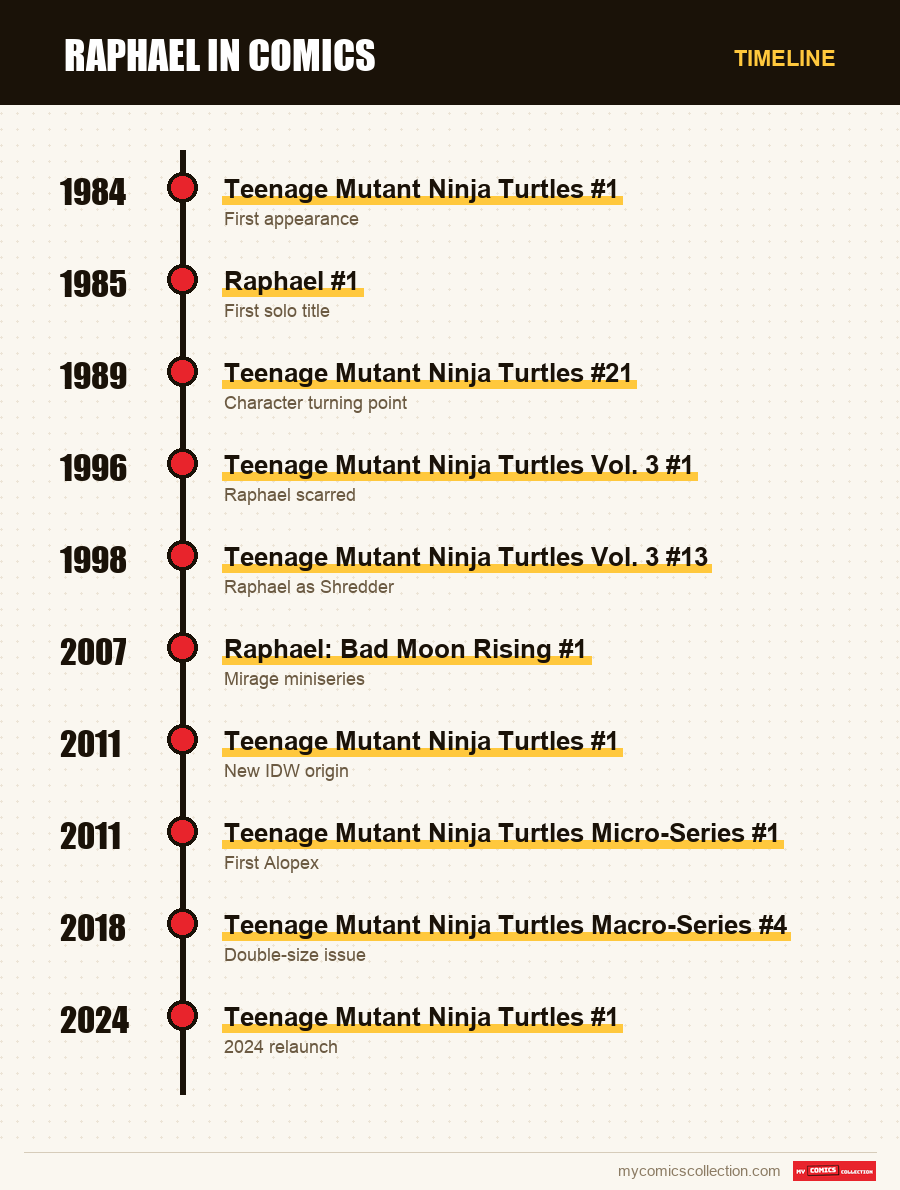
Teenage Mutant Ninja Turtles #1
Raphael is born alongside his three brothers in this issue self-published by Kevin Eastman and Peter Laird through Mirage Studios. He is the one Splinter sends to deliver the challenge to the Shredder, a job he carries out with a brutality that defines him from the start. Any Raphael collection begins here.
Raphael #1
The first of four one-shots each devoted to a single Turtle, this April 1985 issue follows Raphael as he cools off on the rooftops after losing his temper while sparring with Michelangelo. There he runs into Casey Jones, a hockey-masked vigilante even more violent than he is, and their repeated clashes turn into a lasting friendship. A double key: Raphael's first solo title and Casey's first appearance.
Teenage Mutant Ninja Turtles #21
The final chapter of Return to New York sees Raphael charge off alone after the Shredder and walk into an ambush by Foot ninjas. Saved at the last second by Leonardo, he admits he cannot control himself and lets his brother face their enemy alone. That admission eases his rivalry with Leonardo for good in the Mirage continuity.
Teenage Mutant Ninja Turtles Vol. 3 #1
In the first issue of the series published by Image Comics, Raphael insists on poking at a downed cyborg and takes its blast full in the face. He is left with scars that he first hides under one of Casey Jones' old hockey masks, then behind an eye patch. A scarred take on the character, unique to an era later dropped from official continuity.
Teenage Mutant Ninja Turtles Vol. 3 #13
Chased by mobsters into the Shredder's old forge, Raphael dons a variant of the armor to intimidate them. The bluff works so well that he briefly takes charge of the Foot's New York branch, until Lady Shredder overthrows him in issue 22. One of the most unusual turns of the Image run.
Raphael: Bad Moon Rising #1
In 2007 Mirage Studios gave Raphael a four-issue miniseries, following on from a Tales of the TMNT story. He teams up with Shadow Jones, Casey's stepdaughter whom the Turtles treat as their niece, while making no secret of his dislike of the supernatural. Covers are by Sophie Campbell.
Teenage Mutant Ninja Turtles #1
The first issue of the IDW Publishing series, launched in August 2011, shows a Raphael cut off from his family: hood up, he digs through dumpsters and survives alone on the streets. He steps in when a man is beating his son, a young Casey Jones, while Old Hob cruelly reminds Splinter and the other three of his absence. The starting point for the modern Raphael.
Teenage Mutant Ninja Turtles Micro-Series #1
Cover-dated November 2011 and released in December, this first IDW micro-series issue is written by Brian Lynch and drawn by Franco Urru. Raphael is out on patrol with Casey Jones, who quizzes him about the family he has just found again. It marks the first appearance of Alopex, as well as the two thugs who will become Bebop and Rocksteady.
Teenage Mutant Ninja Turtles Macro-Series #4
The last installment of IDW's Macro-Series, this 46-page issue is written by co-creator Kevin Eastman and drawn by Ben Bishop. Cut off from his brothers, Raphael faces an onslaught from Bishop and the Earth Protection Force that pushes him to his breaking point. A recent book, sought out by readers who follow Eastman's own stories.
Teenage Mutant Ninja Turtles #1
After issue 150, IDW started over at 1, with Jason Aaron writing and Joëlle Jones drawing this first issue. The Turtles have each left New York, and the opener focuses on Raphael, locked up in San Quentin prison for reasons nobody knows. It kicks off the era tied to the franchise's 40th anniversary.