Mirage Studios is the micro-organization founded in 1983 in Dover, New Hampshire, by Kevin Eastman and Peter Laird to self-publish their own comic books. His only stroke of brilliance, Teenage Mutant Ninja Turtles #1 (May 1984), printed in just 3,275 copies in black and white on newsprint, transformed two broke cartoonists into icons of independent comics and gave birth to one of the most lucrative franchises in pop culture. Today, the first Mirage prints: handcrafted minicomics Gobbledygook to TMNT #1 in CGC 9.8: are among the most sought-after modern comics, with sales exceeding $245,000 for the best-preserved copies.
There are few editorial stories as improbable as that of Mirage Studios. A company which, when it was created, had no offices, no employees, nor even a registered business name: just two friends, a photocopier and an idea born from a slightly too drunken evening of drawing. The name "Mirage" was chosen precisely because the entity did not really exist: it was a convenient disguise to give the appearance of a studio to what was, initially, only a two-person project.
And yet, from this mirage a global cultural phenomenon was born. The Ninja Turtles conquered newsstands, then cartoons, cinema, toys and video games, but it all started with a confidential print sold on the sly at a convention in New Hampshire. For comic book collectors, Mirage Studios occupies a special place: it is one of the rare examples where the most artisanal self-publishing has directly generated pieces that trade for six figures today.
This article traces the complete history of Mirage Studios: its founding, its editorial golden age, its drift toward merchandising, its role in defending creators' rights, then its slow extinction after the sale of the Turtles rights to Viacom. It also details what, concretely, makes certain Mirage prints so rare and sought-after, and how to approach the purchase of these pieces methodically.
From the meeting in Northampton to the birth of Mirage Studios
Kevin Eastman and Peter Laird met in 1981 in Northampton, Massachusetts. The two men share a common admiration for Jack Kirby and a pronounced taste for horror comics and B-movies, and quickly develop a creative bond based on a simple principle that they will maintain throughout their career together: an equal share, 50/50, on everything they produce together.
It was in 1983, while living in Dover, New Hampshire, that they founded Mirage Studios. The structure serves above all as a vehicle for self-publishing: Eastman and Laird want to publish their own stories without depending on the big New York publishers. Before the Turtles were even born, they experimented with several series and characters, many of which never made it past the sketchbook stage.
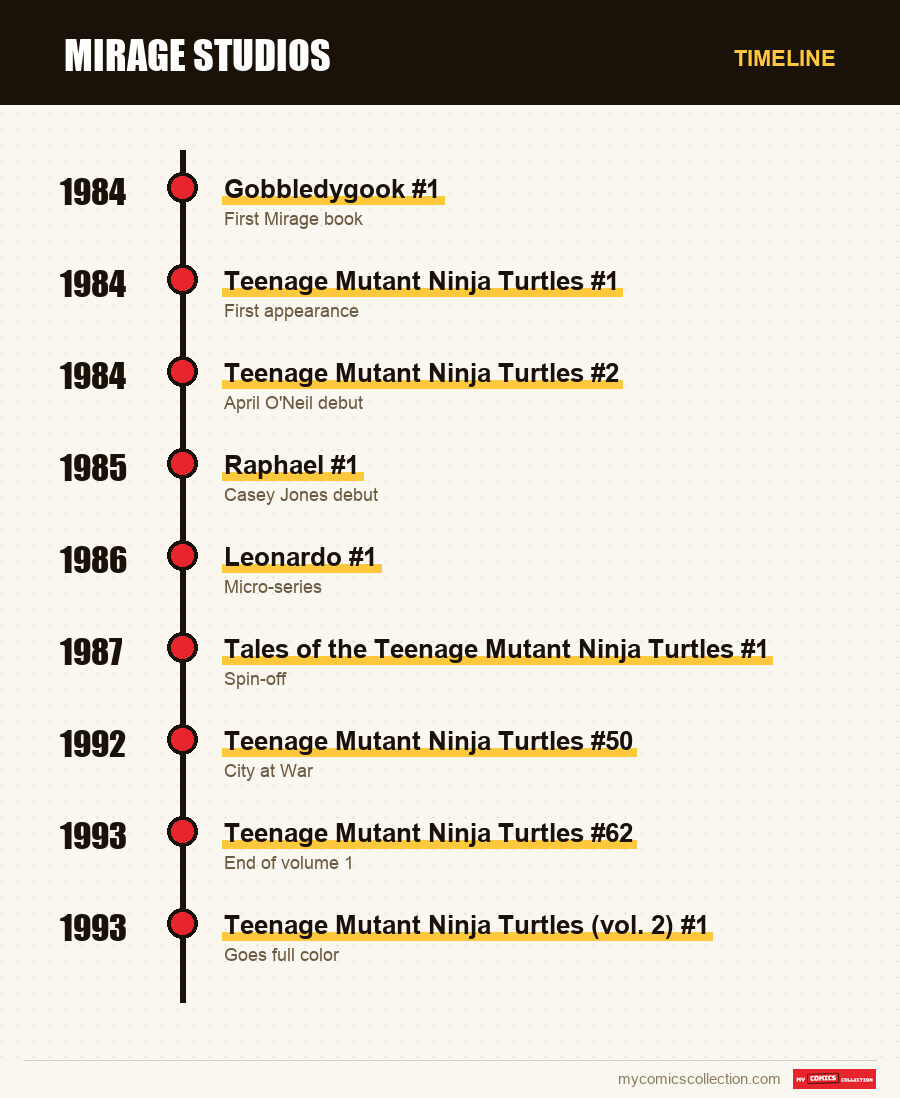
The very first medium published under the Mirage banner is a minicomic called Gobbledygook, made in a completely artisanal manner: the pages are photocopied, folded and stapled by hand by the two authors themselves, without going through a professional printing company. The print run is estimated at only around fifty copies: some sources suggest up to 150 copies for later prints, but the very first version remains one of the rarest objects in the history of modern comic books. Its historical interest is immense: it is on the back cover of this confidential issue, as an advertisement for a future issue, that the Ninja Turtles appear for the very first time, even before their own issue #1. Gobbledygook also contains the first appearance of Fugitoid, a secondary character who will later cross the entire Mirage universe. Given its extreme rarity and the ease with which counterfeits have circulated over the decades, the Overstreet guide already valued an NM-(9.2) copy at $5,000 as of its 2014 edition-an amount that gives a sense of the coin's desirability more than its list price, with actual sales regularly exceeding this figure by several times when an authenticated copy appears at public sale.
The crazy bet of Teenage Mutant Ninja Turtles #1
Building on this first experience, Eastman and Laird decided to devote an entire issue to their mutant turtles, originally conceived as a schoolboy parody mixing the codes of horror comics, ninja movies and mutated superhero stories like Daredevil or New Mutants. The title Teenage Mutant Ninja Turtles #1 was released in May 1984, first shown at a comic convention in Portsmouth, New Hampshire. The format chosen was an oversized black and white magazine, printed on cheap newsprint: an economical as well as aesthetic choice, in line with the independent and underground comics of the time.
The initial print run was set at 3,000 copies, but the printer produced 275 more by mistake, bringing the total to 3,275 copies: a figure that remains famous among collectors and which largely explains the extreme rarity of the first print run today. This issue, initially thought of as a one-shot with no planned sequel, met with totally unexpected success: in just a few months, first print copies were already trading at more than fifty times their cover price on the secondary market. Faced with this enthusiasm, Eastman and Laird transformed their one-shot into a regular series.
A second printing followed in June 1984, with an edition of approximately 6,000 to 6,250 copies. It is distinguished from the first printing by a mention “Second Printing / June 1984” printed on the inside page, as well as by the replacement of the advertising for Gobbledygook by an ad for iron-on transfers bearing the image of the Turtles. Visually, the first three prints are almost indistinguishable from the outside; only the inside page and a slightly lighter shade of red on the second print make it possible to differentiate them with certainty. This is an essential point of vigilance for any collector: without serious authentication, it is very easy to confuse a second or third print with the highly sought-after first print.
A studio that grows to the rhythm of the success of the Turtles
After the success of No. 1, Mirage Studios moved several times: first to Sharon, Connecticut, where the team stayed for about two years, then to Northampton, Massachusetts: the town where it all began for Eastman and Laird. The studio eventually settled in a repurposed former industrial space in Florence, Massachusetts, which would become the beating heart of Mirage production for many years.
The creative team quickly grew around the founding duo: letterer Steve Lavigne joined the adventure in 1984, inker Ryan Brown in 1985, while designer Jim Lawson quickly became a pillar of the series, as did colorist and cover artist Michael Dooney. Beginning in 1989, artist A.C. Farley signed the cover paintings for many issues, a collaboration that lasted until 2004.
Mirage doesn't just publish the Turtles' adventures. The catalog is expanding with derivative titles like Tales of the Teenage Mutant Ninja Turtles, as well as other independent series carried by authors close to the studio: most of these ancillary titles have confidential print runs and very short lifespans compared to the parent series. Mirage will also play a key role, a little later, in the republication of volume 2 of Usagi Yojimbo by Stan Sakai, another pillar of the creator-owned comic of the 1990s.
Merchandising drift and the return to continuity
The success of the Turtles quickly goes beyond the scope of the comic book. From the end of the 1980s, particularly after the “Return to New York” narrative arc, Eastman and Laird found themselves caught up in the management of licenses, merchandising and derivative adaptations (cartoons, toys, licensed products) to the point of no longer being able to ensure the regular writing and drawing of the series themselves. Guest artists then took over to maintain the publication: Michael Dooney, Eric Talbot, Ryan Brown, Steve Murphy and especially Jim Lawson, who would become one of the faces most associated with the series in the long term.
We had to wait until issue 45 for Mirage to truly reconnect with tighter narrative continuity. The pinnacle of this period is the "City at War" arc, a thirteen-part story beginning in issue #50, which marks the return of Eastman and Laird as joint writers for the first time since issue #11. Volume 1 of the series concludes with issue #62, published in August 1993, capping nearly a decade of uninterrupted publication.
Volume 2, entirely written and drawn by Jim Lawson, follows in full color: a radical departure from the iconic black and white of the beginnings. This continuation would only last thirteen issues before being canceled in October 1995, both due to a decline in sales and a flood affecting the studio premises.
Mirage Studios and the defense of creators’ rights
Beyond its commercial success, Mirage Studios occupies a special place in the history of the American comic book industry: that of a concrete example of the success of self-publishing and full creative ownership. This status naturally pushed Eastman and Laird to get involved in the debates of the time on authors' rights in the face of the "work for hire" practices of major publishers and the increasingly concentrated power of distributors.
In November 1988, Eastman and Laird participated, alongside Dave Sim, Steve Bissette, Larry Marder, Rick Veitch and Scott McCloud, main editor of the text, in writing the Creator's Bill of Rights. This document, finalized during a meeting known as the "Northampton summit", precisely in the city where Eastman and Laird had met seven years earlier, was signed by all the participants present. It formalizes fundamental principles still regularly cited today in discussions on the status of independent authors: ownership of characters, right to review the exploitation of the work, and fair remuneration in relation to distribution circuits.
This text has never had a binding contractual value, but its symbolic influence on the independent scene of the 1990s is considerable. That the studio behind the most profitable franchise of the moment actively took a stand alongside much more modest creators helped to legitimize the creator-owned comics movement, of which Mirage will remain one of the most cited founding examples.
The sale of rights, the decline and then the dissolution of Mirage
After several decades of management of the Ninja Turtles by Eastman and Laird (Laird buying out Eastman's share in 2000, who gradually withdrew from the company), the decisive turning point came on October 21, 2009: Viacom bought most of the rights to the Teenage Mutant Ninja Turtles franchise. Mirage Studios then retains a limited residual right to continue publishing up to eighteen issues per year, but the era of total creative independence is coming to an end.
The studio went dormant on December 31, 2009. A few sporadic publications still followed in the following years, until a final release in May 2014 with issue 32 of volume 4: the last comic ever published under the Mirage Studios name. Since August 2011, IDW Publishing has held the publishing rights to the Ninja Turtles comics, with an entirely new editorial line, disconnected from the original Mirage continuity. Mirage Studios will officially dissolve as an entity on September 9, 2021, bringing a legal end to nearly four decades of existence: even though, in reality, the studio has not been truly active for a long time.
This journey in three stages (artisanal self-publishing, creative golden age, then takeover by an entertainment giant) is what makes the original Mirage comics so special for collectors: each issue published between 1984 and 1993 belongs to a specific historical window, the one where two independent authors still fully controlled their creation, before it became a studio asset among others.
Collecting this series?
Track what you own, what you are missing and what your collection is worth. 7 day trial.
Start my trial →The impact of adaptations on the rating of Mirage comics
The popular success of the Ninja Turtles with the general public owes almost nothing, originally, to the Mirage comic book itself. It was the cartoon produced by Fred Wolf, broadcast from 1987, associated with the Playmates toy line, which took the Turtles from the status of an independent curiosity to that of a global merchandising phenomenon for an entire generation of children in the 1980s and 1990s. The first live-action feature film was released in 1990 and enjoyed considerable commercial success, followed by several sequels during the decade, and then new waves of animated and cinematic adaptations in the following decades.
This paradox is precisely what structures the Mirage collection market today. The general public knows the Turtles through a colorful, watered-down version that is far removed from the much darker and satirical tone of the original black and white comic: closer, in its spirit, to independent horror comics and Daredevil period Frank Miller than to a Saturday morning cartoon. This gap between the popular image of the franchise and the original raw material maintains a strong desirability for the very first Mirage prints: to own a TMNT #1 from 1984 is to own the artifact before starification, the object which preceded and made possible the entire media empire which followed.
On a strictly financial level, this desirability translates into spectacular sales of leading copies. A copy of TMNT #1 graded CGC 9.8 sold for $245,000 in September 2021, a record then hailed as historic for a comic from the 1980s. This record was itself broken a few months later: on December 13, 2021, another CGC 9.8 copy sold for $250,000 at auction, at the very time when only a handful of copies still appeared in the CGC census in this maximum note. Since then, the modern comics market has experienced a clear decline after the speculative bubble of the pandemic period: more recent sales of reference guides report 9.8 copies trading instead around $87,000, a figure which remains considerable for an independent comic from the 1980s, but which illustrates the general correction observed on the entire post-2022 market.
The CGC census is itself an interesting indicator of the evolution of this market: when only eight examples appeared in universal 9.8 at the end of 2021, the current census counts around thirty more, a sign that examples previously kept outside the grading circuit continue to emerge and be submitted for authentication, as the value of the piece justifies the cost of professional certification. For such an old and fragile issue (printed on cheap newsprint, with a spine that is often brittle after forty years) each rise in rank has a direct and measurable impact on the rating.
Buying guide: acquire a Mirage Studios comic safely
Buy a vintage Mirage comic, and even more so a first printing of TMNT #1 or a copy of Gobbledygook, requires a rigorous method as the issues of counterfeiting and confusion between prints are real in this specific segment of the market.
- Systematically check the inside page of issue 1: this is the only reliable way to distinguish a first printing (without mention of reprinting, advertising Gobbledygook on the inside page) from a second printing from June 1984 (“Second Printing”, advertising for iron-on transfers) or from later printings: the cover alone is never enough to decide.
- Favor copies already graded by a recognized service like CGC when the budget allows it, in particular beyond a few hundred euros: in a market where the price differences between 8.0, 9.0 and 9.8 sometimes amount to tens of thousands of euros, professional authentication protects both the buyer and the future value of the piece.
- Be particularly wary of copies of Gobbledygook: produced in an artisanal way on a photocopier, this minicomic is notoriously easy to reproduce. Any coin not authenticated by a recognized grading service should be viewed with extreme caution, regardless of the certainty displayed by the seller.
- Find out about the condition of newsprint: Mid-1980s Mirage prints used cheap paper, prone to yellowing, weak spines, and handling creases. A copy advertised as high grade but showing obvious signs of paper aging deserves a thorough examination before purchase.
- Distinguish the Mirage titles from each other: the studio's catalog includes numerous derivative and short series in confidential circulation, the value and rarity of which vary enormously from one title to another. Never assume that a comic simply branded "Mirage Studios" has the same desirability as the original TMNT #1.
- Use an estimate based on actual sales rather than on current listings, which often reflect asking prices well above the prices actually paid: this is particularly true on high-profile pieces like TMNT #1, where sellers tend to aim high.
- Systematically document provenance for any ungraded piece, in particular for prints prior to 1985: purchase invoice, sales history, certificate of authenticity, any element which will facilitate resale or subsequent grading.
To monitor the evolution of the price of a specific copy, whether it is a TMNT #1 first printing or a more common issue of the Mirage series, the site's estimation tool relies directly on the listings currently on eBay rather than on a theoretical guide, which gives a faithful picture of the market at a given moment. It is also a good reflex for anyone who discovers they have an old Mirage number in a family collection and who wishes to quickly assess its value before any decision to sell or conserve.
For collectors who follow several Mirage series in parallel: volume 1, volume 2, spin-off titles like Tales of the Teenage Mutant Ninja Turtles: organizing your collection with a dedicated application makes it much easier to track missing numbers, specific prints owned and the evolution of the overall value of the lot over time.
Key issues to know
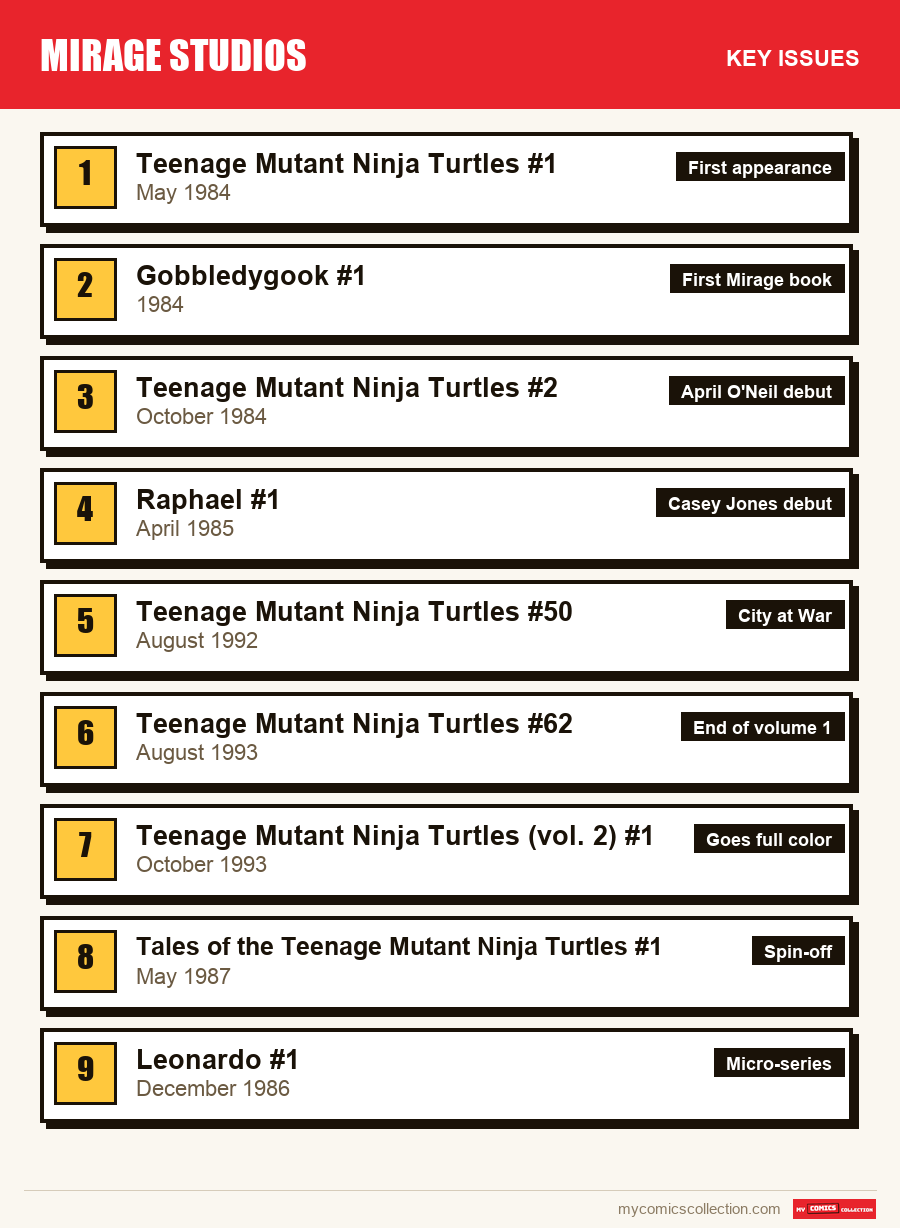
Teenage Mutant Ninja Turtles #1
Kevin Eastman and Peter Laird self-publish this black-and-white magazine, premiered at a convention in Portsmouth with a print run of 3,275 copies. It tells the origin of the four turtles and Splinter, and the Shredder dies in his very first appearance.
Gobbledygook #1
This photocopied, hand-stapled minicomic is Mirage Studios' very first publication. It contains no Turtles story, but features the Fugitoid's first appearance and an advertisement for Teenage Mutant Ninja Turtles #1.
Teenage Mutant Ninja Turtles #2
The second issue, published after the first one's unexpected success, introduces April O'Neil and scientist Baxter Stockman with his Mouser robots. The one-shot becomes an ongoing series.
Raphael #1
The first issue of the "micro-series" giving each turtle a solo book. Raphael runs into a masked vigilante armed with bats and hockey sticks: Casey Jones makes his first appearance here.
Teenage Mutant Ninja Turtles #50
The opening of "City at War", a thirteen-part arc marking the return to tight continuity. It is the first issue fully written and drawn by Eastman and Laird together since issue 11.
Teenage Mutant Ninja Turtles #62
This issue concludes both "City at War" and the series' first volume, after nearly a decade of publication. It closes Mirage's black-and-white golden age.
Teenage Mutant Ninja Turtles (vol. 2) #1
Mirage launches a second, full-color volume that continues the first one's continuity. Jim Lawson writes and draws it alone; the series ends after thirteen issues.
Tales of the Teenage Mutant Ninja Turtles #1
The launch of a regular spin-off title in the Mirage catalog, devoted to side stories from the Turtles' world. It shows the studio expanding beyond the main series.
Leonardo #1
The last instalment of the micro-series devoted to each turtle, centered on Leonardo against the Foot Clan. It is the only one of the four solo issues included in the first colorized collections.