Leonardo #1 is a black and white one-shot published on December 10, 1986 by Mirage Studios , written and drawn by Kevin Eastman and Peter Laird, with a wallet cover signed Laird. Fourth and last of four solo booklets devoted to each Ninja Turtle (after Raphael, Michaelangelo and Donatello), it recounts Leonardo's fight against the Foot Clan on the rooftops of New York one Christmas evening. Long considered the least expensive of the quartet in guide rating, it remains rare in very high grade: the CGC census of September 2021 included only 40 examples rated 9.8, none above.
In the editorial history of the Ninja Turtles, four comics occupy a special place: the solo one-shots published by Mirage Studios between 1985 and 1986, each dedicated to one of the four brothers. Raphael got the ball rolling in 1985 with the seminal appearance of Casey Jones, Michaelangelo and Donatello followed the same year, and it's Leonardo #1, published in December 1986, which closed this series of individual portraits. Less spectacular in appearance than its younger sister Raphael, this booklet nonetheless remains an essential milestone for anyone interested in the genesis of the franchise, at a time when Eastman and Laird still drew each page themselves in their studio in New Hampshire.
What is striking when reading Leonardo #1 is its narrative bias: an almost silent fight, cut into strips which alternate with the Christmas family scenes experienced by the rest of the clan. This choice of layout, both economical and efficient, testifies to the already established know-how of the two creators barely three years after the launch of their first self-produced comic. Understanding this booklet also means understanding how an independent project with a print run of a few thousand copies ended up generating animated series, films and a global toy industry.
This article retraces the complete story of Leonardo #1: its context of creation within the quartet of Mirage one-shots, the story it contains, the creative team which produced it, its particular place in the collectors' rating compared to its three paper brothers, and the points to be aware of before purchasing a vintage copy.
At the origins of Leonardo #1: the birth of Mirage Studios one-shots
Leonardo #1 goes back to May 1984, when Kevin Eastman and Peter Laird presented Teenage Mutant Ninja Turtles #1 at a convention in Portsmouth, New Hampshire. This first issue, printed in black and white in a large, magazine-like format on cheap newsprint, was only printed in 3,275 copies. No one, not even its authors, anticipated what this little self-produced comic would trigger: in just a few months, copies were already trading at more than fifty times their cover price on the resale market between collectors, an early sign of a phenomenon that would go beyond the confines of the comic book to become a multimedia franchise.
Building on this unexpected success, Mirage Studios developed the mythology of the Turtles quartet by devoting to them, between 1985 and 1986, four solo booklets: one per character. This approach, quite unusual for such a small independent publisher, allows Eastman and Laird to delve more deeply into each temperament individually rather than treating them as a homogeneous block. Raphael #1 opens the march in April 1985 and is immediately distinguished by a founding event for the TMNT mythology: it is in these pages that Casey Jones appears for the first time, the masked vigilante with the hockey stick who will become one of the most popular secondary characters of the franchise, both in the comics and in the cartoons and films that will follow. The same year, Michaelangelo #1 appeared, whose story also takes place in the run-up to Christmas and features the most mischievous Turtle of the group confronting thugs who hijack a truck of toys intended for an orphanage. Donatello #1 completes the initial trio before Leonardo #1, in December 1986, closes the series by finally giving the spotlight to the silent and disciplined leader of the clan.
This sequencing is not trivial for those interested in the collection: Leonardo, as the last one-shot of the quartet, marks the end of an editorial format that Mirage Studios never reproduced identically thereafter. After 1986, the publisher focused on the regular monthly series and multi-chapter mini-series, abandoning the single-issue solo portrait formula. Leonardo #1 therefore functions as a logical end point to this narrative experiment initiated by Raphael eighteen months earlier.
The story told in Leonardo #1: “What Goes Around... Comes Around!” »
The story contained in Leonardo #1 is titled “What Goes Around... Comes Around!” » and opens with a seemingly innocuous patrol scene. Where the three previous one-shots each had their own tone, Eastman and Laird choose a particularly ambitious layout process for Leonardo: the pages are split horizontally, the upper part being reserved for the solitary and almost silent fight that Leonardo leads against soldiers of the Foot Clan on the rooftops of New York, while the lower part follows in parallel his brothers, April O'Neil and Splinter decorating the apartment and preparing a much more peaceful Christmas meal.
This visual contrast between the silent violence of Leonardo's fight and the domestic warmth of the family scene creates a dramatic tension that builds to a crescendo as the Foot soldiers multiply. The confrontation changes when the Shredder himself appears at the head of dozens of henchmen, overwhelming Leonardo despite his combat skill. The story closes with a striking image: the Turtle, injured, crosses the window of the apartment to alert his brothers at the last minute of the approaching danger, thereby breaking the border between the two narrative layers which had structured the comic strip until then.
A tight creative team, typical of the early Mirage studio
As with the three other one-shots in the series, Leonardo #1 bears the trademark of the Mirage studio first period: a script and drawing jointly provided by Kevin Eastman and Peter Laird, with a portfolio cover (the illustration extends over the entire front and back) signed by Laird. The booklet also benefits from occasional artistic contributions from other figures then gravitating around the studio, including Steve Bissette, Michael Dooney and Ryan Brown, while the lettering is entrusted to Steve Lavigne, a regular collaborator of Mirage over this period. The comic is presented in the form of a black and white stapled booklet of around thirty pages of story for 36 pages in total including the covers and additional pages, sold for $1.50 at the time of its release on December 10, 1986.
This economy of means (a small team, cheap printing, confidential distribution compared to the standards of the major publishers of the time) is precisely what makes these booklets so sought after by collectors today. Unlike a Marvel or DC comic of the same vintage, printed in hundreds of thousands of copies, the Mirage one-shots circulated in a network of independent comic shops and never benefited from mass distribution, which partly explains their relative rarity today, particularly in very high grades.
Leonardo #1 against his three brothers: a separate rating in the quartet
Rating-wise, Leonardo #1 occupies a special position among the four Mirage one-shots. It is regularly described by market specialists as the least expensive of the four solo issues, without the generating fact that propelled the value of its predecessor: Raphael #1 owes much of its sought-after "key" status to the first appearance of Casey Jones, a collectible argument that neither Michaelangelo, nor Donatello, nor Leonardo can claim. According to the Overstreet Comic Book Price Guide, 2023 edition, a copy of Raphael #1 in grade NM-9.2 is valued at $600, when the same price list, 2021 edition, only valued a Leonardo #1 in equivalent grade at $45: a difference which clearly illustrates the weight that a “first appearance” places on the old comic market.
This difference in odds does not mean that Leonardo #1 is an ordinary comic or easy to find in high conservation. The census of copies graded by CGC, completed in September 2021, counted only 40 copies graded at the maximum observed grade of 9.8, with no copy above in the database at that date. For comparison, the April 2024 CGC census for Raphael #1 already had 155 copies graded 9.6 and 56 copies graded above: much higher volumes that reflect both stronger awareness among collectors pushing for mass submission for certification, and increased attention paid to this specific issue upon its release. A sales record of around $400 was also reported for Leonardo #1 by the sector's specialist press, while an auction observed in September 2021 ended at around $270 for a high-grade copy.
For a collector, this situation opens up a reading on two levels. On the one hand, Leonardo #1 remains accessible compared to the three other one-shots of the quartet, which makes it a realistic entry point for those wishing to bring together the entire series without devoting a disproportionate budget to the last chapter. On the other hand, its relative rarity in very high grades (due to its nature as a cheap black and white comic from the 1980s, particularly susceptible to spine creases and moisture stains) means that an authentic and well-preserved NM/M copy remains an object whose actual availability on the market remains limited, regardless of its guide grade.
Why the value gap between the four one-shots keeps growing
The dynamics of the old comic market historically tends to reward issues carrying an identifiable narrative event (first appearance of a character, origin of a costume, death of a hero) more than episodes which, however well executed artistically, are part of continuity without break. Leonardo #1 is an almost manual illustration of this: the story it offers is praised for its sense of rhythm and its daring layout, but it contains no first appearance of a major secondary character nor any plot twist subsequently taken up in the television and cinematographic adaptations. It is this absence of a collectible “hook” which explains, more than the intrinsic quality of the story, the persistent difference in odds with Raphael #1.
How to recognize a real Leonardo #1 from 1986
The question of authenticity arises all the more acutely as Leonardo #1 experienced several editorial lives after its initial publication as a stand-alone issue. From 1988, Mirage Studios brought together issues 1 to 11 of the regular series as well as the four one-shots (Raphael, Michaelangelo, Donatello and Leonardo) in a collection entitled TMNT: The Collected Book Volume One. This collection exists in softcover version, with a black and white wallet cover signed Laird, and in bound version limited to 1,000 copies, with a color dust jacket illustrated by Eastman. A second edition of this same collection appeared in May 1990, this time with a color cover signed A.C. Farley. More recently, the story of Leonardo #1 was also included in the modern IDW collection dedicated to the Mirage years, alongside issues 8 to 11 of the regular series and the one-shots Michaelangelo and Donatello.
For a buyer who is specifically looking for the original issue from December 1986 - and not one of these multiple reissues in collections: several points of vigilance are necessary:
- Check the date mention in the indexia: the original copy has a release date of December 1986 and a cover price of $1.50 printed on the cover; any different mention indicates a collection or a later reissue.
- Examine the integrity of the portfolio coverage: Peter Laird's illustration is spread across the entire recto-verso of the booklet; the spine creases, very common on this cheap stapled format from the 1980s, significantly devalue the conservation rating.
- Do not confuse the one-shot with the Collected Book collections: the 1988 and 1990 versions bring together several issues in a single bound or soft volume and do not constitute the original independent edition sought by purists of the first publication.
- Favor CGC or CBCS certified copies for high grades: given the low number of copies listed at the top of the rating scale, third-party certification provides a guarantee that is difficult to obtain through a simple visual inspection of an online ad.
- Compare several recent sales rather than relying on a single guide rating: Overstreet values evolve with a time lag behind the real market; for a comic as little traded as Leonardo #1, the observation of several recent transactions gives a more faithful image of the current price.
- Consider purchasing the full quartet: for a collector who is aiming for the Raphael, Michaelangelo, Donatello and Leonardo set, it is often more coherent to think in terms of a complete series than issue by issue, with the availability of the other three titles directly influencing Leonardo's purchase schedule.
Collecting this series?
Track what you own, what you are missing and what your collection is worth. 7 day trial.
Start my trial →The impact of adaptations on the rating
As with many founding comics that have become the matrix of a multimedia franchise, the rating of the Mirage one-shots, Leonardo #1 included, has always reacted to the visibility cycles of the Ninja Turtles license more than to the editorial news of the comics themselves. The first animated television series broadcast from 1987 introduced the Ninja Turtles to a national audience in the United States, transforming a confidential comic into an omnipresent derivative product in just a few years. The first live-action feature film released in 1990 extended this craze onto the big screen, followed by two sequels in the early 1990s.
Each major relaunch of the franchise has since generated a comparable renewed interest in the original comics among nostalgic collectors: the animated series broadcast from 2003, the animated feature film released in 2007, the series produced for Nickelodeon launched in 2012, then the two films carried by Michael Bay in 2014 and 2016, and more recently the animated feature film Teenage Mutant Ninja Turtles: Mutant Mayhem released in 2023. This mechanism is classic in the world of old comics: each new generation of spectators discovering the Ninja Turtles on screen is likely to turn, sooner or later, to the founding comics to explore the genesis of the character, which maintains a fundamental demand for titles like Leonardo #1 well beyond the circle of only comic book readers from the 1980s.
For Leonardo #1 specifically, this dynamic translates less into speculative peaks and more into a regular demand from collectors looking to complete their series of four one-shots rather than speculating on a single isolated issue. This is a collection profile different from that of a pure first appearance comic, where demand can suddenly surge around the release of a film dedicated to the character concerned.
Buying guide
- First set a clear collecting goal: seek out Leonardo #1 alone, or aim for the complete collection of all four Mirage one-shots (Raphael, Michaelangelo, Donatello, Leonardo), which radically changes the budget and purchasing schedule.
- Keep in mind that the guide rating of Leonardo #1 remains significantly lower than that of Raphael #1, due to the lack of an associated first appearance; don't pay a Leonardo the price of a Raphael just because they belong to the same series of one-shots.
- Always inspect the spine of the booklet in photos of an ad: binding creases and yellowing from cheap 1980s newsprint are the most common defects on this type of black and white stapled.
- Always ask for confirmation that this is indeed the original solo issue from December 1986, and not an extract from one of the 1988 or 1990 Collected Book collections, nor a modern IDW reprint.
- For a very high grade purchase, CGC or CBCS certification is particularly recommended given the low number of copies listed at the top of the scale: the price difference between a graded copy and a rough copy of equivalent quality can be significant for this specific title.
- Cross-reference several recent sales before setting your budget: on a comic book as little traded as Leonardo #1, a single transaction does not necessarily reflect the current market, unlike titles with a higher trading volume.
- Document your copy upon purchase (double-sided photos, certification number if applicable, provenance): for a one-shot of this rarity, a clear provenance history greatly facilitates possible future resale.
To follow the evolution of the rating of your copy over time, or to organize your entire collection of Mirage comics and beyond, the use of a dedicated collection tracking tool greatly simplifies the work compared to a simple spreadsheet. OUR comic collection management application allows you to centralize your issues, their condition and their estimated value over time.
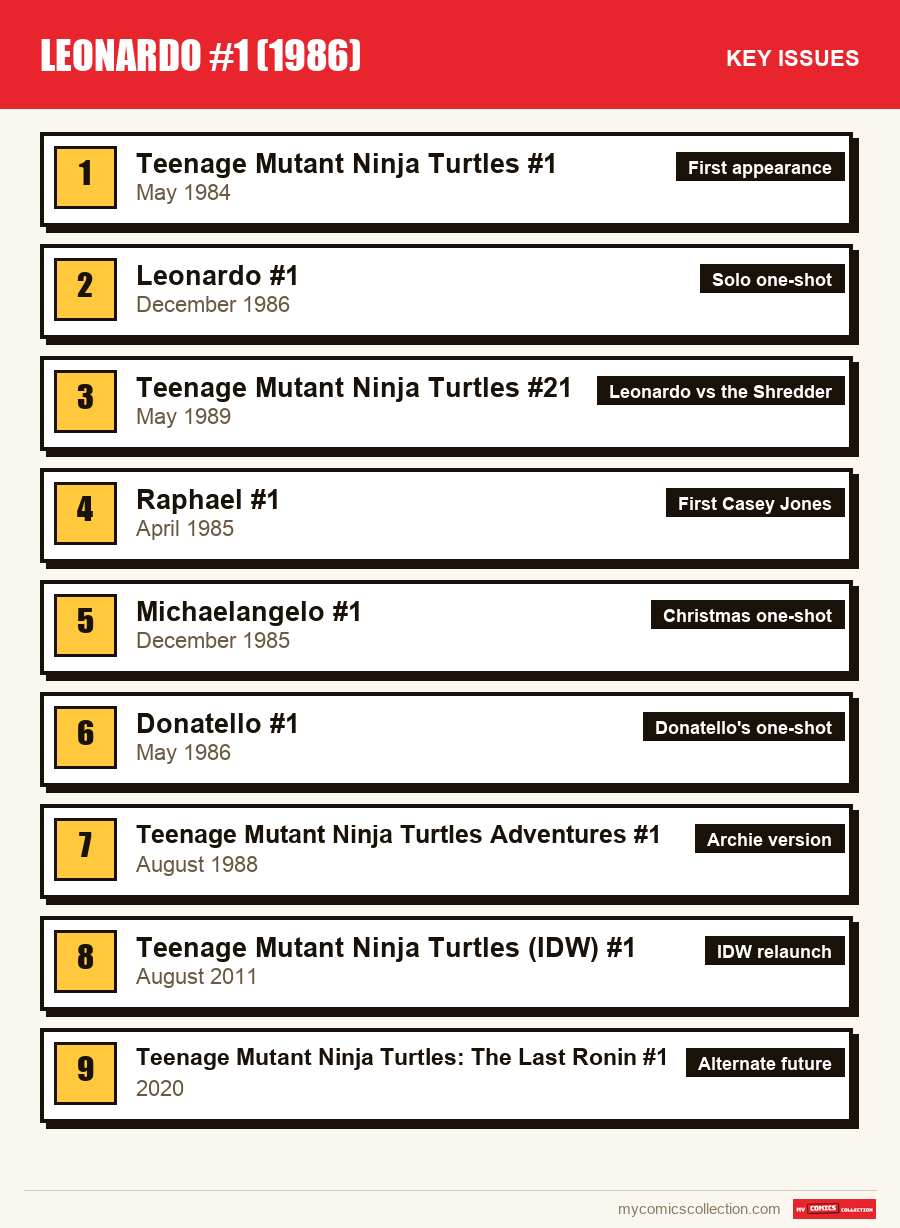
Key issues to know
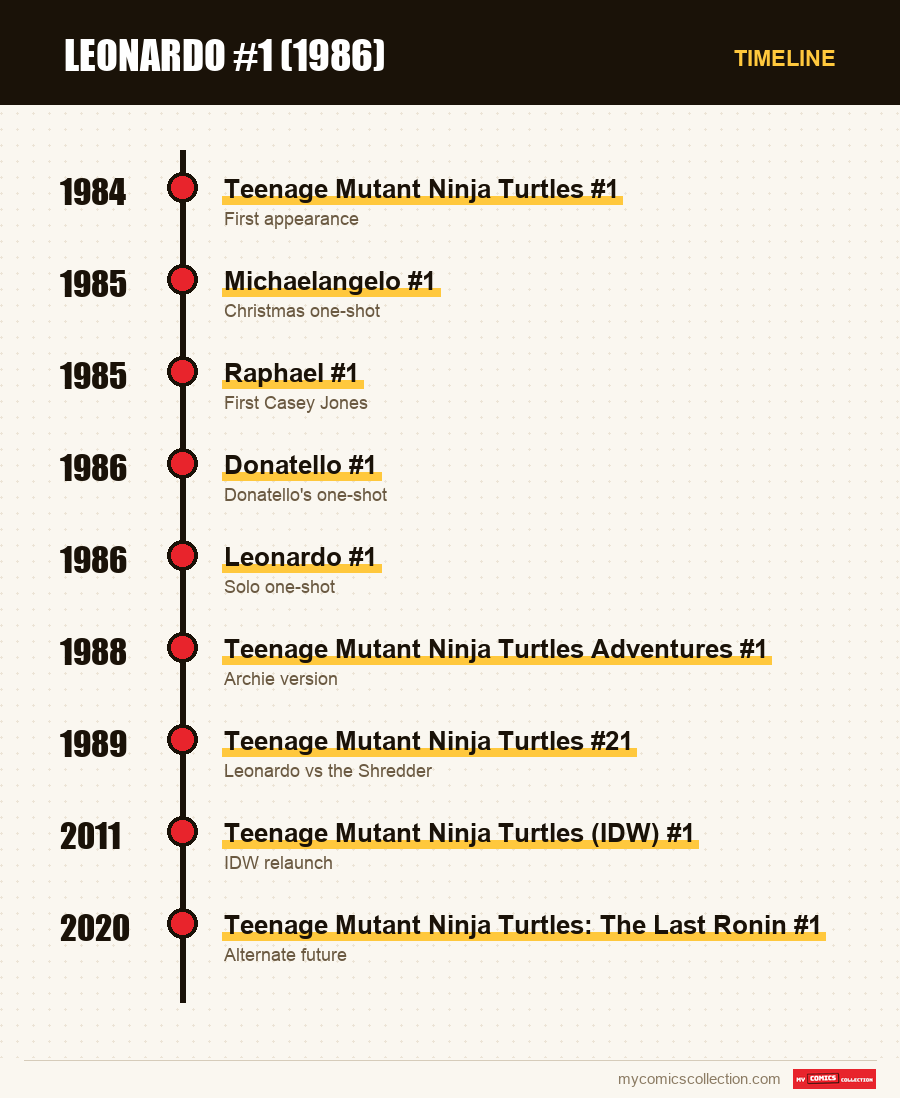
Teenage Mutant Ninja Turtles #1
Kevin Eastman and Peter Laird self-publish, in black and white and in a run of 3,275 copies, the debut of Leonardo and his three brothers, trained by the rat Splinter to avenge his master Hamato Yoshi. The Shredder dies in this very first issue.
Leonardo #1
The last of the four Mirage one-shots, What Goes Around... Comes Around! cuts between Leonardo's lone fight against the Foot on the rooftops and his family's Christmas Eve. Beaten, he crashes through April's window. The issue is the first appearance of the Shredder resurrected as a clone.
Teenage Mutant Ninja Turtles #21
Final chapter of Return to New York: the Turtles storm the Foot's headquarters. After saving Raphael, Leonardo faces the Shredder alone on the rooftop and kills him by decapitation.
Raphael #1
The first of the four one-shots devoted to each Turtle: Raphael runs into a hockey-masked vigilante, Casey Jones, whose brutality worries him. The two end up as allies, and Casey becomes a pillar of the franchise.
Michaelangelo #1
Michaelangelo takes in a kitten he names Klunk, then chases thieves who hijacked a truck of toys meant for orphans. The one-shot also sets up the series' tradition of Christmas stories, picked up again in Leonardo #1.
Donatello #1
In Kirby and the Warp Crystal, Donatello follows Kirby, a reclusive artist whose creatures come to life in another world, through a portal. A nod to Jack Kirby, who approved the roughs according to the issue's editorial.
Teenage Mutant Ninja Turtles Adventures #1
Archie Comics launches a colour series aimed at younger readers, first adapting episodes of the 1987 animated series. Leonardo takes on the look of the blue-masked team leader made popular by television.
Teenage Mutant Ninja Turtles (IDW) #1
Kevin Eastman, Tom Waltz and Dan Duncan relaunch the Turtles at IDW after Nickelodeon acquired the licence, with a reinvented origin. The issue comes with twelve covers and opens a series that would become the longest-running in the franchise.
Teenage Mutant Ninja Turtles: The Last Ronin #1
Kevin Eastman and Tom Waltz, from a story conceived with Peter Laird, imagine a future in which only one Turtle survives and seeks to avenge his brothers. The five-issue mini-series becomes a major hit for the franchise.