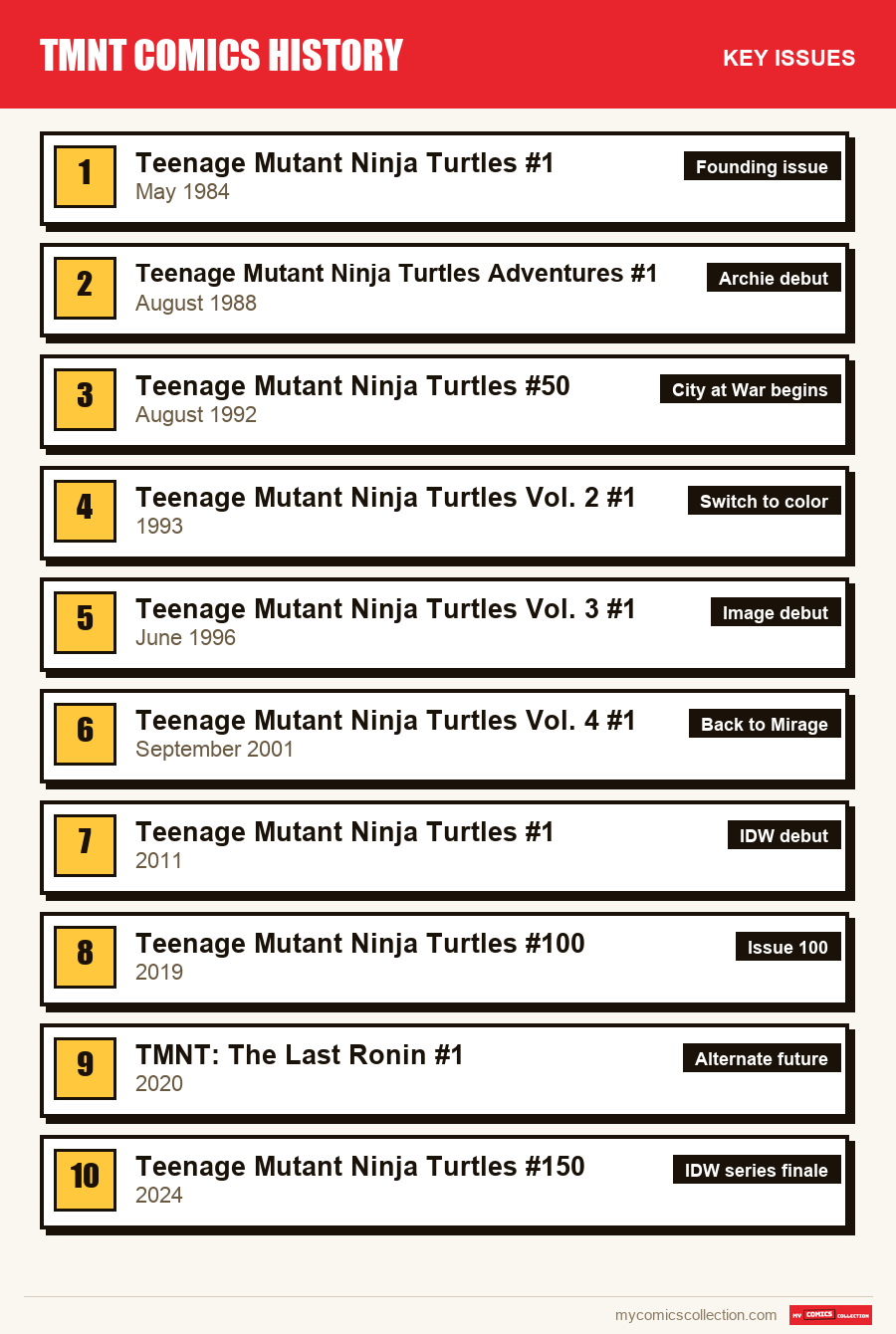
The Teenage Mutant Ninja Turtles comic book was born in May 1984 in Dover, New Hampshire, when Kevin Eastman and Peter Laird printed 3,275 copies in black and white thanks to a loan of $1,300 from Eastman's uncle. From this confidential self-published print run at Mirage Studios, the franchise has gone through five different publishers in forty years: Mirage, Archie Comics, Image Comics, Mirage again, then IDW Publishing since 2011 - with at each stage very different collection rules, print runs and odds issues.
Few American independent comic books can claim an editorial trajectory as chaotic as that of the Ninja Turtles. Unlike Spider-Man or Batman, published without interruption by the same publisher for decades, TMNT has changed publishing house five times, experienced two major interruptions and experienced at least two relaunches numbered "#1" which regularly sow confusion among collectors who discover the series.
This article traces this editorial history in chronological order (who published what, when, and why) to give collectors a clear reading framework before investing in an issue. It deliberately focuses on the narrative thread of the publishers and the eras rather than on the technical details of the prints or the list of key numbers to have: for the precise identification of the different printings of the original TMNT #1 (first, second, third), head to our dedicated guide on the history of TMNT draws; for the selection of the most sought-after issues from all eras, our article on the key issues of the TMNT collection details the essentials.
From broke origins to the Mirage Studios explosion (1984-1990)
The story begins with a joke between two young cartoonists from New Hampshire. Kevin Eastman doodles a bipedal turtle armed with nunchucks; Peter Laird finds the idea of a ninja as slow as a turtle irresistibly funny. The two friends make a team of four, each armed with a different weapon, and put down on paper a story initially conceived as an assumed parody of the comics they were reading at the time: Daredevil by Frank Miller, Ronin also by Miller, and X-Men/New Mutants by Chris Claremont. Nothing in this initial intention suggested a global franchise.
To finance the printing, Eastman put his $500 tax refund on the table, Laird emptied his bank account of $200, and the duo borrowed another $1,300 from Eastman's uncle. This artisanal investment finances a print run of 3,275 copies (some sources suggest a figure rounded to 3,000) of the very first Teenage Mutant Ninja Turtles, an oversized black and white magazine, printed on cheap newsprint under the newly created Mirage Studios label. The issue was first presented in May 1984 at a comic book convention in Portsmouth, New Hampshire.
The rarity of this initial print run (barely more than 3,000 copies distributed mainly in New England) automatically made it one of the most coveted independent comics in the history of the collecting market, in a context where the early 1980s already saw the emergence of strong speculation around black and white comics published by small independent publishers. The success surprised Eastman and Laird themselves: a second printing followed as early as June 1984, still at a cover price of $1.50, then a third in February 1985, with a change of address of the publisher (from Dover, New Hampshire, to Sharon, Connecticut) visible in the ex-libris (indicia) of this third edition. These successive reprints, driven by growing demand, mark the real commercial takeoff of the license.
The decade that followed saw Mirage Studios gradually professionalize its production while maintaining a more mature and darker tone than what the general public would later associate with the Turtles via the cartoon. Volume 1 of the original series continued irregularly until the early 1990s, supported by a loyal but still small readership of independent comics compared to Marvel or DC standards.
City at War and the end of Volume 1 (1990-1993)
The creative peak of this first Mirage era remains the “City at War” arc, begun with issue 50 of the series. This multi-part tale concludes both this story and the entirety of Volume 1 with the publication of issue #62, in August 1993. It's an arc that early purists often consider to be the narrative climax of Eastman and Laird's original vision, before the franchise dispersed among several publishers and several distinct editorial tones.
In the wake of this conclusion, Mirage is relaunching a brand new series numbered from 1, still in 1993 - which immediately creates a source of confusion for collectors who discover the license today, since several "TMNT #1" coexist depending on the publisher and the year. This Volume 2 only lasted two years: a flood in the Mirage Studios premises in 1995 caused the sudden end of the series, an incident that remains famous in the editorial history of the license as it illustrates the logistical fragility of a studio which remained, despite its commercial success, an independent structure of modest size.
Archie Comics and the mainstream wave (1988-1995)
While Mirage Studios continued to publish a relatively mature version of its heroes, a second actor entered the scene in 1988: Archie Comics launched Teenage Mutant Ninja Turtles Adventures, a series designed this time to accompany and adapt the 1987 cartoon which made the Turtles a playground phenomenon. The first issue appeared in August 1988, with a cover by Eastman and Laird themselves and an interior designed by Michael Dooney.
This launch at Archie has a particular importance for collectors of key issues: TMNT Adventures #1 contains the very first comic book appearance of Krang, as well as the first appearance (in animal form, before their mutation) of Bebop and Rocksteady, two emblematic antagonists of the Turtles mythology popularized by the cartoon. From issue 5, the creative direction of the series passes to Ryan Brown and Stephen Murphy, two former members of Mirage Studios, which allows Archie Comics to gradually instill more consistency with the Mirage universe while maintaining a much more accessible and family tone, calibrated for the young audience captivated by the television series.
TMNT Adventures lasted until October 1995, with a total of 72 issues published: a longevity record for a Turtles series at the time, which would only be surpassed decades later by the IDW series. This Archie chapter remains today the most affordable entry point for a collector who wants to own the first appearances of major characters in the franchise, without aiming for the extreme rarity of the very first Mirage #1 from 1984.
Image Comics, The Forgotten Chapter (1996-1999)
After the end of Volume 2 caused by the flood of 1995, the Mirage Turtles migrated to Image Comics in 1996, for a series of twenty-three issues accompanied by a complementary mini-story. This Image period remains a separate chapter in the collective memory of the franchise: when Peter Laird brought the Turtles back to Mirage in 2001, he deliberately chose to ignore this parenthesis and not integrate it into the "canon" continuity of the license. The Image Comics series was canceled in 1999, due to lack of sufficient readership, in a comic book market then in full restructuring after the speculative crash of the mid-1990s.
For current collectors, this passage at Image occupies a special place: neither completely canon, nor totally forgotten, it remains sought after by completionists who wish to possess the entire editorial history of the Turtles rather than just the official continuity retained by the rights holders.
Return to Mirage then sale to Viacom (2001-2011)
Peter Laird therefore relaunched a new series at Mirage Studios in 2001, a Volume 4 which reconnects with the continuity of the original Volumes 1 and 2 by purely and simply erasing the Image years from the official mythology. This new version lasted almost a decade, with thirty issues published on newsstands and a thirty-first chapter distributed only online, until 2010.
The following pivotal event has nothing to do with editorial: in 2009, Peter Laird sold the rights to the Teenage Mutant Ninja Turtles franchise to Viacom, owner of Nickelodeon. This sale marks the end of the independent "creator-owned" era which defined the license since its self-published origins in 1984, and opens the way to a new, much broader multimedia exploitation (cartoons, films, derivative products) under the aegis of a large media group rather than two independent cartoonists from New Hampshire.
IDW Publishing era: Longest TMNT series ever published (2011-2024)
It was during WonderCon 2011 that IDW Publishing announced that it had secured the rights to publish a brand new TMNT series, while ensuring the reprinting of historical comics from previous eras. The new series began in August 2011 with a creative team bringing together co-creator Kevin Eastman (story and layout), Tom Waltz (screenplay), Dan Duncan (drawing) and Bobby Curnow (editing): an explicit way of reconnecting with the original creative legitimacy while being part of post-Nickelodeon editorial continuity.
This IDW series reinvents several parts of the mythology, notably the character of April O'Neil, rewritten as a scientist directly involved in the laboratory at the origin of the Turtles' mutation rather than as a simple journalist rescued by her heroes: a significant evolution compared to previous incarnations of the character. The series also introduces figures who have become essential to the modern mythology of the Turtles, such as Old Hob, Alopex or Harold Lilja.
In terms of longevity, this IDW iteration becomes historic: when it reaches number 73, it exceeds the previous longevity record for a Ninja Turtles series, held until then by TMNT Adventures and its 72 issues published by Archie Comics between 1988 and 1995. In December 2019, the publication of issue 100 concludes an eight-part "City at War" arc: a clear nod to the arc of the same name which had closed the original Volume 1 at Mirage almost thirty years earlier. The series finally ends on April 24, 2024 with its issue 150, making it the longest TMNT series ever published, all editions combined.
The impact of adaptations and event updates on the rating
The demand for old TMNT comics has always closely followed the audiovisual news of the license: the 1987 cartoon directly propelled the launch of the Archie Comics series in 1988, and each new wave of media exposure: live-action films of the 1990s, cartoon 2003, Nickelodeon animated reboot of 2012, Michael Bay films of 2014 and 2016 - generated peaks of occasional interest in the original comics among nostalgic collectors, regularly bringing TMNT #1 from 1984 back into the spotlight as the absolute reference for independent comics speculation from the 1980s.
The most spectacular and best-documented case of recent years, however, remains internal to IDW rather than linked to a film or TV series: the launch of TMNT: The Last Ronin in 2020. This event one-shot, which imagines a dark future where a single surviving Turtle carries out a final revenge, received around 130,000 pre-orders from comic book retailers: a volume which immediately exceeded IDW's planned print run, forcing the publisher to launch a second printing immediately, then to offer to the stores which ordered the first printing a special “Thank You” edition with black and white cover and silver embossed logo. The secondary market reacted accordingly upon release, with standard cover copies resold for around $50 each on the same day of publication, before high grade CGC certified copies circulated at significantly higher price levels on the secondary market.
This Last Ronin episode illustrates a dynamic that every TMNT collector must keep in mind: the price of a recent Ninja Turtles comic depends less on the raw age than on the narrative status of the issue (first chapter of a highly anticipated event, death or significant appearance of a character) and the gap between reader demand and the print run actually available in first printing: exactly the mechanism, on a completely different scale, which had made Mirage #1 of 1984 so sought after forty years later early.
Collecting this series?
Track what you own, what you are missing and what your collection is worth. 7 day trial.
Start my trial →Buying Guide for TMNT Comic Collectors
Faced with five different publishers and nearly forty years of editorial history, putting together a coherent collection of Ninja Turtles comics requires a minimum of method. Here are the points to be aware of before purchasing:
- Always identify the edition before the publisher. A "TMNT #1" can refer to the original Mirage from 1984, the Mirage relaunch from 1993, or the IDW launch from 2011: always check the publisher, the year and, for the Mirage 1984, the edition number (first, second or third printing), because the difference in value between these versions is considerable.
- Spot the physical clues of the 1984 Mirage reprints. The first printing carries an advertisement for Gobbledygook fanzines on the inside back cover; the second and third printings instead display an advertisement for TMNT iron-on transfers, the second carries a "Second Printing" notice and the third a "THIRD PRINTING" notice in small print, with a publisher's address in Sharon, Connecticut, rather than Dover, New Hampshire.
- Don't overlook the Archie Comics part. The 1988 TMNT Adventures #1 remains a much more accessible entry point than a 1984 Mirage to possess a true historical first appearance (Krang, Bebop, Rocksteady), while remaining a sought-after item for collectors specializing in secondary keys.
- Be careful of the fragility of black and white newsprint from the 1980s. The original Mirage prints were printed on cheap paper, susceptible to yellowing and wrinkling; the general condition (corners, spine, whiteness of the pages) weighs even more heavily than usual in the evaluation of an old copy.
- Check canon status before purchasing an Image Comics (1996-1999) issue. This period remains excluded from the official continuity recognized since 2001: an informed purchase, for a collector who aims for completeness rather than narrative continuity.
- For recent IDW releases, always distinguish first printing from reprints. As demonstrated by TMNT: The Last Ronin #1, the print run gap between a first and second printing can be a significant value factor in the medium term, particularly for event issues with high initial demand.
- Cross-reference population data before making a high-grade purchase. For a certified copy, consult the number of copies listed in the targeted grade: on a print run as small as the original Mirage #1, each additional note of rarity in high grade can have a disproportionate impact on the price.
To go further on the precise criteria for identifying the different impressions of Mirage #1, our article on the history of TMNT draws details each variation page by page. And for a narrow selection of the most strategic issues to own, all editions combined, consult our guide to key issues of the TMNT collection.
Already cataloging a collection of comics and want to track their value over time? OUR collection management application allows you to organize your TMNT issues by publisher and by circulation, and to follow the evolution of their rating.
Key issues to know
Teenage Mutant Ninja Turtles #1
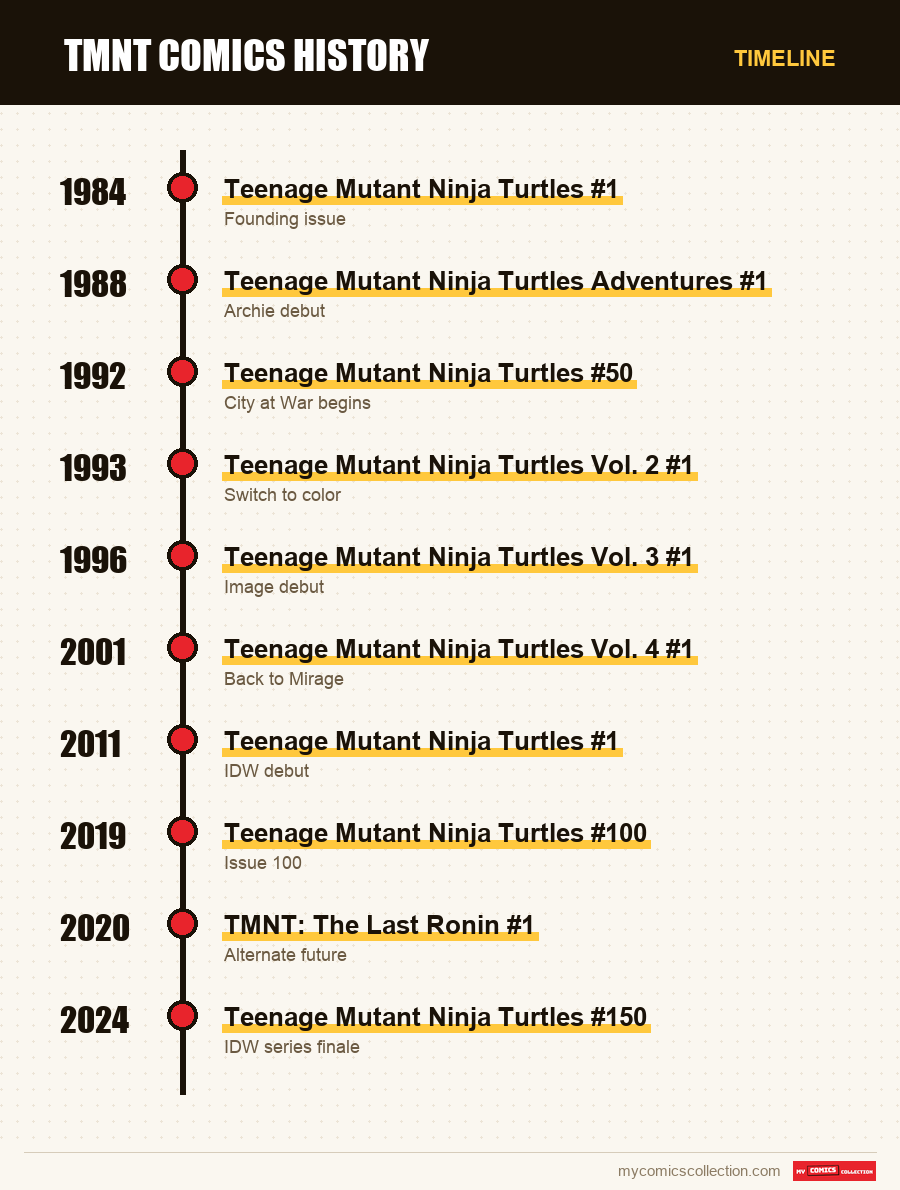
Kevin Eastman and Peter Laird self-published this black-and-white magazine under the Mirage Studios label, then based in Dover, New Hampshire, printing about 3,275 copies and unveiling it at a Portsmouth convention in May 1984. Meant as a one-off parody, it nonetheless lays down the origin of the four brothers, Splinter and the Shredder. The franchise's whole publishing history, across five publishers, flows from this issue.
Teenage Mutant Ninja Turtles Adventures #1
In August 1988 Archie Comics launched a three-issue miniseries adapting the 1987 cartoon, before turning it into a 72-issue ongoing series that ran until 1995. Michael Dooney wrote and drew this first issue, under a cover by Eastman, Laird and Steve Lavigne. Krang, Bebop and Rocksteady make their first comic book appearance here.
Teenage Mutant Ninja Turtles #50
Opening a thirteen-part arc, this is the first issue fully written and drawn by Eastman and Laird together since issue 11. City at War wraps up with issue 62 in August 1993, which also closes the first volume of the series. For many longtime readers, it is the high point of the Mirage era.
Teenage Mutant Ninja Turtles Vol. 2 #1
Mirage launched its second volume in 1993, this time in full color, with Jim Lawson writing and drawing. The series carries on the continuity of the first volume but stops after thirteen issues, in October 1995. It is the first of the relaunch "TMNT #1" issues that make identification tricky for collectors.
Teenage Mutant Ninja Turtles Vol. 3 #1
The Turtles moved to Image Comics in June 1996, written by Gary Carlson and penciled by Frank Fosco, with Erik Larsen as editor. The series ran 23 issues until October 1999 before Peter Laird dropped it from official continuity. In 2018 IDW reprinted the run in color and had Carlson and Fosco produce a three-issue conclusion.
Teenage Mutant Ninja Turtles Vol. 4 #1
Peter Laird relaunched the series at Mirage Studios in September 2001, with Jim Lawson on art and a Michael Dooney cover. This fourth volume picks up the continuity of the first two and ignores the Image years. From 2008 on, new issues were printed in runs of only about a thousand copies, making them scarce pieces from the end of the Mirage era.
Teenage Mutant Ninja Turtles #1
Announced at WonderCon 2011 after Viacom acquired the property, the IDW Publishing series launched in August with Kevin Eastman on story and layouts, Tom Waltz on script and Dan Duncan on art. It reinvents the origin: the Turtles and Splinter are lab subjects, and April O'Neil is a young intern. The issue shipped with a dozen different covers.
Teenage Mutant Ninja Turtles #100
Drawn by Dave Wachter and released in December 2019, the hundredth issue concludes IDW's eight-part City at War, a nod to the arc that closed Mirage's first volume. It also ends an era: from the next issue, in January 2020, Sophie Campbell takes over as the series' lead writer and artist.
TMNT: The Last Ronin #1
The first of five issues in this miniseries by Kevin Eastman, Peter Laird and Tom Waltz, released in late October 2020 after a pandemic delay. It imagines a grim future in which only one Turtle has survived, outside IDW's main continuity. Its success paved the way for a prequel in 2023 and a sequel in 2025.
Teenage Mutant Ninja Turtles #150
Written by Sophie Campbell and drawn by Vincenzo Federici, issue 150 brought the longest TMNT series ever published, launched in 2011, to a close in April 2024. IDW then started again from a new issue 1, handed to Jason Aaron. A useful marker for placing IDW issues between those two eras.