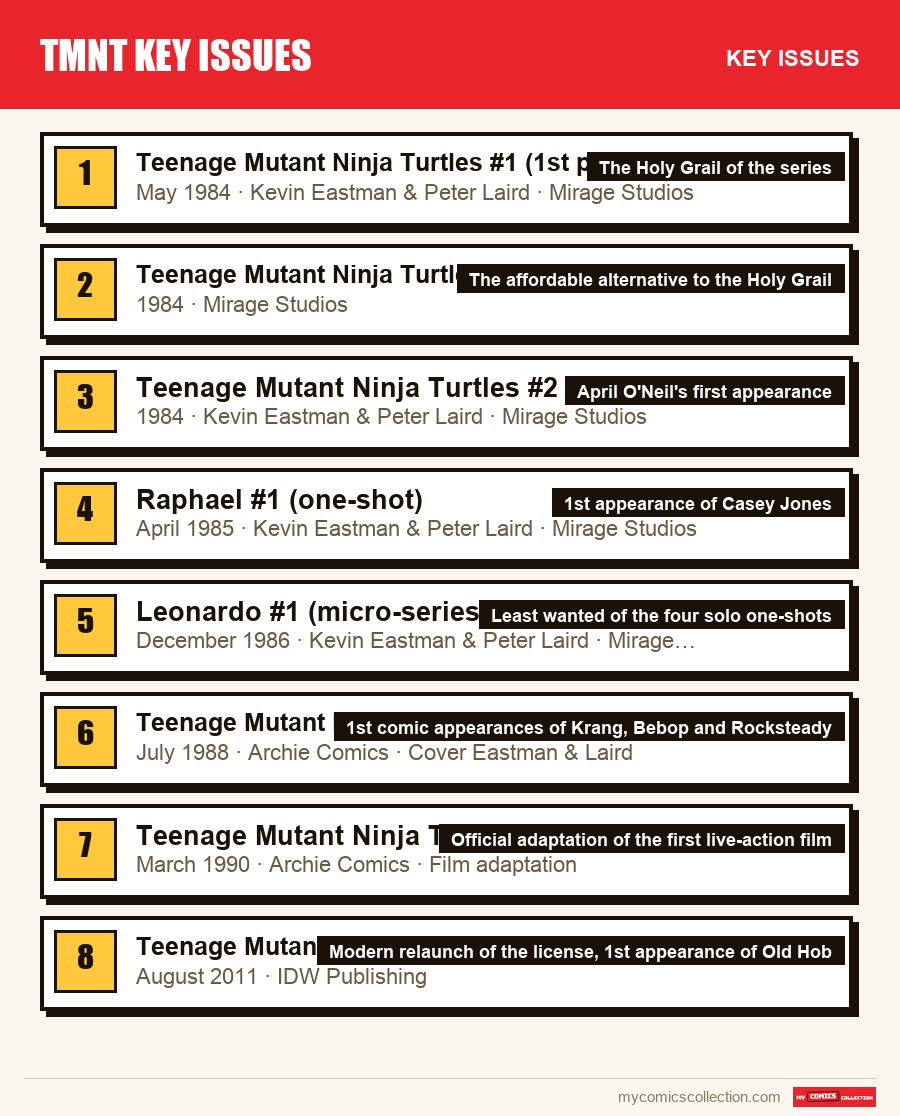
The absolute key number in the Teenage Mutant Ninja Turtles franchise remains Teenage Mutant Ninja Turtles #1 (Mirage Studios, May 1984, Kevin Eastman & Peter Laird), self-published in only about 3,275 copies and of which one CGC 9.8 copy sold $250,000 at ComicConnect in December 2021. Behind this Grail stand Raphael #1 (1985, 1st appearance of Casey Jones), TMNT #2 (1st appearance of April O'Neil), Teenage Mutant Ninja Turtles Adventures #1 (Archie, 1988, 1st comic appearances of Krang, Bebop and Rocksteady) and the relaunch IDW TMNT #1 (2011). Each tells a different chapter in the editorial history of the Turtles, from the underground fanzine in New Hampshire to the Paramount license worth more than a billion dollars in retail sales in 2023.
There are few examples as extreme in American comic book history as that of Teenage Mutant Ninja Turtles. An initial print run of less than 3,300 copies, printed by two young authors broke in New Hampshire to parody Frank Miller, Jack Kirby and Marvel's mutants, has become forty years later a multimedia franchise which exceeds a billion dollars in annual retail and whose first issue exchanges, under the best conditions, for six-figure sums. Few independent comics have experienced such a trajectory, and this is precisely what makes the TMNT key issue market so special: we come across both an ultra-rare self-published artifact worthy of the biggest auctions, and entire piles of accompanying comics (Archie, movie adaptations, micro-series) sold for a few dollars which nevertheless contain major first appearances.
This guide covers, number by issue, the publications which structure the rating of the franchise: the Mirage Studios genesis of 1984-1986, the Archie Comics wave carried by the cartoon of the 1980s-1990s, the adaptation of the first live-action film, then the IDW relaunch of 2011 which gave a second editorial life to the turtles until today. For each entry, we distinguish between what is a verifiable fact (print run, date, creator, documented selling price) and what is relative rarity when no reliable market value is available.
Before diving into the details of the issues, a word on the context: unlike a Marvel or DC event planned months in advance with a print run calibrated by the distributor Diamond, TMNT #1 was born from an almost accidental decision of two amateurs who simply wanted to print a one-shot for fun and sell it directly in comic shops in the Boston area. This artisanal origin explains both the extreme rarity of the first printing and the difficulty in establishing reliable circulation data for the very first issues: a problem that is rarely found on mainstream series of the same period.
Mirage Studios: the artisanal genesis of a phenomenon (1984-1986)
Kevin Eastman and Peter Laird have known each other since their drawing classes in Northampton. In 1983, they drew a humanoid turtle armed with nunchakus for fun, a nod to Marvel mutants and Frank Miller's Daredevil. The idea took shape into a complete comic, and the duo borrowed $1,300-partly from an uncle of Kevin Eastman's-to finance the printing of the first issue at a local printer. The ordered print run was 3,000 copies, but a printer's error added 275 additional copies, bringing the total of the first print run to approximately 3,275 copies according to the most in-depth research on the subject. The format is deliberately excessive (oversized magazine, black and white, cheap newsprint) and the issue, designed as a one-shot, was published in May 1984 under the newly created Mirage Studios label.
This small print run sold out in a few weeks in New England comic shops, driven by word of mouth and rave reviews in the specialized press of the time (notably Comics Buyer's Guide). Faced with demand, Eastman and Laird quickly launched a second, then a third edition of number 1 - externally identical to the first in terms of the cover, which today complicates identification for uninformed collectors. The series then became an ongoing in its own right: issue 2 introduced journalist April O'Neil in 1984, a character who would become a pillar of all subsequent adaptations, both cartoons and films.
Between 1985 and 1986, Mirage Studios developed the universe via one-shots outside of main continuity: the “micro-series” format, one solo comic per turtle, allowed Eastman and Laird to explore each character. It was in the very first of these spin-offs, Raphael #1 (April 1985), that Casey Jones arrived, the hockey-masked vigilante who would become the turtles' recurring human ally. The following micro-series (Michelangelo, Donatello, Leonardo) were released until 1986 and closed what collectors today call the founding Mirage era, before the ongoing series continued its course in the 1990s with a niche but loyal readership.
Teenage Mutant Ninja Turtles #1 (1st printing)
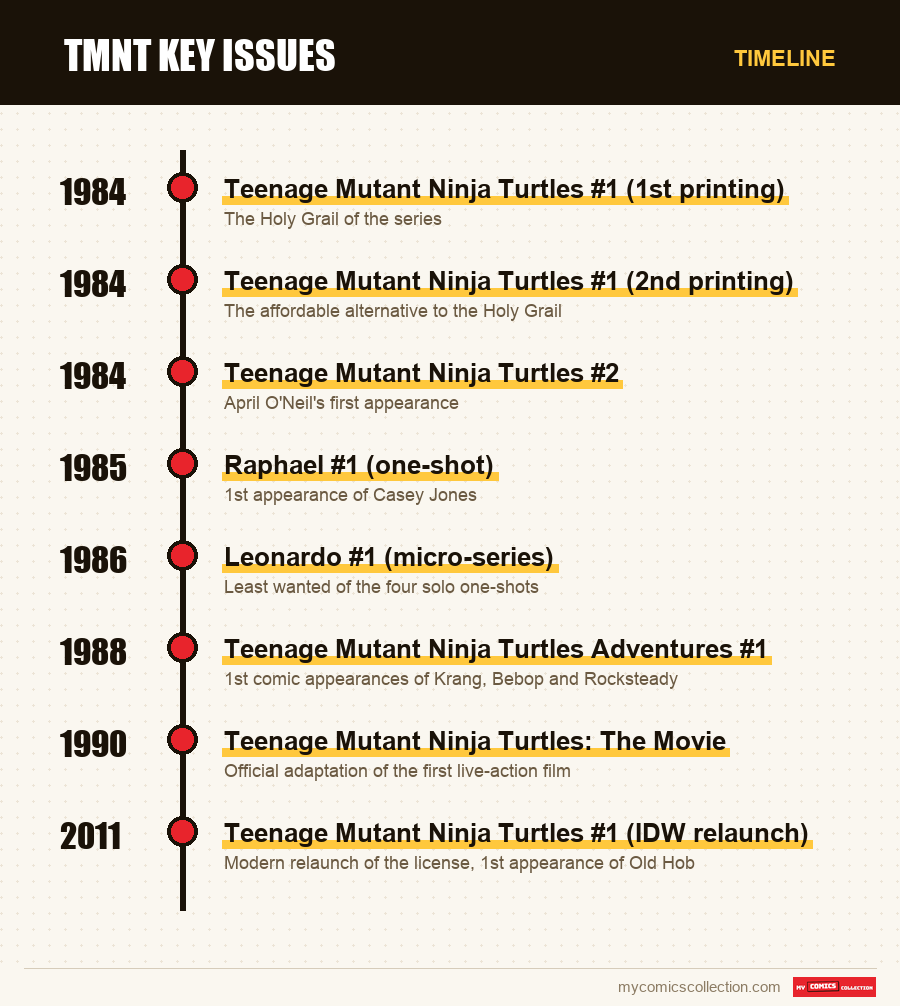
Complete origin of the four turtles and Splinter, and first appearance of the Shredder (Oroku Saki). Self-published with an estimated print run of around 3,275 copies (3,000 ordered plus 275 overprint copies from the printer), it is one of the smallest print runs ever achieved by a comic that has become cult, and one of the rare independent comics to have exceeded the symbolic $200,000 mark at auction. The predominantly black cover makes even the slightest defect visible, making it extremely difficult to achieve a high grade.
Teenage Mutant Ninja Turtles #1 (2nd printing)
Faced with immediate demand generated by the first print run which sold out in a few weeks, Mirage Studios relaunched the printing of issue 1 the same year. The cover is visually identical to the first printing: only internal details (indicia, printing quality) allow them to be reliably differentiated, hence the importance of having a suspect copy authenticated before purchase. Long considered a simple curiosity at a few hundred dollars, this second print has seen its popularity take off in recent years, with some buyers switching to it due to lack of budget for the first print.
Teenage Mutant Ninja Turtles #2
Second issue of the ongoing Mirage series, which introduces April O'Neil, originally presented as a computer scientist before becoming, in the TV and film adaptations, the iconic journalist associated with the Turtles. The circulation of this issue remains significantly higher than that of issue 1 since it was published after the unexpected success of the original one-shot, which makes it a rare issue but less extreme than the very first.
Raphael #1 (one-shot)
First spin-off ever published in the Mirage universe and prelude to the micro-series format. This one-shot marks the first appearance and first cover of Casey Jones, a character who would become a mainstay of the franchise through all of its subsequent adaptations. The first print is distinguished by a two-color cover and contains the very first illustration of the four turtles gathered in a group, dating from 1983, reused at the opening of the story. Originally published for $1.50, it falls chronologically between issues 3 and 4 of the ongoing series.
Leonardo #1 (micro-series)
Last of the four one-shots in the micro-series dedicated to each turtle (after Raphael, Michelangelo and Donatello), Leonardo #1 recounts a clash against the Foot Clan against the backdrop of Christmas Eve. Unlike Raphael #1, this issue does not benefit from a notable first appearance, which explains its significantly more modest rating despite a comparable rarity in terms of circulation. This is traditionally the most affordable entry for anyone wanting to complete the complete series of four solo micro-series.
Teenage Mutant Ninja Turtles Adventures #1
Launched by Archie Comics to accompany the dazzling success of the 1987 cartoon, this series adapts the more colorful and family-friendly universe of the television version, distinct from the original Mirage continuity. Issue 1 marks the very first comic book appearances of Krang, Bebop and Rocksteady, a trio of villains who have become emblematic of mainstream TMNT imagery from the years 1988-1996. Published at $1.00 for 36 pages, it also existed in the form of a promotional pack of three copies distributed on newsstands.
Teenage Mutant Ninja Turtles: The Movie
Published to accompany the release of the very first live-action TMNT film in theaters in 1990, this 62-page adaptation existed in two distinct versions: a prestige edition with colors painted by Steve Lavigne, and a newsstand edition with flat colors signed Barry Grossman, each with its own visual identity. Today it is an affordable and nostalgic entry point into the catalog of TMNT comics linked to cinema adaptations, far from the heights of the Mirage period.
Teenage Mutant Ninja Turtles #1 (IDW relaunch)
After passing the license to Image then Dreamwave and Devil's Due in the years 1990-2000, IDW Publishing resumed exploitation of the turtles in 2011 with a new number 1, sold for $3.99 on newsstands. This relaunch lays the foundations of the IDW continuity still active today (more than ten years of continuous publication) and marks the first appearance of Old Hob, a mutant cat who will become one of the great recurring antagonists of this new editorial era. Several cover variants exist, including some exclusive ones distributed in very small quantities by partner comic shops.
Collecting this series?
Track what you own, what you are missing and what your collection is worth. 7 day trial.
Start my trial →The impact of adaptations on the rating
Few comic book franchises illustrate the link between mainstream exposure and collector interest as well as TMNT. The 1987 syndicated cartoon transformed the Turtles, until then a niche phenomenon in the independent comic world, into a cultural tidal wave affecting an entire generation of children. It was this wave that pushed Archie Comics to launch its own TMNT Adventures series in 1988, in parallel with the original Mirage continuity intended for a more mature audience. The first live-action film of 1990, a huge box office success for an independent studio film, continued this craze and in turn generated its own comic book adaptation as well as a wave of derivative products.
Closer to home, the release in 2023 of the animated feature film Teenage Mutant Ninja Turtles: Mutant Mayhem has once again propelled the brand to the forefront: according to figures cited by Deadline and CBR, the TMNT franchise crossed the billion dollar mark in global retail sales in 2023 alone, a level to be compared to the 8 billion dollars accumulated between 2012 and 2022. In the wake of this success, IDW Publishing has launched a new series, Tales of the Teenage Mutant Ninja Turtles, directly inspired by the Paramount+ animated series that followed the film. This type of cycle (release of a film or series, influx of new fans, editorial relaunch) has been a constant in the history of the license for forty years, and each wave mechanically brings part of the public back to the original publications, in particular to TMNT #1 whose legend (small print run, six-figure auction price) circulates widely beyond the circle of regular collectors.
However, it is necessary to qualify: unlike mainstream series where we can establish a direct correlation between the release of a film and the immediate rise in the rating of a specific issue, most of the value of TMNT #1 is due to its structural rarity (less than 3,300 copies printed forty years ago, of which only a fraction has survived in good condition) rather than to the cinematographic news of the moment. The market also experienced a clear decline after the peak of the 2020-2021 period: a CGC 9.8 which was trading around $90,000 in 2019 reached $245,000 then $250,000 at the end of 2021 in the midst of a post-pandemic speculative bubble, before returning to levels closer to $87,000 on more recent sales. This volatility is a reminder that an extremely rare key issue remains subject to the cycles of the collecting market as a whole, regardless of the success of the content it represents.
Buying guide
- Distinguish the first three prints of TMNT #1: the covers of the first, second and third printings from 1984-1985 are almost identical to the naked eye. The first print can be recognized by precise details of the indicia and the interior printing quality: it is better to buy a copy already encapsulated and authenticated CGC or CBCS than to rely on a simple cover photo on a classified ad.
- Beware of counterfeits: given the amounts involved in the first printing, TMNT #1 is one of the most regularly counterfeited or fraudulently reproduced comics on the American market. Any five or six-figure transaction must go through a recognized auction house or a copy already graded by a trusted third-party service.
- Understand the impact of newsprint on the score: printed on cheap stock typical of the early 1980s, TMNT #1 yellows easily and the mostly black cover brings out even the slightest scuff or corner crease. The difference between a grade 9.4 and a 9.8 often comes down to details invisible at first glance: see our comparison CGC grade 9 vs 9.8 to understand what justifies such differences in value on this type of comic with a dark cover.
- Do not neglect micro-series and one-shots: Raphael #1 concentrates most of the group's value thanks to Casey Jones, but Michelangelo #1 and Donatello #1 remain sought-after pieces by collectors who aim for the complete series of four solo one-shots, even without a significant first appearance.
- Check the origin on the Archie comics and the film adaptations: these issues, much more affordable, are an excellent entry point to discover the franchise without a four or five-figure budget: provided you check that it is indeed the first print run when a variant exists (promo pack, prestige edition vs newsstand).
- Compare actual sales before buying or selling: price guides evolve slowly in the face of a market as volatile as that of TMNT #1 in recent years. Cross-referencing several recent sales remains essential before any major transaction.
- Catalog your collection upon purchase: With so many prints, variants and reissues on this franchise, keeping an accurate inventory avoids costly mix-ups: that's exactly what our comic collection management application.