
Ninja Turtles (1990) Steve Barron adapts the comic book Kevin Eastman and Peter Laird (Mirage Studios, 1984). The film combines the darkness of the original comic with the lighter spirit of the cartoon, with Leonardo, Michelangelo, Donatello, Raphael and Splinter. Here is the detailed comparison, film versus comics.
Adaptation of an independent comic strip that has become a global phenomenon, Ninja Turtles oscillates between the dark tone of its source and the lightness of the cartoon. Source-by-source decryption.
As in each article in this series, only verified information (creators, distribution, dates, publishers) is stated; the comparative analysis is ours, without reproducing dialogue or protected images.
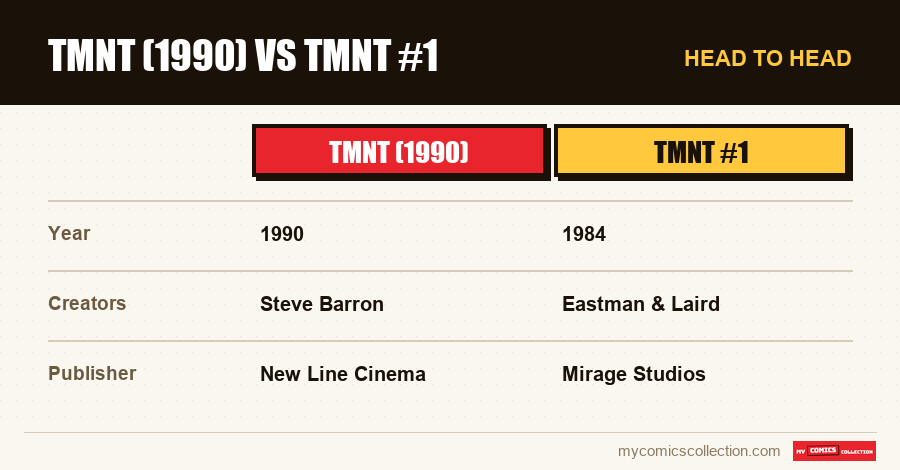
Title : Ninja Turtles (1990)
Director: Steve Barron
Actors/voices: Judith Hoag (April O'Neil), Elias Koteas (Casey Jones)
Exit : March 1990
Studio: New Line Cinema
TMNT #1 (1984): Kevin Eastman & Peter Laird
Mirage Studios: the independent publisher
Four mutant turtles: raised by Splinter
The Football Clan and Shredder
- THE four turtles mutants and their weapons.
- Splinter, the rat sensei, and their origin.
- Le football clan and its leader Shredder.
- April O'Neil and Casey Jones.
- A tone more dark, close to comics.
- THE colored headbands come from the cartoon (comics: all red).
- L'humor and the lighthearted lines from the cartoon.
- The origin of Splinter mixes comics and cartoons.
- Comic book violence is attenuated.
- An origin story condensed.
TMNT #1 (1984): the independent comic book by Eastman and Laird
Ninja Turtles adapts the comic strip Teenage Mutant Ninja Turtles, created by Kevin Eastman and Peter Laird, published in 1984 by Mirage Studios, an independent publisher founded by the two authors. Originally, the comic was a dark and violent parody of superhero and ninja comics of the time, printed in black and white in a small print run. It features four mutant turtles (Leonardo, Michelangelo, Donatello and Raphael) raised in the sewers of New York by a mutant rat, sensei Splinter, who teaches them the art of ninjutsu. Named after Italian Renaissance masters, the Turtles face off against the Foot Clan and its leader, Shredder. This improbable concept, born from a joke between two authors, would become one of the greatest phenomena in popular culture.
The film faithfully covers the fundamental concept: the four turtles, their weapons and personalities, Splinter and the origin of the group, the Foot Clan and Shredder, as well as the allies April O'Neil and Casey Jones. It also maintains, for a family film, a relatively dark tone and careful production, notably the elaborate animatronic costumes. This fidelity to the comic strip, while integrating elements of the then popular cartoon, makes the film a balanced adaptation. The film thus draws from two sources: the dark comic of Mirage and the lighter cartoon:, seeking to satisfy fans of both universes while remaining accessible to the general family audience.
Between the darkness of the comic and the lightness of the cartoon
The particularity of the 1990 film is to navigate between two tones: the darkness of the original comic book and the lightness of the 1987 cartoon. Eastman and Laird's comic book was dark, violent and satirical, anchored in the aesthetics of ninjas and urban thrillers. The cartoon, on the other hand, had transformed the turtles into colorful and funny heroes for children, with different colored headbands, catchphrases and a permanent good mood. The film seeks a balance: it retains the humor, the lines and the team spirit of the cartoon, while reintegrating some of the darkness and urban atmosphere of the comic, with more realistic fights and a nocturnal atmosphere.
This mixture of tones makes the film unique. By drawing on both sources, it offers a more mature version of the turtles than the cartoon without reaching the violence of the comics. The fights, the atmosphere of the sewers and the threat of the Football clan are reminiscent of the comic, while the humor and camaraderie come from the cartoon. This synthesis appealed to a large audience and made the film a success. It illustrates how an adaptation can reconcile different visions of the same universe. For the reader, the film is an invitation to discover the original comic strip, much darker and more adult than the popular image of the turtles, where Eastman and Laird deploy an urban and martial satire as opposed to the colorful cartoon which made the characters world famous.
A phenomenon born from a confidential comic book
The story of the Ninja Turtles is that of an improbable success, born from an independent and confidential comic strip. Kevin Eastman and Peter Laird created the Turtles in 1984 as a parody, self-funding the printing of their first issue in a few thousand copies. Against all expectations, this absurd concept, teenage mutant ninja turtles, met with growing success, before exploding with cartoons, toys and films, becoming one of the greatest merchandising phenomena of the end of the 20th century. This trajectory, from a small-run black and white comic to a global business empire, illustrates the unsuspected potential of independent comics and the power of an original idea.
The 1990 film is a major milestone in this phenomenon, bringing the Turtles to cinema with considerable success. It bears witness to the path traveled by a creation that started from nothing, the fruit of the imagination of two independent authors. This success illustrates the vitality of the independent scene of the 1980s, where creators could, outside of major publishers, give birth to lasting universes. For the reader and the collector, the story of the turtles is fascinating: it reminds us that some of the greatest successes in popular culture have modest origins, in the pages of confidential comics. The Ninja Turtles invite you to rediscover TMNT #1, a founding issue that has become legendary, a symbol of the potential of independent comics and an authors' dream that has become a global reality.
Collecting this series?
Track what you own, what you are missing and what your collection is worth. 7 day trial.
Start my trial →The characters, from paper to screen
- The four turtles: Leonardo, Michelangelo, Donatello, Raphael, faithful to the comics.
- Splinter: Rat sensei, master of turtle ninjutsu.
- Shredder: The leader of the Foot clan, sworn enemy of the turtles.
- April O'Neil: The turtle ally reporter.
- Casey Jones: The vigilante in the hockey mask, ally of the turtles.
Mirage Studios and independent comics
The Ninja Turtles were born at Mirage Studios, the publisher founded by Kevin Eastman and Peter Laird to publish their creation. This independent framework, where authors retained total control of their work, allowed the emergence of a concept that no major publisher would probably have financed. Mirage illustrates the vitality of the independent scene of the 1980s, a thriving period when many creators self-published original works, on the fringes of the giants of the sector. This creative freedom has given birth to atypical universes, of which the Ninja Turtles are the most resounding example. The success of Mirage inspired an entire generation of independent authors and proved that a personal creation could conquer the world.
This independent origin makes the Ninja Turtles a symbol of the potential of author comics. Starting with a self-financed parody, Eastman and Laird built an empire, while maintaining control of their creation for a long time. This model, where authors control their universe, has produced some of the most original franchises, often adapted to the cinema for their freshness. The success of Turtles confirmed the appeal of independent properties. For the reader, it illustrates the richness of the underground comics scene, where free creators shape new worlds. The Ninja Turtles remind us that independent comics, far from the superheroes of major publishers, have generated major phenomena, born solely from the imagination of passionate authors, and that Mirage Studios remains one of the most emblematic and inspiring examples.
Costumes that marked the cinema of the 1990s
One of the great achievements of the 1990 film is its costumes and practical effects. To bring the four turtles to life, the production used elaborate animatronic costumes, designed by a workshop renowned for its creature expertise. These costumes, equipped with mechanisms allowing facial expressions, gave the turtles a credible and endearing physical presence, far from the digital effects which would dominate later. This artisanal approach, combining puppeteers, stuntmen and animatronics, made the turtles alive and expressive, contributing greatly to the success and lasting charm of the film. It bears witness to the know-how of practical effects of the time.
This technical success partly explains why the film has aged so well in the hearts of fans. The tangible costumes give the turtles a materiality that computer-generated images sometimes struggle to match, anchoring the characters in the real world. This artisanal dimension, characteristic of 1990s cinema, contributes to the nostalgic charm of the film. It also illustrates the care taken in this adaptation, which, far from treating the turtles as a simple derivative product, sought to bring them to life with ambition. For the reader and viewer, these iconic costumes are an integral part of the film's legacy. They remind us that bringing comic book characters as atypical as mutant turtles to the screen required real technical prowess, achieved here with know-how that left its mark on an entire generation of Ninja Turtles fans.
Where to start reading
To learn about the Turtles, Eastman and Laird's TMNT #1 (1984) presents their origin, in dark black and white. The first issues of the Mirage series, much more violent than the cartoon, reveal the true nature of the concept. Reissues and complete editions are accessible. This comic reveals a world a thousand miles from the cartoon image of turtles.
Chronology of comics to know
- 1984: TMNT #1: the beginning of comics at Mirage Studios.
- 1987: The cartoon popularizes turtles among the general public.
- 1990: The film successfully brings the turtles to the cinema.
Collection side: what numbers to aim for after the film
The Ninja Turtles point to a major key to independent comics. TMNT #1 (1984, first issue at Mirage Studios) is one of the most sought-after and valuable keys to independent comics, due to its very limited initial print run and its founding status. First impressions are particularly prized and can reach new heights. Reissues remain accessible. These numbers cover a wide variety of budgets, from the affordable to the very high. As always, condition and gradation determine value; relying on real recent sales is strongly recommended.
Its place in the saga and for the collector
Ninja Turtles (1990) will remain as the adaptation which brought to the cinema a phenomenon born from an independent comic book, balancing the darkness of the comic and the lightness of the cartoon. For the collector, it increased interest in TMNT #1, one of the most valuable keys to independent comics. It illustrates the potential of self-published creations. Beyond the film, Eastman and Laird's comic book deserves to be discovered for its original darkness. The Ninja Turtles are a reminder that an improbable idea, born from a small publisher, can become a global and lasting cultural phenomenon.
The verdict: a balance between comic and cartoon
- Loyalty: the four turtles, Splinter, the origin, the Foot Clan, Shredder, April O'Neil, Casey Jones and a relatively dark tone come from the comics.
- Freedoms: the colored strips of the cartoon, the humor of the cartoon, the mixed origin of Splinter, the attenuated violence, a condensed story.
- Collectible numbers: TMNT #1 (1984, Mirage Studios).
Ninja Turtles adapts Eastman and Laird's independent comic book by balancing the darkness of the original comic and the lightness of the cartoon. Faithful to the four turtles, Splinter and Shredder while integrating popular elements of the cartoon, the film brought to the cinema a phenomenon born from a small publisher. For both the reader and the collector, it is an invitation to discover TMNT #1.
Frequently asked questions
From Teenage Mutant Ninja Turtles, created by Kevin Eastman and Peter Laird, published in 1984 by Mirage Studios, an independent publisher they founded. Originally a dark and violent parody in black and white, it features four mutant turtles raised by the rat Splinter.
No. The original comic is much darker and more violent, a satirical parody of ninjas and superheroes. The 1987 cartoon transformed the turtles into colorful children's heroes. The 1990 film seeks a balance between these two tones.
This element comes from the 1987 cartoon, not the comic strip. In the original comic, the four turtles all wear red headbands. The distinct colors (blue, orange, purple, red) were introduced to help children distinguish them, and the film incorporates them.
In part. It retains the turtles, Splinter, the origin, the Foot Clan, Shredder, April and Casey Jones, as well as a relatively dark tone close to the comic. But it incorporates the humor and color strips of the cartoon, and attenuates the violence of the original comic strip.
TMNT #1 (1984, first issue from Mirage Studios) is one of the most sought-after and valuable keys to independent comics, due to its very limited initial print run. First impressions can be so high; reissues remain accessible.
Does the film make you want to collect? Estimate the value for free of your numbers (TMNT #1…) with our tool based on current eBay listings.