Kick-Ass (2010) Matthew Vaughn , with Aaron Taylor-Johnson and Chloe Grace Moretz, adapts the comic book of Mark Millar and John Romita Jr. (Icon/Marvel, 2008). The film faithfully follows the idea of a powerless teenager playing a superhero, but softens the darkness of the comics. Here is the detailed comparison, film versus comics.
Crazy satire of the superheroic myth, Kick-Ass questions what would happen if an ordinary teenager really decided to become a vigilante. Source-by-source decryption.
As in each article in this series, only verified information (creators, distribution, dates, publishers) is stated; the comparative analysis is ours, without reproducing dialogue or protected images.
Title : Kick-Ass (2010)
Director: Matthew Vaughn
Actors: Aaron Taylor-Johnson (Dave/Kick-Ass), Chloë Grace Moretz (Hit-Girl), Nicolas Cage (Big Daddy)
Exit : April 2010
Studio: Lionsgate
Kick-Ass #1 (2008): Mark Millar & John Romita Jr.
icon: Marvel's creator-owned label
An ordinary teenager: without powers, as a vigilante
A satire: violent and realistic superhero
- Dave Lizewski, teenager becoming Kick-Ass without powers.
- Hit Girl and Big Daddy, the vigilante duo.
- La violence and the raw realism of the concept.
- La satire superheroic fantasy.
- The inspiration of viral videos.
- The end is more optimistic than comics.
- The origin of Big Daddy is softened.
- Dave's Romance results (unlike comics).
- The tone, although dark, is more heroic.
- Some of the darkness in the comics is toned down.
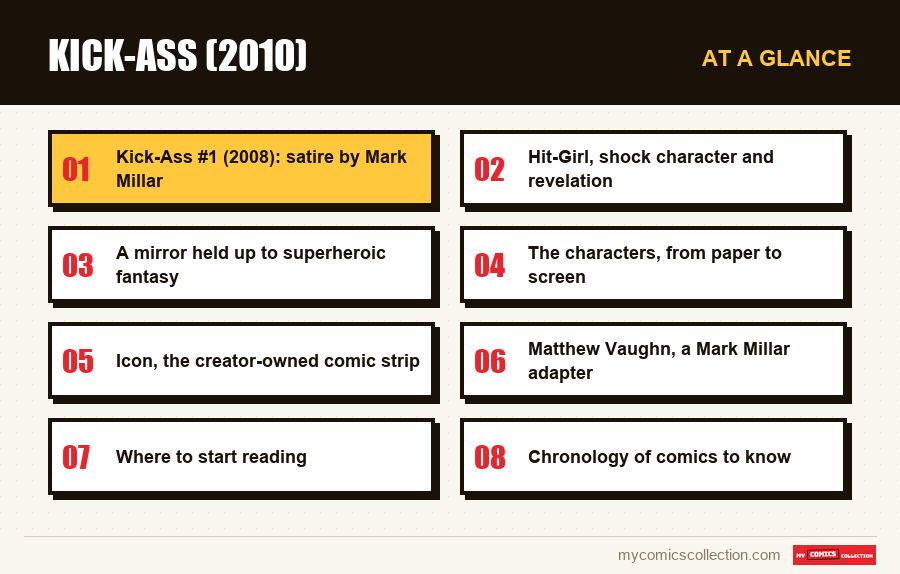
Kick-Ass #1 (2008): satire by Mark Millar
Kick-Ass adapts the eponymous comic book, written by Mark Millar and drawn by John Romita Jr., published from 2008 under the Icon label, Marvel's creator-owned imprint. The comic poses a provocative question: what would happen if an ordinary teenager, without any superpowers, really decided to become a superhero? Dave Lizewski, a young, ordinary comic book fan, makes himself a costume and sets out to fight crime, with brutal and realistic results: beatings, serious injuries, humiliation. The comic is a violent and cynical satire of superheroic fantasy, confronting the imagination of comics with harsh reality. Millar deploys his provocative style, mixing dark humor, ultraviolence and criticism of geek culture.
The film faithfully takes up this premise: Dave Lizewski, an ordinary teenager, becomes Kick-Ass without powers and discovers the brutality of reality. Aaron Taylor-Johnson plays this unlikely hero, whose beginnings end in beatings and a stay in hospital. The film retains the raw realism, violence and satire of the concept, as well as the iconic characters of Hit-Girl and Big Daddy. This fidelity to the spirit of the comic strip, in particular its provocative dimension and its disenchanted view of heroism, anchors the film in the world of Mark Millar. The film, however, softens certain aspects, notably the outcome and the fate of the characters, which are darker in the comics.
Hit-Girl, shock character and revelation
The big revelation of Kick-Ass, both film and comic book, is Hit-Girl. A ten-year-old girl trained by her father, Big Daddy, to become a formidable killer, Hit-Girl overturns the codes by being both a child and a frighteningly efficient killing machine. Wielding weapons and crude language with disconcerting aplomb, she is the most striking and controversial character in the work. His extreme violence, shocking in contrast to his young age, embodies the provocation at the heart of Mark Millar's project. Hit-Girl subverts the image of childish innocence, creating a character as disturbing as she is fascinating, who has become iconic.
The film reprises Hit-Girl with Chloë Grace Moretz in a role that caused a sensation. It retains its violence, its deadly effectiveness and the shock of seeing a child engage in such acts, faithful to the comics. This character, both endearing and disturbing, is the beating heart of the film and the comic strip. The film fully exploits his provocative potential, while developing his touching relationship with his father. This dimension has sparked debate and controversy, with some seeing it as a brilliant criticism, others as a gratuitous provocation. For the reader, Hit-Girl illustrates Mark Millar's style: pushing the boundaries to question the conventions of the genre. She has become one of the most emblematic characters of modern independent comics, to be discovered in the pages of Kick-Ass, where her darkness is even more assumed than on screen.
A mirror held up to superheroic fantasy
At the heart of Kick-Ass is a reflection on superheroic fantasy and its confrontation with reality. By showing an ordinary teenager trying to become a hero and being beaten, stabbed and humiliated, the work deconstructs the comic book ideal. It poses a disturbing question: in the real world, playing vigilante would be suicidal unconsciousness, not heroism. This satire, faithful to the provocative spirit of Mark Millar, questions comic book culture and the desire for escape that it nourishes. Kick-Ass is thus both a tribute and a sharp criticism of the superheroic genre, playing on the gap between dreams and brutal reality.
The film captures this satirical dimension, showing the very real consequences, physical and psychological, of vigilante life. It retains the comics' disillusioned view of heroism, while offering, paradoxically, moments of true superheroic exaltation. This double level, criticism and celebration, is the richness of the work. The film, however, softens the cynicism of the comic, offering a more optimistic ending and a romance that achieves, where Millar leaned towards darkness and failure. For the reader, this difference in tone illustrates the choices of an adaptation seeking a balance between provocation and general public entertainment. Kick-Ass invites you to discover the original comic book, darker and more radical, which pushes the deconstruction of the superheroic myth even further, offering a raw and uncompromising look at what it would really mean to put on a hero's costume.
Collecting this series?
Track what you own, what you are missing and what your collection is worth. 7 day trial.
Start my trial →The characters, from paper to screen
- Dave Lizewski / Kick-Ass: The teenager without powers, faithful to the comics.
- Hit Girl: The little killer girl, a shocking character in the work.
- Big Daddy: The vigilante father, whose origin is softened in the film.
- Red Mist: The false ally turned enemy, faithful to the comics.
- Frank D'Amico: The antagonistic mafia boss, adapted for the film.
Icon, the creator-owned comic strip
Kick-Ass was published under the Icon label, Marvel's imprint dedicated to creator-owned works, where authors retain the rights to their creations. This framework allowed Mark Millar to develop a personal, violent and provocative work, impossible within the framework of traditional Marvel superheroes. Kick-Ass is thus part of the author's comics movement, where creators explore original universes with total freedom. Millar is one of the great architects of this movement, having built an entire universe of creator-owned properties adapted for cinema. This dimension makes Kick-Ass a separate work, born of creative freedom rather than an established franchise.
This creator-owned origin explains the audacity of Kick-Ass. Freed from the constraints of great frankness, Mark Millar was able to create an uncompromising satire, driven by violence and cynicism. This model, where the author controls his creation, has produced some of the most original works of modern comics, often noted by the cinema for their freshness. The success of Kick-Ass at the cinema confirmed the appeal of these independent properties. For the reader, it illustrates the vitality of creator-owned comics, where authors shape personal universes far from classic superheroes. Kick-Ass is an invitation to discover this facet of comics, that of creators who, like Mark Millar, reinvent the genre with freedom and provocation, offering stories that shake up conventions and, in return, nourish a cinema in search of new stories.
Matthew Vaughn, a Mark Millar adapter
The film Kick-Ass marks the start of a fruitful collaboration between director Matthew Vaughn and the world of Mark Millar. Vaughn has captured the provocative energy, dark humor and stylized violence that characterize the Scottish author's work, while making it accessible to a wide audience. His adaptation of Kick-Ass, faithful to the spirit of the comic book while balancing its darkness, demonstrated that a creator-owned property could produce a successful film. This success established Vaughn as a privileged adapter of Millar's works, capable of translating their particular tone to the screen, between satire, unbridled action and assumed irreverence.
This collaboration illustrates the attraction of cinema for the worlds of Mark Millar, whose visual and narrative style particularly lends itself to adaptation. Millar's works, designed with a sense of spectacle and provocation, offer directors rich and cinematic material. Matthew Vaughn knew how to exploit this dimension, making Kick-Ass a model for adapting a daring independent comic book. For the reader, this dynamic reminds us that certain comic book authors, through their style and ambition, have become regular providers of stories for the big screen. Kick-Ass is the result of this meeting between a provocative author and a director capable of restoring its energy, offering an adaptation that honors comics while attracting a much wider audience than that of independent comics readers.
Where to start reading
To check out the source, Kick-Ass #1 (2008) by Mark Millar and John Romita Jr. features the debut of Dave Lizewski. The first complete series (eight issues) is available as a collection and can be read in one sitting. The sequels expand the universe, notably Hit-Girl. This comic, darker than the film, reveals all the radicality of the concept.
Chronology of comics to know
- 2008: Kick-Ass #1: the beginning of comics at Icon (Marvel).
- 2010: The film adapts the first series and propels the concept.
- 2010+: The sequels (Kick-Ass 2, Hit-Girl) expand the universe.
Collection side: what numbers to aim for after the film
Kick-Ass points to modern keys. Kick-Ass #1 (2008, first issue of the comic) is the key sought after by collectors, marking the beginning of a creator-owned property that has become cult. The first issues, especially those introducing Hit-Girl, are popular. The collections in the series are accessible targets. These numbers cover generally affordable budgets. As always, condition and gradation determine value; relying on real recent sales is strongly recommended.
Its place in the saga and for the collector
Kick-Ass will remain as a faithful and striking adaptation of a provocative creator-owned comic book, revealing the shocking character of Hit-Girl. For the collector, it highlighted Kick-Ass #1, the key to a cult work by Mark Millar. It illustrates the vitality of author comics and its appeal for cinema. Beyond the film, the original comic book deserves to be discovered for its radicalism and black humor. Kick-Ass reminds us that creator-owned works, freed from franchises, offer some of the most daring satires of the superhero genre.
The verdict: a faithful satire, slightly softened
- Loyalty: Dave Lizewski as Powerless Kick-Ass, Hit-Girl, Big Daddy, realistic violence and satire of superheroic fantasy come from comics.
- Freedoms: a more optimistic ending, the origin of Big Daddy softened, the romance which results, a more heroic tone, certain darkness attenuated.
- Collectible numbers: Kick-Ass #1 (2008, Icon/Marvel).
Kick-Ass adapts Mark Millar and John Romita Jr.'s violent satire, following an ordinary teenager who becomes a powerless vigilante. Faithful to the concept, to Hit-Girl and to the criticism of the superheroic fantasy but softening the darkness of the comics, the film is a success of the genre. For both the reader and the collector, it is an invitation to discover Kick-Ass #1.
Frequently asked questions
From Kick-Ass (2008), written by Mark Millar and drawn by John Romita Jr., published under Icon, Marvel's creator-owned imprint. The comic imagines an ordinary teenager becoming a superhero without powers. The film faithfully takes up the concept and satirical spirit.
Largely. It retains Dave Lizewski, Hit-Girl, Big Daddy, realistic violence and genre satire. However, it softens certain aspects: a more optimistic ending, a successful romance and the origin of Big Daddy modified, where the comic is more dark and cynical.
A ten-year-old girl trained by her father, Big Daddy, to become a formidable killer. A shocking and controversial character, she subverts the image of childish innocence with her extreme violence. She is the most striking character in both the comics and the film.
Marvel's imprint dedicated to creator-owned works, where authors retain the rights to their creations. It allowed Mark Millar to develop Kick-Ass, a violent satire impossible within the framework of classic Marvel superheroes. This framework explains the audacity of the work.
Kick-Ass #1 (2008, first issue of the comic) is the key sought after, marking the beginning of a creator-owned property that has become cult. The first issues introducing Hit-Girl are popular, and the collections are accessible targets.
Does the film make you want to collect? Estimate the value for free of your numbers (Kick-Ass #1…) with our tool based on current eBay listings.