Sin City (2005) Robert Rodriguez and Frank Miller , with Mickey Rourke and Bruce Willis, adapts the graphic novels of Frank Miller (Dark Horse, 1991). The film reproduces the comic strip panel by panel, in contrasting black and white of rare fidelity. Here is the detailed comparison, film versus comics.
A masterpiece of literal adaptation, Sin City transposes the aesthetic of Frank Miller's thriller noir directly to the screen. Source-by-source decryption.
As in each article in this series, only verified information (creators, distribution, dates, publishers) is stated; the comparative analysis is ours, without reproducing dialogue or protected images.
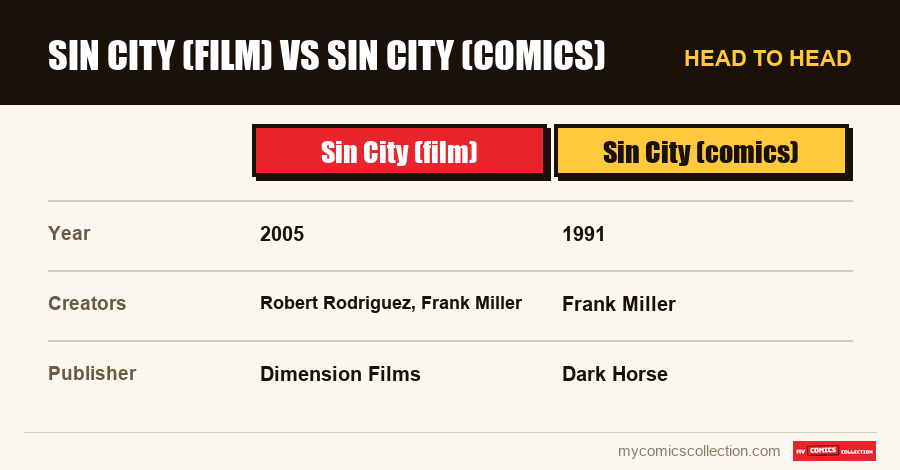
Title : Sin City (2005)
Directors: Robert Rodriguez, Frank Miller
Actors: Mickey Rourke (Marv), Bruce Willis (Hartigan), Jessica Alba (Nancy), Clive Owen (Dwight)
Exit : April 2005
Studio: Dimension Films
Sin City (1991): Frank Miller, at Dark Horse
“The Hard Goodbye”: Marv's story
“That Yellow Bastard”: Hartigan's story
A black and white: contrasting and expressionistic
- THE intertwined stories from Basin City.
- Le black and white contrasting, with touches of color.
- La composition of boxes, reproduced shot by shot.
- THE characters: Marv, Hartigan, Dwight, Nancy.
- La voiceover narration black polar type.
- A few stories of comics are left aside.
- L'order stories are reorganized.
- La duration requires cuts in the material.
- The move to cinema adds the movement and sound.
- Very few freedoms: almost total loyalty.
Sin City (1991): the noir thriller by Frank Miller
Sin City adapts the series of graphic novels created by Frank Miller, published from 1991 by Dark Horse Comics. A cult comic book work, Sin City is a tribute to the noir thriller and the station novel, transposed into a universe of extreme black and white, where sharp shadows and cut-out silhouettes create an atmosphere that is both stylized and brutal. Set in the fictional Basin City, a town riddled with crime, corruption and violence, the series intertwines dark tales populated by tough guys, femme fatales, killers and disillusioned police officers. Frank Miller deploys a unique, expressionist and radical graphic style, making Sin City an absolute reference in black comics for adults.
The film is recognized as one of the most faithful adaptations ever made. Robert Rodriguez, supported by Frank Miller himself as co-director, reproduced the comic strip almost panel by panel, transposing to the screen the composition of the boards, the framing, the dialogues and the aesthetic in contrasting black and white. The film recreates the emblematic stories of the series, the characters and the atmosphere of thriller noir. This meticulous fidelity, where the cinematographic image seeks to equal the drawn panel, makes Sin City a unique experience: that of a comic book literally brought to the screen, without betrayal of the original material.
An aesthetic reproduced plan by plan
What sets Sin City apart is its absolute visual fidelity. The film reproduces the contrasting black and white aesthetic of Frank Miller's comic strip, with its flat areas of black, its bright whites and its occasional touches of bright color (the red of a dress, the yellow of a character) which punctuate the image. This approach, obtained by filming on a green screen and extensive digital work, directly transposes the graphic style of the boards to the screen. The framing, compositions and even certain panels of the comic strip are recreated identically, making the film a true animation of the original plates. This technical and artistic prowess makes Sin City an unrivaled visual experience, where the line between comics and cinema blurs.
This aesthetic fidelity illustrates a rare approach to adaptation: not reinterpreting, but literally transposing. Where most films are freely inspired by their source, Sin City seeks to reproduce it, to be the version in motion. This bias, made possible by the direct collaboration of Frank Miller, honors the original work with exceptional reverence. The result is a film that feels like a living comic book, preserving Sin City's unique visual identity. For the reader, this adaptation is a celebration of Frank Miller's style, each panel of which finds its echo on the screen. It recalls the graphic power of the original comic strip and invites us to discover the graphic novels, where Miller's art deploys all its expressionist force, offering a reading experience as immersive as the film is spectacular.
Basin City and its intersecting stories
Sin City consists of several distinct but intersecting narratives, all set in the corrupt town of Basin City. The film adapts the most emblematic: “The Hard Goodbye”, the story of Marv, a brutal colossus seeking to avenge a murdered woman; “That Yellow Bastard,” the police officer’s tale, includes Hartigan protecting a young woman; and “The Big Fat Kill,” focusing on Dwight and the town’s prostitutes. These stories, populated by colorful characters, share an atmosphere of violence, redemption and fatality specific to thriller noir. Frank Miller explores themes of corruption, revenge and honor in a merciless world, where even heroes are broken.
The film faithfully respects these stories and their characters, while making the necessary adjustments to the cinematic format. Some stories from the series are left out, and the order is rearranged for the structure of the film, but the spirit and letter of each adapted story are preserved. The characters (Marv, Hartigan, Dwight, Nancy) retain their psychology and their trajectory. This fidelity to the stories makes the film a true anthology of Sin City, restoring the richness of Frank Miller's universe. For the reader, the film is an ideal gateway to graphic novels, from which it adapts the most striking stories. It invites you to discover the entire series, where other stories, just as dark and stylized, enrich the mythology of Basin City, city of all vices and tragedies.
Collecting this series?
Track what you own, what you are missing and what your collection is worth. 7 day trial.
Start my trial →The characters, from paper to screen
- Marv: The brutal colossus of “The Hard Goodbye”, faithful to the comics.
- Hartigan: The honest policeman from “That Yellow Bastard”.
- Dwight: The protagonist of “The Big Fat Kill”.
- Nancy: The dancer protected by Hartigan.
- Basin City: The corrupt city, a character in its own right.
Frank Miller, master of black comics
Sin City is the most personal work of Frank Miller, one of the most influential writers in modern comics. Famous for his major work on superheroes, Miller developed with Sin City an entirely his own, creator-owned universe, published by Dark Horse. He deploys his vision of crime fiction, his taste for tortured characters, stylized violence and a radical graphic aesthetic. Sin City embodies Miller's style at its peak: extreme contrasts, cut-out silhouettes, hard-boiled storytelling. This work marked adult comics and confirmed Miller as a master of the noir genre, whose influence goes far beyond the confines of comics.
The film, co-directed by Miller himself, is a natural extension of his vision. By participating directly in the adaptation, the author guaranteed absolute respect for his work, making the film a faithful expression of his style. This involvement of the author in the adaptation is rare and explains the exceptional fidelity of the result. Sin City thus illustrates what a close collaboration between a comic book creator and cinema can produce: a transposition that fully honors the original material. For the reader, the film is a celebration of Frank Miller's art, inviting us to discover his entire body of work, from Sin City to his other major creations. He reminds us that comics include authors whose graphic and narrative vision, like that of Miller, has redefined the medium and lastingly inspired contemporary cinema.
Where to start reading
To discover Sin City, “The Hard Goodbye” (1991), the first story featuring Marv, is the ideal starting point. “A Dame to Kill For”, “That Yellow Bastard” and “The Big Fat Kill” complete the universe. These graphic novels by Frank Miller, available in collections, can be read independently and reveal all the richness of Basin City.
Chronology of comics to know
- 1991: Sin City: “The Hard Goodbye” debuts at Dark Horse.
- 1993-94: “A Dame to Kill For” and “The Big Fat Kill” enrich the series.
- 1996: “That Yellow Bastard”: one of the stories adapted for the film.
Collection side: what numbers to aim for after the film
Sin City points to the keys to independent comics. The first collections of Sin City by Frank Miller, notably “The Hard Goodbye” (1991), are sought-after targets by collectors. The first Dark Horse editions are popular with fans of black comics. The complete works and reissues are accessible targets for readers. These numbers cover various budgets. As always, condition and gradation determine value; relying on real recent sales is strongly recommended.
Its place in the saga and for the collector
Sin City will remain as a model of faithful adaptation, reproducing Frank Miller's comic book panel by panel in striking black and white. For the collector, it highlighted the Sin City graphic novels, cult works by Dark Horse. It illustrates what the direct involvement of an author can achieve in the adaptation of his work. Beyond the film, Frank Miller's series remains a reference in black comics for adults, to be discovered in its entirety. Sin City recalls the graphic power of comics and its ability to inspire cinema of remarkable fidelity and visual audacity.
The verdict: an adaptation of exceptional fidelity
- Loyalty: the intersecting stories, the contrasting black and white, the composition of the panels shot by shot, the characters and the thriller noir narration come from comics.
- Freedoms: a few stories left aside, the order rearranged, cuts imposed by duration, the addition of movement and sound: very few betrayals.
- Collectible numbers: Frank Miller's Sin City collections, including "The Hard Goodbye" (1991).
Sin City brings Frank Miller's graphic novels to the screen with exceptional fidelity, replicating the black-and-white aesthetic and frame composition shot by shot. Co-directed by Miller himself, the film is a living comic book, fully honoring its source material. For both the reader and the collector, it is an invitation to discover the Sin City graphic novels.
Frequently asked questions
From the graphic novel series created by Frank Miller, published from 1991 by Dark Horse Comics. A cult work of black comics, it intertwines dark stories in the corrupt city of Basin City, in extreme black and white. The film adapts it very faithfully.
Exceptionally. Robert Rodriguez, supported by Frank Miller as co-director, reproduced the comic strip almost panel by panel: composition of the boards, framing, dialogue and black and white aesthetic. This is one of the most faithful adaptations ever made.
To reproduce the aesthetic of Frank Miller's comic strip, made of flat black, bright whites and occasional touches of bright color. Obtained by filming on a green screen and digital work, this style directly transposes the expressionist art of the boards to the screen.
The most iconic: “The Hard Goodbye” (Marv), “That Yellow Bastard” (Hartigan) and “The Big Fat Kill” (Dwight). Some stories from the series are left out and the order is rearranged, but the spirit and letter of each adapted story are preserved.
Frank Miller's early Sin City collections, including "The Hard Goodbye" (1991), are sought after. The first Dark Horse editions are popular with fans of black comics, and the complete books are accessible targets for readers.
Does the film make you want to collect? Estimate the value for free of your numbers (Sin City by Frank Miller…) with our tool based on current eBay listings.