
300 (2007) Zack Snyder , with Gerard Butler, adapts the graphic novel by Frank Miller and Lynn Varley (Dark Horse, 1998), inspired by the Battle of Thermopylae. The film reproduces the aesthetics of the comic strip with remarkable visual fidelity. Here is the detailed comparison, film versus comics.
An epic and stylized fresco, 300 transposes Frank Miller's vision of Spartan resistance against the Persian Empire. Source-by-source decryption.
As in each article in this series, only verified information (creators, distribution, dates, publishers) is stated; the comparative analysis is ours, without reproducing dialogue or protected images.
Title : 300 (2007)
Director: Zack Snyder
Actors: Gerard Butler (Leonidas), Lena Headey (Gorgo), David Wenham (Dilios)
Exit : March 2007
Studio: Warner Bros.
300 (1998): Frank Miller & Lynn Varley
Dark Horse Comics: a 5-issue mini-series
The Battle of Thermopylae (480 BC)
A fresco: epic and stylized
- Leonidas and the 300 Spartans at Thermopylae.
- L'aesthetic stylized and pictorial by Miller.
- La composition of boxes, often reproduced.
- Le heroic story narrated by Dilios.
- Xerxes and the Persian Empire stylized.
- The plot of the Queen Gorgo is developed for the film.
- Of the fantastic creatures are added.
- Comics, more short, is fleshed out.
- The movement and slow motion specific to Snyder.
- Very little liberties with the central story.
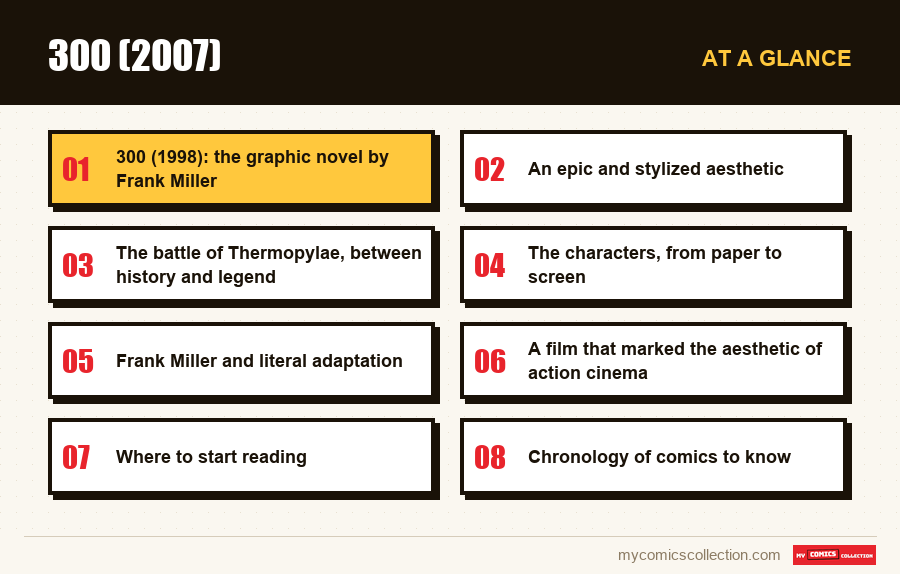
300 (1998): the graphic novel by Frank Miller
300 adapts the five-issue miniseries created by Frank Miller, colored by Lynn Varley, published in 1998 by Dark Horse Comics. Inspired by the historic Battle of Thermopylae (480 BC), the graphic novel recounts the heroic resistance of King Leonidas and his 300 Spartan warriors against the immense army of the Persian Empire led by Xerxes. Frank Miller delivers an epic, mythologized and highly stylized vision of this episode, favoring heroic grandeur and symbolism over historical accuracy. His graphic style, enhanced by the colors of Lynn Varley, deploys pictorial compositions, sculptural bodies and an evocative palette. 300 is a celebration of courage and sacrifice, a work where history becomes legend.
Zack Snyder's film is recognized for its remarkable visual fidelity to the graphic novel. He transposes Frank Miller's aesthetic to the screen, reproducing numerous iconic panels, compositions and scenes. The film recreates the heroic story of Leonidas and the 300, the confrontation at Thermopylae, the excess of the Persian Empire and the epic tone of the work. This fidelity, comparable to that of Sin City, makes the film a faithful transposition of Miller's vision. The film, however, develops certain aspects, notably the intrigue of Queen Gorgo in Sparta, absent or embryonic in the comics, and adds elements to flesh out a relatively short origin story.
An epic and stylized aesthetic
What defines 300, both a film and a comic book, is its epic and highly stylized aesthetic. Frank Miller and Lynn Varley have created a visual universe where the muscular bodies of the Spartans, the tormented skies and the grandiose compositions evoke classical painting and myth. The film reproduces this aesthetic through extensive digital work, shooting on a green background to recreate the pictorial settings of the comic strip. Zack Snyder's characteristic slow motion, the ocher and copper tones, and the choreography of the fights transpose the graphic power of the boards onto the screen. This approach makes 300 a spectacular viewing experience, where every shot seeks to match the sculptural beauty of Miller's panels.
This aesthetic fidelity illustrates Snyder's approach, which, as with the adaptation of Sin City, aims to literally transpose the graphic style of the source. The film does not seek historical realism but the mythical grandeur desired by Miller, assuming extreme stylization. This bias has marked action cinema, influencing the aesthetics of many subsequent productions. It honors the vision of Frank Miller, whose work finds a spectacular echo on screen. For the reader, this adaptation is a celebration of Miller and Varley's style, inviting you to discover the graphic novel in which each page is a painting. She reminds us that 300, before being a blockbuster, is a comic book work of exceptional visual power, where ancient history is sublimated into a timeless heroic fresco.
The battle of Thermopylae, between history and legend
At the heart of 300 is the Battle of Thermopylae, a historical episode from 480 BC. BC where a small Greek force, led by the 300 Spartans of King Leonidas, held off the immense Persian army of Xerxes in a mountainous defile. This feat of arms, which has become a symbol of courage and sacrifice in the face of overwhelming adversity, inspired Frank Miller. Far from aiming for historical accuracy, the comics and the film deliver a mythologized version, where the Spartans embody absolute heroism and the Persians a disproportionate and fantastic threat. This legendary, assumed approach transforms History into a universal epic story, celebrating freedom and duty until death.
The film takes up this mythologized vision, with its liberties with History: Xerxes is an almost divine colossus, the Persian army includes monstrous creatures, and the story favors symbol over reality. These choices, faithful to Miller's comics, have sometimes sparked debates regarding their representation. However, they are part of an assumed approach of legend, not of documentary. The film captures the spirit of sacrifice and resistance which is the strength of the story. For the reader, 300 illustrates how comics take hold of History to transform it into myth. It invites you to discover Frank Miller's graphic novel, where the battle of Thermopylae becomes a heroic fresco, celebrating courage in the face of the impossible, a universal theme that resonates through the ages and is the timeless power of this work.
The characters, from paper to screen
- Leonidas: The king of Sparta leading the 300, faithful to the comics.
- Xerxes: The Persian emperor, stylized and disproportionate colossus.
- Dilios: The narrator of the heroic story, faithful to the work.
- Gorgo: The Queen of Sparta, whose plot is developed for the film.
- Ephialtes: The traitor who reveals the path to the Persians.
Collecting this series?
Track what you own, what you are missing and what your collection is worth. 7 day trial.
Start my trial →Frank Miller and literal adaptation
300 is part, alongside Sin City, of a tradition of faithful adaptations of the works of Frank Miller, where the cinema seeks to directly transpose the graphic style of the comic strip. Miller, one of the most influential authors of modern comics, has developed an aesthetic so marked that it calls for visual transposition rather than reinterpretation. Zack Snyder, in adapting 300, chose fidelity, recreating the pictorial universe of Miller and Varley. This approach testifies to Frank Miller's status as an author whose graphic work directly inspires the cinematic language. 300 thus confirms Miller's influence on the cinema of the 2000s, marked by his aesthetic.
This fidelity illustrates the visual richness of Frank Miller's works, designed as total graphic experiences. By transposing 300 panels by panel, the film pays homage to this pictorial dimension and confirms that certain comics call for a faithful adaptation rather than a free rereading. The success of the film has had a lasting influence on the aesthetics of action and fantasy cinema. For the reader, this adaptation is an invitation to discover the work of Frank Miller, of which 300 is one of the visual summits. She recalls that comics include authors whose graphic style, like that of Miller, has redefined the codes of the medium and profoundly marked contemporary cinema, making the comic strip a direct source of inspiration for the moving image.
A film that marked the aesthetic of action cinema
Beyond its fidelity to comics, 300 exerted a considerable influence on the aesthetics of action and fantasy cinema of the 2000s and 2010s. Its very particular visual style (the choreographed slow motions, the coppery hues, the pictorial digital decorations, the sculptural bodies) has been abundantly imitated and parodied, to the point of becoming an immediately recognizable reference. The film demonstrated that a feature film could assume extreme stylization, directly transposing the aesthetic of a comic book without seeking realism. This visual audacity opened the way to other productions favoring style over naturalism, lastingly marking the language of spectacular cinema.
This influence testifies to the power of the aesthetics of Frank Miller, whose graphic vision spread well beyond comics. By bringing the style of 300 to the screen, Zack Snyder helped make this pictorial approach a major trend in cinema. The film also confirmed the commercial potential of faithful adaptations of stylized comics, encouraging studios to explore this type of project. For the reader, this posterity illustrates the fruitful dialogue between comics and cinema, each nourishing the visual imagination of the other. 300 reminds us that the graphic art of an author like Frank Miller can redefine not only comics, but also the aesthetics of the big screen, proving that the drawn panel is a source of visual inspiration of inexhaustible richness for the seventh art.
Where to start reading
To discover 300, the graphic novel by Frank Miller and Lynn Varley (1998) is available as a collection, bringing together the five issues of the mini-series. An independent and short work, it can be savored in one sitting. Each panel is a painting, revealing the visual power that inspired the film. This comic is sufficient in itself and requires no further reading.
Chronology of comics to know
- 1998: 300: the 5-issue mini-series is published by Dark Horse.
- 1999: Publication in collections: the graphic novel becomes a classic.
- 2007: Zack Snyder's film propels the work to the general public.
Collection side: what numbers to aim for after the film
300 points to keys to independent comics. 300 #1 (1998, first issue of the mini-series from Dark Horse) is the key sought after by collectors. The complete series #1-5 is a popular target. The hardcover collection, with colors by Lynn Varley, is an accessible must-have for readers. These numbers cover various budgets. As always, condition and gradation determine value; relying on real recent sales is strongly recommended.
Its place in the saga and for the collector
300 will remain as a faithful and spectacular adaptation of Frank Miller's graphic novel, transposing its epic aesthetic to the screen. For the collector, it highlighted 300 #1s and the graphic novel, cult works by Dark Horse. It illustrates the influence of Frank Miller on cinema and the power of literal adaptation. Beyond the film, the work of Miller and Varley remains a remarkable visual fresco, to be discovered in its entirety. 300 reminds us that comics can sublimate History into myth and inspire a cinema of exceptional visual ambition.
The verdict: a faithful and stylized fresco
- Loyalty: Leonidas and the 300, the battle of Thermopylae, the stylized aesthetic, the composition of the panels and the heroic story narrated by Dilios come from comics.
- Freedoms: Queen Gorgo's plot expanded, fantasy creatures added, the short comic fleshed out, Snyder's movement and slow motion.
- Collectible numbers: 300 #1 (1998, Dark Horse), the hardcover collection.
300 brings Frank Miller and Lynn Varley's graphic novel to the screen with remarkable visual fidelity, celebrating the heroic resistance of the 300 Spartans at Thermopylae. Faithful to the aesthetics and mythical story of the comics while developing the intrigue of Sparta, the film is a spectacular fresco. For the reader as for the collector, it is an invitation to discover 300 #1s.
Frequently asked questions
From the five-issue miniseries created by Frank Miller and colored by Lynn Varley, published in 1998 by Dark Horse Comics. Inspired by the Battle of Thermopylae (480 BC), it recounts the heroic resistance of Leonidas and the 300 Spartans. The film adapts it very faithfully.
Very. Zack Snyder transposes the aesthetic of Frank Miller, reproducing many iconic panels, compositions and scenes. However, it develops the intrigue of Queen Gorgo in Sparta and fleshes out a relatively short origin story, while respecting the epic spirit of the work.
No, and that’s assumed. Both the comic strip and the film deliver a mythologized and stylized version of the Battle of Thermopylae, favoring heroic grandeur over realism. Xerxes is an almost divine colossus and the Persian army includes fantastic creatures: History becomes legend.
To reproduce the pictorial style of Frank Miller and Lynn Varley, made of sculptural bodies, tormented skies and grandiose compositions. The film, shot on a green screen with extensive digital work and Snyder's slow motion, transposes this graphic power to the screen.
300 #1 (1998, first issue of the mini-series from Dark Horse) is the key you're looking for. The complete series #1-5 is popular, and the hardcover collection, with colors by Lynn Varley, is an accessible must-have for readers.
Does the film make you want to collect? Estimate the value for free of your numbers (300 #1…) with our tool based on current eBay listings.