Watchmen (2009) Zack Snyder adapts the cult graphic novel Alan Moore and Dave Gibbons (Watchmen #1, 1986). An adaptation of rare fidelity, shot by shot, which only modifies the outcome. Here is the detailed comparison, film versus comics, of one of the masterpieces of comics.
Considered the greatest graphic novel of all time, Watchmen has been brought to the screen with meticulous reverence. The film draws on a work that revolutionized the medium. Source-by-source decryption.
As in each article in this series, only verified information (creators, distribution, dates, comic numbers) is stated; the comparative analysis is ours, without reproducing dialogue or protected images.
Title : Watchmen (2009)
Director: Zack Snyder
Actors: Jackie Earle Haley (Rorschach), Patrick Wilson (Nite Owl), Billy Crudup (Dr Manhattan), Malin Åkerman (Silk Spectre)
Exit : March 2009
Studio: Warner Bros.
Watchmen #1-12 (1986-87): Alan Moore & Dave Gibbons
A graphic novel: 12 chapters, a complete work
A uchrony: America in the 1980s
A deconstruction: from the superhero myth
- L'plot complete, chapter by chapter.
- THE characters: Rorschach, Dr. Manhattan, Ozymandias…
- L'uchrony 1980s and the Cold War.
- La visual composition, often shot by shot.
- La deconstruction of the superheroic myth.
- Le outcome: the final threat is reinvented.
- The embedded story “Tales of the Black Freighter» is removed.
- Some subplots are condensed.
- Le your is more stylized and violent.
- The pace of the novel is tight.
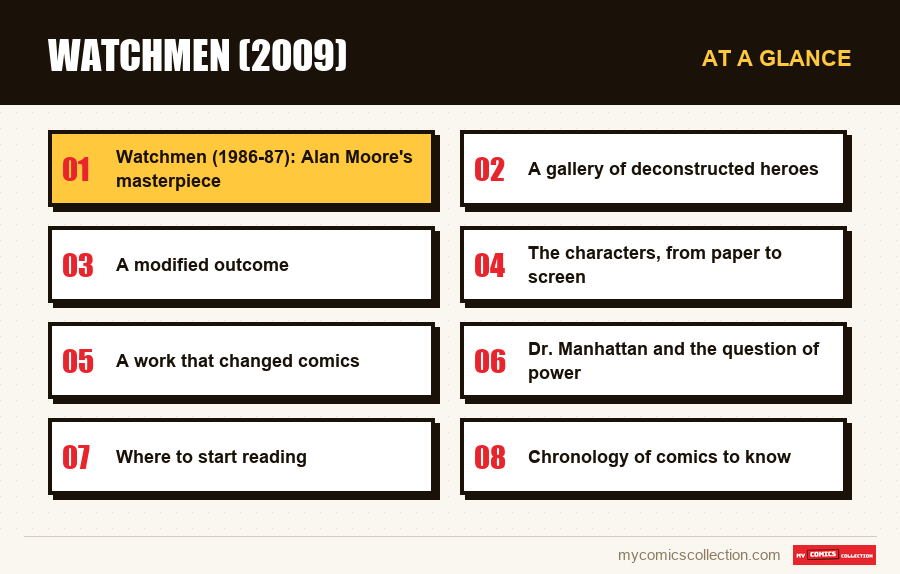
Watchmen (1986-87): Alan Moore's masterpiece
Watchmen adapts the twelve-issue miniseries published between 1986 and 1987, written by Alan Moore and drawn by Dave Gibbons. Considered the greatest graphic novel of all time, the work revolutionized comics by proposing a radical deconstruction of the superhero myth. Set in a uchrony where the United States won the Vietnam War thanks to costumed vigilantes and where the nuclear threat is at its height, the story follows a group of aging or retired heroes, faced with the murder of one of their own. Dark, complex and deeply adult, Watchmen elevated the comic strip to the status of a literary work, exploring morality, power, time and human nature with unprecedented depth.
Zack Snyder's film is recognized for its exceptional fidelity to this work. It covers the complete plot, the characters, the atmosphere and even the composition of numerous panels, recreated shot by shot on the screen. This meticulous reverence reflects the director’s respect for a material deemed “unadaptable”. The film recreates the uchronistic universe of the 1980s, the nuclear tension and the gallery of complex characters. However, he makes some modifications, notably a change in the outcome and the removal of an embedded story. These choices, motivated by the constraints of the cinematographic format, distinguish the film from its source while preserving the essence of its subject.
A gallery of deconstructed heroes
The heart of Watchmen lies in its characters, radically deconstructed superheroes. Rorschach is a psychopathic and uncompromising vigilante, with a changing mask, embodying absolute and frightening morality. Dr. Manhattan, the only being endowed with true superpowers, is a blue god detached from humanity, capable of perceiving time in its entirety. Ozymandias is the smartest man in the world, willing to do anything to save humanity. Nite Owl and Silk Specter are aging heroes searching for meaning, while the Comedian is a cynical and brutal mercenary. Each embodies a facet of criticism of the superheroic myth, revealing the dark, neurotic or dangerous side of those who disguise themselves to do justice.
The film faithfully reproduces this gallery of complex characters. Jackie Earle Haley plays a critically acclaimed Rorschach, and each hero retains his tormented psychology and flaws. The film explores their motivations, their contradictions and their humanity, faithful to the depth of the comics. This fidelity to the characters is one of the great successes of the adaptation. By showing them as Moore and Gibbons conceived them (fallible, ambiguous, sometimes monstrous) the film preserves the harsh criticism of the classic superhero. For the reader, this gallery is the genius of Watchmen: figures who question the very notion of heroism. The film, by accurately embodying them, honors this dimension and invites us to (re)discover in the graphic novel the psychological richness of characters who have become icons of adult comics.
A modified outcome
The main modification of the film concerns the ending. In the graphic novel, Ozymandias' plan to unite humanity in the face of a common threat is based on the staging of a monstrous creature, a telepathic extraterrestrial "squid" whose appearance ravages New York. The film replaces this element with a threat attributed to Dr. Manhattan, whose energy is used to devastate several cities, making him the unifying scapegoat. This change, one of the most debated by readers, aims to simplify and make the outcome more credible for cinematic audiences, while retaining the logic and message of the original: a peace built on a lie and a monstrous sacrifice.
This modification illustrates the trade-offs of an adaptation, even a very faithful one. By removing the squid, the film sacrifices an iconic element of the novel, but preserves the central moral question: does the end justify such terrible means? The result retains the ambiguity and ethical dilemma that make Watchmen so strong. This choice, although controversial, is part of a desire for cinematic coherence. For the reader, it underlines the unique character of the graphic novel, certain elements of which resist adaptation. The film, despite this sprain, remains one of the most faithful transpositions ever made, and invites us to discover the original work, whose squid ending and the embedded story “Tales of the Black Freighter” enrich the subject with a complexity that the cinematographic format could not entirely restore.
Collecting this series?
Track what you own, what you are missing and what your collection is worth. 7 day trial.
Start my trial →The characters, from paper to screen
- Rorschach: The uncompromising vigilante with the changing mask, faithful to the comic.
- Dr Manhattan: The only being endowed with true powers, detached from humanity.
- Ozymandias: The most intelligent man in the world, architect of the outcome.
- The Comedian: The cynical mercenary whose murder kicks off the plot.
- Nite Owl & Silk Specter: The heroes in search of meaning, faithful to the novel.
A work that changed comics
The importance of Watchmen goes beyond the simple story. In 1986, the work of Moore and Gibbons shook up the perception of comics, demonstrating that they could carry adult themes, narrative complexity and literary depth worthy of the greatest novels. Its sophisticated structure, its recurring symbols, its exploration of time and morality have made it a reference studied in universities. Watchmen paved the way for more mature comics and influenced generations of authors. Alongside other major works of the 1980s, it marked the advent of the graphic novel as a recognized artistic form.
The film, by bringing this reputedly unadaptable work to the screen, testifies to its cult status. By respecting it with such fidelity, Zack Snyder paid homage to its historical importance. The film introduced Watchmen to a wider audience, prompting many viewers to read the graphic novel. This heritage dimension distinguishes Watchmen from other comic book adaptations: it is not simple entertainment, but the transposition of a milestone in the history of the medium. For the reader, the film is a gateway to an essential masterpiece, whose richness and depth continue to fascinate. He reminds us that comics can reach the heights of narrative art, and that Watchmen remains the most striking example.
Dr. Manhattan and the question of power
Among the characters of Watchmen, Dr. Manhattan occupies a special place: he is the only one to possess real superpowers, of almost divine magnitude. Former physicist transformed by an accident, Jon Osterman has become a blue being capable of manipulating matter, of splitting himself, of perceiving past, present and future time simultaneously. This omnipotence has gradually detached him from humanity: he observes the world of men with an increasing distance, incapable of understanding their concerns. Through him, the work poses a dizzying question: what becomes of a being endowed with absolute power? Dr. Manhattan embodies the loneliness of omnipotence and the alienation it engenders.
The film faithfully reproduces this fascinating character, his non-linear perception of time and his growing detachment. Billy Crudup gives him a presence that is both majestic and melancholic. Through Dr. Manhattan, the film explores the themes of determinism, free will and responsibility, central to the graphic novel. His transformation, from man to god, illustrates the deconstruction of the classic superhero: here, the only holder of true powers is also the furthest from humanity. For the reader, Dr. Manhattan is one of Moore and Gibbons' most profound creations, a meditation on power and the human condition. The film, by accurately embodying it, preserves this philosophical dimension which elevates Watchmen well beyond a simple superhero story.
Where to start reading
To discover Watchmen, the ideal is to read the complete graphic novel (Watchmen #1-12, 1986-1987) by Moore and Gibbons, available as a complete collection. It is an autonomous work, without prerequisites, to be savored in one sitting. The embedded story “Tales of the Black Freighter”, present in the novel, enriches the reading. This masterpiece is sufficient in itself and requires no further reading.
Chronology of comics to know
- 1986: Watchmen #1: the start of the Moore and Gibbons mini-series.
- 1987: Watchmen #12: the conclusion of the work.
- 1987: Publication in collections: the graphic novel becomes a classic.
Collection side: what numbers to aim for after the film
Watchmen points to modern keys. Watchmen #1 (1986, first issue of the mini-series) is the key sought after by collectors, emblematic of the golden age of the graphic novel. The complete series #1-12 is a popular target. The complete collection (“absolute” or standard edition) is a must-have accessible to any reader. These numbers cover various budgets. As always, condition and gradation determine value; relying on real recent sales is strongly recommended.
Its place in the saga and for the collector
Watchmen will remain as one of the most faithful adaptations in the history of comic book cinema, transposing a masterpiece deemed unadaptable. For the collector, it reinforced interest in Watchmen #1 and the graphic novel, comic book milestones. It illustrates the difficulty and value of adapting a cult work. Beyond the film, Watchmen remains essential reading, to be discovered in its entirety. By deconstructing the superhero myth, he reminds us that comics can reach the heights of art, and that Watchmen is the most famous example.
The verdict: an adaptation of rare fidelity
- Loyalty: the plot, the characters, the history, the atmosphere and even the composition of the panels, recreated shot by shot, come from the graphic novel.
- Freedoms: the modified outcome (threat attributed to Dr. Manhattan), the removal of “Tales of the Black Freighter,” condensed plots, a more stylized tone.
- Collectible numbers: Watchmen #1 (1986), the complete collection.
Watchmen brings Alan Moore and Dave Gibbons' masterpiece to the screen with exceptional fidelity, rendering the plot, characters and visual composition shot by shot. Modifying only the outcome and tightening the story, the film honors a work that revolutionized comics. For both the reader and the collector, it is an invitation to discover Watchmen #1 and the complete graphic novel.
Frequently asked questions
From the miniseries Watchmen #1-12 (1986-1987), written by Alan Moore and drawn by Dave Gibbons. Considered the greatest graphic novel of all time, it deconstructs the superhero myth in a 1980s uchronia. The film adapts it very faithfully.
Extremely. Zack Snyder recreates the plot, the characters, the atmosphere and many panels shot by shot. It is one of the most faithful adaptations in the history of comic book cinema, with the exception of the changed ending and the removal of an embedded narrative.
In the novel, Ozymandias unites humanity by simulating the attack of an alien "squid" on New York. The film replaces this threat with a catastrophe attributed to Dr. Manhattan. The message, a peace built on a lie and a monstrous sacrifice, is preserved.
No. Watchmen is an independent and complete work, without prerequisites, to be read in one go in its entire collection. The embedded story “Tales of the Black Freighter”, present in the novel but removed from the film, enriches the reading.
Watchmen #1 (1986) is the sought-after key, emblematic of the golden age of the graphic novel. The complete series #1-12 is a popular target, and the complete collection is an accessible must-have for any reader.
Does the film make you want to collect? Estimate the value for free of your issues (Watchmen #1, the complete…) with our tool based on current eBay listings.