Alan Moore, born November 18, 1953 in Northampton, is the British screenwriter behind Watchmen (DC Comics, 1986-1987), V for Vendetta, From Hell, Batman: The Killing Joke and the revival of Swamp Thing where he created John Constantine in 1985. His original comics from the 1980s, now rare in high CGC grade, remain among the most sought-after titles on the modern comics market, in largely thanks to the film adaptations which have revived collector interest in each of its flagship series.
There are few comic book authors whose name alone is enough to increase the value of a book. Alan Moore is one of them, along with a handful of screenwriters who have changed the way the industry thinks about the medium. What sets Moore apart is that he not only wrote impactful stories: he literally redefined what a comic book could tell, with what narrative density, and for what audience. Before him, American superhero comics remained largely confined to a young readership. After Swamp Thing and Watchmen, the idea that a comic can be studied like a novel, cited in a literary list or dissected academically is no longer exotic.
For a collector, understanding Alan Moore's trajectory is not a free academic exercise: it is the best way to know which issues to look for, why certain prints are rarer than others, and how the price of his comics has evolved over the course of reissues, adaptation trials and changes of publisher. This article retraces his editorial career, from the British fanzines of the late 1970s until his definitive break with the big studios, based on circulation data, CGC census and actually documented sales for his most collected titles.
We will also see why certain 75 cent issues are worth much more today than an equivalent 95 cent issue, how to spot a real first printing of The Killing Joke, and what Hollywood adaptations, often publicly disowned by the author himself, have really done to the popularity of his original comics.
From English fanzines to Warrior: the genesis of a singular author
Alan Moore did not go through the usual channels of American industry. He grew up and still lives in Northampton, England, an industrial town in the Midlands which infuses much of his work, from Voice of the Fire to Jerusalem. His career began at the end of the 1970s in fanzines and the British underground music press, where he first published illustrations and comic strips under various pseudonyms, before signing scripts for the magazine 2000 AD, the nursery of a whole generation of English authors who would then migrate to the United States.
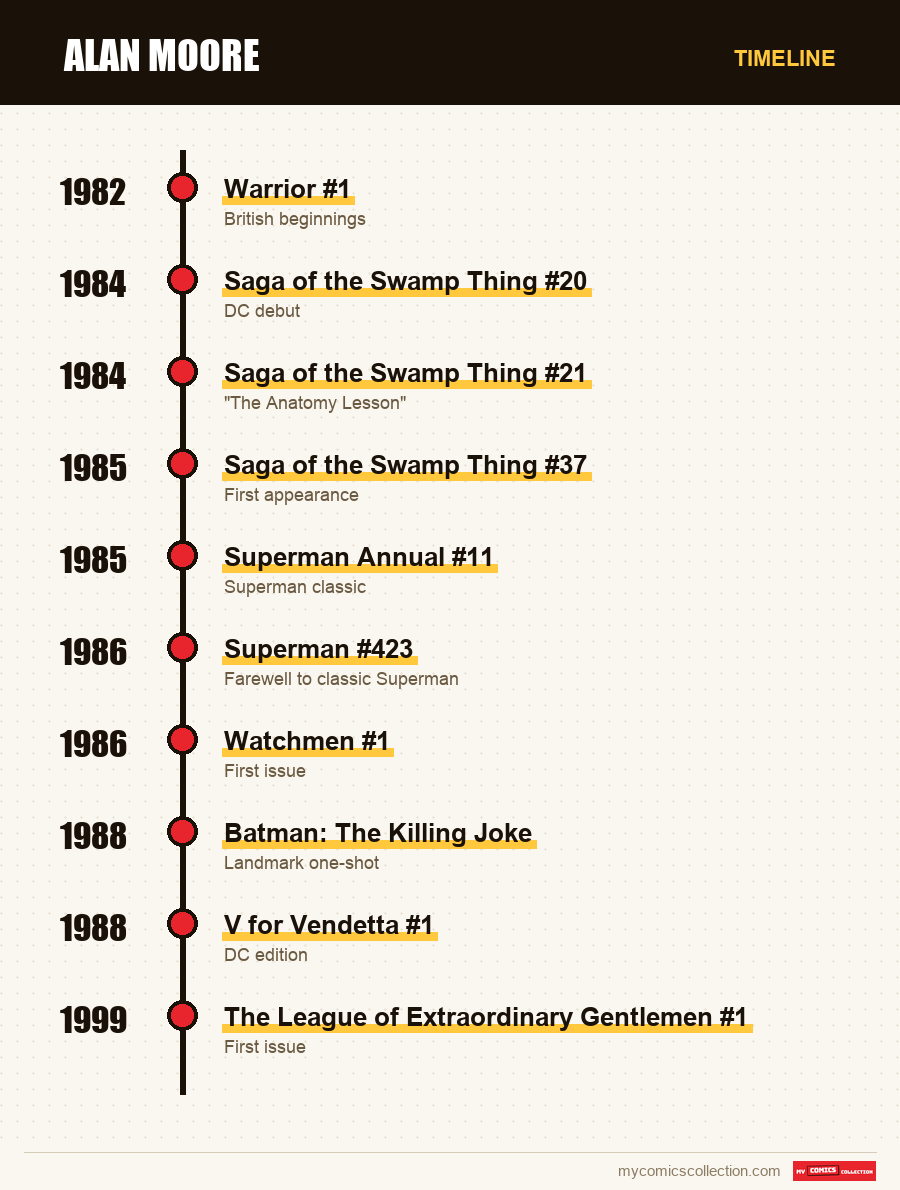
The real turning point came in March 1982, when British publisher Dez Skinn launched the anthological magazine Warrior. Moore wrote two series there that would shape the rest of his career. The first, Marvelman (later renamed Miracleman for rights reasons with Marvel Comics), resurrects a forgotten British superhero from the 1950s with a drawing by Garry Leach, then Alan Davis. Moore already applies his favorite method: taking a naive character and seriously questioning its implications, here the question of what the existence of a being endowed with quasi-divine powers in the real world would imply, concretely. The second series launched in Warrior, V for Vendetta, drawn by David Lloyd, imagines a totalitarian Britain in the near future and already lays the aesthetic and political foundations that will define Moore's writing: anarchism, distrust of authority, narrative construction in symbolic layers.
These two British series remain sought-after pieces today by the most discerning collectors, but their original circulation (English anthological magazines, print runs limited to the British market) makes them significantly more difficult to find in high grade than the American publications that followed. It is precisely their standout that will attract the attention of American publishers, DC Comics in the lead, looking for new voices capable of renewing a catalog of superheroes considered aging in the early 1980s.
Saga of the Swamp Thing: taking over at DC Comics (1983-1987)
DC Comics recruited Alan Moore in 1983 to take over the writing of the Saga of the Swamp Thing series, a horror title then in decline. The choice is bold: entrust an established American series to an English screenwriter virtually unknown to the US public. The gamble immediately paid off. Moore not only continues the story of the plant monster created by Len Wein and Bernie Wrightson: he rewrites its fundamental premise in a twist that has become legendary, revealing that the creature is not a man transformed into a plant but a plant that has absorbed the memories of a dead man. This reversal changes the very nature of the character, shifts him from classic body horror towards ecological and cosmic reflection, and paves the way for the style that we will find in all of his subsequent DC work: an in-depth rewriting that respects continuity while subverting it from the inside.
John Constantine, an almost incidental creation
It is in this run that Moore introduces, with artist Rick Veitch, a secondary character who will become one of the pillars of the DC universe: John Constantine. His first full appearance was in Saga of the Swamp Thing #37, cover-dated June 1985 (released on newsstands late May 1985), for a cover price of $0.75. Constantine, a cynical and manipulative occultist inspired in part by the appearance of the singer Sting, would become the hero of his own series, Hellblazer, launched in 1988, then a central character of the entire DC Vertigo label created a few years later: a label whose very existence stemmed directly from the editorial work accomplished by Moore on Swamp Thing.
In terms of collecting, Saga of the Swamp Thing #37 clearly illustrates a recurring phenomenon among comics from this pivotal period of the American direct market: the existence of cover price variants. The comic was distributed both as a standard "direct market" edition and as a $0.95 newsstand variant, the latter significantly rarer. The census censuses put forward a proportion of around 1.2% of 95 cent variants compared to the standard copies, with around 33 copies listed compared to more than 2,700 for the classic edition: a difference which is directly reflected in the prices: when a standard edition in VF/NM sells for around $110, the equivalent 95 cent variant can exceed $350-550 according to the odds guides. On the CGC graded sales market, high grades (9.0 to 9.6) of this issue have traded in recent years in a range ranging roughly from $300 to $700 depending on the variant and the time of sale, a level which reflects its status as a major "first appearance" rather than a simple horror anthology issue.
Moore left Saga of the Swamp Thing after issue #64 (1987), leaving behind a run of about forty-five issues (#20 to #64), often cited as one of the most influential horror comics runs ever published, and the direct foundation on which DC would build its entire "mature readers" ecosystem.
Watchmen (1986-1987): the work that redefines the medium
While still working on Swamp Thing, Alan Moore launched the project that would become Watchmen with artist Dave Gibbons and colorist John Higgins. Published by DC Comics in twelve monthly issues, from September 1986 to October 1987, the series imagines an alternative America where costumed superheroes existed, were banned by federal law, and where the Cold War had just reached its climax under the perpetual presidency of Richard Nixon. The premise could have remained a simple “what if” exercise; Moore and Gibbons make it a narrative object of clockwork precision, built on a recurring grid of nine boxes, visual symmetries reflected from one issue to the next, and a mirrored structure that literally closes on itself at the twelfth issue.
Unprecedented recognition for a comic book
Watchmen became, in 1988, the first and to date the only superhero comic book to win a Hugo Award, the highest distinction in science fiction and fantasy, in an “Other Forms” category created especially for the occasion. In 2005, Time magazine included it in its list of the hundred best English-language novels published since 1923: the only comic book ever included in this ranking. These recognitions, obtained at a time when superhero comics were almost unanimously snubbed by literary critics, have permanently changed the cultural status of the medium and continue to fuel interest in the series among readers who have never opened another comic in their lives.
Watchmen #1 rating today
On the graded market, Watchmen #1 remains one of the most sought-after modern age comics, but there should be no mistake about its real rarity: unlike golden age or silver age comics, the circulation of Watchmen #1 in 1986 was already large, and the title has seen multiple reprints over the decades (including a new edition on the occasion of the 2009 film). The CGC census lists more than 630 copies graded 9.8 without any copy to date having exceeded this grade, which makes it an abundant book in very high conservation compared to older series, but where the price differential between a 9.6 and a 9.8 can nevertheless remain significant due to demand. Documented sales in 9.8 vary greatly depending on the platform and the period: some auction house sales have been around several hundred dollars, while private sales between collectors can significantly exceed this level for a truly impeccable first impression example. The main point of vigilance for a buyer therefore remains less the raw rarity than the authentication of the printing (first edition versus reprint) and the condition of the pages, the comics from 1986 being particularly subject to the yellowing of the newsprint used at the time.
V for Vendetta and From Hell: the political and documentary side
While Watchmen takes center stage, DC Comics is also finishing publishing V for Vendetta, the series started in Warrior with David Lloyd, whose British production was interrupted in 1985 with the disappearance of the magazine. DC ensured the complete republication between 1988 and 1989, with new episodes closing the story. The story, that of a masked anarchist leading a symbolic guerrilla war against a fictional British fascist regime, would much later become a visual symbol taken up by protest movements across the world, with the character's mask becoming a cultural icon independent of the comic strip itself.
From Hell, co-written with the cartoonist Eddie Campbell, took a very different editorial path: the series was serialized from 1989, first in the anthology Taboo then in the form of independent booklets published by Eddie Campbell's own structures, before being collected in its entirety in 1999. The story, a meticulously documented and largely speculative reconstruction of the Jack the Ripper murders in London in 1888, radically deviates from the traditional format of the American comic book: no color, an irregular publication rhythm, dense pagination close to the graphic novel in the most literal sense. The title won the Critics' Prize at the Angoulême festival in 2001, confirming the European recognition that Moore has already enjoyed from the prize for best album awarded to Watchmen in 1989 then to V for Vendetta in 1990 at the same festival.
For a collector, these two series are collected very differently from Watchmen: their original issues, printed in much more modest volumes and often published by small independent British or American publishers, are much more rarely subjected to CGC grading and are exchanged mainly in the form of bound completes sought for reading rather than for speculation.
Batman: The Killing Joke (1988), the last major DC collaboration
In 1988, when his relations with DC Comics were already deteriorating over questions of copyright and merchandising, DC having notably refused to pay Moore and Gibbons royalties on a series of promotional badges derived from Watchmen, Alan Moore nevertheless delivered one of the most significant Batman stories ever published: Batman: The Killing Joke, drawn by Brian Bolland. Published in prestige format (hardcover, square spine, 52 pages) for a cover price of $3.50, the story proposes a possible origin of the Joker and features one of the most violent acts ever committed against Barbara Gordon in mainstream comics, an event whose narrative repercussions will be felt in the DC Universe for decades.
On the collectible market, locating the true first printing of The Killing Joke requires a little attention: the title of the comic is printed in lime green embossed on this original edition, a characteristic absent from later printings: the book having seen a total of fourteen successive reprints over the decades, a sign of its continued popularity. First printing copies in high conservation remain sought after, with values which, depending on the grades and sales recorded, most often range between several tens and several hundred dollars for standard copies, the top of the market being reserved for the very rare copies in almost perfect condition.
The break with the big publishers and the America's Best Comics adventure
After V for Vendetta, in 1989, Alan Moore stopped working for DC Comics, believing that the publisher had not respected the initial agreements on the rights to Watchmen, which were supposed to revert to him as soon as the title left the active catalog: which, given the continued success of the series, never happened. This dispute, never really closed, largely explains why Moore systematically refused, in the following decades, to be publicly associated with adaptations based on his works and requested the removal of his name from the credits.
Moore then worked for other structures (Image Comics in the mid-1990s, notably on titles like Supreme) before creating his own label, America's Best Comics, in 1999, in editorial partnership with Jim Lee at Wildstorm, which DC Comics had just acquired: an irony that Moore will not fail to point out. It was under this label that The League of Extraordinary Gentlemen #1 was published in March 1999, drawn by Kevin O'Neill, which brought together characters from Victorian literature (Captain Nemo, Doctor Jekyll, the Invisible Man, Mina Harker) in a team of improbable adventurers. The issue, published for $2.95 on 32 pages, inaugurates a series with a decidedly more playful tone than Watchmen, while retaining the same demand for layered construction of references and subtext that characterizes all of Moore's work.
This period also marks the conclusion, decades later, of the legal saga around Marvelman/Miracleman: after a rights imbroglio involving several successive publishers, Marvel Comics ended up acquiring the rights to the character in 2009 and gradually republished Moore's original material from the 2010s onwards, under the name Miracleman, finally making seminal episodes that had long remained almost impossible to find accessible to a wider readership.
Collecting this series?
Track what you own, what you are missing and what your collection is worth. 7 day trial.
Start my trial →The impact of adaptations on the rating
Alan Moore is undoubtedly the comic book author whose attitude towards film adaptations is the most radically negative: he has each time requested the removal of his name from the credits and traditionally pays any royalties to the original artists rather than collecting them himself. This public disavowal, however, never prevented studios from continuing to adapt his work, nor did it prevent these adaptations from having a measurable effect on collector interest in the original comics.
From Hell arrived in cinemas in 2001 with the Hughes brothers behind the camera and Johnny Depp in the lead. The League of Extraordinary Gentlemen followed in 2003, a film whose complicated production with Sean Connery and mixed commercial results did not prevent the paper series from retaining its own readership. V for Vendetta was released in 2005, written and produced by the Wachowskis and directed by James McTeigue, with Hugo Weaving and Natalie Portman; the film lastingly popularized the Guy Fawkes mask designed by David Lloyd well beyond the circle of comic book readers, to the point of making it a political symbol taken up internationally. Watchmen, finally, was brought to the screen in 2009 by Zack Snyder, in an adaptation very visually faithful to Gibbons' original comic, followed ten years later by the television series Watchmen by Damon Lindelof for HBO (2019), which does not directly take up Moore's story but presents itself as a thematic sequel in the same universe.
Each of these releases generated, in a documented way on the secondary market, a temporary increase in demand for the corresponding original comics, particularly for the first issues and high-grade copies: a classic phenomenon of "bump" linked to an adaptation, observable for many comics beyond Moore's work, but particularly clear here due to the notoriety of the contrast between the popular success of the films and the assumed rejection of their own author.
Buying Guide: How to Collect Alan Moore
- Distinguish between printing and reprinting on Watchmen #1. DC has re-released the series several times, most notably around the release of the 2009 film; Always check the printing code on the back cover or the CGC certificate before making any expensive purchase.
- Spot the 95 cent variant on Saga of the Swamp Thing #37. It is this newsstand edition, significantly less printed than the direct market edition at 75 cents, which concentrates the value on this key issue of the first appearance of John Constantine.
- Check out the embossed lime green on The Killing Joke. The colored relief title only appears on the very first printing from 1988; all subsequent reprints (fourteen in number) use a different presentation and are worth significantly less.
- Favor white or near-white pages for books from the 1980s. The newspaper used on Watchmen and Swamp Thing at the time yellows quickly; the condition of the pages strongly influences the CGC grade and therefore the value, even more than on more recent series.
- Don't overlook Warrior's UK publications. The very first episodes of Marvelman and V for Vendetta, published in 1982 in this limited-circulation English magazine, are much rarer than subsequent American reissues and are of interest to a circle of specialist collectors.
- Consider the integrals for From Hell and V for Vendetta. Given their fragmented and poorly standardized original mode of publication, these two works are most often collected in the form of complete collections rather than in individual graded fascicles.
- Follow your collection over time. To keep an overview of the status, origin and evolution of the rating of each number acquired, the use of a dedicated monitoring tool such as comic collection management application allows you to avoid duplicates and identify the best resale opportunities.
The key issues to know
Watchmen #1
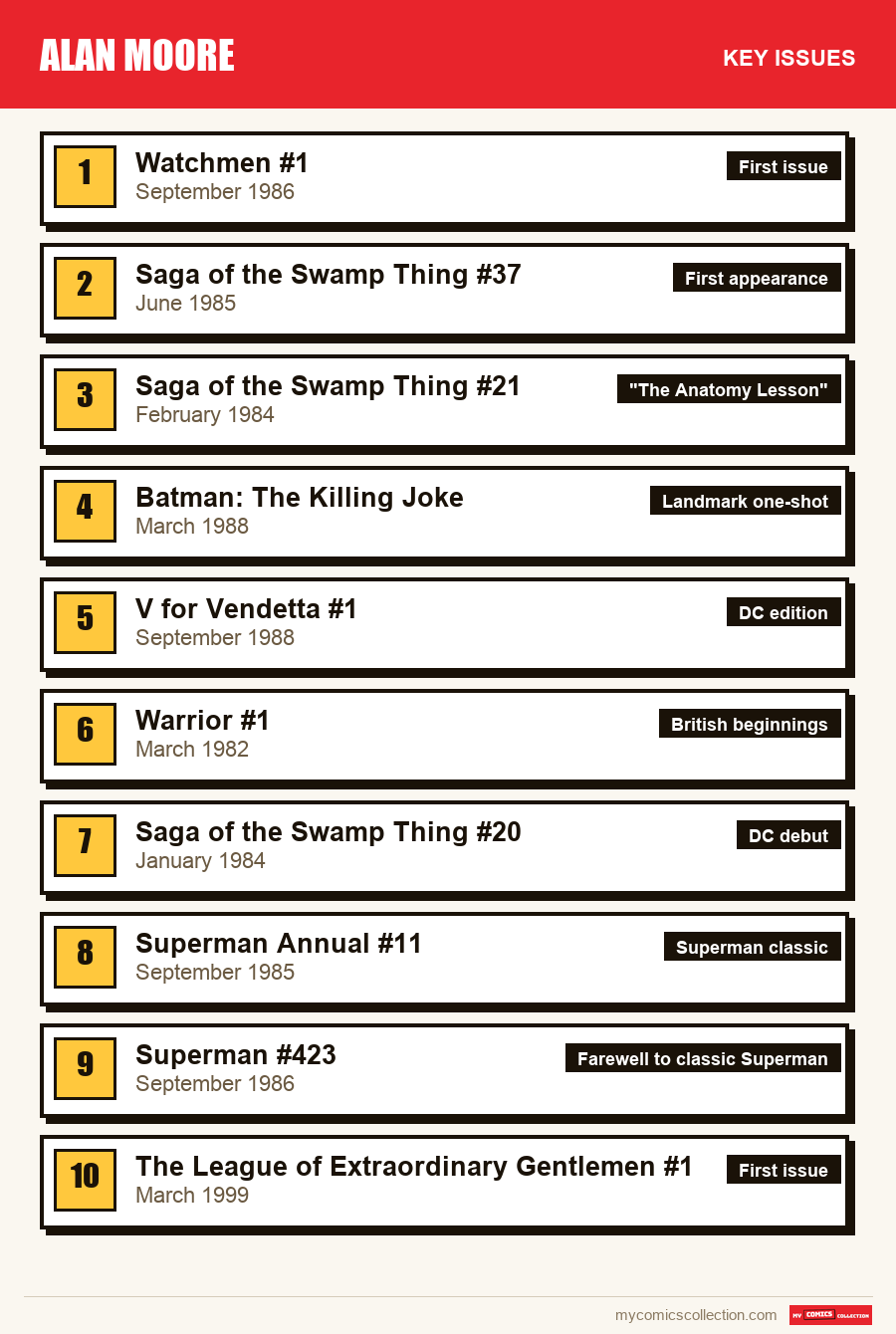
The first of twelve issues of Alan Moore and Dave Gibbons's series, colored by John Higgins: an alternate America where masked vigilantes have been outlawed. Built on a nine-panel grid, the work was recognized far beyond comics, all the way to Time's list of the 100 best novels. The major key of Moore's bibliography.
Saga of the Swamp Thing #37
The official first appearance of John Constantine, an English occultist created by Alan Moore with Rick Veitch and John Totleben. He enters the story by offering his services to Swamp Thing. The character got his own series, Hellblazer, in 1988.
Saga of the Swamp Thing #21
With Stephen Bissette and John Totleben, Alan Moore rewrites the character: examining his remains, Jason Woodrue concludes that Swamp Thing is not Alec Holland. The creature is not a man turned into a plant, but a plant that absorbed his memories. The issue that launched Moore's American career.
Batman: The Killing Joke
A one-shot drawn by Brian Bolland that offers a possible origin for the Joker and leaves a lasting mark on Barbara Gordon's fate. It is Moore's last major collaboration with DC. Note that the book has been reprinted many times, and only the first printing carries special collector value.
V for Vendetta #1
DC reprints in color, over ten issues, the Alan Moore and David Lloyd series begun in the British magazine Warrior, then delivers the unpublished chapters that conclude it. A masked anarchist wages a guerrilla war against a fascist British regime. V's mask would become a symbol far beyond comics.
Warrior #1
The first issue of the British anthology edited by Dez Skinn, in which Alan Moore launches Marvelman, with Garry Leach, and V for Vendetta, with David Lloyd. The magazine ran for twenty-six issues, until January 1985. A rare piece, sought by the most specialized collectors.
Saga of the Swamp Thing #20
Alan Moore's first issue on the series, drawn by Dan Day, titled "Loose Ends". It ties up the running plots before the reinvention of the following issue. The starting point of the run that paved the way for DC's mature titles.
Superman Annual #11
"For the Man Who Has Everything...", drawn by Dave Gibbons a year before Watchmen: on his birthday, Superman is trapped in a dream of a perfect life on Krypton. Batman, Robin and Wonder Woman must free him. One of the most celebrated Superman stories.
Superman #423
The first part of "Whatever Happened to the Man of Tomorrow?", pencilled by Curt Swan and inked by George Pérez: Alan Moore writes the story meant to close the era of Superman before John Byrne's relaunch. The story concludes in Action Comics #583. A farewell that became a classic.
The League of Extraordinary Gentlemen #1
Under his America's Best Comics label, Alan Moore teams with Kevin O'Neill to bring together figures from Victorian literature, including Captain Nemo, Dr. Jekyll, the Invisible Man and Mina Harker. The tone is more playful than Watchmen, with the same density of references. The series was adapted for film in 2003.