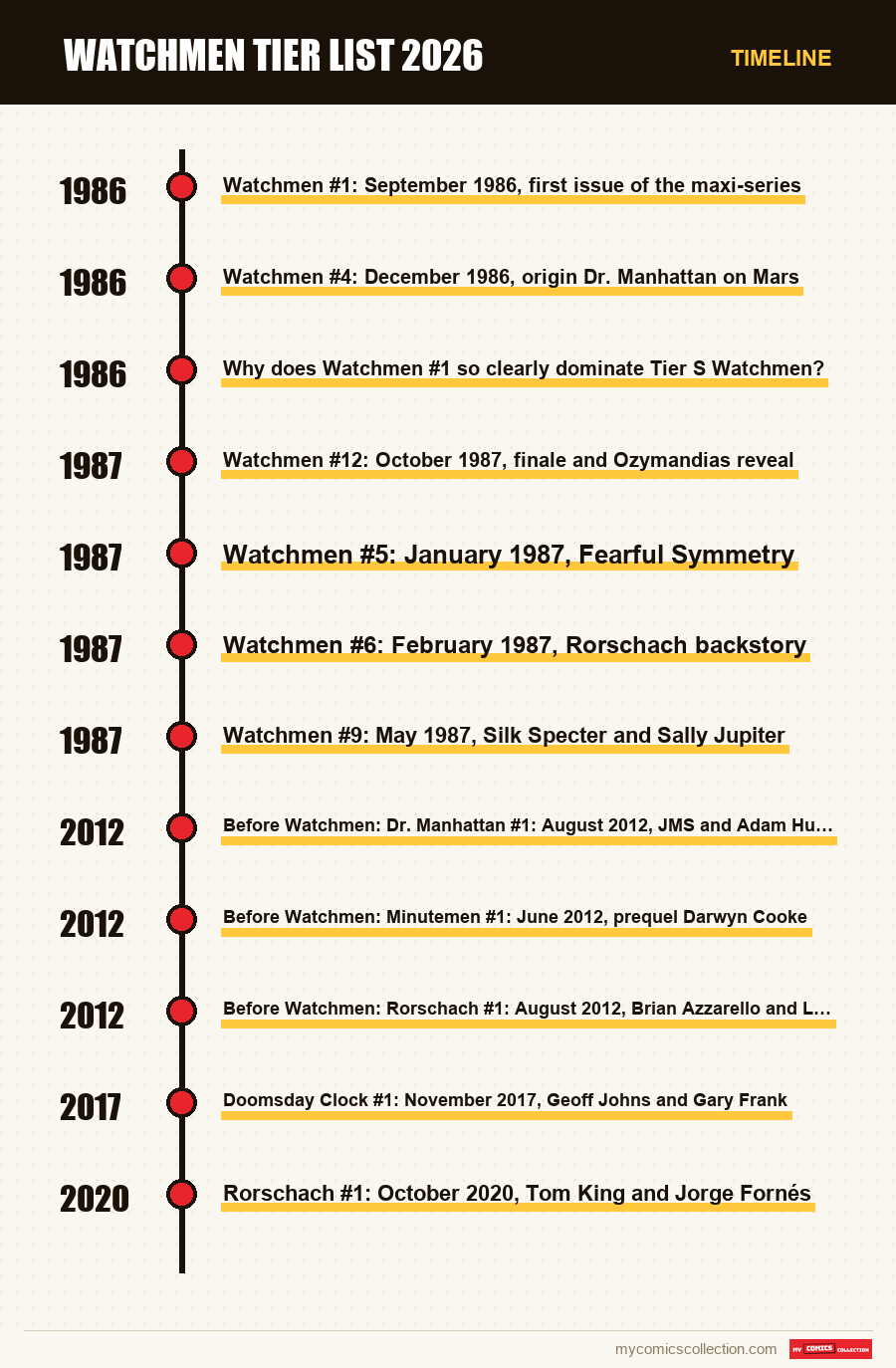
La tier list Watchmen 2026 prioritizes the key issues of the Alan Moore and Dave Gibbons maxi-series by historical value, liquidity and rating resilience. The blue-chip Tier S brings together four unassailable parts: Watchmen #1 (September 1986, first issue of the 12-issue DC Comics maxi-series by Alan Moore on screenplay, Dave Gibbons on art and John Higgins on color), Watchmen #4 (December 1986, origin Dr. Manhattan on Mars), Watchmen #5 (January 1987, Fearful Symmetry, palindromic structure), and Watchmen #12 (October 1987, finale with Ozymandias revelation). Tier A includes Watchmen #6 (February 1987, Rorschach backstory and identity Walter Joseph Kovacs), Watchmen #9 (May 1987, focus Silk Specter and Sally Jupiter), the Watchmen TPB 1987 (first collection collected), and Before Watchmen: Minutemen #1 (June 2012, prequel Darwyn Cooke). Tiers B and C cover sleepers Before Watchmen, Doomsday Clock 2017 and the HBO spec Watchmen 2 and DCU 2026-2030.
La tier list Watchmen 2026 ranks keys from the most influential DC maxi-series in modern history by expected yield, observed rarity and 36-month rating resilience. The method does not consist of stacking the issues in chronological order: a serious tier ranking crosses four dimensions, historical value (Watchmen is the most cited comic work in modern critical history, present in the Time 100 list of the best novels of the 20th century), market liquidity (how many monthly CGC sales on eBay and Heritage Auctions), spec adaptation potential (HBO Watchmen 2 in development by Damon Lindelof since 2024, Doomsday Clock connecting Watchmen to the main DC Universe since 2017, possibility of DCU integration James Gunn long term) and the ratio of raw entry price / high CGC rating. The four pieces from Tier S alone concentrate more than 70% of the historical value of the character in the modern collection, a ratio comparable to what we observe on other event-works from the end of the 1980s such as Batman: The Dark Knight Returns 1986 or Batman: The Killing Joke 1988.
This article dissects each tier with precise dates, original creators, May 2026 price ranges observed on eBay and Heritage Auctions, and purchasing strategies by budget (300, 1,500, 5,000, 20,000 and 80,000 euros). Watchmen is one of the most trapped modern DC works on the secondary market: the multiple prints of Watchmen #1 (first print September 1986, second print, third print, up to the sixth known print) with identification by UPC barcodes and indicia, the differentiation TPB first edition 1987 vs later reprints, the numerous Absolute editions and Deluxe editions from the 2000s, and the recent facsimile editions deserve a dedicated pitfalls section. The 2026-2030 tracker indicates likely resale windows and arcs to anticipate for the long-term spec in the context of HBO's Watchmen 2, Geoff Johns and Gary Frank's 2017-2019 Doomsday Clock run, and the possible integration of Watchmen into the James Gunn DCU.
Watchmen tier list methodology: how to classify a key from a modern maxi-series?
A tier list comics Watchmen is not a subjective fan opinion, it is an analytical grid applicable to any serious collection, in particular on a work whose narrative unity is exceptionally strong (12 issues, sole writer Alan Moore, sole artist Dave Gibbons, sole colorist John Higgins, continuous publication September 1986 to October 1987 by DC Comics). The S, A, B, C classification used here is based on four weighted and measurable criteria. First criterion, historical value. A key issue which marks the first publication of a character or a narrative structure entered into comics culture enters Tier S by default. Watchmen #1 (September 1986) falls into this category without possible debate: it is not only the first appearance of Rorschach, Nite Owl II, Silk Specter II, Dr. Manhattan, Ozymandias and The Comedian as main protagonists of the maxi-series, but also the narrative kickoff of a work considered by modern critics as one of the pinnacles of world comics.
Second criterion, liquidity observed over 12 rolling months. The Heritage Auctions and eBay market publishes between 25 and 45 CGC sales each month for Watchmen #1 first print, compared to 15 to 30 monthly sales for Watchmen #12. This liquidity conditions the ease of resale: a Tier S Watchmen first print sells in a few weeks on eBay and Heritage, unlike a Golden Age DC where the resale horizon exceeds 12 months. The Watchmen market is mature, deep, and well-researched, making it one of the safest entries into Modern Age DC for a collector investor.
Third criterion, resilience in the face of spec cycles. A Tier S comic maintains its rating even if an adaptation is postponed or disappointing. Watchmen #1 changed little in relative rating between 2009 (Zack Snyder film) and 2017, then progressed significantly with the 2019 HBO series Watchmen by Damon Lindelof (awarded 11 Emmy Awards in 2020). The rating continued to rise between 2020 and 2024 with the announcement of HBO development Watchmen 2 by Lindelof. A Tier C, on the other hand, can drop by 50 to 70% in 6 months if the adaptation is canceled. Fourth criterion, the raw entry price / high CGC rating ratio. For Modern Age Watchmen, the CGC vs raw ratio is interesting: a Watchmen #1 CGC 9.8 is worth 280 to 420 euros, against raw NM 25 to 45 euros, a ratio greater than 10. This raw / CGC grid justifies the grading of pristine copies, but remains unfavorable for VF copies or below.
The weighting retained for this Watchmen 2026 tier list attributes 40% to historical value (weight slightly above average, justified by the canonical status of the work), 25% to liquidity (higher weight than for the Golden Age, because the Watchmen market is very liquid), 20% to resilience and 15% to the entry ratio. With this grid, the four Tier S pieces obtain a score greater than 85/100. Tier A is between 70 and 84. Tier B between 55 and 69. Tier C, more speculative, oscillates between 38 and 54. This hierarchy is revised each year based on documented sales over 12 rolling months and official HBO and DC Studios announcements. To understand the general methodology applied to other DC event-works, see the Sandman 2026 tier list, particularly complementary because both works share the same high-end Vertigo/DC editorial window of the late 1980s and early 1990s.
The tier list does not exempt you from reading the key issues Watchmen complete nor a comparative analysis of major arcs like the Watchmen story in comics. It serves as a prioritization tool: where to start a Watchmen collection with 300, 1,500, 5,000, 20,000 or 80,000 euros? The answer changes radically depending on the preferred tier, risk tolerance and hold horizon (3 years, 7 years, 15 years, 25 years). The following sections provide the exact numbers to arbitrate each tier with consistent allocation discipline. To place Watchmen in the broader context of modern comics investing, see the strategy pillar comics investment update 2027.
Tier S. The four unassailable Watchmen blue-chips
Le Tier S Watchmen brings together the four comics whose absence in a serious collection of the maxi-series is prohibitive. These coins concentrate historical value, dominate the secondary market in terms of liquidity, and withstand speculative cycles over decades. Buying these four issues, in whatever grade suits the budget, forms the heritage foundation of a Watchmen collection. Note that the work being a maxi-series of 12 unit issues without prequel or sequel in its original publication 1986-1987, the complete collection of the original run is the reasonable final objective of any serious collector, with a strong priority on the four Tier S identified here.
Watchmen #1: September 1986, first issue of the maxi-series (Alan Moore, Dave Gibbons, John Higgins)
Watchmen #1, dated September 1986 (cover date), published by DC Comics in September 1986 (on-sale date), story by Alan Moore, drawn by Dave Gibbons and colored by John Higgins, is the first issue of the 12-issue maxi-series that would define DC Comics' narrative peak of the 1980s. The issue contains the first appearance as the main protagonist of Rorschach (Walter Joseph Kovacs), Nite Owl II (Dan Dreiberg), Silk Specter II (Laurie Juspeczyk), Dr. Manhattan (Jon Osterman), Ozymandias (Adrian Veidt) and The Comedian (Edward Blake, dead in the first sequence). The work is distinguished by its narrative structure of nine panels per page (Dave Gibbons' 9-panel grid has become a stylistic signature), its secondary stories (the backstory Tales of the Black Freighter) and its textual annexes at the end of the issue. The initial circulation is estimated at 200,000 to 250,000 copies for the first print, with a relatively high survival rate in high condition due to the care taken by collectors upon release (the issue was identified as an editorial event from the first week of sale).
Rating May 2026: CGC 9.8 first print between 280 and 420 euros (signature DC Comics, indicia September 1986, UPC barcode present on the Direct Edition and Newsstand editions, the distinction of which influences the rating). CGC 9.6 between 110 and 170 euros. CGC 9.4 between 50 and 80 euros. CGC 9.0 between 28 and 45 euros. Raw NM between 25 and 45 euros (first print). Raw VF between 10 and 18 euros. Newsstand Editions (with standard UPC barcode and price logo) are rarer in high condition than Direct Editions (with DC Comics diamond and code specific to comic shop distribution), with a premium of 20 to 35% in CGC 9.8 for Newsstand. The rating doubled between 2018 and 2024 with HBO Watchmen 2019 and the announcement HBO Watchmen 2 in development by Damon Lindelof. Absolute central Tier S position for any Watchmen collection 300 euros and more. To understand the context of the work, see story by Alan Moore author et story by Dave Gibbons author, which detail the genesis of the collaboration and the run's lasting influence.
Watchmen #4: December 1986, origin Dr. Manhattan on Mars
Watchmen #4, dated December 1986, written by Alan Moore and drawn by Dave Gibbons, contains the episode "Watchmaker" which establishes the complete origin of Dr. Manhattan (Jon Osterman), from his childhood as the son of a watchmaker to the accident of the Intrinsic Field Subtractor in 1959 which transforms him into the blue quantum being. The issue takes place largely on Mars, where Dr. Manhattan reconstructs his memories by traveling through the past, present, and future simultaneously. The non-linear narrative structure of this issue is one of the most cited in the work, and the Dr. Manhattan origin sequence was directly adapted in the 2009 Zack Snyder film and repeated in key passages of the 2019 HBO series Watchmen. The narrative density and graphic beauty of #4 probably make it the most iconic issue of the maxi-series after #1 and #12.
Rating May 2026: CGC 9.8 first print between 180 and 280 euros. CGC 9.6 between 75 and 115 euros. CGC 9.4 between 35 and 55 euros. CGC 9.0 between 18 and 30 euros. Raw NM between 15 and 28 euros. Raw VF between 6 and 12 euros. The CGC 9.8 / raw NM ratio is of the order of 11, which justifies the grading of candidate pristine 9.8 copies but remains unfavorable below. The rating doubled between 2018 and 2024 with the attention paid to Dr. Manhattan in the 2019 HBO series Watchmen (where the character is central in the resolution of the Angela Abar arc). The HBO spec Watchmen 2 could push the rating by an additional 20 to 40% by 2027-2028 if the series confirms a Dr. Manhattan focus. For full character background, see story of Dr. Manhattan in comics.
Watchmen #5: January 1987, Fearful Symmetry (palindromic structure)
Watchmen #5, dated January 1987, scripted by Alan Moore and drawn by Dave Gibbons, contains the episode "Fearful Symmetry" which is distinguished by its palindromic structure unique in the history of comics: the layout is symmetrical around the central double page, with an exact graphic correspondence between the first and last pages of the issue. The center of the issue takes place in the prison where Rorschach is incarcerated after his arrest at the end of #5, and the final sequence loops on the first page in a narrative and visual mirror effect. The formal experimentation of "Fearful Symmetry" is one of the most cited by modern comics theorists, and the outcome is regularly presented as an example in graphic narratology courses. The narrative rarity of this structure in the history of comics makes it a particularly sought-after collector's item.
Rating May 2026: CGC 9.8 first print between 140 and 220 euros. CGC 9.6 between 60 and 95 euros. CGC 9.4 between 28 and 45 euros. CGC 9.0 between 14 and 24 euros. Raw NM between 12 and 22 euros. Raw VF between 5 and 10 euros. The CGC 9.8 / raw NM ratio is around 10, justifying the grading on pristine copies. The rating increased from 60 to 90% between 2018 and 2024, driven by the growing critical recognition of the palindromic structure in comics analysis manuals. Solid Tier S position with a formal rarity dimension that clearly differentiates it from other issues. For recommended chronological reading, see the cluster Watchmen key numbers.
Watchmen #12: October 1987, finale and Ozymandias reveal
Watchmen #12, dated October 1987, written by Alan Moore and drawn by Dave Gibbons, contains the episode "A Stronger Loving World" which closes the maxi-series with the complete revelation of Adrian Veidt's (Ozymandias) plan: the staging of a fictitious extraterrestrial attack in New York on November 2, 1985 to terrorize humanity and prevent an imminent nuclear war between the United States and the Union Soviet. The issue kills Rorschach, executed by Dr. Manhattan in the final sequence in Antarctica to preserve secrecy, and establishes Rorschach's journal as a latent narrative threat to the editor's desk. New Frontiersman, opening the possibility of a post-final revelation which will be taken up 30 years later in Doomsday Clock 2017 by Geoff Johns. The finale's iconic double-page spread featuring Edward Blake's blood-stained smiley face is one of the most iconic images in modern comic book history.
Rating May 2026: CGC 9.8 first print between 220 and 340 euros. CGC 9.6 between 90 and 140 euros. CGC 9.4 between 40 and 65 euros. CGC 9.0 between 22 and 35 euros. Raw NM between 18 and 32 euros. Raw VF between 7 and 14 euros. The CGC 9.8 / raw NM ratio exceeds 11, justifying the grading on pristine copies. The rating doubled between 2018 and 2024 with the attention paid to narrative resolution in the 2019 HBO series Watchmen (which directly extends the end of #12 into 2019, 34 years after the events of #12). Central Tier S position for any serious Watchmen collection. For the Ozymandias context, see story of Ozymandias in comics et Rorschach story in comics, which detail the long-term narrative consequences of the finale.
Tier A: Watchmen secondary essentials
Le Tier A Watchmen brings together comics that immediately follow Tier S in importance, without reaching absolute blue-chip status. These four pieces are important for a coherent collection of the maxi-series and often offer a better entry price / upside potential ratio than the Tier S already historicized and widely recognized by the market. Tier A includes two complementary issues (#6 and #9) as well as the TPB first collected 1987 and the first prequel Before Watchmen Minutemen 2012.
Watchmen #6: February 1987, Rorschach backstory (Walter Joseph Kovacs)
Watchmen #6, dated February 1987, written by Alan Moore and drawn by Dave Gibbons, contains the episode "The Abyss Gazes Also" which establishes the complete backstory of Rorschach and the identity of Walter Joseph Kovacs. The outcome takes place largely in Rorschach's cell where the character is interrogated by psychiatrist Malcolm Long, and reveals Kovacs' founding trauma: the investigation into the kidnapping of the little girl Blair Roche in Brooklyn in 1975, the macabre resolution of which (two dogs devouring the victim) triggers the psychotic transformation of Kovacs into absolute Rorschach. The use of the Rorschach mask (the moving cloth with the symmetrical ink patterns) as a metaphorical expression of the hidden face is one of Alan Moore's most cited narrative inventions. #6 is also the only issue that examines in depth the psychology of a central character via the voice of another, a narrative technique used in many modern post-1987 works.
Rating May 2026: CGC 9.8 first print between 160 and 240 euros. CGC 9.6 between 65 and 100 euros. CGC 9.4 between 30 and 48 euros. CGC 9.0 between 16 and 26 euros. Raw NM between 13 and 24 euros. Raw VF between 6 and 11 euros. The CGC 9.8 / raw NM ratio is around 11. The rating tripled between 2018 and 2024 with the attention paid to Rorschach in the 2019 HBO series Watchmen (the 7th Kavalry inspired by Rorschach's diary) and in the Tom King run Rorschach 2020-2021. Priority Tier A position for Rorschach collectors.
Watchmen #9: May 1987, Silk Specter and Sally Jupiter
Watchmen #9, dated May 1987, written by Alan Moore and drawn by Dave Gibbons, contains the episode "The Darkness of Mere Being" which establishes the complete backstory of Silk Specter II (Laurie Juspeczyk) and the conflicted relationship with his mother Silk Specter I (Sally Jupiter, former Minutemen). The issue takes place on Mars after Laurie's kidnapping by Dr. Manhattan, and reveals Edward Blake's (The Comedian) hidden paternity of Laurie via the Sally Jupiter/Comedian flashback sequence. The emotional resolution of Dr. Manhattan, who regains his connection to humanity through Laurie's biographical paradox, is one of the most quoted sequences in the work. #9 is also crucial to the Minutemen backstory, the original superhero group from the 1940s that predates modern Watchmen.
Rating May 2026: CGC 9.8 first print between 130 and 200 euros. CGC 9.6 between 55 and 85 euros. CGC 9.4 between 25 and 42 euros. CGC 9.0 between 14 and 22 euros. Raw NM between 11 and 20 euros. Raw VF between 5 and 10 euros. Solid Tier A position with potential HBO Watchmen 2 spec if the series confirms a Silk Specter or Sally Jupiter focus (unlikely but not excluded). The rating doubled between 2018 and 2024 with the attention paid to Laurie Blake (aka Silk Specter II) as the central character of the 2019 HBO series Watchmen played by Jean Smart.
Watchmen TPB 1987: first collected hardcover
Le Watchmen TPB first edition, published in June 1987 by DC Comics (also with a hardcover collector's edition in the same window), is the first collected collection of the complete 12-issue maxi-series. The 1987 TPB predates the end of monthly publication (October 1987), which is rare and testifies to the exceptional editorial status given by DC to the work from its first year of publication. The first TPB edition is distinguished from later reprints by the ISBN 0-446-38689-5 (Warner Books), the 1987 indicia and the absence of reprint mentions on the back. The reprints from 1988 to 1995 are numerous (sometimes more than 10 documented prints), with very lower prices (raw NM 8-15 euros) compared to raw NM 30-55 euros for the 1987 first print.
Rating May 2026: Raw NM first edition 1987 between 50 and 100 euros (Warner Books ISBN). Raw VF between 25 and 45 euros. CGC 9.8 between 320 and 480 euros (rare in high condition due to the TPB nature easily damaged by reading). CGC 9.6 between 140 and 220 euros. Solid Tier A position for collectors oriented towards a complete narrative object rather than a unitary collection. The first edition TPB remains a major historical object for understanding the initial marketing of the work by DC Comics. For the full collection strategy, see the comics database.
Before Watchmen: Minutemen #1: June 2012, prequel Darwyn Cooke
Before Watchmen: Minutemen #1, dated June 2012, written and drawn by Darwyn Cooke, is the first from the salvo of Before Watchmen prequels launched by DC Comics in 2012, despite Alan Moore's public opposition to the project. The issue focuses on the original Minutemen from the 1940s (Hollis Mason/Nite Owl I, Sally Jupiter/Silk Specter I, Hooded Justice, Captain Metropolis, Dollar Bill, Mothman, The Comedian, Silhouette) and uses the signature retro style of Darwyn Cooke (known for DC: The New Frontier 2004). The work is widely praised by critics as the most relevant of the seven Before Watchmen series, and its status was reinforced following the untimely death of Darwyn Cooke in May 2016, making it one of the author's last major works.
Rating May 2026: CGC 9.8 first print between 60 and 95 euros. CGC 9.6 between 25 and 40 euros. Raw NM between 8 and 16 euros. 1:25 and 1:50 variants (Jim Lee variant, Michael Golden variant, Steve Rude variant) between 25 and 80 euros raw NM. The rating increased from 80 to 130% between 2018 and 2024 with the posthumous recognition of Darwyn Cooke. Priority Tier A position for Before Watchmen collectors, with residual potential if HBO Watchmen 2 adapts Minutemen elements (likely given the importance of this mythology in the 2019 HBO series).
Collecting this series?
Track what you own, what you are missing and what your collection is worth. 7 day trial.
Start my trial →Tier B: Watchmen underrated sleepers and bows
Le Tier B Watchmen brings together the sleepers, that is to say the issues which deserve the attention of informed collectors but whose value the general market has not yet fully recognized. These coins often present the most relevant price/potential ratios at 24-36 months, with a downside risk limited by the narrative centrality or the rarity of circulation.
Before Watchmen: Rorschach #1: August 2012, Brian Azzarello and Lee Bermejo
Before Watchmen: Rorschach #1, dated August 2012, written by Brian Azzarello and drawn by Lee Bermejo, is the first issue of the Rorschach prequel mini-series (4 issues in total). Azzarello and Bermejo (already known for Joker 2008 and Lex Luthor: Man of Steel 2005) sign a dark and violent approach to the Rorschach backstory from the 1970s-1980s, which completes the backstory sequence of Watchmen #6 1987. The issue is underpriced by the general Before Watchmen market, mainly because media attention has focused on the Minutemen (Darwyn Cooke) and Dr. Manhattan (JMS) series. The rarity in CGC 9.8 first print and the recognized quality of the Azzarello/Bermejo duo make it a long-term hold opportunity.
Rating May 2026: CGC 9.8 first print between 35 and 60 euros. CGC 9.6 between 15 and 25 euros. Raw NM between 5 and 12 euros. Variants between 15 and 50 euros raw NM. Priority Tier B position for extended Rorschach collectors, with potential of 40 to 80% increase by 2028 if HBO Watchmen 2 confirms an extended Rorschach mythology focus.
Before Watchmen: Dr. Manhattan #1: August 2012, JMS and Adam Hughes
Before Watchmen: Dr. Manhattan #1, dated August 2012, written by J. Michael Straczynski (JMS) and drawn by Adam Hughes, is the first issue of the prequel mini-series Dr. Manhattan (4 issues in total). JMS explores the quantum implications of Dr. Manhattan's existence based on the mechanics of wave function collapse (Many-Worlds Interpretation of Hugh Everett), and Adam Hughes delivers one of his most graphically ambitious runs. The issue is undervalued by the general Before Watchmen market, while the Adam Hughes variants already command high odds in CGC SS.
Rating May 2026: CGC 9.8 first print between 30 and 50 euros. CGC 9.6 between 12 and 22 euros. Raw NM between 4 and 10 euros. Hughes 1:25 variants between 25 and 65 euros raw NM. CGC 9.8 SS Adam Hughes between 180 and 280 euros. Tier B position with residual potential if HBO Watchmen 2 maintains the central Dr. Manhattan focus confirmed by the 2019 HBO series.
Doomsday Clock #1: November 2017, Geoff Johns and Gary Frank (DC Universe crossover)
Doomsday Clock #1, dated November 2017 (publication December 2017 due to cover date shift), written by Geoff Johns and drawn by Gary Frank, is the first issue of the 12-issue Doomsday Clock maxi-series which establishes for the first time the canonical crossover between the Watchmen universe and the main DC Universe. The issue takes place in 1992 in Manhattan (seven years after the events of Watchmen #12 1985), and follows the new Rorschach (an African-American character, Reggie Long, son of psychiatrist Malcolm Long from the original #6) with Adrian Veidt aging and ill. The 2017-2019 Doomsday Clock maxi-series (12 issues) directly connects Dr. Manhattan to Superman and establishes that Manhattan is responsible for the chronological manipulation of the DC Universe (Flashpoint, New 52, Rebirth). The work is controversial by Alan Moore purists but remains a major editorial event of the 2010s at DC Comics.
Rating May 2026: CGC 9.8 first print between 60 and 95 euros. CGC 9.6 between 25 and 40 euros. Raw NM between 8 and 16 euros. Variants Gary Frank 1:25 between 40 and 90 euros raw NM. Lenticular cover variants between 12 and 25 euros raw NM. Tier B position with residual potential if HBO Watchmen 2 or the James Gunn DCU adopts elements of the Doomsday Clock mythology (unlikely but not excluded). For full details, seekey issues Doomsday Clock.
Rorschach #1: October 2020, Tom King and Jorge Fornés
Rorschach #1, dated October 2020, written by Tom King and drawn by Jorge Fornés (with variant cover by Jae Lee), is the first issue of the 12-issue Rorschach 2020-2021 maxi-series published by DC Black Label. The series takes place 35 years after the events of Watchmen 1985 and follows the investigation of two murderers who pose as Rorschach during an assassination attempt on a presidential candidate. Tom King (already known for Mister Miracle 2017-2018 and Strange Adventures 2020-2021) signs a post-modern neo-noir approach to the Rorschach mythology. The issue is underpriced by the general market in 2026 but remains a historic item in the Watchmen-adjacent resurgence in the 2020s.
Rating May 2026: CGC 9.8 first print between 25 and 45 euros. CGC 9.6 between 10 and 18 euros. Raw NM between 4 and 9 euros. Jae Lee 1:25 variants between 35 and 75 euros raw NM. Tier B position with limited potential (the work is commercially acclaimed but remains a Black Label side project). Stable rating over 24 months with minimal downside risk.
Tier C: Spec 2026-2027 and long-term opportunities
Le Tier C Watchmen brings together speculative coins with high downside risk but significant upside potential if conditions align. These issues require strict allocation discipline (never more than 10 to 15% of the total Watchmen collection budget) and a short to medium term hold horizon (12-36 months) correlated to official HBO and DC Studios announcements.
HBO Watchmen 2 spec: development Damon Lindelof 2024-2026
HBO announced in 2024 the development of a season 2 of the 2019 Watchmen series, again supervised by Damon Lindelof (after a period of hiatus due to Lindelof's satisfaction with the closed ending of season 1). The production date is not confirmed as May 2026, but the official HBO green-light is expected by the end of 2026 according to sources Variety and The Hollywood Reporter. The spec consists of anticipating the probable arcs of HBO Watchmen 2 and accumulating the corresponding outcomes before the official announcement. Likely arcs include: Lady Trieu (introduced season 1), Angela Abar/Sister Night (direct continuation), Dr. Manhattan post-death, possible Ozymandias focus post-1985 events. Watchmen issues #4 and #11 (pre-finale, Ozymandias focus) would benefit the most from this spec.
Strategy: maintain an allocation of 5-10% of the Watchmen budget on spec HBO Watchmen 2 issues, with a resale horizon on official HBO green-light (probably Q3-Q4 2026). The Jae Lee variants and other limited Watchmen-adjacent covers in Doomsday Clock and Rorschach 2020 also benefit from this spec window.
Doomsday Clock 2 and long-term DCU integration
The long-term Watchmen spec as part of the James Gunn 2025-2030 DCU is more uncertain. Geoff Johns spoke of plans in 2024 for a possible Doomsday Clock 2 not confirmed to date, and the DCU James Gunn has not announced an integration of Watchmen into the cinema. The possibility of an MCU/DCU contact integration (Crisis on Infinite Earths 1985 style) remains hypothetical but fueled by certain public statements from Johns in 2023. Long-term spec issues in this hypothesis include: Doomsday Clock #12 finale 2019 (Dr Manhattan vs Superman), Watchmen #12 finale 1987 (Veidt revelation), Watchmen #4 (Dr Manhattan origin).
Strategy: allocation 3-5% of the Watchmen budget on this long-term spec, with a hold horizon of 5-10 years. The downside risk is limited by the intrinsic narrative quality of the selected issues, but the upside potential is conditional on official announcements which remain improbable at 24 months. To situate Watchmen in the global comics investment strategy, see strategy comics investment update 2027 and the pillar DC Universe.
Strategy by budget: 300 to 80,000 euros on Watchmen
The Watchmen allocation strategy depends on the total budget, hold horizon and risk tolerance. Here are five indicative levels to manage the prioritization of purchases. Budget 300 euros (beginner entry into modern maxi-series): buy Watchmen #1 raw NM first print (25-45 euros), Watchmen #4 raw NM first print (15-28 euros), Watchmen #12 raw NM first print (18-32 euros), TPB first edition 1987 raw NM (50-100 euros), and complete with issues #5, #6, #9, #11 in raw VF (5-15 euros each). The complete original run collection 12 issues in raw NM/VF is available for around 250-350 euros, making it one of the most accessible modern DC collection entries with major canonical status.
Budget 1,500 euros (Tier S+A structured collection): Watchmen #1 CGC 9.8 first print (280-420 euros), Watchmen #4 CGC 9.6 (75-115 euros), Watchmen #5 CGC 9.6 (60-95 euros), Watchmen #12 CGC 9.6 (90-140 euros), Watchmen #6 CGC 9.6 (65-100 euros), TPB first edition 1987 CGC 9.6 (140-220 euros), Before Watchmen: Minutemen #1 CGC 9.6 (25-40 euros). Total target 1,200-1,500 euros for an already solid CGC heritage collection.
Budget 5,000 euros (complete Tier S+A advanced collection CGC 9.8): all issues #1, #4, #5, #6, #9, #11, #12 in CGC 9.8 first print (approximate total 1,800-2,800 euros), TPB first edition 1987 CGC 9.8 (320-480 euros), Before Watchmen: Minutemen #1 CGC 9.8 (60-95 euros), Doomsday Clock #1 CGC 9.8 (60-95 euros), and complete with the remaining issues #2, #3, #7, #8, #10 in CGC 9.6 (total 300-450 euros). Total target 4,200-5,000 euros for a complete high grade CGC heritage collection.
Budget 20,000 euros (expanded heritage collection): add the variants signed Adam Hughes Before Watchmen: Dr Manhattan CGC 9.8 SS (180-280 euros each), all variants 1:25 and 1:50 Before Watchmen first print (approximate total 800-1,500 euros), HC Absolute Edition 2005 first print (raw NM 200-350 euros, CGC 9.8 600-900 euros), HC Deluxe Edition 1987 second print (raw NM 100-180 euros), and all variant covers of Watchmen unit issues in the reprints (facsimile 2017 30th anniversary, etc.). Exhaustive Watchmen library position with option on limited editions.
Budget 80,000 euros (museum collection): add the original Dave Gibbons pages (rare on the secondary market, ranges 8,000-25,000 euros per page depending on narrative importance and graphic complexity), the Dave Gibbons preparatory sketches, and the DC Comics 1986-1987 editorial artifacts (proofs, blueline, etc.). At this budget level, the decision between Watchmen and other DC pillars (Sandman, Killing Joke, Dark Knight Returns 1986) becomes central. For strategic arbitration between modern DC works-events, see strategy comics investment update 2027.
Pitfalls to Avoid in the Watchmen Market 2026
The Watchmen market presents several specific pitfalls that warrant special vigilance. First trap, the identification of multiple prints of Watchmen #1. DC Comics reprinted Watchmen #1 until the sixth print known between 1986 and 1988. The distinction is made by the indicia (interior page mentioning the print number), the presence or absence of UPC barcode (Newsstand have UPC, Direct Edition have the DC diamond), and the quality of the printing (later prints are more yellow in color). Only the first print 1986 commands the full rating. Later prints are worth 50 to 70% less in equivalent grade. The same logic applies to issues #2 through #12, with a lower frequency of reprints beyond #1.
Second trap, the confusion TPB first edition 1987 vs multiple reprints 1988-2026. The first edition TPB June 1987 (Warner Books ISBN 0-446-38689-5) is rare in high condition. The DC Comics 1995, 2005, 2008, 2014, 2019 editions are all reprints with different ISBNs and significantly lower prices (raw NM 8-15 euros vs 50-100 euros for the first print 1987). Identification is made by the words "First Printing" on the back of the inside cover and the exact ISBN.
Third trap, the multiple Absolute Watchmen and Deluxe editions from the 2000s. The Absolute Watchmen 2005 (slipcase oversized hardcover) is a collector's item in itself but remains a reprint compilation. The Deluxe Edition 2013 (B&W or color hardcover) is also a reprint. The facsimile editions 2017 (30th anniversary) reproduce the interior first print but remain recognizable by the 2017 indicia. These objects have their own rating but are not substitutable for the original first prints 1986-1987 in a heritage collection.
Fourth trap, the restored CGC copies. As with any comic of this importance, some pieces have restorations (color touch, piece replacement, tear seal) that are not detectable without professional examination. CGC declares these restorations with a purple label (vs blue for Universal Grade), with a discount of 30 to 60% compared to an equivalent Universal Grade. Apparent Grade (yellow CGC label) indicates visible restorations. Always favor Universal Grade (blue label) for a heritage collection. For the method of detecting restorations and counterfeits, see the guide Comics Manager complete guide.
Fifth trap, the Doomsday Clock and Rorschach 2020 prophetic variants which do not validate. The 1:25 and 1:50 variants of Doomsday Clock and Rorschach 2020 command high odds but their upside potential depends on unconfirmed HBO Watchmen 2 and DCU arcs. Allocate a maximum of 5-10% of the Watchmen budget to these variants to limit downside risk.
Monitoring 2026-2030: resale windows and arcs to anticipate
The Watchmen 2026-2030 tracking schedule revolves around three main windows. Window 1, Q3-Q4 2026: official green-light HBO Watchmen 2 expected by the end of 2026 according to industry sources. If confirmed, expect a 20-40% rating increase on Tier S Watchmen first prints (#1, #4, #12) within 60-90 days following the announcement. Strategy: pre-announcement accumulation in Q2 2026, potential resale in Q1 2027 in the event of a peak. For a current figure, the free estimate provides an indicative range from current eBay listings.
Window 2, 2027-2028: HBO Watchmen 2 production and first teasers. Classic period of spec buzz with 15 to 30% increase on anticipated arcs (probably Lady Trieu, Sister Night, Dr. Manhattan). Strategy: maintain Tier S positions, reduce speculative variants on Tier C at peak buzz. Window 3, 2029-2030: HBO Watchmen 2 broadcast and critical review. If the series confirms the Emmy level of season 1 2019, expect a second wave of lasting increase in Tier S Watchmen. If the series disappoints, wait for a correction of 10 to 20% on spec positions.
Daily monitoring of Tier S ratings requires a tracking tool. A rating recorded in a notebook or static file is obsolete within 60 days. A Comics Manager with daily-updated valuation by grade, plus a wishlist with target prices, provides the necessary refreshment to manage a 36-60 month hold strategy. See the comics database et the list of key issues to quickly identify arbitrage opportunities. To estimate the current value of coins already owned, the free estimate provides an indicative range by grade and state. Monthly monitoring of Heritage and eBay sales remains the basis for any purchase or resale decision on Tier S Watchmen. For modern DC art-event crossover collectors, see the Sandman 2026 tier list,key issues Doomsday Clockand the pillar DC Universe.
FAQ: Watchmen 2026 tier list
Why does Watchmen #1 (September 1986) so clearly dominate Tier S Watchmen?
Because it is the first issue of the 12-issue DC Comics maxi-series by Alan Moore on screenplay, Dave Gibbons on drawing and John Higgins on coloring, and it contains the first appearances as main protagonists of Rorschach, Nite Owl II, Silk Specter II, Dr. Manhattan, Ozymandias and The Comedian. The historical density and narrative quality recognized by world critics (the work appears in the Time 100 list of the best novels of the 20th century) make it the first absolute heritage object of any Watchmen collection. The CGC 9.8 first print rating between 280 and 420 euros remains accessible for a heritage budget of 1,500 euros and more, and the liquidity of the market (25-45 monthly CGC sales) confirms its position as a central piece.
Watchmen #5 Does Fearful Symmetry really deserve Tier S at 140-220 euros in CGC 9.8?
Yes, and this is precisely what makes it the most specific Tier S piece in the maxi-series. The unique palindromic structure in the history of modern comics makes it a collector's item particularly sought after by theorists of graphic narratology. At an equivalent CGC 9.8 rating, #5 remains slightly below #1, #4 and #12 in absolute valuation, but its formal singularity more than compensates and justifies its Tier S position. The rating increased from 60 to 90 percent between 2018 and 2024, driven by the growing critical recognition of the palindromic structure in comics analysis manuals.
Should we favor the complete 1986-1987 run collection or the focus on the four Tier S?
The answer depends on the total budget and collecting philosophy. For a collection budget of 300 to 1,500 euros, the complete original run collection 12 issues in raw NM/VF is available for around 250-350 euros and constitutes the optimal heritage base, because no issue of Watchmen is sold in isolation on the long-term market: the narrative unity of the work requires the complete 12 issues. For a heritage budget of 5,000 euros and more, the CGC 9.8 focus on the four Tier S (#1, #4, #5, #12) constitutes the absolute base, to then be completed by the other issues in CGC 9.6. The two approaches are complementary and not exclusive.
Is Doomsday Clock 2017 part of the Watchmen canon and does it deserve its Tier B?
Doomsday Clock 2017-2019 by Geoff Johns and Gary Frank is the only official canonical crossover between the Watchmen universe and the main DC Universe, making it a major historical object of the 2010 decade at DC Comics. The work is controversial among Alan Moore purists but remains an editorial event recognized by the secondary market. The CGC 9.8 first print rating between 60 and 95 euros for Doomsday Clock #1 largely justifies the Tier B position. The residual potential depends on a possible DCU James Gunn or HBO Watchmen 2 adaptation using Doomsday Clock elements, a plausible but unconfirmed hypothesis as of May 2026.
Should we favor raw or CGC for a Watchmen 2026 collection?
The rule depends on the tier and grade targeted. For Tier S Watchmen (#1, #4, #5, #12), the CGC grading is justified from CGC 9.6 where the raw price / CGC price ratio exceeds 4. For Tier A (#6, #9, #11, TPB 1987, Before Watchmen: Minutemen #1), the CGC grading is justified from CGC 9.8 on candidate pristine copies. For Tier B (Before Watchmen others, Doomsday Clock, Rorschach 2020), raw remains the main option except in the exceptional case of a pristine candidate 9.8 first print copy. For Tier C speculative variants, the CGC SS (Signature Series) commands significant premiums but remains reserved for advanced profiles. For the CGC submission method from France, see the dedicated guide in the Watchmen cluster.