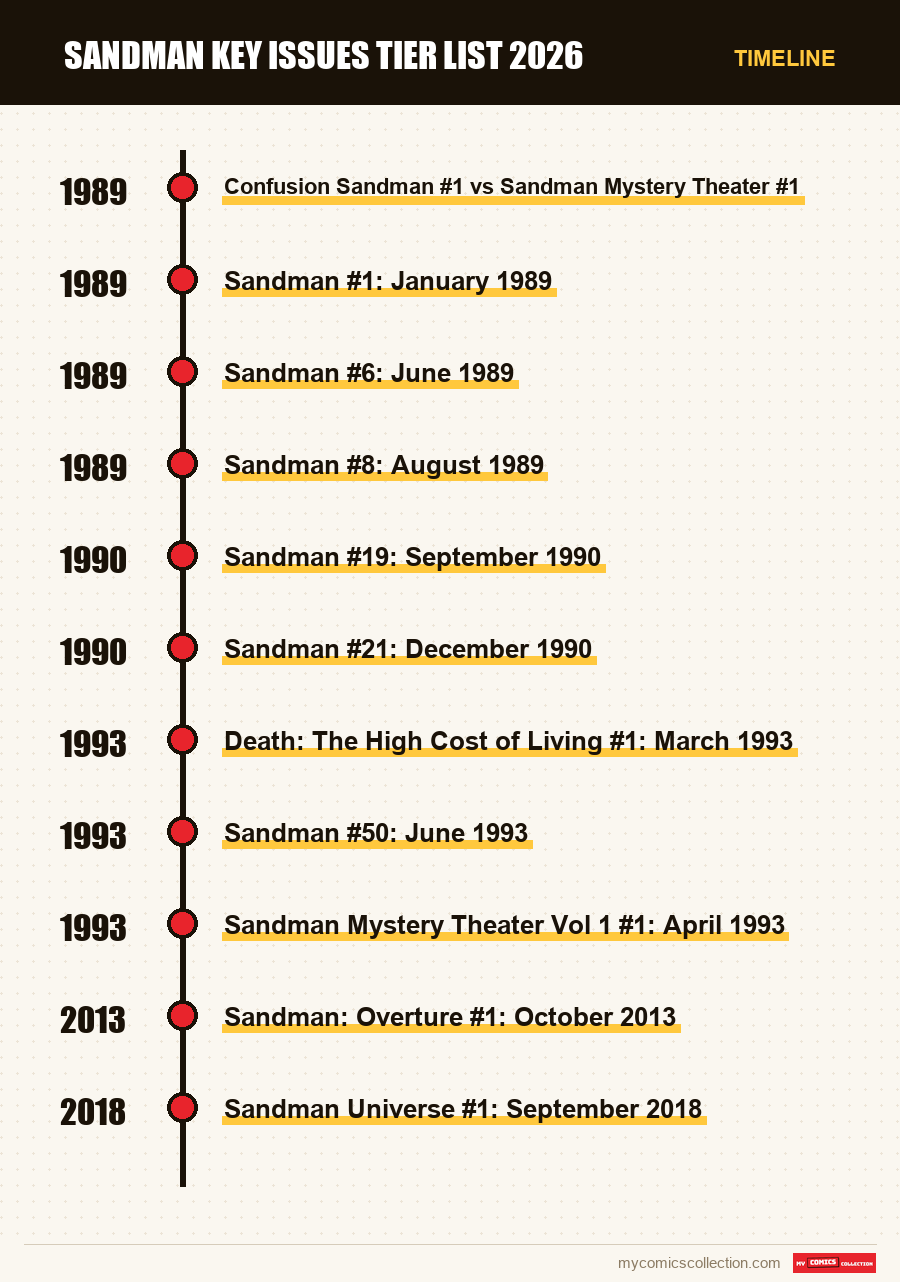
The 2026 tier list of key Sandman issues ranks Vertigo and pre-Vertigo numbers by valuation potential: Tier S blue-chip (Sandman #1 January 1989 1st Morpheus Neil Gaiman/Sam Kieth/Mike Dringenberg DC Comics precursor Vertigo, Sandman #8 August 1989 1st Death of the Endless, Sandman #19 September 1990 1st Delirium A Midsummer Night's Dream Will Shakespeare guest star, Sandman Vol 3 Dream Country collected volume): Vertigo core assets at 60-1,200 € depending on grade. Tier A (Sandman #6 June 1989 24 Hours horror classic, Sandman #21 December 1990 Season of Mists arc starts, Sandman #50 June 1993 Ramadan one-shot, Sandman Endless Nights 2003 OGN Gaiman). Tier B sleepers (Sandman Mystery Theater Vol 1 #1 April 1993 Wesley Dodds, Death The High Cost of Living #1 March 1993 spin-off Gaiman, Sandman Overture #1 October 2013 prequel Gaiman/JH Williams III, Sandman Universe #1 September 2018 relaunch). Tier C speculative bets 2026-2027 (Netflix Sandman season 2 end of 2025, Death of the Endless spin-off potential).
Building a coherent Sandman collection in 2026 requires a careful reading of the Vertigo catalog: the main series covers seventy-five issues published between January 1989 and March 1996, the pre-Vertigo material (DC Comics before the formal creation of imprint in March 1993), the Death spin-offs, the Endless Nights anthologies, and the Sandman Universe relaunch launched September 2018. Without clear prioritization, the collector French language disperses its budget on secondary issues of the Worlds' End arc or on Sandman Universe relaunches while the real fundamental pieces (Sandman #1, #8, #19) continue their upward trajectory driven by the Netflix success.
Ce Sandman 2026 tier list guide classifies the major key issues into four tiers (S, A, B, C) according to three weighted criteria: narrative historical importance in the Endless mythos, market performance over five rolling years documented by GoCollect and Heritage Auctions, and probability of Netflix catalyst in the 2025-2028 window. Each issue is documented with exact date, full creative team and price range by CGC grade. Objective: to allow the French-speaking collector to build a budgeted purchasing strategy, without falling into the classic traps of the Sandman catalog (confusion between Sandman #1 Gaiman 1989 and Sandman Mystery Theater #1 1993, multiple Sandman #1s in the different Vertigo relaunches).
Sandman 2026 tier list methodology
A useful Sandman tier list does not simply align numbers in order of CGC rarity: it prioritizes according to a collection thesis consistent with the particular status of the series in world pop culture. Sandman is the only mainstream comic to have won a World Fantasy Award (1991, for issue #19), to appear in Time Magazine's list of the hundred best graphic novels, and to benefit from literary recognition that goes far beyond the traditional comic book readership. This particularity makes the analysis grid different from that applied to Batman or Spider-Man.
Tier S/A/B/C classification criteria
- Narrative historical significance (45%): first appearances of the Endless (Morpheus, Death, Delirium, Destiny, Desire, Despair, Destruction), canonical arcs cited in Anglo-Saxon academic criticism, founding retcons of the Vertigo myth. The weighting is higher than for traditional franchises because Sandman's value is based on documented narrative richness rather than cinematic exposition.
- Market performance 5 years (30%): CGC price trend documented on GoCollect and ComicConnect between 2021 and 2026. Sandman experienced two distinct valuation peaks: Netflix announcement June 2019, and effective release August 2022. Post-peak windows have stabilized without major correction.
- Netflix catalyst probability 2025-2028 (25%): Netflix production schedule confirmed for season 2 (filming 2024, release expected at the end of 2025 or beginning of 2026), potential Death of the Endless spin-offs, and new phase of visibility for the general French-speaking public via the platform.
Sandman Third Party Definition
- Tier S: blue-chip Vertigo: central numbers of the Endless myth, value recognized worldwide by Vertigo communities, no risk of historical downgrading. These are the absolute defensive assets of any serious Sandman collection. If you only had three or four numbers, these would be them.
- Tier A: fundamentals: historically critical issues with solid performance but without the absolute status of Tier S. Make up the backbone of a serious collection spanning the Season of Mists, A Game of You, Brief Lives and The Kindly Ones arcs.
- Tier B: sleepers with conviction: numbers undervalued in view of their significance, with catalyst identified at 12-36 months or canonical status in consolidation. Includes spin-offs Death and Sandman Mystery Theater, prequel Overture, and relaunch Sandman Universe.
- Tier C: speculative bets: numbers with a strong thesis but dependent on uncertain future events (Netflix season 3, spin-off Death). Limited budget allocation recommended at 5-10% of total Sandman budget.
Voluntary out-of-scope
This tier list does not classify modern post-2018 variants without lasting narrative significance, DC Black Label reprints of Sandman arcs (useful for reading, without market value), nor secondary Vertigo annuals unless directly influenced by the Endless mythos. The pre-Vertigo Sandman Golden Age material (Adventure Comics #40 July 1939 1st Wesley Dodds Sandman original) is covered briefly in the pitfalls section because confusion with the Sandman Gaiman constitutes a major risk for the beginning French-speaking collector. For full publisher context, see guide pillar comics DC universe.
Tier S: the central Sandman blue-chips
Three issues absolutely dominate the Sandman catalog and form the defensive core of any serious Vertigo collection. They combine relative rarity in high grade Modern Age, indisputable historical importance in the myth of the Endless, and maximum liquidity on major auction markets. These three titles alone represent the narrative foundations of the entire Sandman universe and remain priority acquisitions for any French-speaking collector building a Vertigo collection in 2026.
Sandman #1: January 1989 (Neil Gaiman / Sam Kieth / Mike Dringenberg)
The absolute founding number. Published by DC Comics in January 1989, several years before the formal creation of the Vertigo imprint in March 1993, Sandman #1 introduced Morpheus aka Dream of the Endless in Sleep of the Just, written by Neil Gaiman, drawn by Sam Kieth, and inked by Mike Dringenberg. The iconic cover by Dave McKean inaugurates a visual language that will have a lasting impact on the medium. The story recounts Morpheus' capture by occultist Roderick Burgess in 1916 and his confinement for seventy-two years, laying the mythological foundation for the entire series. Print run estimated to be limited for a first Vertigo precursor issue, which explains the relative rarity in high grade despite the Modern Age character of the title.
- CGC 9.8: public sales 2023-2026 between €500 and €1,200. Census 9.8 documented around 800-900 copies, stabilizing since Netflix peak 2022.
- CGC 9.6: €220 to €380. Recommended entry point for serious collecting.
- CGC 9.4: €130 to €220.
- CGC 9.0: €80 to €140.
- Raw VF/NM: €50 to €110 on verified eBay sales 2025-2026.
5-year trend: +160% between 2021 and 2026 in CGC 9.8, with a clear acceleration following the Netflix June 2019 announcement then stabilization post-release August 2022. The issue is more liquid than the Modern Age Vertigo average thanks to the stable international fan base. Heritage Auctions has seen steady sales every quarter since 2020. The Netflix season 2 catalyst in late 2025/early 2026 could trigger a new bullish phase documented on GoCollect. For a perspective on the author's overall work, consult the complete story by Neil Gaiman author.
Sandman #8: August 1989 (Neil Gaiman / Mike Dringenberg / Malcolm Jones III)
The first appearance of Death of the Endless. Published by DC Comics in August 1989, Sandman #8 introduced Death in the story The Sound of Her Wings, written by Neil Gaiman and drawn by Mike Dringenberg with inking by Malcolm Jones III. Morpheus' older sister appears in the guise of a smiling young Gothic woman, a thousand miles from the classic representations of the Reaper. This iconic design would become one of the most recognizable images in Vertigo comics history and inspire an entire generation of popular depictions of death. The issue has won several critical awards and is often the preferred entry point for new Sandman readers, maintaining a steady secondary demand in the markets.
- CGC 9.8: €200 to €500. Census 9.8 slightly higher than Sandman #1, but higher demand.
- CGC 9.6: €110 to €200.
- CGC 9.4: €70 to €120.
- CGC 9.0: €45 to €75. Most economical entry point for 1st Death.
- Raw VF/NM: €25 to €60.
5-year trend: +140% between 2021 and 2026 in CGC 9.8. The potential Death spin-off in the Netflix Sandman universe constitutes the major catalyst being monitored: an announced development would probably trigger a revaluation of 40-80% over 12 months according to the previous Walking Dead and Umbrella Academy. For an in-depth character analysis, see complete story of Death of the Endless in comics.
Sandman #19: September 1990 (Neil Gaiman / Charles Vess)
A Midsummer Night's Dream and first Delirium. Published by DC Comics in September 1990, Sandman #19 is a doubly seminal issue. On the one hand, it features the first formal appearance of Delirium of the Endless (originally named Delight before her transformation). On the other hand, the story A Midsummer Night's Dream, drawn by Charles Vess and scripted by Neil Gaiman, features Will Shakespeare's troupe performing the eponymous play in front of King Auberon, Queen Titania and their magical court. In 1991, this issue became the first and only comic to win the World Fantasy Award for Best Short Fiction, which prompted the organizers to change the rules to exclude comics from subsequent editions. This literary consecration gives the issue a unique status in the entire history of the medium.
- CGC 9.8: €220 to €480. Census 9.8 limited to approximately 350-450 copies.
- CGC 9.6: €110 to €200.
- CGC 9.4: €70 to €120.
- CGC 9.0: €45 to €80.
- Raw VF/NM: €28 to €65.
5-year trend: +130% between 2021 and 2026 in CGC 9.8. Main catalyst: Delirium is expected in season 2 or 3 of the Netflix series, its appearance on screen will automatically trigger additional demand. The issue also benefits from a literary prestige value which protects it against major market corrections, unlike recent speculative variants. For the full narrative context, see complete story of Sandman in comics.
Sandman Vol 3: Dream Country (collected volume 1990-1991)
The reference hardcover volume for Sandman #17-20 (including #19 World Fantasy Award). Originally published as a Vertigo trade paperback in 1991, reissued as a deluxe hardcover and as Absolute Sandman Volume 1 (2006). Although the bound editions are outside the strict scope of a single-issue classification, the cult status of Dream Country as a literary gateway to Sandman justifies its mention in Tier S. First printings trade paperback Vertigo 1991 in pristine grade sell for €80-180 on verified sales 2025-2026, while Absolute Sandman Volume 1 first printings 2006 reach €150-350 depending on condition. These collected volumes often constitute the first purchase of new collectors seduced by Netflix before switching to the original single issues.
Tier A: Sandman fundamentals
Four issues make up the second major circle of any serious Sandman collection. They correspond to major narrative moments from the Preludes and Nocturnes, Season of Mists, Brief Lives arcs and the special anthologies. Their fundamental status is solid, their market performance documented and their probable integration in seasons 2-3 Netflix strengthens their thesis at 24-36 months.
Sandman #6: June 1989 (Neil Gaiman / Mike Dringenberg / Malcolm Jones III)
24 Hours, the absolute horror classic. Published by DC Comics in June 1989 as part of the inaugural Preludes and Nocturnes arc, Sandman #6 contains the story 24 Hours featuring John Dee aka Doctor Destiny in a diner. The episode is cited by Neil Gaiman himself as one of the most difficult to write of his career, and remains one of the most significant psychological horror stories ever published in mainstream comics. The Dave McKean cover and the diner sequence have become iconic. The number was directly adapted into season 1 Netflix (episode 5), which increased its mainstream visibility since 2022.
- CGC 9.8: €130 to €240.
- CGC 9.6: €65 to €110.
- CGC 9.4: €40 to €70.
- Raw VF/NM: €18 to €38.
5-year trend: +110% in CGC 9.8 driven by the Netflix adaptation. The issue constitutes an excellent Tier A acquisition for mid-budget, with an importance/price ratio higher than Sandman #21 in 2026.
Sandman #21: December 1990 (Neil Gaiman / Kelley Jones / Malcolm Jones III)
Season of Mists Prologue, the kickoff to the most famous arc. Published by DC Comics in December 1990, Sandman #21 opens the Season of Mists arc written by Neil Gaiman with Kelley Jones drawing. The story begins with the Endless meeting in the family castle, the first time where Destiny, Desire, Despair, Delirium, Death and Morpheus appear together in the same narrative sequence. This founding scene is one of the most reproduced in the entire series and is the preferred entry point for academic analysts studying the Endless mythos. The Season of Mists arc (Sandman #21-28) is consistently ranked among the most relevant Vertigo arcs in history.
- CGC 9.8: €90 to €180.
- CGC 9.6: €50 to €90.
- CGC 9.4: €30 to €55.
- Raw VF/NM: €15 to €32.
5-year trend: +95% in CGC 9.8. Potential Catalyst: Season of Mists is the most anticipated arc for Seasons 2-3 Netflix. Its adaptation would mechanically trigger an additional request on the opening number.
Sandman #50: June 1993 (Neil Gaiman / P. Craig Russell)
Ramadan, the most acclaimed one-shot. Published by Vertigo (the first Sandman issue officially labeled Vertigo after imprint creation in March 1993) in June 1993, Sandman #50 contains the standalone story Ramadan, scripted by Neil Gaiman and drawn by P. Craig Russell. The story features Caliph Haroun al-Rashid negotiating with Morpheus for the eternal preservation of the glory of medieval Baghdad. The episode is regularly cited as one of the finest examples of Vertigo storytelling, and has won several critical awards. The editorial transition to the official Vertigo imprint gives this issue additional historical significance for Vertigo collectors.
- CGC 9.8: €75 to €150.
- CGC 9.6: €42 to €75.
- CGC 9.4: €25 to €45.
- Raw VF/NM: €12 to €28.
5-year trend: +85% in CGC 9.8. The issue remains undervalued relative to its critical stature, making it a serious sleeper for 2026-2028. Potential catalyst: Netflix could choose to adapt Ramadan as a standalone season 2 or 3 episode.
Sandman: Endless Nights: September 2003 OGN (Neil Gaiman and artist collective)
The major post-series anthology. Published in original hardcover by Vertigo in September 2003 then in trade paperback, Endless Nights is an anthology written by Neil Gaiman bringing together seven stories each devoted to one of the Endless, illustrated by seven different artists (Glenn Fabry for Destiny, Milo Manara for Desire, Miguelanxo Prado for Despair, Bill Sienkiewicz for Delirium, P. Craig Russell for Destruction, Frank Quitely for Dream, and Barron Storey for Death). OGN reached first place on the New York Times Best-Seller list the week of its release, a historic event for a Vertigo graphic novel. Hardcover 2003 first printings sell for €60-140 on the secondary market 2025-2026 depending on condition.
Tier B: Sandman conviction sleepers
Four titles make up the most relevant sleeper category in the expanded Sandman catalog. They cover the major spin-offs, the prequel Overture and the relaunch Sandman Universe. Their sleeper status is based on a current undervaluation compared to their potential 18-36 month catalyst, mainly linked to the Netflix calendar and DC Black Label announcements.
Sandman Mystery Theater Vol 1 #1: April 1993 (Matt Wagner / Guy Davis)
Alternative Sandman Wesley Dodds. Published by Vertigo in April 1993, Sandman Mystery Theater #1 is written by Matt Wagner with Guy Davis drawing. The series explores the original Golden Age Sandman Wesley Dodds (first introduced in Adventure Comics #40 July 1939) in a pulp detective approach set in 1930s New York. Although distinct from Sandman Gaiman in narrative timeline, the title shares the Vertigo universe and plays a crucial role in building the extended Sandman mythos. The series lasted for seventy issues published between April 1993 and April 1999.
- CGC 9.8: €80 to €180.
- CGC 9.6: €42 to €80.
- CGC 9.4: €25 to €45.
- Raw VF/NM: €12 to €28.
5-year trend: +75% in CGC 9.8. Potential catalyst: a Wesley Dodds appearance in Sandman Netflix (already confirmed season 1 in reference form) could trigger a significant revaluation. The title is also heavily undervalued compared to its Marvel equivalent (Daredevil Born Again #226-233). For a broader Vertigo perspective, see Vertigo key issues.
Death: The High Cost of Living #1: March 1993 (Neil Gaiman / Chris Bachalo / Mark Buckingham)
The first official Death spin-off. Published by Vertigo in March 1993 (the official launch month of Vertigo imprint), Death: The High Cost of Living #1 is the first mini-series centered on Death of the Endless, written by Neil Gaiman with Chris Bachalo drawing and Mark Buckingham inking. The story chronicles the annual day when Death takes human form to better understand the mortal experience. The iconic Dave McKean cover and debut solo Death status give the issue special significance. The three-issue miniseries was followed by Death: The Time of Your Life (1996).
- CGC 9.8: €70 to €150.
- CGC 9.6: €38 to €72.
- CGC 9.4: €22 to €42.
- Raw VF/NM: €10 to €25.
5-year trend: +95% in CGC 9.8. The issue remains an extremely interesting sleeper for 2026-2028: any announcement of a Death spin-off in the Netflix Sandman universe would trigger major secondary demand. The parallel with X-23 (NYX #3) and the first strong female appearances in Modern Age suggests a +150% revaluation potential on a confirmed live-action series catalyst.
Sandman: Overture #1: October 2013 (Neil Gaiman / J.H. Williams III)
The ultimate prequel from Gaiman. Published by Vertigo in October 2013, Sandman Overture #1 is the official prequel to the main series, written by Neil Gaiman with J.H. Williams III drawing. The six-issue miniseries, published between October 2013 and September 2015 (with significant editorial delays), recounts the events preceding the capture of Morpheus in 1916 recounted in Sandman #1. The graphic work of J.H. Williams III is regularly cited as one of the finest Vertigo visual performances of the 2010s. Several variant covers have been published, the 1:200 J.H. Williams III print is particularly sought after.
- CGC 9.8 cover A: €50 to €110.
- CGC 9.8 cover B (J.H. Williams III variant): €80 to €180.
- CGC 9.6: €25 to €55.
- Raw VF/NM: €8 to €18.
5-year trend: +60% in CGC 9.8 cover A. Catalyst: Netflix season 2 could integrate Overture flashbacks, which would trigger a moderate revaluation of the number. Gaiman canonicity status protects the title from major corrections.
Sandman Universe #1: September 2018 (Neil Gaiman / Si Spurrier / collective)
The Vertigo / DC Black Label relaunch. Published in September 2018, Sandman Universe #1 is the relaunch issue which opens a new editorial phase around the Endless myth, partially scripted by Neil Gaiman with Si Spurrier and a collective of authors. The one-shot lays the foundations for four new spin-off series (House of Whispers, Books of Magic, The Dreaming, Lucifer relaunch). Although the commercial performance was mixed compared to Vertigo expectations, the issue constitutes a historical marker of the franchise's transition to the streaming era.
- CGC 9.8 cover A: €35 to €80.
- CGC 9.8 variants: €45 to €120 depending on ratio.
- CGC 9.6: €18 to €38.
- Raw VF/NM: €6 to €15.
5-year trend: +50% in CGC 9.8. The number remains a moderate bet, its potential dependent on Netflix resonance on the extended franchise. Limited budget allocation recommended.
Tier C: speculative Sandman bets 2026-2027
This category brings together issues with a strong thesis but dependent on uncertain future events, mainly linked to the Netflix season 2 and 3 schedule, and Death spin-off announcements. The recommended budget allocation on the Tier C set should not exceed 5-10% of the serious collector's total Sandman budget.
Netflix Sandman season 2 (release late 2025/early 2026)
Season 2 of the Netflix series Sandman has confirmed that it will film in 2024 and arrive in late 2025 or early 2026. This second season should cover a significant part of the Season of Mists arc (Sandman #21-28), introduce Delirium (Sandman #19) and potentially Destruction. Issues directly impacted by casting announcements and trailers include Sandman #21 (Season of Mists Prologue), Sandman #19 (1st Delirium), Sandman #22-28 (Season of Mists arc), and Sandman #41-49 (Brief Lives, possible season 3). Recommended strategy: Q4 2025 positioning on Sandman #21 and #22 in CGC 9.6-9.8 before the halo effect.
Death of the Endless potential spin-off (announcement expected 2026-2027)
Several industry sources have mentioned the development of a Death spin-off in the Netflix Sandman universe, without official confirmation as of this guide. A possible announcement would trigger a major revaluation of Sandman #8 (1st Death) and Death: The High Cost of Living #1. Speculative strategy: constitution of a light position on Sandman #8 CGC 9.4-9.6 and Death: The High Cost of Living #1 CGC 9.6-9.8, with a horizon of 18-36 months. Previous Marvel Disney+ (Loki, Wandavision) suggest a potential +60 to +120% revaluation upon confirmed production announcement.
Hellblazer / John Constantine potential integration
John Constantine appears in Sandman #3 (March 1989), making the number one latent asset susceptible to any Constantine 2 announcement in the James Gunn DCU or Sandman series integration. The issue is currently trading in CGC 9.8 between €80 and €160, with a floor protected by its own Hellblazer series (Vertigo 1988-2013).
Collecting this series?
Track what you own, what you are missing and what your collection is worth. 7 day trial.
Start my trial →Sandman 2026 Acquisition Strategy by Budget
Building a cohesive Sandman collection depends on the annual budget available and the planned holding horizon. Three budgetary profiles structure the 2026 recommendations for the French-speaking collector.
Budget €500-1,000: Sandman entry essential
For a budget of €500-1,000 annually, the absolute priority is the acquisition of Sandman #1 in CGC 9.4 (€130-220) or Raw VF/NM (€50-110), accompanied by Sandman #8 1st Death in CGC 9.4 (€70-120). These two fundamental acquisitions constitute the defensive base. The rest of the budget can be allocated to Sandman #6 (24 Hours) or Sandman Vol 3 Dream Country trade paperback first printing 1991, which provide complementary narrative exposition. Avoid Sandman Universe variants and secondary spin-offs at this stage.
Budget €1,000-3,000: serious Tier S/A collection
With €1,000-3,000 annually, the recommended strategy combines Sandman #1 CGC 9.6 (€220-380), Sandman #8 CGC 9.6 (€110-200), Sandman #19 CGC 9.6 (€110-200) and Sandman #21 Season of Mists CGC 9.6 (€50-90). This base covers the three major Endless (Morpheus, Death, Delirium) and the entry point to the most famous arc. The supplement can include Sandman #50 Ramadan CGC 9.6 (€42-75) and Death: The High Cost of Living #1 CGC 9.6 (€38-72). For tactical arbitrations, the free estimate allows you to validate the positioning before purchase.
Budget €3,000-10,000: complete institutional collection
Beyond €3,000 annually, the strategy aims for complete Tier S coverage in CGC 9.8 (Sandman #1, #8, #19) with an additional budget on Tier A (Sandman #6, #21, #50) in CGC 9.6-9.8. Typical allocation: 60-70% Tier S in high grade, 20-25% Tier A in high grade, 10-15% Tier B sleepers in medium grade for Netflix catalyst exposure. At this level, the use of dedicated tools such as Comics Manager guide becomes relevant: daily-updated eBay estimates in one place, read alongside the CGC census and the streaming announcements calendar.
Classic Sandman Market Pitfalls
The Sandman catalog has several specific pitfalls that should be understood before making any significant investment. These pitfalls particularly affect beginner French-speaking collectors unfamiliar with the Vertigo editorial history.
Confusion Sandman #1 (1989) vs Sandman Mystery Theater #1 (1993)
The most common trap. Sandman #1 (January 1989, Neil Gaiman) introduces Morpheus aka Dream of the Endless to the Vertigo universe. Sandman Mystery Theater #1 (April 1993, Matt Wagner) introduces Golden Age Sandman Wesley Dodds in a 1930s detective setting. These two issues are regularly confused in French-speaking eBay listings, sometimes with significant price differences. Systematic verification: Sandman #1 1989 bears the mention DC Comics on the back (Vertigo precursor before creation of the imprint), Sandman Mystery Theater #1 1993 bears the official Vertigo mention. The screenwriter and cover (Dave McKean vs Gavin Wilson) are also distinctive.
Multiple Sandman #1s across Vertigo/DC Black Label relaunches
The Sandman catalog has at least six issues bearing the title Sandman #1 or close variants: Sandman #1 (Vol 1, January 1989, Gaiman), Sandman Mystery Theater #1 (April 1993, Wagner), Sandman Midnight Theater #1 (1995 one-shot), Sandman Presents Vertigo series (multiple #1s between 1999-2003), Sandman Overture #1 (October 2013, Gaiman prequel), Sandman Universe #1 (September 2018, relaunch). This multiplicity regularly generates purchasing errors. Simple rule: systematically check the year of publication, writer, and CGC serial number before any acquisition over €100.
Pre-Gaiman Golden Age Sandman
Adventure Comics #40 (July 1939) contains the first appearance of the Golden Age Sandman Wesley Dodds created by Gardner Fox and Bert Christman. This issue is completely separate from the Sandman Gaiman and trades on very different Golden Age price ranges (CGC 5.0 typically €8,000-15,000). The confusion between these two characters sharing the same code name remains a source of major errors for new French-speaking collectors. For a comparative analysis, consult the Sandman key number analysis.
Upgraded modern Sandman Universe variants
The 2018-2022 period saw a proliferation of Sandman Universe variant covers and spin-offs (House of Whispers, Books of Magic, The Dreaming) often overpriced by eBay merchants based on the Sandman name without lasting narrative meaning. Simple rule: a Sandman Universe variant without a direct Gaiman contribution and without a major canonical connection should be considered a marginal speculative product, with no place in a Tier S/A/B strategy. The risk of correction is documented on 2024-2025 sales.
Trade paperback reprints confused with first printings
The Sandman hardcover volumes (10 main volumes Preludes and Nocturnes to The Wake) have seen numerous reprints since 1991. Only the first printing trade paperback Vertigo 1991-1996 and the Absolute Sandman first printing hardcover 2006-2011 have a significant market value. Post-2018 DC Black Label reprints are useful for reading but without lasting collectible value. For comparisons to other Vertigo franchises, see the reference Vertigo key issues.
Sandman Market 2026-2030 Monitoring
Operational monitoring of a Sandman portfolio requires quarterly discipline structured around the Netflix calendar, DC Black Label announcements, and comparative performance versus other Vertigo franchises (Hellblazer, Preacher, Y The Last Man). This is the recommended monitoring grid.
Quarterly reassessment schedule
- Q1: previous year report: Heritage Auctions and ComicConnect sales on Sandman #1, #8, #19, calculation of progression by issue and by grade. Recalibration of budgetary weighting against actual performance.
- Q2: analysis of San Diego Comic-Con announcements and DC Black Label / Netflix confirmations. Updated Tier C targets based on new Death or Sandman Universe spin-off developments.
- Q3: monitoring of Netflix Sandman releases and price impact observed on D+30, D+90, D+180 on the associated keys. This window is historically the most predictive of annual repricing.
- Q4: end-of-year tax arbitrage, opportunistic sales of Tier C positions having achieved their catalyst objectives, repositioning on Tier S/A if a market correction is identified.
Sandman Re-ranking Indicators
Three signals can justify moving a Tier C number to Tier B, or Tier B to Tier A:
- Official Netflix announcement of a spin-off centered on a specific Endless (Death, Delirium, Destruction).
- Reduction of the CGC 9.8 census below a structural threshold (typically 400 copies in public circulation for Sandman Vol 1 post-#10 issues, 600 for Sandman #1-9).
- Price progression greater than 80% over 18 rolling months with maintenance over 24 months, validated on GoCollect and three consecutive Heritage Auctions sales.
Sandman Operational Tracking Tools
To manage a diversified Sandman portfolio over 20-80 issues, manual tools (Excel, Google Sheets) quickly reach their limits given the diversity of the catalog (main series 75 issues, Mystery Theater 70 issues, multiple Death spin-offs, Sandman Universe extended). Dedicated applications like Comics Manager keep daily-updated eBay estimates in one place, to read alongside the CGC census and the Netflix ad calendar. See the complete guide Comics Manager for initial setup and free estimate for individual arbitrations. For comparisons with other major franchises, see guide pillar comics DC universe and analysis Watchmen tier list key issues 2026.
Horizon 2027-2030: areas to monitor Sandman
Five major theses will probably structure the following decade on the Sandman franchise:
- Netflix Sandman seasons 3-4 (target 2027-2029): progressive coverage of the Brief Lives (Sandman #41-49) and The Kindly Ones (Sandman #57-69) arcs triggering sequential revaluation of the associated issues.
- Death spin-off confirmed by Netflix: major catalyst on Sandman #8 and Death: The High Cost of Living #1, base scenario 2026-2027.
- New Gaiman DC Black Label initiative: any new Sandman work by Gaiman post-Overture would have a halo effect on the entire catalog.
- Resignification Vertigo millennial collectors: the Vertigo nostalgia of collectors who read Sandman in high school in the 1990s enters the 35-45 year window, historically the most active period for high-grade acquisitions.
- Adaptation of other Gaiman works: Good Omens season 3, Stardust spin-offs, American Gods potential relaunch would create increased mainstream exposure of the Gaiman name benefitting Sandman by halo.
For collectors wishing to actively track the global market, the overview of referenced comics and the index of key issues comics provide a systematic entry point. For the Sandman franchise specifically, the Sandman character archive centralizes editorial resources, and the panorama Sandman key numbers details specific editions and variants. Female collectors constitute a growing fraction of the Sandman base, see dedicated analysis comics collector woman 2026. For the multi-franchise strategic perspective, consult the investment strategy update 2027. For related Vertigo contexts and major author comparisons, see Watchmen comics story and the story Alan Moore author.
Sandman 2026 tier list FAQ
Sandman #1 (January 1989, Neil Gaiman / Sam Kieth / Mike Dringenberg) remains the absolute foundational issue, first appearance of Morpheus aka Dream of the Endless. For a moderate budget, aim for CGC 9.4 between €130 and €220, or Raw VF/NM between €50 and €110. For a higher budget, CGC 9.6 between €220 and €380 constitutes the optimal entry point for a serious, lasting collection. The issue enjoys above-average liquidity in Modern Age Vertigo thanks to Gaiman's stable international fan base.
Four indicators are decisive. First, the year of publication: Sandman #1 has the cover date January 1989 while Sandman Mystery Theater #1 is April 1993. Second, the writer: Neil Gaiman for Sandman #1, Matt Wagner for Sandman Mystery Theater #1. Third, the cover: iconic Dave McKean photo-collage for Sandman #1, more traditional Gavin Wilson illustration for Sandman Mystery Theater #1. Fourth, the imprint: Sandman #1 1989 bears the mention DC Comics (Vertigo precursor before formal creation of the imprint in March 1993), Sandman Mystery Theater #1 1993 bears the official Vertigo mention. For any acquisition over €100, require CGC slabbed with verifiable serial number on the official register.
Sandman #8 (August 1989, 1st Death of the Endless) currently offers the most relevant importance/price ratio on the Tier S Sandman base. 9.4 at €70-120 remains more accessible than Sandman #19 in equivalent grade, and the potential Death Netflix spin-off catalyst is more immediate than that of a Delirium adaptation. Sandman #19 nevertheless remains major in the long term, notably for its status as the only mainstream comic to have won the World Fantasy Award (1991). Recommended strategy: Sandman #8 priority in year N, Sandman #19 in year N+1 if annual budget less than €1,500.
The two are complementary and not substitutable. Sandman #50 (June 1993, first issue officially labeled Vertigo) in CGC 9.8 at €75-150 remains a serious sleeper undervalued in relation to its critical stature. Endless Nights hardcover first printing 2003 at €60-140 offers a complete exhibition of the seven Endless series in a collected format. For a single budget under €200, choose Sandman #50 CGC 9.6 for the sustainable single issue value. For €300 and more, buying both in matching grade maximizes the coherence of the Vertigo prestige collection.
For Sandman #1, #8, #19: CGC 9.6 minimum is the institutional liquidity threshold, below which resale remains possible but with discounts negotiated on eBay. For Sandman #6, #21, #50: CGC 9.6 offers the most relevant preservation/price ratio. The 9.8 remains accessible on Modern Age Vertigo but the premium can reach 100-150% of the 9.6, which degrades the risk/return ratio except for a horizon greater than 5 years. For sleepers like Death High Cost of Living #1 or Sandman Mystery Theater #1: aim for CGC 9.8 to take full advantage of the potential catalyst. For Sandman Universe spin-offs and post-2018 modern variants: sufficient VF/NM raw grade, limited allocation recommended.
Related articles
- Sandman key numbers: detailed overview
- Story by Neil Gaiman author
- History of Death of the Endless in comics
- Key issues Vertigo reference
- Watchmen tier list key issues 2026
Do you own any Sandman comics? Estimate the value of your collection for free to know their current rating.