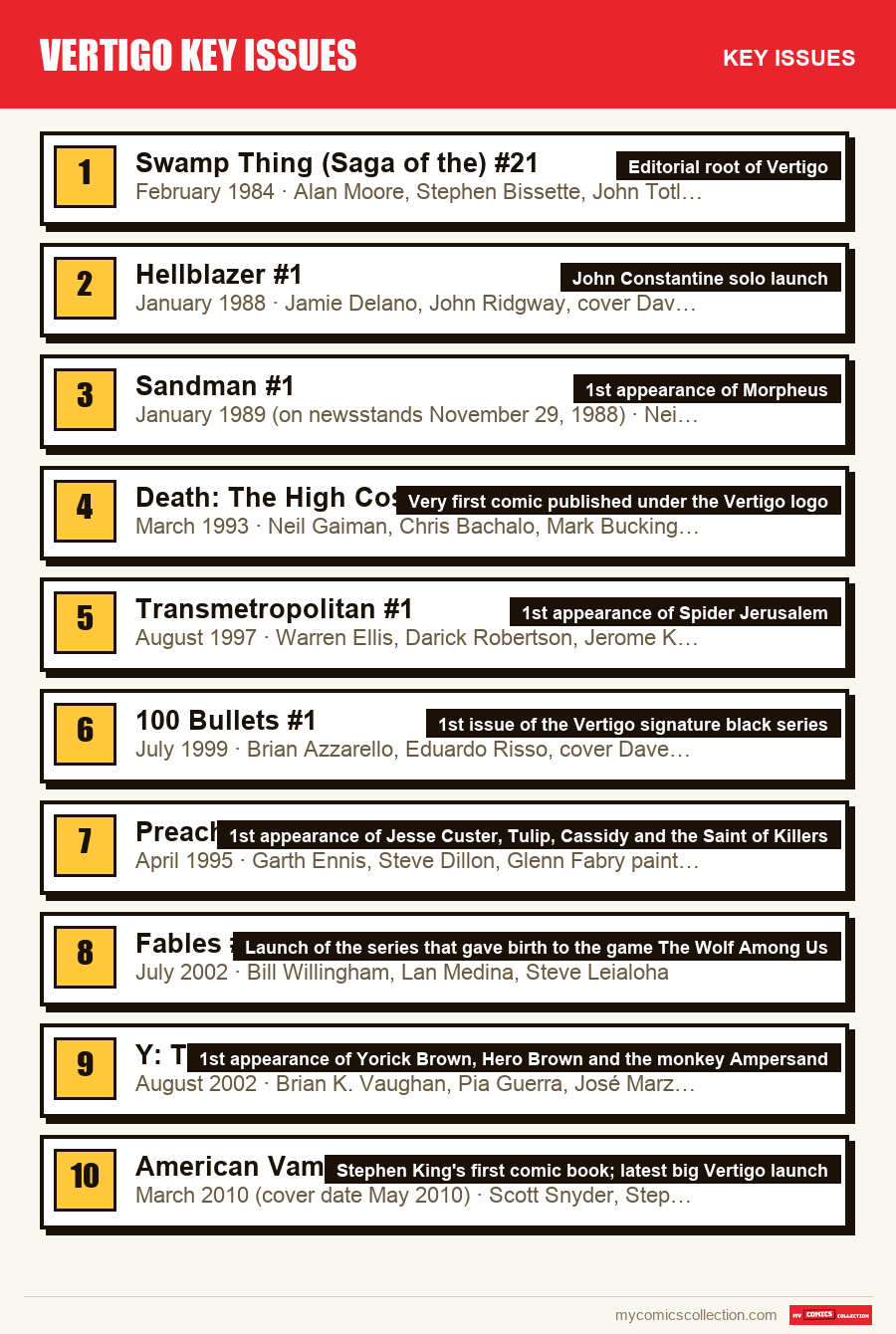
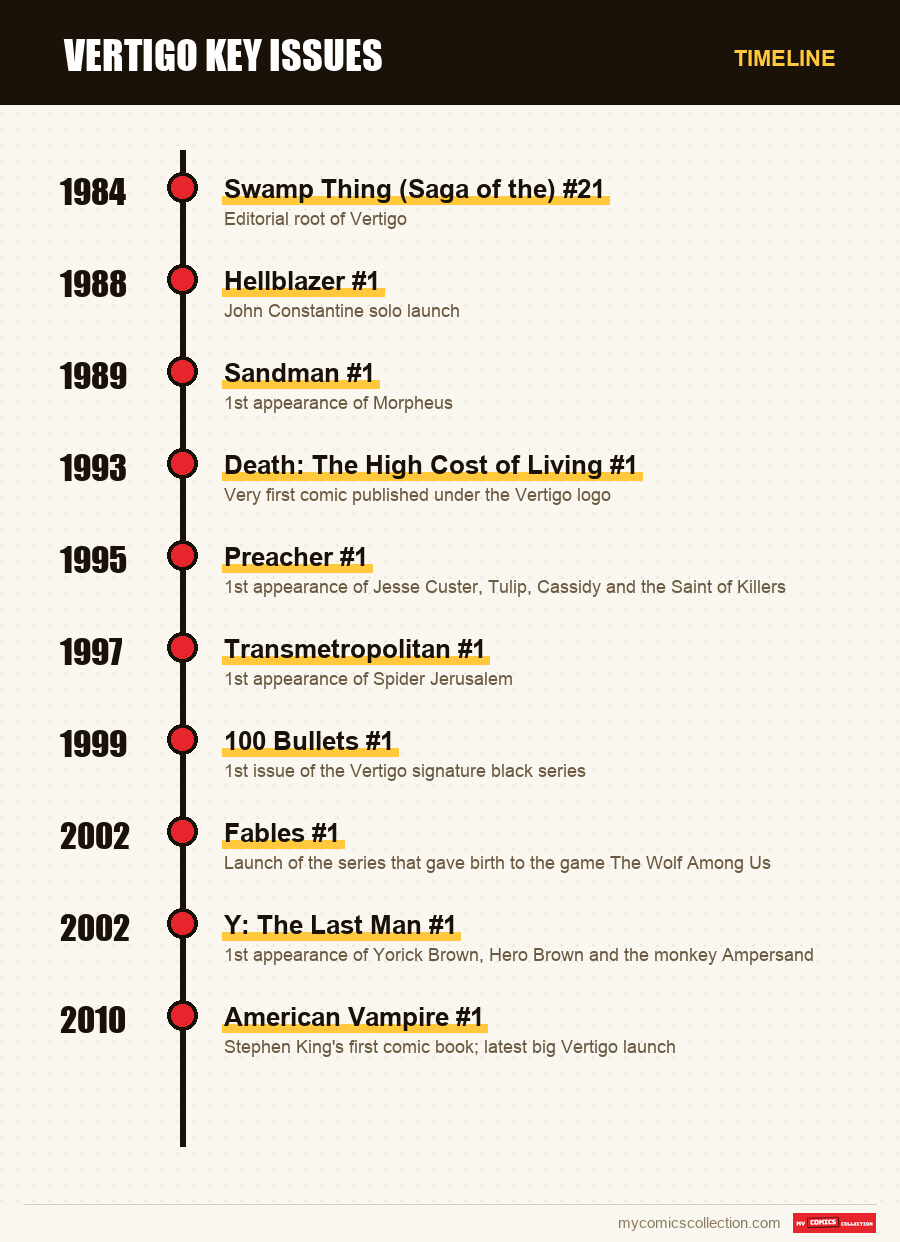
The most searched Vertigo key issues are Swamp Thing #21 (1984, editorial root of the label under the pen of Alan Moore), Sandman #1 (1989, 1st appearance of Morpheus) and Hellblazer #1 (1988, solo launch by John Constantine). Then come the top seeds from the 1990s-2000s like Preacher #1 , 100 Bullets #1 , Transmetropolitan #1 , Fables #1 , Y: The Last Man #1 and American Vampire #1. Their value rests less on speculation than on authorial importance: Vertigo was, between 1993 and the 2010s, the main reservoir of DC Comics author series, and its first issues often mark the true starting point of a work still read and adapted today.
Unlike classic superhero comics, where the key to an issue almost always lies in the appearance of a costumed character, Vertigo key issues are judged by another yardstick: that of the voice of an author. A Vertigo issue 1 is almost never the start of a shared continuity with crossovers and event books: it is the launch of an autonomous work, thought out from start to finish by a screenwriter and an artist who retain creative control. This is precisely what makes the market for these comics different: we don't collect continuity, we collect bibliographies.
This guide lists the issues that have a consensus among collectors and specialized auction houses: significant first appearances, launches of series that have become cult, and a few special cases (such as the very first comic published under the Vertigo logo) which have more historical than speculative value. For each title, we distinguish what is a verifiable fact (date of publication, circulation, creators, status of first appearance) from what is a market price, when this is documented by actual sales rather than by a vague estimate.
If you want to understand how the Vertigo label was born and why it occupies a special place in the history of DC Comics, our article on the history of the Vertigo imprint traces the entire editorial chronology, from its creation to its closure. The angle here is different: we focus only on issues that have identifiable collectible value, with the context needed to understand why they matter.
How Vertigo became a breeding ground for key issues
The story actually begins ten years before the official birth of the label. In February 1984, DC published The Saga of the Swamp Thing #21, “The Anatomy Lesson”, by Alan Moore, Stephen Bissette and John Totleben. This issue completely reconstructs the origin of the character: Swamp Thing is no longer a man transformed into a plant monster, but a sentient plant who believes he was once a man. It is this issue that most historians of the medium consider to be the direct root of what would become Vertigo: DC had stopped submitting the title to the Comics Code Authority, paving the way for a line of mature comics edited by Karen Berger, then a young editor from House of Mystery . The critical success of Watchmen and of Batman: The Dark Knight Returns in 1986 confirmed that this adult readership existed, and DC's line of mature titles grew throughout the 1980s under Berger's leadership.
In 1992, this editorial line was sufficiently distinct from the rest of the DC catalog to be separated administratively, and Berger obtained the green light to transform it into a full-fledged imprint. Vertigo was officially launched in January 1993, with a wave of titles dated March 1993: some were existing DC series which fell directly under the new banner:Shade, the Changing Man (from #33), The Sandman (#47), Hellblazer (#63), Animal Man (#57), Swamp Thing (#129) and Doom Patrol (#64, with Rachel Pollack writing): while others are new launches. The very first comic book published under the Vertigo logo is Death: The High Cost of Living #1, a spin-off of Sandman written by Neil Gaiman himself. This editorial detail, often ignored, makes this issue a piece apart: it is not the most sought-after comic in the catalog, but it is historically “number zero” of the entire imprint.
This switching of existing titles explains a subtlety that sometimes confuses first-time buyers: the golden key to a Vertigo series is not always its “#1” in the strict sense. For Sandman, the issue which officially bears the Vertigo logo is #47, but the first appearance of Morpheus, and therefore the key sought by the market, remains #1 from January 1989, published four years before the creation of the imprint. This is an essential point of vigilance before any purchase: always check what you are actually collecting, the first appearance of the character or the first number under the logo.
Swamp Thing (Saga of the) #21
“The Anatomy Lesson” is not a Vertigo issue in the strict sense, the imprint does not yet exist, but it is the founding story cited by almost all historians as the tipping point that made Vertigo possible. Moore completely rewrites the mythology of Swamp Thing with Bissette and Totleben on the brushes, on a title that DC had already withdrawn from approval by the Comics Code Authority. It is the second story in the Moore run, and the cornerstone of the “mature readers” line which will give birth to Vertigo nine years later.
Hellblazer #1
Constantine had already been introduced into Swamp Thing by Moore, but it was this number that gave him his first solo title, with the story “Hunger! ". It features the first appearances of several recurring characters from the Constantine mythology, including Papa Midnite, Chas Chandler and Gary Lester. Delano and Ridgway immediately establish the very British, cynical and political tone that will make the reputation of the longest series in the entire Vertigo catalog, published without interruption until 2013.
Sandman #1
Published four years before the official creation of the imprint, this issue nevertheless remains THE absolute key to the Vertigo catalog in the eyes of the market, because it is the very first appearance of Morpheus, the Sandman of the modern era, in the story "Sleep of the Just". The title did not formally join the Vertigo logo until its #47 in 1993, but it is this 52-page #1, sold for $2, that any collector starting a Sandman collection is looking for. According to GoCollect market tracking data, CGC 9.8 graded copies have gone from a range of $300-$400 to an average of around $550, with sales no longer falling below $575 in early July: a rise fueled by the Netflix adaptation of the character.
Death: The High Cost of Living #1
This three-issue spin-off from Sandman, centered on Mort, the older sister of Morpheus, is a special case in this list: its value is not due to a significant first appearance of a character (Mort had already been introduced in Sandman #8), but to its status as the very first title published under the “Vertigo” logo proper, alongside Enigma by Peter Milligan. Rarely for a Vertigo comic of the time, this #1 was offered with an alternative cover, a practice almost non-existent elsewhere in the label's catalog in its early days.
Transmetropolitan #1
Often forgotten detail: this #1 was not originally published under the Vertigo logo, but under that of Helix, a short-lived science fiction imprint launched by DC in 1996. When Helix closed its doors after only one year of existence, Transmetropolitan is one of the rare series to survive, repatriated to Vertigo from #13. #1 “The Summer Of The Year” nevertheless remains collected as a Vertigo key in its own right since it is under this banner that the series lived most of its 60 issues and built its satirical cyberpunk reputation.
100 Bullets #1
Launch of a series which will span exactly one hundred issues until 2009, winning an Eisner Award and a Harvey Award along the way. Azzarello and Risso establish the principle that will form the entire narrative mechanics of the series: a mysterious Agent Graves offers victims of injustice a briefcase containing an untraceable weapon and one hundred bullets, with total immunity to use them. #1, 36 pages sold for $2.50, remains sought after as an entry point to one of the most accomplished thriller series in the catalog.
Preacher #1
This issue alone concentrates four major first appearances: the first full appearance of Jesse Custer, Tulip and Cassidy, as well as the very first appearance of the Saint of Killers. Ennis and Dillon install in a single issue the entire triangle of characters that will carry the series for 66 issues, an irreverent tone and graphic violence that will become the duo's trademark. 52 pages, sold for $2.95 upon release.
Fables #1
Willingham establishes the premise that will make the series successful for 150 issues: the fairy tale characters, chased from their kingdoms by a mysterious Adversary, live incognito in New York in the community of Fabletown. The opening story, centered on the disappearance of Rose Red, sister of Snow White, immediately establishes the polar-fantasy tone that distinguishes Fables from the rest of the Vertigo catalog. The series then spread to video games The Wolf Among Us from Telltale Games, released in 2013.
Y: The Last Man #1
Vaughan and Guerra open their world post-apocalypse of an unprecedented kind (the simultaneous disappearance of every mammal carrying the Y chromosome, except a man and his capuchin monkey) with a 44-page #1 which already poses all the issues of the series over 60 issues. It is one of the most sought-after Vertigo key issues of the 2000 period, driven by the lasting critical reputation of the series, often cited as one of the best comics of the 2000s from all publishers.
American Vampire #1
This double issue marks Stephen King's first-ever work on an original material comic book-he co-authored Skinner Sweet's origin story as a back-up, while Snyder developed the main story centered on Pearl in 1920s Los Angeles. The first printing sold out at DC shortly after its release, leading to a second printing with a recolored cover; Orders for this second printing also gave access, at a 1:25 ratio, to a variant of the first printing signed Jim Lee: a low-run variant particularly sought after today.
Collecting this series?
Track what you own, what you are missing and what your collection is worth. 7 day trial.
Start my trial →The impact of adaptations on the rating
The Vertigo catalog has long been seen by Hollywood as a storehouse of options that are difficult to bring to fruition: too many authors, too much intellectual property fragmented between creators and studio, tones often deemed too dark or too cerebral for the general public. This reputation has changed over the past fifteen years, and each successful adaptation immediately shifted demand for the corresponding key issues.
The clearest example is Sandman. The Netflix series, launched in 2022 with Tom Sturridge in the role of Morpheus, brought an entire generation of new readers back to the original comic. Netflix went further in July 2025 by broadcasting a special episode directly adapted from Death: The High Cost of Living, with Kirby Howell-Baptiste reprising the role of Mort: a choice which mechanically brought back into focus the 1993 miniseries mentioned above, until then considered a curiosity for purists rather than a key one.
Preacher had its TV adaptation on AMC between 2016 and 2019, produced by Seth Rogen and Evan Goldberg with Dominic Cooper, Joseph Gilgun and Ruth Negga. Four seasons were enough to put #1 from 1995 back on the radar of first-time collectors, particularly the copies signed by Ennis and Dillon.
Hellblazer/Constantine had a more chaotic adaptation journey, which paradoxically diluted its effect on the #1 rating: the 2005 film with Keanu Reeves took significant liberties with the original material, the 2014 NBC series with Matt Ryan, more faithful to the spirit of Delano, only lasted one season before cancellation, and the character then continued to live in animation (Constantine: City of Demons ) and in Legends of Tomorrow on The CW. Result: a reputation maintained continuously for twenty years, but without the occasional peak experienced Sandman or Preacher.
Y: The Last Man had its series on FX/Hulu in 2021, canceled after just one season: a textbook case that reminds us that an adaptation does not always have a lasting effect on the ratings if it does not find its audience on screen. Conversely, Fables never had a successful TV or cinema adaptation despite years of options in development, but found its second life via video games The Wolf Among Us, which continues to fuel interest in the original #1. 100 Bullets and American Vampire remain, to this day, without a major successful screen adaptation despite regular interest from studios: their rating therefore remains driven almost exclusively by the critical reputation of the comic itself, with no televisual halo effect.
For buyers, this overview provides a simple reading grid: an adaptation that meets its audience (Sandman, Preacher) sustainably drives demand upwards for the corresponding #1; a quickly canceled adaptation (Y: The Last Man, Constantine NBC, Swamp Thing on DC Universe) creates a one-off peak followed by a return to a demand base driven only by long-time collectors.
Buying guide
Buying a Vertigo key issue requires different vigilance than that applied to a classic superhero comic, because the market is narrower, the print runs are often less publicly documented, and the distinction between “character key” and “print key” can be confusing.
- Check what you're actually buying. For Sandman in particular, do not confuse #1 (1989, first appearance of Morpheus, excluding the Vertigo logo) with #47 (1993, first issue under the Vertigo logo). Both are collectible, but for different reasons and at different price points.
- Be wary of misidentified Helix prints. Transmetropolitan #1 is a special case: some ads present it as a “Vertigo comic” while the original print bears the Helix logo. This is not a defect, but the information must be accurate in the ad and in your own collection sheet.
- Compare grades methodically rather than instinctively. The difference in rating between a 9.2 and a 9.8 can be considerable on these titles, particularly since the recent increase seen on Sandman #1. Our article comparing CGC grades 9 and 9.8 details what concretely justifies these price differences and helps you not to overpay for an intermediate grade.
- Favor copies signed for Preacher and Sandman. The CGC signature series with Ennis/Dillon or Gaiman/Kieth/Dringenberg benefit from a stable premium, unlike signatures obtained outside the official circuit whose traceability is lower.
- Do not neglect recent low-run variants. The Jim Lee variant of American Vampire #1 (1:25 ratio on second printing) is a good example of an underrated "modern" key because the title itself is still relatively young (2010).
- Beware of unreported reprints. Many of these titles have had several printings (American Vampire #1 is the most documented example): always check the printing number indicated in the summary or on the back cover before purchasing.
- Follow your collection seriously rather than by feeling. With titles that multiply variants, prints and reissues, our collection management application allows you to keep a reliable trace of each copy (edition, grade, provenance) rather than relying on memory.
- Contextualize before comparing isolated prices. A single sale price on an auction platform does not make a trend; looking at several recent sales on the same grade gives a much more reliable reading of the actual rating.