The Sandman by Neil Gaiman (1989-1996) is much more than a comic series: it's a literary work in its own right, a revolution in the history of the medium. Published under the DC Vertigo label, this 75-issue series tells the story of Morpheus / Dream of the Endless, personification of dream and imagination, and his relationships with his siblings: Death, Desire, Delirium…
The Sandman by Neil Gaiman (1989-1996) is much more than a comic series: it's a literary work in its own right, a revolution in the history of the medium. Published under the DC Vertigo label, this 75-issue series tells the story of Morpheus / Dream of the Endless, personification of dream and imagination, and his relationships with his siblings:Death , Desire , Delirium , Destiny , Despair and Destruction. The first comic series to win a World Fantasy Award, Sandman paved the way for a generation of authors who proved that comics could rival great literature.
For collectors, the original DC Vertigo issues (1989-1996) are rare and sought-after objects, particularly since the Netflix adaptation (2022). This guide lists the 10 essential Sandman key issues, with their narrative significance and current CGC value.
Top 10 Sandman key issues: Neil Gaiman
Unlike superhero franchises where key issues are often first appearances of high-MCU-potential characters, Sandman key issues stand out for their narrative and literary importance: first appearances of the Endless, award-winning issues, pivotal moments of the work.
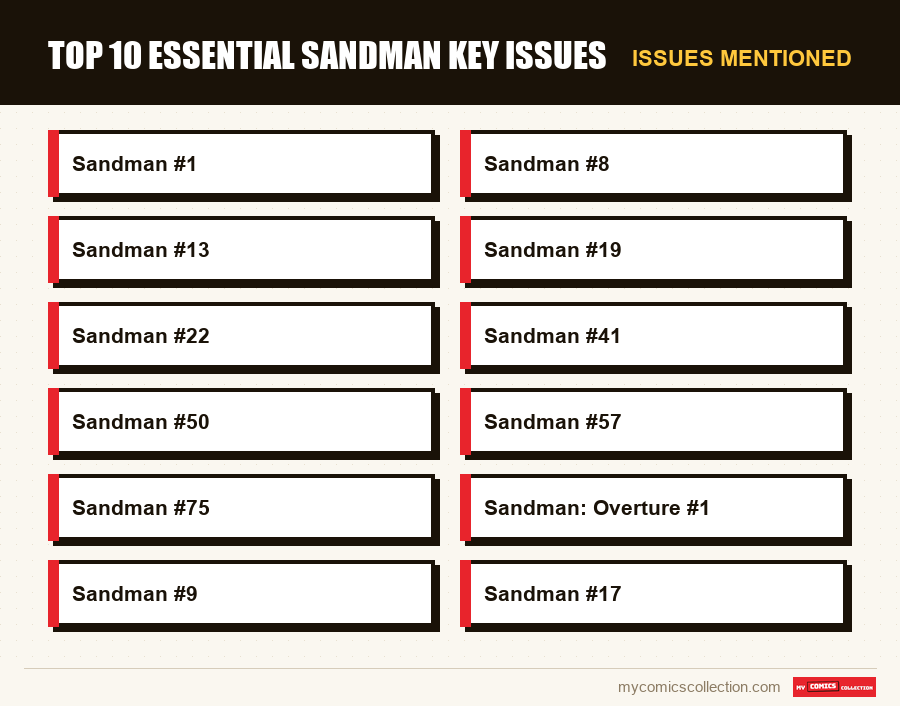
Sandman #1
Sandman #1 "Sleep of the Just" is the first issue of the series and the starting point of one of the most important works in comic history. It introduces Morpheus / Dream of the Endless, personification of Dream imprisoned for a century by a botched human occult ritual. Drawn by Sam Kieth and Mike Dringenberg, this first issue establishes a unique atmosphere at the border of myth, fairy tale and horror. A founding issue whose value has been considerably boosted by the Netflix series and which remains the absolute grail of any Sandman collection.
Sandman #8
Sandman #8 "The Sound of Her Wings" marks the first appearance of Death of the Endless, personification of death revealed to be a young, warm, wise goth woman: a radical subversion of the death symbol in popular culture. This standalone issue is considered by many to be one of the most beautiful in the series: Dream reunites with his sister Death who helps him regain taste for his work after his long captivity. Death has become one of Gaiman's most popular and influential characters, with her own miniseries. This is the most valuable key issue after Sandman #1.
Sandman #13
Sandman #13 "Men of Good Fortune" is one of the most beloved stories in the series: Morpheus meets a 14th-century man, Hob Gadling, who refuses to die, and Dream, amused, grants this wish. What follows is a tale spanning six centuries, showing Morpheus and Hob meeting every hundred years in the same tavern. This standalone issue illustrates Gaiman's ability to explore the human condition, loneliness and friendship through a narrative structure unique in comics. Drawn by Colleen Doran, it's one of the issues most often cited by fans as emblematic of the series' genius.
Sandman #19
Sandman #19 "A Midsummer Night's Dream" is one of the most exceptional issues in comic history: it was the first comic to win a World Fantasy Award (1991), typically reserved for prose works. Drawn by the legendary Charles Vess , this issue tells how Shakespeare performs his play A Midsummer Night's Dream before Morpheus and his court of Faeries: a dizzying meta-fiction on art, fiction and imagination. No other issue better encapsulates why Sandman belongs to great literature. A culturally major key issue.
Sandman #22
Sandman #22 opens the "Season of Mists" arc, one of the series' most impressive: Lucifer decides to close Hell and hands the key to Morpheus, triggering a series of negotiations between gods, demons and cosmic entities all coveting this priceless asset. This arc is a demonstration of Gaiman's ability to build a coherent and fascinating mythological universe, blending Norse, Egyptian, Japanese and Judeo-Christian pantheons. Gaiman's Lucifer in Sandman actually inspired the TV series of the same name. A major arc opener to own.
Sandman #41
Sandman #41 opens the "Brief Lives" arc and marks the true introduction of Delirium of the Endless: the youngest of the Endless, formerly Delight, now incarnation of delirium and creative madness. An extraordinarily complex character whose way of speaking and perceiving the world is always unexpected and poetic, Delirium is one of Gaiman's most original creations. Drawn by Jill Thompson whose dreamlike colorful illustrations perfectly match the character, this issue inaugurates one of the series' most moving arcs.
Sandman #50
Sandman #50 "Ramadan" is one of the most visually beautiful issues in the entire series. Gaiman and illustrator P. Craig Russell: whose style draws on Persian miniatures and the Arabian Nights: tell how Caliph Haroun al-Raschid of Baghdad, at the peak of his civilization, calls on Morpheus to preserve his city's glory in eternal dreams. A standalone issue of rare formal beauty that illustrates the cultural and geographical scope of Gaiman's vision. The numbered and signed editions of this issue are particularly sought-after.
Sandman #57
Sandman #57 opens "The Kindly Ones", the longest arc in the series (13 issues) and the start of the inevitable denouement of Morpheus's fate. The Furies, the Erinyes of Greek mythology, turn against Dream, triggering a tragedy foretold since the series' earliest issues. Gaiman constructs the conclusion of his work with impressive narrative rigor and mythological density. Marc Hempel's geometric, stylized art creates a striking contrast with the horrors the characters endure. An essential arc to own in series.
Sandman #75
Sandman #75 "The Tempest" is the last issue of the original series, conclusion of the "The Wake" arc. Gaiman entrusts the art to Charles Vess: the same artist who illustrated the mythical #19: and closes the Shakespeare loop: Morpheus had asked Will to write A Midsummer Night's Dream; the last dream revolves around The Tempest. A narratively and metatextually poignant, luminous conclusion. Owning this issue along with #1 and #8 constitutes the fundamental triptych of any quality Sandman collection.
The Sandman: Overture #1
The Sandman: Overture #1 (2013) is the official prequel to the original series, written by Neil Gaiman and illustrated by J.H. Williams III: whose experimental layouts and stunning illustrations are among the most beautiful ever published in a comic. Released nearly 20 years after the end of the original series, Overture explores the events that led to Morpheus's weakening before his capture. Williams III's extraordinary graphic quality makes it a collector's object in its own right, even for readers unfamiliar with the original series. An accessible and striking Modern Age key issue.
Collecting this series?
Track what you own, what you are missing and what your collection is worth. 7 day trial.
Start my trial →Essential Sandman story arcs
The Sandman series is built in distinct narrative arcs, each with a different tone, illustrators and themes. Here are the arcs to know to understand the work's structure:
Preludes & Nocturnes
The opening arc where Morpheus, newly freed, recovers the attributes of his power: his helm, his sand bag and his ruby. An arc closer to traditional comics that progressively establishes Gaiman's own mythology.
The Doll's House
Rose Walker, a "dream vortex", inadvertently threatens to collapse the Dreaming. The arc that develops the mythology of the Endless and introduces recurring characters like Lucien and the Dreaming's inhabitants.
Dream Country
Four short standalone stories, including the legendary #19 "A Midsummer Night's Dream". The arc that demonstrates Gaiman and Vertigo's formal and thematic versatility, with four different illustrators.
Brief Lives
Dream and Delirium set out in search of their missing brother Destruction. The most human and moving arc of the series, exploring themes of loss, change and impossible choices.
The Kindly Ones
The tragic and inevitable denouement of Morpheus's fate. The Furies unleash on Dream in a sprawling arc that constitutes the culmination of all narrative threads woven since the first issue.
The Wake
The epilogue and conclusion of the original series, including the magnificent #75 illustrated by Charles Vess. The arc that closes the Shakespearean themes and concludes the work with remarkable melancholic elegance.
To follow these arcs and organize your Sandman collection issue by issue, the Story Arcs feature in My Comics Collection lets you create custom lists and track your progress arc by arc.
How My Comics Collection handles your Sandman collection
Collecting Sandman has specifics different from major Marvel or DC franchises: 75 main issues, satellite miniseries (Death: The High Cost of Living , Death: The Time of Your Life ), a prequel ( Overture), and special issues. Without an overview, it's hard to know where your collection stands.
- Catalogue all Sandman Vol.1 issues (1-75), Death miniseries and the Overture prequel
- Identify your missing issues to complete each arc
- Create story-arc lists: Preludes & Nocturnes, Brief Lives, The Kindly Ones, The Wake
- Manage your CGC-graded copies: Gaiman-signed copies have a particular value
- Estimate the total value of your complete Sandman collection with daily-updated valuation
- Differentiate your key issues (# 1, 8, 19, 75) from your run issues in your catalogue
FAQ: Sandman key issues
Start managing your Sandman collection
Track your key issues, organize your story arcs and estimate your collection value. 7-day free trial.
Start free 7-day trialNo commitment · Cancel anytime · Instant access