
Created in 1961 by Stan Lee and Jack Kirby , the Fantastic Four are literally the cradle of the Marvel universe. Before Spider-Man, before the Avengers, before the X-Men, there were Reed Richards, Sue Storm, Johnny Storm and Ben Grimm.
Created in 1961 by Stan Lee and Jack Kirby , the Fantastic Four are literally the cradle of the Marvel universe. Before Spider-Man, before the Avengers, before the X-Men, there were Reed Richards, Sue Storm, Johnny Storm and Ben Grimm. The most important superhero family in American comic history produced some of the most valuable Silver Age first appearances: Doctor Doom, Galactus, Silver Surfer, Black Panther, Adam Warlock… characters that now define the Marvel universe as a whole, and whose key issues reach astronomical values.
This guide ranks the 10 absolutely essential Fantastic Four key issues for any serious collector, with their editorial context, their importance in Marvel mythology, and their CGC value estimates. From prohibitive Silver Age to accessible Modern Age, there's something for every collection level.
The Fantastic Four series history: the family that founded Marvel
The Fantastic Four franchise at Marvel is one of the richest in major key issues. Here are the key milestones:
- Fantastic Four Vol. 1 (1961-1996): the original founding series, 416 issues under the stewardship of Stan Lee & Jack Kirby then successive authors
- Fantastic Four Vol. 2 (1996-1997): the controversial Jim Lee reboot during the Heroes Reborn era, 13 issues
- Fantastic Four Vol. 3 (1998-2003): return to main continuity with Chris Claremont then Mark Waid
- Fantastic Four Vol. 1 cont. (2003-2011): run by Mark Waid , J. Michael Straczynski then Jonathan Hickman
- FF #1 (2011): Future Foundation, parallel title launched during the Hickman run
- Fantastic Four Vol. 4 (2013-2014): Matt Fraction run
- Fantastic Four Vol. 6 (2018-2022): revival by Dan Slott
To manage a complete Fantastic Four run and identify your missing key issues, the Collection tracking feature in My Comics Collection lets you map the entire franchise.
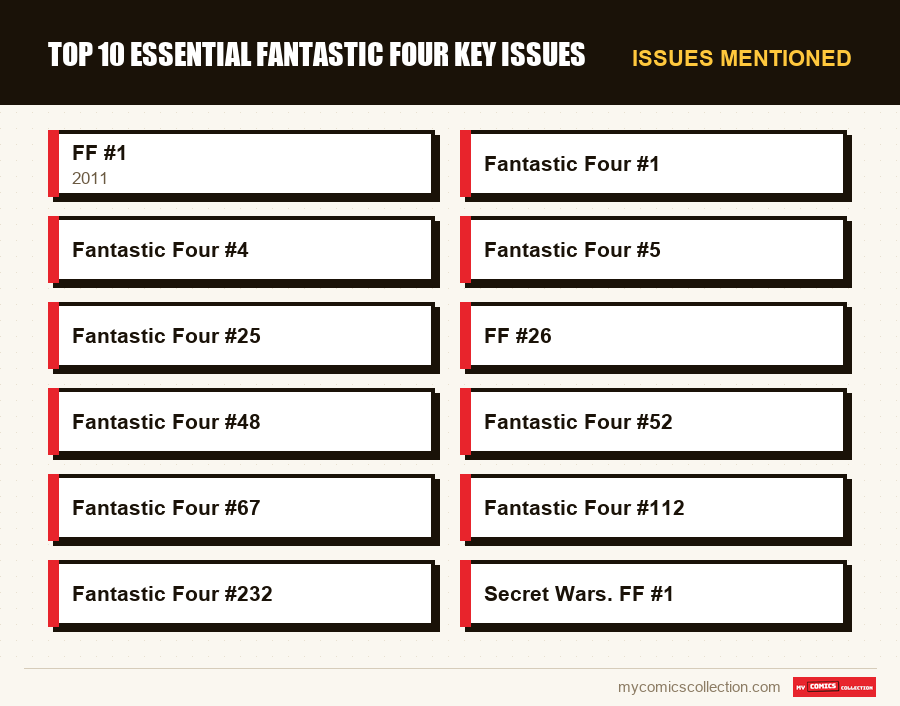
Top 10 Fantastic Four key issues
Here are the ten absolutely essential issues for any Fantastic Four collector.
Fantastic Four #1
Fantastic Four #1 is the comic that changed everything. In November 1961, Stan Lee and Jack Kirby invented a new way of doing superheroes: imperfect, in conflict, human despite their extraordinary powers. This first issue simultaneously introduces Reed Richards / Mr Fantastic , Sue Storm / Invisible Woman , Johnny Storm / Human Torch and Ben Grimm / The Thing, along with their first antagonist, the Mole Man. It's the founding issue of the Marvel Age of Comics: all other Marvel titles derive directly from it. A top-condition copy is one of the safest comic investments possible.
Fantastic Four #4
Fantastic Four #4 marks the return of Namor the Sub-Mariner to Marvel comics after a long absence since the Golden Age. It's Johnny Storm who finds an amnesiac Namor living among New York's homeless: a scene of remarkable narrative inventiveness. This issue establishes Namor as an ambiguous character, enemy and ally depending on circumstances, and revives a figure that would become central to the Marvel universe. It's also important because it anchors the FF in an extended continuity that exceeds their own series.
Fantastic Four #5
Fantastic Four #5 introduces Doctor Doom / Victor Von Doom, the most important and complex supervillain in the Marvel universe. Dictator of Latveria, scientific genius, sorcerer, rival of Reed Richards: Doom combines dimensions that make him an antagonist of unmatched richness. In this issue, he captures the FF and sends them into the past to steal Blackbeard's pirate treasure. Doctor Doom's first appearance is an absolute grail for any serious Marvel collector. This issue also contains the first depiction of a time capsule in Marvel comics.
Fantastic Four #25
Fantastic Four #25 features one of the most legendary battles in comic history: The Thing vs. Hulk. This titan clash through the streets of New York has become an absolute reference, abundantly reprinted, cited and parodied. The rivalry between Ben Grimm and Bruce Banner / Hulk, two involuntary monsters struggling with their humanity, gives this fight an emotional depth that exceeds simple spectacle. This issue should be read alongside FF #26, which concludes the confrontation. A highly in-demand mid-Silver Age key issue.
Fantastic Four #48
Fantastic Four #48 opens the Galactus Trilogy, considered the creative peak of Lee and Kirby and one of the most important arcs in comic history. This issue simultaneously introduces Galactus: the cosmic world-devourer, and his herald Silver Surfer / Norrin Radd. Two characters of unprecedented mythological ambition in superhero comics. Silver Surfer in particular immediately becomes one of Marvel's most poetic and philosophical creations. This issue is an absolute Silver Age masterpiece and its price reflects this unique place in medium history.
Fantastic Four #52
Fantastic Four #52 marks the entry into history of the first Black superhero in American mainstream comics: T'Challa / Black Panther, king of Wakanda. His creation by Stan Lee and Jack Kirby amid the American civil rights movement is a courageous and visionary editorial act. Black Panther challenges the FF with superior technology and intelligence before becoming one of Marvel's most powerful allies. This issue's value has exploded with the MCU films: notably the global success of Black Panther (2018). It's one of the most sought-after Silver Age key issues of the decade.
Fantastic Four #67
Fantastic Four #67 introduces Him, the perfect being created by rogue scientists: a character who would later become Adam Warlock, one of Marvel's most important cosmic figures. Although his definitive identity as Warlock isn't established until later issues, this first appearance is an essential key issue for collectors of the character. Adam Warlock would play a central role in the Infinity Gauntlet saga and in Guardians of the Galaxy Vol. 3 (MCU). A late Silver Age key issue still accessible compared to the earlier numbers.
Fantastic Four #112
Fantastic Four #112 offers the second major confrontation between The Thing and Hulk, seven years after the first in #25-26. This time the duel reaches an even more epic and dramatic scale, with an emotionally devastating conclusion. Drawn by John Buscema at the peak of his art, this issue is often cited as one of the series' most beautiful. It perfectly represents the transition between Silver Age and Bronze Age in Fantastic Four. A very popular key issue among The Thing fans and lovers of great comic brawls.
Fantastic Four #232
Fantastic Four #232 marks the start of John Byrne's legendary run on the series, often considered the best FF period after the Lee-Kirby era. Byrne handles both writing and art, giving the series back an authentic family dynamic, renewed scientific ambition and cosmic adventures worthy of the golden age. His run, which extends to issue #293, is essential reading for any FF fan. Inexpensive issues in CGC 9.8 that represent an excellent gateway into the FF collection.
FF #1
FF #1 (2011) launches the parallel Future Foundation title within Jonathan Hickman's revolutionary run. This run, spanning Fantastic Four and FF from 2009 to 2012, is considered the best modern franchise period. Hickman offers an ambitious vision, scientifically dense and emotionally rich, laying the groundwork for what would become his Avengers epic and Secret Wars. FF #1 introduces the Future Foundation, an expanded group including Spider-Man, Intelligencia children and former enemies. An accessible investment for starting a modern FF collection.
Collecting this series?
Track what you own, what you are missing and what your collection is worth. 7 day trial.
Start my trial →Essential Fantastic Four story arcs
The Fantastic Four series has produced some of the most important arcs in Marvel comic history. Here are the runs every collector should own:
Galactus Trilogy
The founding Lee & Kirby arc that introduces Galactus and Silver Surfer. Three issues of unprecedented cosmic ambition in the comics of the era. The most important arc of the entire franchise.
The Kree-Skrull War
The grand cosmic crossover that involves the FF in the conflict between two galactic empires. Founding arc of Marvel cosmic mythology, with a resolution involving Rick Jones in an unexpected role.
Byrne Run
The John Byrne renaissance run that restored the series' luster after years of stagnation. Writing and art by Byrne, exemplary family dynamic, cosmic adventures. The best series period after Lee-Kirby.
Hickman Run
The franchise's most ambitious vision in the modern era. Jonathan Hickman weaves a complex narrative tapestry over four years, blending hard science fiction, family drama and cosmic mythology. Essential to understand Secret Wars.
To organize tracking of these arcs that sometimes span dozens of issues and parallel titles, use the Story Arcs feature in My Comics Collection.
How My Comics Collection handles your Fantastic Four collection
Collecting the Fantastic Four means juggling multiple volumes, prohibitively expensive Silver Age key issues and accessible Bronze/Modern Age runs. My Comics Collection gives you a complete overview:
- Import the entire Volume 1 (416 issues) from a worldwide comics catalogue
- Identify your missing key issues with the Missing comics feature
- Create story-arc lists to track the Galactus Trilogy, Byrne Run or Hickman Run
- Manage your CGC-graded copies with individual values
- Estimate your total FF collection value with daily-updated valuation
- Compare your collection with other Marvel runs like the Avengers
FAQ: Fantastic Four key issues
Start managing your Fantastic Four collection
Track your key issues, organize your story arcs and estimate your FF run value. 7-day free trial.
Start free 7-day trialNo commitment · Cancel anytime · Instant access