
Created in 1964 by Stan Lee and Bill Everett, Daredevil / Matt Murdock is one of the most complex and collectible Marvel characters. Lawyer by day, blind vigilante by night, the Man Without Fear has experienced one of the most consistently high-quality arcs in all comic history: notably thanks to Frank Miller's foundational work in the 1980s, which transformed a minor series into one of the medium's absolute references.
Created in 1964 by Stan Lee and Bill Everett , Daredevil / Matt Murdock is one of the most complex and collectible Marvel characters. Lawyer by day, blind vigilante by night, the Man Without Fear has experienced one of the most consistently high-quality runs in all comic history: notably thanks to Frank Miller's foundational work in the 1980s, which transformed a minor series into one of the medium's absolute references. From the founding 1964 first issue to the Elektra Saga, from Born Again to the celebrated runs of Brian Michael Bendis , Ed Brubaker and Mark Waid: Daredevil has consistently attracted the industry's best authors and produced some of the most acclaimed comics in history.
This guide presents the 10 absolutely essential Daredevil key issues for any collector, with their historical context, their meaning in the character's mythology, and their estimated CGC values. Whether you're starting a Daredevil collection or completing your run, this ranking gives you all the priorities.
The Daredevil series history: from origins to today
The Daredevil series at Marvel is one of the industry's longest and most coherent, organized into several distinct eras:
- Founding Silver Age (1964-1970): the early years with Stan Lee, then Roy Thomas: a light tone very far from today's Daredevil
- Bronze Age (1970-1979): various approaches, introduction of Bullseye (#131), then early experiments toward a darker tone
- Frank Miller revolution (1979-1983): the run that radically transforms the character, with Elektra's introduction, Kingpin's development, and a revolutionary cinematic narration
- Born Again (1986): the Miller and Mazzucchelli masterpiece, a 7-part arc considered among the best comics ever published
- Post-Miller years (1987-1998): various authors maintain the level with notable runs by Ann Nocenti
- Volume 2, Smith/Quesada (1998-2001): Kevin Smith relaunches the series with Joe Quesada, restoring Daredevil's prestige-title status
- Bendis Run (2001-2006): the most ambitious Volume 2 era, with the secret identity revealed publicly
- Brubaker Run (2006-2009): continuation of the Bendis run with additional darkness
- Mark Waid Run (2011-2015): a brighter, more adventurous tone, rebalancing years of darkness
Organizing a complete Daredevil run across its two volumes and many arcs requires an adapted tool. The Collection tracking feature in My Comics Collection lets you map your progress and identify your missing key issues.
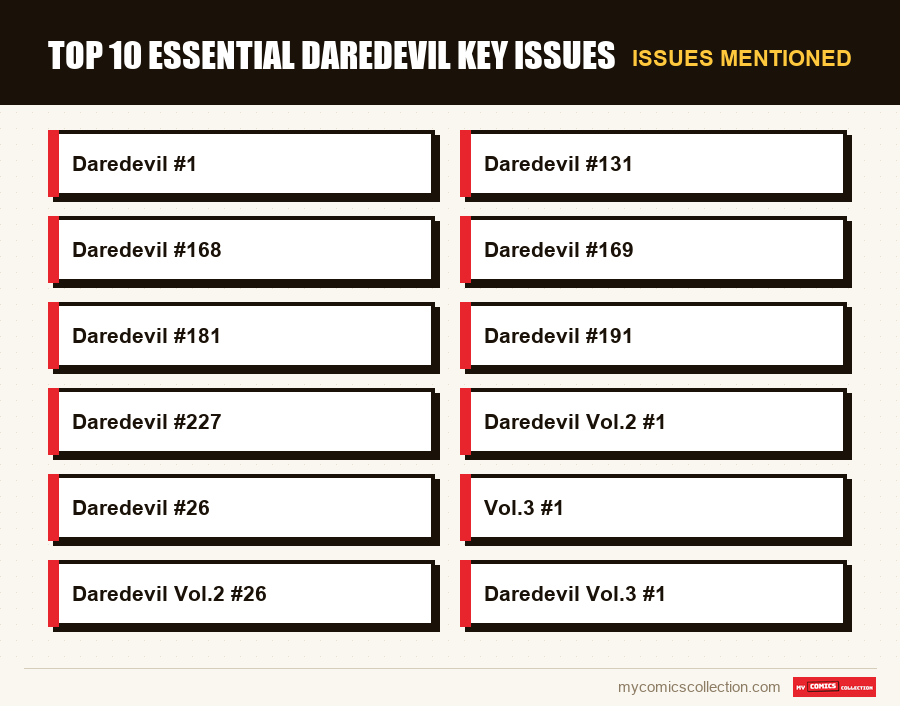
Top 10 Daredevil key issues
Here are the ten absolutely essential issues for any Daredevil franchise collector.
Daredevil #1
Daredevil #1 introduces Matt Murdock / Daredevil, the blind Hell's Kitchen lawyer whose senses are heightened after being exposed to a radioactive substance in his childhood. This first issue lays the mythology foundations: the hero's origins, his original yellow costume, the boxer father Jack Murdock, and early confrontations with Electro. It's a foundational Silver Age key issue whose value is supported both by the rarity of top-condition copies and by the character's persistent popularity, reinforced by the Netflix series and MCU appearances. The transition to the iconic red costume wouldn't occur until issue 7.
Daredevil #131
Daredevil #131 introduces Bullseye / Benjamin Poindexter, the psychopathic assassin able to turn any object into a lethal projectile, and the only antagonist to have truly broken Daredevil over the years: notably by killing Elektra. The relationship between Bullseye and Daredevil is one of the most intense and definitive in the entire Marvel universe, a duel between order and chaos spanning decades of issues. This Bronze Age key issue has appreciated thanks to media adaptations, notably Bullseye's role in Netflix's Daredevil Season 3 and his MCU appearances as Benjamin Poindexter.
Daredevil #168
Daredevil #168 is one of the most important Marvel key issues of the 1980s: it marks the first appearance of Elektra Natchios, the ninja assassin ex-girlfriend of Matt Murdock, created and drawn by Frank Miller. Elektra quickly became one of Marvel's most complex and popular female characters: a tragic figure whose moral ambiguity and heartbreaking relationship with Daredevil defined decades of stories. This issue also marks the start of Frank Miller's complete run as writer on the series (he'd been drawing since #158). It's the most sought-after Daredevil key issue among collectors.
Daredevil #169
Daredevil #169 represents the nascent confrontation between Bullseye and Daredevil in the context of the Frank Miller run, laying the dramatic groundwork that would lead to Elektra's death in issue 181. This issue perfectly illustrates Miller's revolutionary narrative style: cinematic noir, fragmented panels, punchy dialogue and inexorably rising tension. It's in this period that the Miller run definitively establishes Daredevil as one of the darkest and most sophisticated Marvel comics. A key issue for understanding the dynamic between the three major characters of this era.
Daredevil #181
Daredevil #181 is one of the most devastating moments in Marvel comic history: Bullseye assassinates Elektra by impaling her heart with her own sai. The scene, illustrated with absolute graphic mastery by Frank Miller, has become a medium icon: a traumatic turning point for millions of readers and an unsurpassed example of how a comic can achieve emotional impact comparable to great literature. This issue is also known for the final page, where a dying Elektra crawls to Matt Murdock's door. An essential Miller-era key issue.
Daredevil #191
Daredevil #191, titled "Roulette", is one of the most experimental and admired issues of the entire Frank Miller run. The story, in which a morally exhausted Daredevil plays Russian roulette with a paralyzed Bullseye in a hospital bed, isn't an action story but a pure psychological tension exercise. This issue illustrates how far Miller pushes comic format limits in terms of interior narration and moral questioning. It's the last issue of the first Miller run before his departure from the series, and it marks the conclusion of an era. Highly appreciated by connoisseurs: a key issue for great Daredevil lovers.
Daredevil #227
Daredevil #227 launches the Born Again arc by Frank Miller and David Mazzucchelli, unanimously considered one of the greatest story arcs in comic history. In seven issues (#227 to #233), Miller systematically destroys everything that defines Matt Murdock (his career, his apartment, his mental health, his relationships) before making him reborn in a cathartic process of extraordinary narrative power. Mazzucchelli's art, more expressionist and streamlined than ever, gives this arc an incomparable visual dimension. This opening issue, where Kingpin learns Daredevil's secret identity, is the most sought-after Born Again key issue.
Daredevil Vol.2 #1
Daredevil Vol.2 #1 marks the series relaunch after difficult years, under the direction of writer-director Kevin Smith with art by Joe Quesada. The "Guardian Devil" arc that follows this first issue reconnects with the narrative depth and dark atmosphere of the Miller run, while opening new perspectives for the character. This relaunch is historically important because it restored Daredevil's prestige-title status at Marvel and paved the way for the Bendis run that would transform the title into one of the most acclaimed comics of the 2000s. A Modern Age key issue accessible for beginning collectors.
Daredevil #26 (Vol.2)
Daredevil #26 (Volume 2) marks the start of Brian Michael Bendis's and Alex Maleev's legendary run, one of the most celebrated runs in modern comic history. Bendis tackles Matt Murdock's secret identity with unprecedented narrative ambition: after the Daily Globe publishes the revelation that Daredevil is Matt Murdock, the series explores the legal, social and psychological consequences of this exposure. Alex Maleev's photorealistic style, combined with Bendis's chiseled dialogue writing, creates a unique atmosphere. This run won multiple Eisner Awards and is regularly cited among the best in all of Daredevil history.
Daredevil #1 (Vol.3)
Daredevil #1 (Volume 3) launches the Mark Waid and Paolo Rivera run that represents a radical turning point in the series' tone: after years of intense darkness with Miller, Bendis and Brubaker, Waid makes the courageous choice of a brighter, almost swashbuckling Daredevil who embraces life despite his trials. This run won five Eisner Awards including Best Comic Book two consecutive years, making this Vol.3 #1 the most award-winning Modern Age key issue in the franchise. The alternating art by Paolo Rivera and Marcos Martin represents some of the most beautiful graphic work of the 2010s. An essential run for any Daredevil collector.
Collecting this series?
Track what you own, what you are missing and what your collection is worth. 7 day trial.
Start my trial →Essential Daredevil story arcs
The Daredevil franchise may be the Marvel series with the greatest number of celebrated story arcs. Here are the runs every serious collector should own:
Elektra Saga
The founding Frank Miller run that introduces Elektra, transforms Bullseye into an absolute threat, and revolutionizes comic narrative with a cinematic noir style influenced by Japanese noir films. The saga that defined Daredevil for the next forty years.
Born Again
The absolute masterpiece by Frank Miller and David Mazzucchelli. Kingpin systematically destroys Matt Murdock's life before his rebirth. Regularly ranked among the ten best comics ever published, across all franchises. Absolutely essential reading.
Bendis Run
The Brian Michael Bendis and Alex Maleev run that transforms Daredevil into a photorealistic crime narrative, with the secret identity reveal, the marriage, the legal pursuits, and the climactic arc where Matt Murdock becomes Kingpin of Hell's Kitchen.
Mark Waid Run
Five Eisner Awards, sublime art by Paolo Rivera and Marcos Martin, and a Daredevil rediscovering joy after years of misery. The run that reconciles the character with his adventurous Silver Age heritage while maintaining the narrative sophistication of modern runs.
To organize tracking of these arcs across different volumes, use the Story Arcs feature in My Comics Collection: it lets you create custom lists and track your progress arc by arc.
How My Comics Collection handles your Daredevil run
Collecting Daredevil represents a particularly interesting challenge: the series spans several volumes, with very different runs in tone and style, annuals, spin-off miniseries (Elektra: Assassin , Elektra Lives Again , Daredevil: The Man Without Fear…) and event crossovers.
My Comics Collection gives you a complete overview:
- Import every volume of the Daredevil franchise from a worldwide comics catalogue
- Mark your owned copies by volume, identify missing key issues with the Missing comics feature
- Create custom story-arc lists to track Born Again or the Elektra Saga issue by issue
- Manage your CGC-graded copies with grade and individual value
- Estimate the total value of your Daredevil collection with daily-updated valuation
- Share your wishlist with other collectors to fill your gaps
FAQ: Daredevil key issues
Start managing your Daredevil collection
Track your key issues, organize your story arcs and estimate the value of your Daredevil run. 7-day free trial.
Start free 7-day trialNo commitment · Cancel anytime · Instant access