
Black Widow is one of the most singular figures in the Marvel universe. Natasha Romanoff first appeared in 1964 as a Soviet antagonist of Iron Man, before becoming one of the most popular heroines in the comics multiverse, and one of the most in-demand female Marvel characters among collectors.
Black Widow is one of the most singular figures in the Marvel universe. Natasha Romanoff first appeared in 1964 as a Soviet antagonist of Iron Man, before becoming one of the most popular heroines in the comics multiverse, and one of the most in-demand female Marvel characters among collectors. Decades of scattered runs, uneven solo series, then the post-MCU explosion of the 2010s have turned Black Widow collecting into a demanding discipline, with key issues whose value has multiplied tenfold in fifteen years.
This comprehensive guide gives you all the keys to build, organize, and maximize the value of your Black Widow collection: complete character history in comics, analysis of the major series, key issue identification, organization methods, and the state of the market in 2026. Whether you're a seasoned Marvel collector or a fan of the character since the movies, this guide is for you.
Natasha Romanoff: from Silver Age origins to MCU stardom
Black Widow's history in comics begins well before she became the superheroine we know today. Understanding this evolution is essential to grasp why certain issues are worth considerable sums today.
Tales of Suspense #52 (1964), The very first appearance
It's in Tales of Suspense #52, published in April 1964, that Natasha Romanoff makes her debut. She was created by Stan Lee, Don Rico, and Don Heck. At this stage, she's not yet the Black Widow in a black suit: she's an elegant Soviet spy, without a distinctive costume, who confronts Iron Man on behalf of the KGB. This first appearance is the most valuable key issue in the entire Black Widow collection, a Silver Age issue whose value in good condition regularly exceeds 3,000 euros in 2026.
Over the following years, Natasha reappears in several issues of Avengers and Daredevil, gradually transformed into a less black-and-white character. She switches to the heroes' side around 1966-1967, and her relationship with Hawkeye begins to develop in the pages of Avengers, which explains why fans of both characters often overlap in their collections. See our guide on Hawkeye key issues for more on this.
Amazing Adventures #1 (1970), The iconic costume and the first solo series
Amazing Adventures #1 (August 1970) marks a major turning point in the character's history. This is where Natasha first adopts her iconic black costume, complete with the magnetic "Widow's Bites" bracelets. The Amazing Adventures series, co-written by Gary Friedrich and Roy Thomas with art by John Buscema, alternates between Black Widow and Beast stories. Black Widow is finally treated as a full-fledged heroine, with a solo series and a distinct visual identity. This issue is a major Bronze Age key issue, essential in any serious Black Widow collection.
The Daredevil run (1970-1971), Hell's Kitchen partner
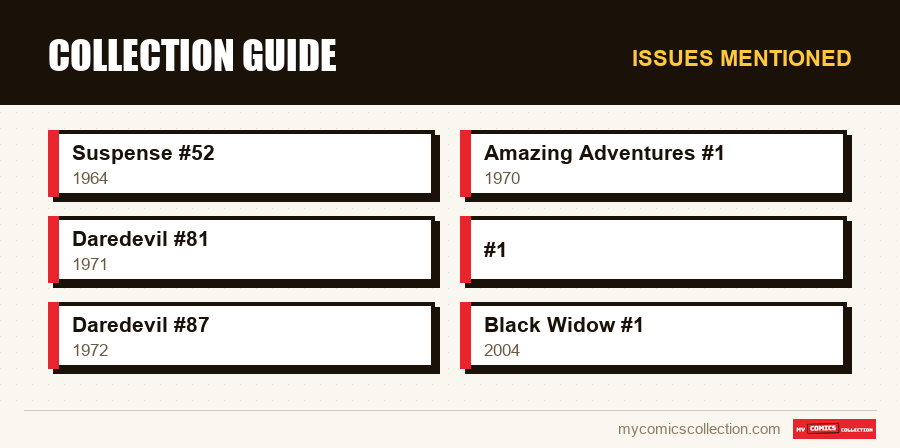
Black Widow's relationship with Daredevil is one of the richest in her comics history. Starting from Daredevil #81 (1971), Natasha becomes Matt Murdock's romantic and professional partner, and the series title temporarily becomes "Daredevil and the Black Widow" (issues #92 through #107). This run, written by Gerry Conway then Tony Isabella and drawn by Gene Colan, gives Black Widow unprecedented narrative depth. Issues from this period, notably Daredevil #81, #87, #92, are sought-after pieces by collectors of both characters.
The major Black Widow solo series
Unlike Spider-Man or Captain America, Black Widow has never had a long, continuous solo series. Her solo history is made up of mini-series, limited runs, and successive relaunches, which makes her collection both more accessible and more complex to structure.
Black Widow: Marvel Knights (2004), Richard Morgan
The first significant solo series of the modern era is Black Widow (Vol. 3, 2004) written by novelist Richard Morgan, with art by Bill Sienkiewicz. In six issues, Morgan delivers a brutal, stylized espionage tale rooted in post-Cold War geopolitics. This mini-series is a narrative masterpiece, long underestimated by the market but increasingly sought after since the MCU films. The #1 of this series remains very accessible in terms of price, a good opportunity for savvy collectors.
Black Widow Vol. 4 (2010), Marjorie Liu
The Black Widow (Vol. 4, 2010) series by Marjorie Liu, with art by Daniel Acuna, is one of the best solo series ever devoted to the character. In eight issues, Liu explores Natasha's complex psychology, her debts to her Soviet spy past, and her difficulty trusting others. The series benefits from sublime art and sophisticated writing. The #1 of this series has seen its value increase significantly between 2010 and 2026, notably thanks to the post-Black Widow movie enthusiasm.
Black Widow Vol. 6 (2016), Mark Waid & Chris Samnee
The run by Mark Waid and Chris Samnee (2016-2017, 12 issues) is unanimously considered the best Black Widow solo run in history. Samnee, whose narrative art style evokes the best graphic novels, delivers pages of rare efficiency and elegance. Waid builds a pure action story where Natasha flees S.H.I.E.L.D. while seeking to atone for her crimes. These 12 issues form a cohesive whole, ideal to collect as a complete run.
Black Widow Vol. 8 (2020), Kelly Thompson
The Black Widow (2020) series by Kelly Thompson with art by Elena Casagrande takes a bold approach: Natasha, suffering from amnesia, leads an ordinary life in a small New England coastal town. This 15-issue run explores what Natasha's life would be like without her spy past. It's a well-received modern run, with a #1 that has performed well on the secondary market since publication.
Catalog your Black Widow collection
Import your Black Widow series into My Comics Collection and instantly identify your missing issues, from Silver Age to the Thompson run.
Free 7-day trial, No commitmentThe must-know Black Widow key issues
Here is the list of essential issues for any serious Black Widow collection, sorted chronologically and by market importance:
- Tales of Suspense #52 (1964) : First appearance of Natasha Romanoff. The absolute key issue. Value in CGC 5.0: 2,000 to 4,000 euros based on recent sales.
- Amazing Adventures #1 (1970) : First solo series and first appearance of the iconic black costume. Major Bronze Age key issue.
- Daredevil #81 (1971) : First appearance of Black Widow as Daredevil's partner. Beginning of the "Daredevil and the Black Widow" run.
- Daredevil #87 (1972) : First time the title officially becomes "Daredevil and the Black Widow." Key issue for collectors of both characters.
- Black Widow #1 (2004, Vol. 3) : Start of the Marvel Knights series by Richard Morgan. Accessible and increasingly sought after.
- Black Widow #1 (2010, Vol. 4) : Marjorie Liu run, one of the best solo series. Value steadily increasing since 2021.
- Black Widow #1 (2016, Vol. 6) : Waid/Samnee run, unanimously considered the best solo run. Modern key issue.
- Black Widow #1 (2020, Vol. 8) : Thompson run, solid modern series with good secondary market pricing.
Investment tip: In 2026, Silver Age Black Widow key issues (Tales of Suspense #52) remain the most valuable but also the most out of reach. For a lower-cost investment, focus on Amazing Adventures #1 (1970) and the first issues of the Liu (2010) and Waid/Samnee (2016) runs, these issues have demonstrated post-MCU value resilience and remain in reasonable price ranges.
Collecting this series?
Track what you own, what you are missing and what your collection is worth. 7 day trial.
Start my trial →The post-MCU boom: how the movies transformed the market
The impact of the Marvel Cinematic Universe films on the Black Widow comics market is one of the most documented phenomena in recent collectibles history. The trajectory is clear: Iron Man 2 (2010), where Scarlett Johansson plays Natasha for the first time, triggered an initial increase in key issue values, particularly Tales of Suspense #52. But it was with Avengers (2012) and Captain America: The Winter Soldier (2014) that demand exploded.
The solo film Black Widow (2021) triggered the most spectacular increase. Tales of Suspense #52 in CGC 6.0 went from around $500 before 2010 to over $3,500 at the 2021-2022 peak. Amazing Adventures #1 followed the same curve, multiplying its value fivefold in ten years. In 2026, the market has partially normalized after the general cooling of the speculative comic book market, but Black Widow key issues maintain pricing well above their pre-MCU levels.
This dynamic makes Black Widow one of the most interesting Marvel characters to collect from a wealth perspective: key issues have proven their resilience, and any new MCU project involving the character (Disney+ series, Yelena Belova film) could reignite demand on the secondary market. Check out our comprehensive guide to Marvel collecting for a market overview.
How to organize your Black Widow collection
The distinctive feature of a Black Widow collection lies in its fragmented structure: no continuous 400-issue series like Amazing Spider-Man, but a mosaic of mini-series, crossovers, and appearances in other titles. Here's a five-step method to organize it effectively:
Define the scope of your collection
Decide whether you're collecting only solo series (the most coherent approach), or if you're including appearances in other titles (Daredevil, Avengers, Champions). A "solo series only" collection is more manageable and more cohesive to present.
Catalog by volume and year
With My Comics Collection, organize your Black Widow comics by volume (Vol. 1, Vol. 2, Vol. 3...) and by publication year. Each volume corresponds to a distinct editorial era with its own creators and tone.
Prioritize Silver and Bronze Age key issues
If your budget allows, prioritize Tales of Suspense #52 and Amazing Adventures #1, they are the two cornerstones of the collection. Look for them in acceptable condition (CGC 4.0 to 6.0) for a reasonable quality-to-price ratio.
Complete modern runs first
The Liu (2010, 8 issues), Waid/Samnee (2016, 12 issues), and Thompson (2020, 15 issues) runs are accessible, cohesive, and make excellent complete runs. Start there before tackling Silver Age issues.
Use a scanner for convention purchases
At conventions or comic fairs, use the barcode scanner app to instantly check if an issue is already in your collection and in what condition, avoid costly duplicates.
Black Widow market state in 2026
In 2026, the Black Widow comics market shows a stable profile after the speculative euphoria of 2020-2022. Silver Age key issues (Tales of Suspense #52, Amazing Adventures #1) have maintained about 70 to 80% of their peak value, which is remarkable in a global market that has corrected more sharply. Modern runs (Liu, Waid/Samnee, Thompson) remain in accessible price ranges, with well-preserved #1s between 15 and 60 euros depending on the volume.
The trigger for the next surge will most likely be a new MCU project involving Yelena Belova (Florence Pugh) in a film or Disney+ series. Demand for Black Widow #1 (2020, Vol. 8, which introduces the Yelena arc) and second-generation key issues could then return to record levels. For an informed investment strategy, consult our Black Widow key issues guide.
FAQ, Managing your Black Widow collection
Manage your Black Widow comics issue by issue
My Comics Collection lets you track every series, every volume, and every appearance of Natasha Romanoff, from Silver Age to the most recent runs.
Free 7-day trial, No commitment