Marvel is the largest American comics publisher, with over 80 years of history and thousands of series. Managing a Marvel collection is a unique challenge: crossovers, relaunches (Amazing Spider-Man has been relaunched several times from #1), cover variants, tie-ins...
Marvel is the largest American comics publisher, with over 80 years of history and thousands of series. Managing a Marvel collection is a unique challenge: crossovers, relaunches (Amazing Spider-Man has been relaunched several times from #1), cover variants, tie-ins... This guide explains how to navigate it all and build a coherent Marvel collection, issue by issue.
Whether you've been a Spider-Man fan forever or you're discovering the Marvel universe through the films, Marvel's editorial complexity can discourage the beginning collector. Decades of continuity, hundreds of active and inactive series, regular relaunches, without a method, it's easy to get lost. This guide gives you the keys to approach your Marvel collection with confidence.
The major Marvel series to collect
The Marvel universe is vast, but certain series stand out as essential pillars for any serious collector. Here are the fundamental series to know:
Amazing Spider-Man
Amazing Spider-Man is one of the longest-running and most popular series in the history of comics. Launched in 1963, it surpasses 700 issues in its original volume before being relaunched several times. The runs by Stan Lee and Steve Ditko (the origins), Gerry Conway (the death of Gwen Stacy, #121-122), Roger Stern, J.M. DeMatteis, and J. Michael Straczynski are particularly sought after by collectors. The key issues from this series command considerable prices.
Uncanny X-Men
The Uncanny X-Men series experienced a major renaissance with Giant-Size X-Men #1 in 1975 and the arrival of the new team (Wolverine, Storm, Colossus, Nightcrawler...). Chris Claremont's run (1975-1991) is considered one of the most significant in comics history. Arcs like "The Dark Phoenix Saga" (#129-138) or "Days of Future Past" (#141-142) are absolute classics. Several parallel X-Men series exist, which complicates collecting.
Avengers
The Avengers have been active since 1963. The series has seen numerous relaunches and memorable runs by Roy Thomas, Kurt Busiek, Brian Michael Bendis (notably New Avengers), and Jonathan Hickman. The early issues from the 60s are prized collector's pieces, and major Marvel universe crossovers often run through the Avengers.
Fantastic Four
Fantastic Four #1 (November 1961) is the starting point of the modern Marvel universe as we know it. Stan Lee and Jack Kirby created with this series the foundations of the Marvel Universe. The original series remains an absolute reference, and its early issues are among the most valuable of the entire Silver Age.
Daredevil
Daredevil is a series that owes much to two exceptional runs: Frank Miller's (#158-191, including the famous #168-191 with the introduction of Elektra) and Brian Michael Bendis with Alex Maleev (2001-2006). These two periods are particularly sought after by collectors and represent an excellent entry point into Marvel collecting.
Iron Man, Thor, Captain America
Iron Man , Thor , and Captain America round out the pantheon of essential Marvel series. Iron Man #128 (the "Demon in a Bottle" arc) is a major key issue on the theme of Tony Stark's alcoholism. Thor's original series begins in Journey into Mystery #83 (1962). Captain America #1 (1941, Timely Comics) is one of the most legendary pieces in the history of American comics.
Starting advice: Marvel publishes over 80 new series per month. Focusing on 3 to 5 series at first is the wisest strategy for a beginning collector. Choose series that you actually read and enjoy, and aim to complete specific runs rather than collecting superficially.
Essential Marvel key issues
Marvel key issues are the most important issues in the publisher's history, first appearances, origins, character deaths, iconic covers. Here are the reference pieces every Marvel collector must know:
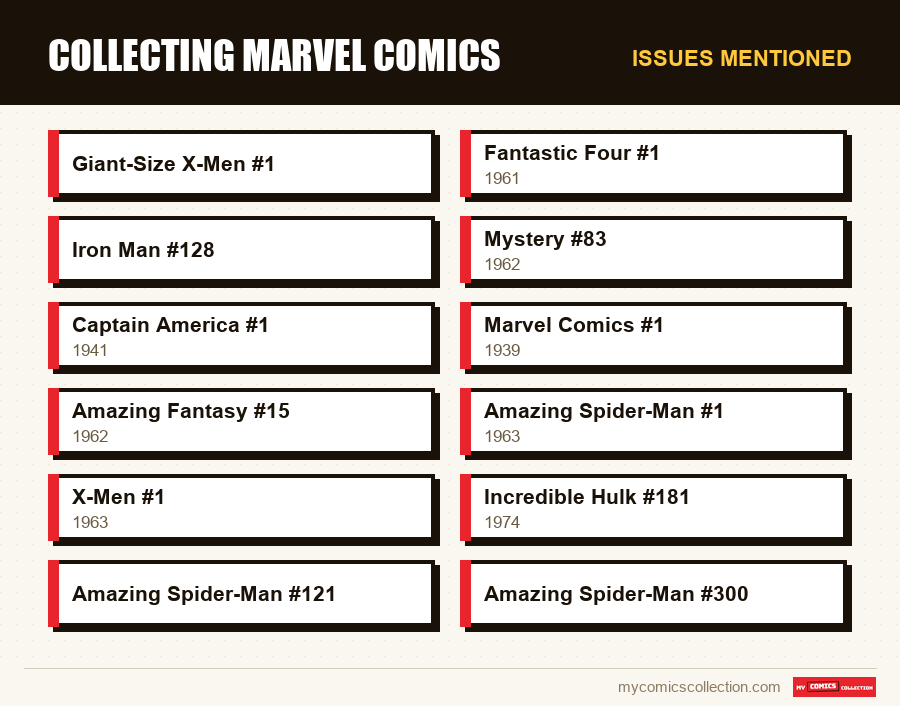
- Marvel Comics #1 (1939) : The very first comic published by Timely Comics, the future Marvel. Contains the first appearance of the original Human Torch and Namor. Copies in good condition are worth over 100,000 euros.
- Amazing Fantasy #15 (1962) : The first appearance of Spider-Man. One of the most valuable comics in history, across all publishers. A CGC 9.6 copy sold for several million dollars.
- Amazing Spider-Man #1 (1963) : Spider-Man's first solo series. Less rare than Amazing Fantasy #15 but still extremely valuable.
- X-Men #1 (1963) : The first appearance of the original X-Men team (Cyclops, Jean Grey, Beast, Iceman, Angel) and Professor X.
- Giant-Size X-Men #1 (1975) : The introduction of the new X-Men team with Wolverine, Storm, Colossus, and Nightcrawler. Starting point of Claremont's legendary run.
- Incredible Hulk #181 (1974) : The first full appearance of Wolverine (after a cameo in #180). One of the most sought-after key issues of the entire Bronze Age.
- Amazing Spider-Man #121-122 (1973) : The death of Gwen Stacy, one of the most significant moments in comics history. These two issues are highly sought after by collectors.
- Iron Man #128 (1979) : "Demon in a Bottle," the arc that reveals Tony Stark's alcoholism. A major Bronze Age key issue.
The Marvel Silver Age (1961-1970) is considered the golden age for collectors. Series like Amazing Spider-Man or Uncanny X-Men in very good condition are worth thousands of euros. These issues are rare, fragile, and their value tends to appreciate over the long term for copies in fine condition.
The complexity of Marvel relaunches
Since the 1990s, Marvel has developed a regular practice: relaunching its major series from #1. This editorial strategy boosts per-issue sales and attracts new readers, but it creates considerable confusion for collectors.
Take the most obvious example: Amazing Spider-Man has several distinct volumes. Vol.1 starts in March 1963 and runs to #441 in 1998. Vol.2 picks up in 1999 with a new #1 ("Heroes Reborn" numbering). In 2014, Marvel launches Vol.3 with yet another new #1 as part of the "All-New Marvel NOW!" initiative. In 2018, a new relaunch, a new #1 for Vol.4. In 2022, the same again for Vol.5 as part of "Beyond."
The same phenomenon affects X-Men, Avengers, Daredevil, and virtually all major Marvel series. Editorial initiatives like Heroes Reborn , All-New All-Different Marvel , Fresh Start , Empyre , or Destiny of X have each generated their share of new #1s and relaunches.
To navigate this, the golden rule is to always mention the volume AND the start year when referencing an issue. "Amazing Spider-Man #1 (1963, Vol.1)" and "Amazing Spider-Man #1 (2022, Vol.5)" are two completely different comics with radically different values. A collection management app lets you distinguish these volumes and organize your Marvel library without ambiguity.
How to correctly cite a Marvel issue
- Always specify the exact series title (Amazing Spider-Man, Spectacular Spider-Man, etc.)
- Indicate the volume number if multiple exist (Vol.1, Vol.2...)
- Add the publication year in parentheses to remove any ambiguity
- Correct example: Amazing Spider-Man #300, Vol.1 (1988) : first appearance of Venom
Collecting this series?
Track what you own, what you are missing and what your collection is worth. 7 day trial.
Start my trial →How to organize your Marvel collection
Given the complexity of the Marvel universe, rigorous organization is essential. Here is the five-step method to bring order to your collection:
Choose your priority series
It's impossible to collect everything at Marvel. Define 3 to 5 series or runs that you want to complete first. It's better to own the entirety of Miller's Daredevil run than a few scattered issues across ten different series.
Import your series into My Comics Collection
With the catalog integrated into My Comics Collection, import your Marvel series in seconds. Each volume is clearly distinguished, each issue listed with its publication date. No more confusion between different relaunches.
Identify missing key issues by series
Once your series are imported, check the list of issues you don't yet own. Prioritize the missing key issues, they are what determine the value and completeness of your collection.
Organize physically by publisher, series, and chronological order
Store your Marvel comics in dedicated long boxes, sorted by series and in numerical order. For series with multiple volumes, create clear dividers with the volume number and start year. Coherent physical organization goes hand in hand with effective digital management.
Value your collection with eBay data
My Comics Collection integrates valuation data based on current eBay listings. Track the value evolution of your Marvel key issues and identify issues with rising prices, valuable information for guiding your next purchases or deciding when to sell.
Marvel crossovers: friend or foe of the collector?
Marvel crossovers are narrative events that span multiple series simultaneously. They are both one of the great strengths of the Marvel universe, epic stories involving all the characters, and one of the greatest challenges for the collector.
The major crossovers to know
Among the most important crossovers in Marvel history: Secret Wars (1984-1985, 12 issues) which introduces the Venom symbiote, Infinity Gauntlet (1991, 6 issues) with the Thanos saga and the Infinity Stones, House of M (2005), Civil War (2006-2007), Secret Invasion (2008), and Jonathan Hickman's trilogy, Avengers , New Avengers , and Infinity (2012-2015), considered one of Marvel's narrative peaks.
The advantages of crossovers for collectors
The main mini-series of major crossovers are often highly sought-after key issues. Secret Wars #8 (first appearance of Spider-Man's black costume), New Mutants #98 (first appearance of Deadpool during X-Force), or Infinity Gauntlet #1 are pieces that collectors fight over. Crossovers also create dense narratives that give even more meaning to individual issues from each series.
The drawbacks: the proliferation of tie-ins
The downside is the proliferation of tie-ins : issues from regular series that tie into the crossover. An event like Civil War generates dozens of tie-in issues across the Avengers, Spider-Man, X-Men, Iron Man, Captain America series... Following a crossover exhaustively can require purchasing 40 to 80 additional issues.
Practical advice: If your budget is limited, focus on the main mini-series of each crossover and ignore non-essential tie-ins. The main narrative is self-contained in 90% of cases. Tie-ins can be collected later, and their value generally remains well below that of the central series issues.
FAQ, Managing your Marvel collection
Manage your Marvel collection efficiently
With My Comics Collection, import your Marvel series in minutes and instantly identify your missing issues.
Free 7-day trial, No commitment