Star Wars comics published by Marvel cover two radically different major eras, and confusing them is the most common mistake among beginner collectors. The first is the original 1977-1986 series (107 issues), published alongside the three original films and which was the primary source of expanded storytelling before the concept of an "Expanded Universe" even existed.
Star Wars comics published by Marvel cover two radically different major eras, and confusing them is the most common mistake among beginner collectors. The first is the original 1977-1986 series (107 issues), published alongside the three original films and which was the primary source of expanded storytelling before the concept of an "Expanded Universe" even existed. The second is the relaunched series from 2015 to today, after Disney's acquisition of Lucasfilm in 2012, which brought the Star Wars license back to Marvel, with top-tier writers and integration into the official canon.
For a collector, Star Wars at Marvel is one of the richest and most complex licensed universes to tackle. Between the cover variants from 1977-1986, the #1 issues of the multiple series launched since 2015, and key issues like Darth Vader #3 (first appearance of Doctor Aphra), there's enough to fill entire longboxes, with some truly valuable pieces to identify. This guide gives you the complete method.
The original 1977-1986 series: Marvel Star Wars #1-107
The relationship between Marvel Comics and Star Wars started unexpectedly. In 1977, the Star Wars franchise was an unknown quantity, the film hadn't been released yet, and Marvel accepted the license, which was considered unpromising. Roy Thomas (writer) and Howard Chaykin (artist) adapted the first film in issues #1-6, which sold millions of copies thanks to the film's phenomenal success. Marvel technically contributed to Star Wars' commercial launch by putting the character on newsstands before the film.
The series then continued with numerous original arcs, including characters that would never appear in the films, like Jaxxon (a green humanoid rabbit) or stories in the "Outer Rim", before adapting each film: The Empire Strikes Back (#39-44) and Return of the Jedi (#81-82). The series ended in 1986 with #107 after the rights passed to Dark Horse Comics.
Key variants of the 1977 series
Star Wars #1 (1977) is the ultimate key issue of this era. Several important variants exist:
- Regular 30-cent edition : The standard edition, the most common. Value in NM: $160-430.
- 35-cent variant : A test-market edition distributed in certain regions of the United States. Identifiable by the "35 cents" price on the cover. Extremely rare, it is one of the most valuable Marvel Bronze Age variants, potentially exceeding $15,000-20,000 in CGC 9.6.
- Whitman edition : Distributed in bagged sets by the Whitman publisher. Recognizable by the Whitman sticker on the cover. Rarer than the regular edition but less so than the 35-cent variant.
35-cent variant warning: The Star Wars #1 35-cent variant is one of the most counterfeited and hardest-to-authenticate pieces on the Marvel Bronze Age market. Never buy without a verified CGC or CBCS certificate. Counterfeits circulate regularly, the "35 cents" price is sometimes fraudulently added to regular copies.
Marvel Star Wars series since 2015: the new canonical era
When Disney acquired Lucasfilm in October 2012, the Star Wars comics rights automatically returned to Marvel (a Disney subsidiary since 2009). In 2015, Marvel relaunched Star Wars with considerable editorial ambition: top-tier writers, integration into the official canon (unlike the Dark Horse comics which were reclassified as "Legends"), and a proliferation of satellite series.
Star Wars Vol.2 (2015), Jason Aaron then Kieron Gillen
The relaunched series debuted in January 2015 with Jason Aaron writing and John Cassaday on art. It takes place canonically between The Empire Strikes Back and Return of the Jedi. Star Wars #1 (2015) is one of the best-selling Marvel issues in decades, its phenomenal print run makes it a very accessible issue with little speculative value, but essential in any modern-era Marvel Star Wars collection.
Darth Vader Vol.1 (2015-2016), Kieron Gillen
This is the most important satellite series of the entire Marvel Star Wars era. Kieron Gillen writes an extraordinarily complex Darth Vader, showing his activities within the Empire just after the events of The Empire Strikes Back. The series introduces several original characters including Doctor Aphra, the quintessential modern Marvel Star Wars key issue.
Doctor Aphra Vol.1 (2016-2019) and Vol.2 (2020)
The success of Doctor Aphra in Darth Vader earned her her own series in 2016. Chelli Lona Aphra, an unscrupulous archaeologist and former ally of Vader, became one of the most beloved original Star Wars characters among fans. Her solo series is both a classic adventure comic and an exploration of the galaxy's fringes far from the Rebellion. Doctor Aphra Vol.1 #1 is a secondary key issue to own.
Other major series from the Disney era
Marvel launched numerous series between 2015 and 2022:
- Princess Leia (2015, 5 issues) : Mark Waid writing. Accessible mini-series.
- Han Solo (2016, 5 issues) : Marjorie Liu. Excellent mini-series, accessible.
- Poe Dameron (2016-2018, 31 issues) : One of the longest modern runs.
- Darth Vader Vol.2 (2017-2018, 25 issues) : Charles Soule. Covers Vader's transformation. Key issue: Darth Vader #1 (2017).
- Star Wars: The High Republic (2021-present) : Canonical series set in the High Republic era, 200 years before the Skywalker saga.
Catalog your Marvel Star Wars collection
Manage your Marvel Star Wars series, from the 1977 series to Doctor Aphra, in an organized collection, with key issue and price tracking.
Start for free, 7 daysThe ultimate Star Wars Marvel key issues
| Issue | Significance | Indicative NM price (2026) |
|---|---|---|
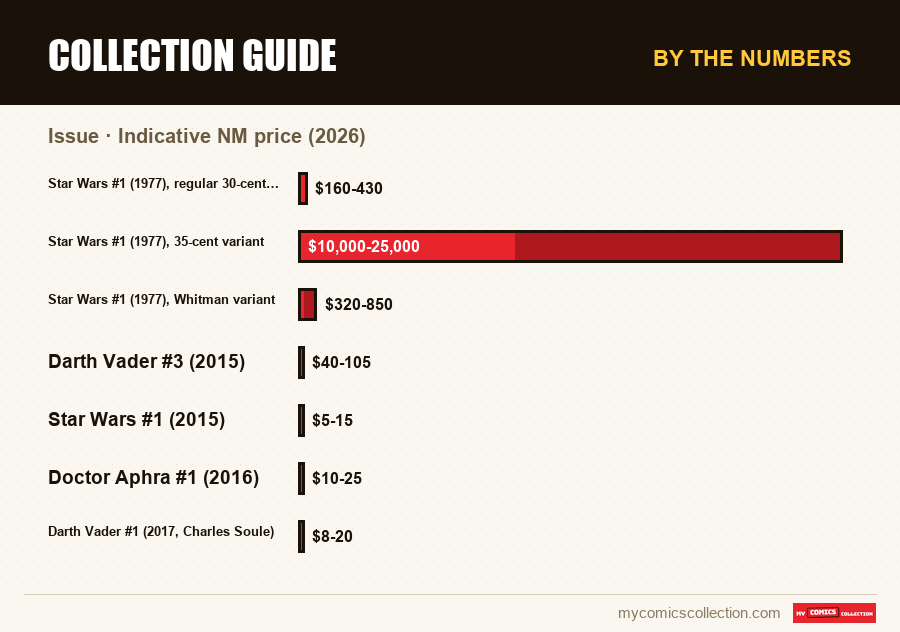
| Star Wars #1 (1977), regular 30-cent edition | Foundational key issue, 1st Star Wars app in comics | $160-430 |
| Star Wars #1 (1977), 35-cent variant | Ultra-rare variant, premium collectible | $10,000-25,000 |
| Star Wars #1 (1977), Whitman variant | Limited distribution variant | $320-850 |
| Darth Vader #3 (2015) | 1st appearance Doctor Aphra | $40-105 |
| Star Wars #1 (2015) | Canonical relaunch, 1st Disney-era issue | $5-15 |
| Doctor Aphra #1 (2016) | 1st Aphra solo series | $10-25 |
| Darth Vader #1 (2017, Charles Soule) | Covers Vader's transformation, series debut | $8-20 |
The Dark Horse era (1991-2014): what you need to know
Between 1986 (end of the original Marvel series) and 2014 (end of the Dark Horse license), Dark Horse Comics published Star Wars comics. This period produced a considerable amount of material, Tales of the Jedi, Shadows of the Empire, Dark Empire, Legacy, Knights of the Old Republic, which was part of the "Expanded Universe" and has since been reclassified as "Legends" (non-canonical) by Disney.
For a collector focused on Marvel, the Dark Horse period is distinct and doesn't fit into a "Star Wars Marvel" collection. However, some Dark Horse issues remain highly collected independently, notably Dark Empire #1 (1991) and Star Wars: Crimson Empire #1 (1997).
Collecting this series?
Track what you own, what you are missing and what your collection is worth. 7 day trial.
Start my trial →How to organize your Marvel Star Wars collection
Separate the two major eras
Create two distinct sections in your collection: "Star Wars Marvel 1977-1986" and "Star Wars Marvel 2015-present." These two eras are narratively and commercially different, confusing them in your catalog is the most common source of errors.
Identify and secure key issues first
For the 1977 series: Star Wars #1 (regular 30-cent edition) is your baseline goal. For the 2015 series: Darth Vader #3 (first appearance Aphra) is the issue to have. These two pieces form the foundation of your Marvel Star Wars collection.
Catalog in My Comics Collection
With My Comics Collection, import each Marvel Star Wars series with precision: distinguish "Star Wars #1 (1977)" from "Star Wars #1 (2015)", two issues with the same title but radically different values. Use the series and volume filters to avoid any confusion.
Choose a run to complete
Completing Star Wars #1-107 (original series) is an ambitious but achievable goal with patience. Completing Darth Vader Vol.1 (25 issues) or Doctor Aphra Vol.1 (40 issues) is a more accessible option for a modern collector.
Scan and protect your Bronze Age issues
The 1977-1986 issues are fragile and often in poor condition. Use My Comics Collection's scanner app to quickly catalog your Bronze Age issues by barcode or cover, and store them in mylar bags suited for Bronze Age formats.
State of the Marvel Star Wars market in 2026
The Marvel Star Wars comics market has a unique profile in 2026. The 35-cent variant of Star Wars #1 remains one of the most valuable and volatile pieces on the Marvel Bronze Age market, with international demand driven by both Star Wars collectors and Marvel collectors. Its authenticity must always be carefully verified.
Issues from the 2015 series generally have modest value for regular editions, as they were printed in large quantities. The notable exception is Darth Vader #3 (2015), which benefits from Doctor Aphra's growing popularity, an original Star Wars character who has won over a significant fan base. If Doctor Aphra appears in a live-action Disney+ production, her key issue could see a significant demand spike.
For issues from the original 1977-1986 series, the general rule is that issues in good condition are increasingly rare, they've aged for 40-50 years without the majority being preserved. NM or NM+ copies of ordinary series issues have growing value simply due to their rarity in that condition.
FAQ, Managing your Marvel Star Wars collection
Manage your Star Wars comics issue by issue
From Star Wars #1 (1977) to the Darth Vader and Doctor Aphra series, organize your entire Marvel Star Wars collection with My Comics Collection.
Free 7-day trial, No commitment