
Watchmen is a limited series of 12 numbers published by DC Comics between September 1986 and October 1987 , written by Alan Moore and drawn by Dave Gibbons (colorist: John Higgins). Inspired by Charlton Comics characters bought by DC, the series deconstructs the myth of the superhero in a uchrony where Nixon is still president in 1985. This is the only graphic novel included in TIME magazine's list of the 100 best novels of all time (2005). The trade paperback compiling the 12 issues is the best-selling graphic novel in history, with more than 10 million copies elapsed. A copy of the #1 in CGC 9.8 is being negotiated today between $2,500 and $4,500.
In the history of American comics, there is a before and an after Watchmen. Before September 1986, the superhero was a codified genre, intended for an adolescent audience, governed by the Comics Code Authority and its moral prohibitions. After October 1987, when the twelfth and final issue hits newsstands, nothing will be the same. Alan Moore and Dave Gibbons proved that a comic book could be literature: with a mirrored narrative structure, recurring symbols (the clock, the bloody smiley face, the literary quotations at the end of the chapter), a grid of nine panels per page of absolute rigor, and characters whose psychological complexity had no equivalent in the medium.
This guide traces the birth of Watchmen, from the acquisition of the Charlton characters by DC until the publication of the last issue, gives the complete list of the 12 original issues with their key issues and market values, and covers all suites and extensions: Before Watchmen (2012), Doomsday Clock (2017-2019), the HBO series (2019) and its impact on the back issue market. By the end of this read, you'll know exactly what to look for, what to buy first, and how to structure a rigorous Watchmen collection.
The genesis of Watchmen: the Charlton characters and Moore's vision (1983-1985)
To understand how Watchmen came to be, we have to go back to 1983. DC Comics has just purchased the catalog of Charlton Comics, a second-tier publisher based in Derby (Connecticut), in gradual bankruptcy since the end of the 1970s. Among the lot are characters created in the 1960s by authors like Steve Ditko and Joe Gill : Captain Atom (1960), Blue Beetle / Ted Kord (1966), The Question (1967, created by Ditko), Nightshade (1966), Thunderbolt / Peter Cannon (1966) and Peacemaker (1966). DC plans to integrate these heroes into its universe during Crisis on Infinite Earths (1985-1986).
Alan Moore, a 30-year-old British screenwriter who has just revolutionized Swamp Thing for DC since 1984, proposes a radical project: using the Charlton characters to tell a realistic, dark superhero story, in which the masks are broken, violent, paranoid or powerless human beings. His initial proposal, titled “Who Killed the Peacemaker?”, is a murder story that allegedly left several characters dead or unusable.
Dick Giordano, editor-in-chief of DC and formerly of Charlton, refuses: he has just paid for these characters and does not want to see them destroyed in their first major DC appearance. He suggested that Moore create original analogues, inspired by Charlton archetypes but distinct enough to be sacrificed. Moore accepts, and this editorial refusal will prove providential: freed from DC continuity, Moore can push his deconstruction much further.
Charlton matches → Watchmen
Every character in Watchmen is a distorted mirror of a Charlton hero, amplified by Moore's thematic obsessions:
- The Comedian / Edward Blake → Peacemaker (Christopher Smith). Pacifist idealism is inverted into nihilistic cynicism. Blake is a violent government agent who embodies the worst of American foreign policy.
- Dr. Manhattan / Jon Osterman → Captain Atom (Allen Adam). The scientist disintegrated then reconstituted becomes a quantum being whose perception of time is non-linear: chapter 4,“Watchmaker”, is considered one of the greatest chapters ever written in comics.
- Nite Owl II / Dan Dreiberg → Blue Beetle / Ted Kord. The gadget inventor becomes an overweight middle-aged man, helpless without his suit, nostalgic for a bygone heroism.
- Rorschach / Walter Kovacs → The Question (Vic Sage, Steve Ditko). Ditko's objectivist vigilante is pushed to his logical extremes: an obsessive sociopath, incapable of compromise, whose symmetrical inkblot mask reflects a moral vision in absolute black and white.
- Ozymandias / Adrian Veidt → Thunderbolt / Peter Cannon. The athletic genius inspired by oriental disciplines becomes the "smartest man in the world", whose cold utilitarianism justifies a calculated genocide.
- Silk Specter II / Laurie Juspeczyk → Nightshade (Eve Eden). The heroine, heir to a family legacy, becomes a woman trapped between two generations, seeking to exist outside of her mother's shadow.
The role of Dave Gibbons: If Moore is the narrative mastermind, Dave Gibbons is the visual architect without whom Watchmen would not exist in this form. It is Gibbons who imposes the strict grid of 9 boxes (3×3) per page, creating a mechanical visual rhythm like a clock: the central metaphor of the work. The colorist John Higgins completes the trio with a deliberately dull, anti-heroic palette, which contrasts with the bright colors of DC comics of the time.
La publication des 12 issues (septembre 1986: octobre 1987)
Watchmen is released under the label DC Comics , en format prestige: hardcover, better quality paper than standard newsstand, and absence of the Comics Code Authority seal: a first for a major DC series. Publication spans 14 months, from September 1986 to October 1987, with some delays between the final issues.
Each issue follows an identical structure: the main story (drawn by Gibbons), followed by a prose appendix that enriches the universe: extracts from Hollis Mason's autobiographical book (Under the Hood), psychiatric reports, fictitious press articles, military files. This double narration, unique in 1986, gives Watchmen a documentary depth which amplifies the realism. The last exit (#12) does not contain an appendix, signaling the end of all illusion.
La liste complète des 12 issues originaux
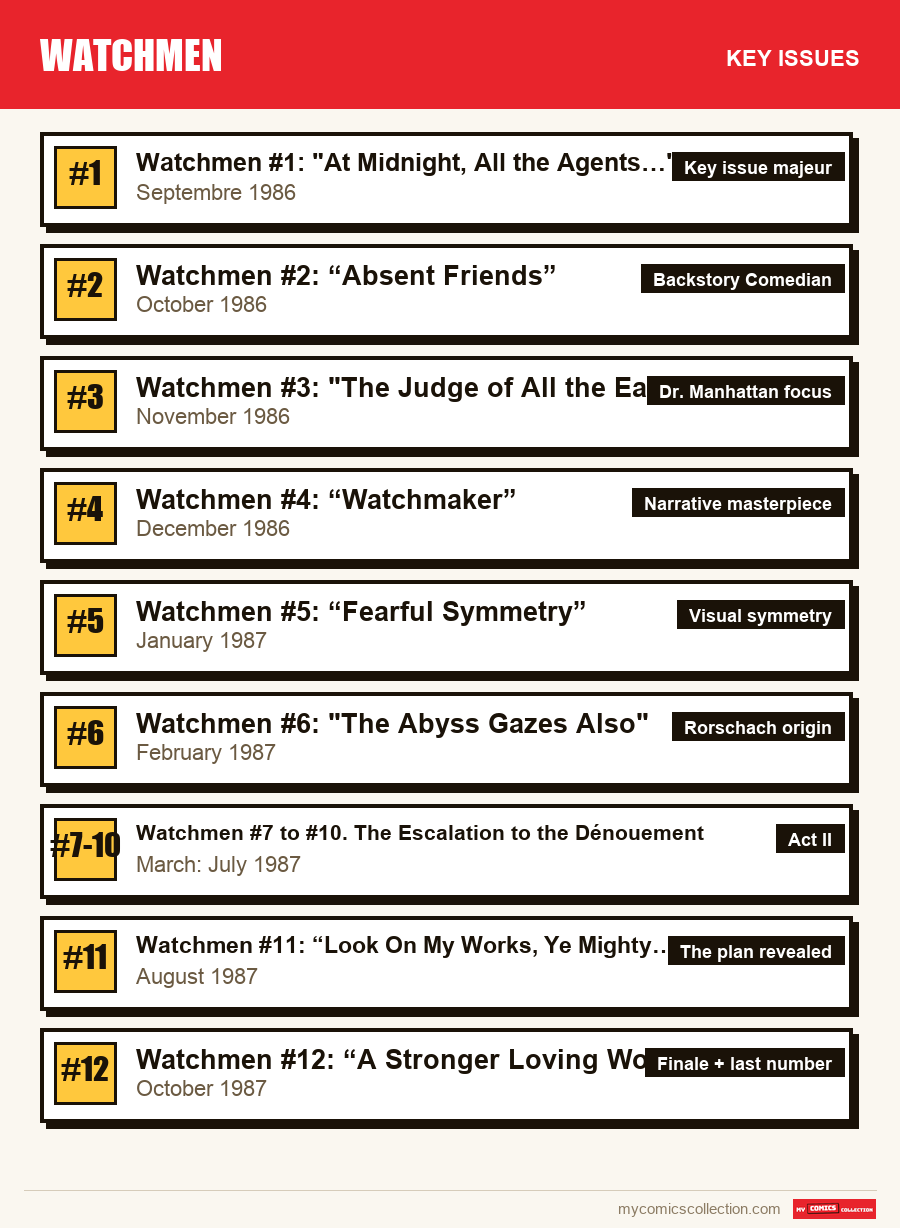
Watchmen #1: "At Midnight, All the Agents…"
Première apparition de all main characters: Rorschach, Nite Owl II, Dr. Manhattan, Silk Specter II, Ozymandias, the Comedian (as a corpse). The issue opens with the famous image of the bloody smiley face in the gutter and the voice-over from Rorschach's diary. Appendix: first chapters of Under the Hood by Hollis Mason. This is the most sought-after issue in the series.
Watchmen #2: “Absent Friends”
Flashbacks on the Comedian's life: Vietnam War, relationship with the Minutemen, attempted rape of Sally Jupiter (Silk Specter I). First appearance in flashback of Minutemen (1940s team). This issue establishes the moral darkness of the series.
Watchmen #3: "The Judge of All the Earth"
Introduction to the embedded story Tales of the Black Freighter, the comic-within-a-comic read by a teenager at a Manhattan newsstand. Parallel between nuclear paranoia and the shipwreck of the pirate story. The mirrored structure, Moore's signature, takes on its full scope here.
Watchmen #4: “Watchmaker”
Chapter entirely devoted to Dr.Manhattan, told in non-linear narration. Jon Osterman simultaneously relives his past (the accident in the intrinsic particle field), his present (the exile on Mars) and his future. It is the most critically acclaimed number, often cited as the best single issue ever written.
Watchmen #5: “Fearful Symmetry”
The most impressive formal feat of the series: the structure of the number is palindromic. The first page is the visual mirror of the last, the second of the penultimate, and so on, with the central page as the axis of symmetry. Focus on Rorschach. This technical tour de force is invisible at first reading but revolutionary for the medium.
Watchmen #6: "The Abyss Gazes Also"
The complete origin of Rorschach, told during psychiatric sessions with Dr. Malcolm Long. Walter Kovacs, an abused child, becomes a Rorschach after discovering the murder of a little girl by dogs. The title is a quote from Nietzsche. It is the most psychologically intense issue of the series and one of the most sought after #1.
Watchmen #7 to #10. The Escalation to the Dénouement
#7 “A Brother to Dragons”: focus Nite Owl, theme of powerlessness and return to costume. #8 “Old Ghosts”: escape from Rorschach, death of Hollis Mason (Nite Owl I). #9 “The Darkness of Mother Being”: on Mars, Laurie discovers that the Comedian is her father: Manhattan agrees to return to Earth. #10 “Two Riders Were Approaching…”: Rorschach and Nite Owl identify the conspirator. These four issues form the second narrative act of the series.
Watchmen #11: “Look On My Works, Ye Mighty…”
Ozymandias reveals his plan: he orchestrated the conspiracy from the beginning, eliminated the Comedian, discredited Dr. Manhattan, and is preparing to teleport a giant psychic creature to New York to kill millions and unite humanity in the face of a fictitious extraterrestrial threat. The title quotes Shelley (Ozymandias). The final twist: “I did it thirty-five minutes ago.”
Watchmen #12: “A Stronger Loving World”
The aftermath of the attack on New York. The heroes choose to keep Ozymandias' secret to preserve the peace-unless Rorschach, who refuses to compromise and is disintegrated by Dr. Manhattan. Last issue of the series. No appendix in prose, only the last box: the hand of an employee of the New Frontiersman which approaches Rorschach's journal, leaving the ending open. It is the second most searched number after #1.
Cultural impact and revolution of the medium (1987-2000)
Watchmen's impact on the comics industry is comparable to that of The Dark Knight Returns by Frank Miller, released the same year (February 1986). Together, these two works pushed mainstream comics into the so-called era "grim and gritty": dark heroes, explicit violence, ambiguous morality. But where Miller tells a superhero story pushed to the dark, Moore deconstructed the very concept of superhero. Watchmen is not a dark comic: it's a anti-comics.
En 1988 , Watchmen wins the Hugo Award ("Other Forms" category), a first for a comic book. The same year, DC compiled all 12 issues into one trade paperback which became the best-selling graphic novel in the history of American publishing. In 2005, the magazine TIME includes Watchmen in its list of 100 best English novels of all time , alongside 1984 , Brave New World and The Great Gatsby. It is the only graphic novel to appear there.
The legacy of Watchmen is visible everywhere in comics from the 90s and 2000s: the label Vertigo (1993), the wave of British comics at DC (Neil Gaiman, Grant Morrison, Peter Milligan, Jamie Delano), the fashion for "superheroic deconstructionism" which will culminate with The Authority (1999), Planetary (1999) and, much later, The Boys (2006) by Garth Ennis.
The rights controversy: The contract signed by Alan Moore and Dave Gibbons stipulated that the rights would revert to the creators when the series left the DC catalog. However, thanks to the ongoing success of the trade paperback, Watchmen is not Never out of catalog: meaning DC retained the rights indefinitely. Alan Moore considers this a contractual betrayal and has publicly cut ties with DC. He refuses to allow his name to appear on any adaptation or sequel. This dispute shaped the debate over creators' rights in the comics industry.
Before Watchmen (2012): the controversial prequel
En June 2012 , DC Comics launches Before Watchmen , a set of 7 mini-series + 1 epilogue totalizing 37 numbers (+ a #0 number). The project explores the past of the main characters, long before the events of the original series. Alan Moore publicly condemns the project and refuses any involvement. Dave Gibbons takes a more measured stance, not participating but not formally opposing.
The mini-series Before Watchmen are as follows:
- Minutemen (6 num.): Darwyn Cooke. The most acclaimed series of the lot.
- Silk Specter (4 num.): Darwyn Cooke & Amanda Conner.
- Actor (6 num.): Brian Azzarello & J.G. Jones.
- Nite Owl (4 num.): J. Michael Straczynski & Andy & Joe Kubert.
- Ozymandias (6 num.): Len Wein & Jae Lee.
- Rorschach (4 num.): Brian Azzarello & Lee Bermejo.
- Dr.Manhattan (4 num.): J. Michael Straczynski & Adam Hughes.
- Moloch (2 num.): J. Michael Straczynski & Eduardo Risso.
- Dollar Bill (1 issue): Len Wein & Steve Rude. One-shot.
Critical reception is mixed: Minutemen and Silk Specter are praised, while Straczynski's series receive more divided opinions. For collectors, variant covers of Before Watchmen remain accessible ($20 to $80 at high CGC grade), making it an affordable entry into the Watchmen universe.
Doomsday Clock (2017-2019): Watchmen meets the DC universe
En November 2017 , DC launches Doomsday Clock , a maxi-series of 12 numbers written by Geoff Johns and drawn by Gary Frank, which is a direct sequel to Watchmen and integrates it into the continuity of the DC universe. The concept is audacious: Dr. Manhattan, after leaving the Watchmen universe, went to the DC Universe, where he altered the timeline, causing successive reboots (Crisis, Flashpoint, New 52). Ozymandias, dying of cancer, travels to the DC Universe to find Manhattan and save their world.
The series has suffered considerable delays: the 12 issues run from November 2017 to December 2019. #12 reveals that the Metaverse DC is centered around Superman, and that every attempt by Manhattan to alter the universe is corrected by Superman's existence.
For collectors, Doomsday Clock is of specific interest:
- Doomsday Clock #1 (November 2017): first appearance of the new Rorschach (Reggie Long, son of Dr. Malcolm Long). CGC value 9.8: $50-$120.
- Doomsday Clock #12 (December 2019): Superman / Dr. Manhattan confrontation. Key number for post-Rebirth DC mythology.
- THE variant covers by Gary Frank reproducing the iconic covers of the original series (smiley, clock, hand of Dr. Manhattan) are prized by collectors.
The HBO series Watchmen (2019) and its impact on the market
En October 2019 , HBO broadcasts Watchmen , a television series 9 episodes created by Damon Lindeloff ( Lost , The Leftovers). Rather than a faithful adaptation, Lindelof designs a following taking place in Tulsa (Oklahoma) in 2019, 34 years after the events of the comics. The series includes the Tulsa massacre of 1921 as a historical backdrop, mixes masked superheroes and white supremacism, and explores the long-term consequences of Ozymandias' plan.
The series is a critical triumph: it wins 11 Emmy Awards, including that of the best limited series. The impact on the back issue market is immediate and massive:
- Sales of Watchmen #1 CGC 9.8 go from $1,200-1,800 (mid-2019) to $3,000-4,500 end of 2019-beginning of 2020.
- The trade paperback is temporarily out of stock at distributors, a rare phenomenon for a book published for more than 30 years.
- The intermediate numbers (#3 to #10), long underrated, see their prices double in high CGC grade.
- THE newsstand editions (kiosk variants, recognizable by their UPC barcode instead of the direct DC logo) become distinct collector's items, with premiums of 30 to 50% on direct editions.
Prices have corrected slightly since the post-HBO peak, but Watchmen remains one of the most stable DC series on the secondary market.
Collecting Watchmen: The Original 12 Issues Vs. the TPB
The fundamental question for any Watchmen collector is: should you look for the 12 individual numbers or settle for the trade paperback? The answer depends on your goals.
The original 12 issues (1986-1987)
Singles offer the most authentic experience and best resale value. Here are the points to know:
- Draw: the first issues were printed in between 200,000 and 300,000 copies, a high figure for the time but much lower than the print runs of the major Marvel titles. The series was not considered an investment in 1986: many copies were read, folded, or thrown away.
- Newsstand vs. Direct Market: Like all DCs of this period, Watchmen exists in two distribution variants. THE newsstand editions (sold at newsstands, with UPC barcode) are rarer than direct editions (sold in comic shops, with the DC logo at the top left). The price difference in high grade is significant.
- Blankets: all covers are by Dave Gibbons, with no variant covers: an advantage for collectors who want a complete run without getting lost in variants.
- State: the soft cover and the period paper make the high CGC grades (9.6+) relatively rare on the first issues, especially the newsstands.
The trade paperback and compiled editions
Le trade paperback Watchmen (first edition 1987, ISBN 0-930289-23-4) is the best-selling graphic novel in English-speaking history. It has gone through dozens of reprints with different covers. Notable editions include:
- First softcover edition (1987): recognizable by the mention "First printing" on the copyright page. Value depending on state: $50 to $200.
- First hardcover edition (1987): rarer, with dust jacket. Value: $100 to $400 depending on condition.
- Absolute Watchmen (2005): oversized edition with recoloring supervised by Dave Gibbons and John Higgins. Size 21×32 cm. This is the definitive reading edition for many fans.
- Watchmen: The Annotated Edition (2017): with notes by Leslie S. Klinger, historical context and page-by-page analysis.
- Watchmen Black (2016): reproduction of Gibbons' plates only in black and white, without color. Edition prized by lovers of sequential art.
Collector's advice: For a long-term investment, 12 original issues in CGC 9.4+ remain the best choice. #1 and #12 are the two major key issues, followed by #4 ("Watchmaker") and #6 (Rorschach origin). If your budget is limited, start with #1 in good grade, then gradually add to it. The TPB first edition softcover is an excellent addition, but its resale value plateaus well below the graded singles.
Collecting Guide: Where to Start and What to Prioritize
Here is the recommended order of priority by budget level:
- Less than $500: a Watchmen #1 raw in VF/NM ($80-200), the TPB first edition ($50-150), and one or two key issues (#4, #6, #12).
- $500-$2,000: the complete run of the 12 raw VF+ issues at NM ($600-1,500), or the #1 graded CGC 9.4 ($800-1,500) plus the Absolute Watchmen ($80-120).
- $2,000 and more: the #1 CGC 9.8 ($2,500-4,500), the full run CGC 9.6+ ($3,000-6,000), and the high-grade newsstand editions (30-50% premium). The Holy Grail: a #1 CGC 9.8 Newsstand, whose sales regularly exceed $6,000 to $8,000.
The Watchmen Legacy: A Franchise That Never Dies
Despite Alan Moore's continued refusal to endorse any expansion, the Watchmen universe continues to expand. DC Comics integrated the characters into its main continuity via Doomsday Clock, then into Dark Crisis (2022), and continues to use Dr. Manhattan as a cosmic deus ex machina in its multiverse mythology. At the same time, HBO has not announced a season 2 (Lindelof said he designed the series as a one-off), but the studio's interest in the franchise remains strong.
For the collector, this means that each new announcement (series, film, video game) causes a temporary increase in prices out of the original 12 issues. It's a reliable market mechanism: Watchmen is a franchise whose fan base is both large enough to generate demand and cultivated enough to value original editions above reprints.
The best strategy remains to buy during periods of media calm, when no adaptation is announced, and to keep in the long term. The original 12 issues of Watchmen are not speculation: they are permanent classics, whose value is backed by literary, critical and cultural recognition without equivalent in the world of comics.
To go further in your Watchmen collection, consult our specialized guides: the top key Watchmen numbers to know et the complete guide to collecting Watchmen.
→ See all “History” articles on the blog
Go further
- Watchmen Reading Guide: Issues, TPB, Back-Matter and Spin-Offs
- The Best Watchmen Runs: Complete Ranking for Collectors
- Watchmen: the standout chapters and spin-offs every collector should know
- Top 10 essential Watchmen key issues
- Watchmen #1 (1986): First Appearance, CGC Census & Collector's Value Guide
- Watchmen Collection Guide: How to Collect Watchmen Comics
Frequently asked questions
Watchmen is a 12-issue limited series published by DC Comics between September 1986 and October 1987. It is written by Alan Moore, drawn by Dave Gibbons and colored by John Higgins.
Alan Moore first wanted to use them, but Dick Giordano, DC's executive editor, refused to see them destroyed right after their acquisition. He suggested original analogues, which freed Moore from DC continuity and let him take his deconstruction much further.
Watchmen #1 is the most sought after, with the first appearance of all the main characters. #4, "Watchmaker", devoted to Dr. Manhattan, is often cited as the best single issue ever written, and #6 tells Rorschach's complete origin.
#5, "Fearful Symmetry", is palindromic: the first page is the visual mirror of the last, the second of the second-to-last, with the central page as the axis. This formal feat is invisible on a first read but revolutionary for the medium.
Before Watchmen (2012), Doomsday Clock (2017-2019) and the television series (2019) extend the universe. Watchmen is also the only graphic novel on TIME's list of the 100 best novels of all time (2005).