Alan Moore and Dave Gibbons' Watchmen is a 12-issue maxiseries published by DC Comics from September 1986 to October 1987. The only comic ever to win a Hugo Award (1988, "Other Forms" category), it is also one of the very few graphic works to appear on Time magazine's list of the 100 best English-language novels. For collectors, value lies in high-grade CGC first prints and complete runs: eBay listing volume stays below 15 copies per issue, a sign that the raw single-issue market is structurally thin.
Published monthly from September 1986 to October 1987, Watchmen is written by Alan Moore, drawn by Dave Gibbons, and colored by John Higgins. Its characters:Rorschach, Doctor Manhattan, Nite Owl (Dan Dreiberg), Silk Spectre, Ozymandias, and The Comedian: are world-weary heroes loosely inspired by the Charlton Comics characters DC acquired in the early 1980s. The story deconstructs the superhero genre as a Cold War political thriller.
This guide covers the optimal reading order, the "issues vs TPB" question, the valuable prose texts hidden in each issue, and the spin-offs and adaptations that followed.
The 12 issues: structure and key moments
Watchmen is designed to be read in publication order, from #1 to #12: each chapter was crafted for linear reading with no need to jump around.
| Issue | Chapter title | Key moment |
|---|---|---|
| #1 (Sept. 1986) | At Midnight, All the Agents… | Cast introduced; the Comedian's murder; Rorschach in action |
| #2 | Absent Friends | The Comedian's funeral; Minutemen flashbacks |
| #3 | The Judge of All the Earth | Doctor Manhattan interviewed live on TV; Tales of the Black Freighter begins |
| #4 | Watchmaker | Doctor Manhattan's origin told in non-linear time: the series' formal high point |
| #5 | Fearful Symmetry | Pages structured as a perfect mirror (page 1 mirrors page 28): formal virtuosity |
| #6 | The Abyss Gazes Also | Rorschach's origin and psychology, told through a prison psychiatric interview |
| #7 | A Brother to Dragons | Nite Owl and Silk Spectre break Rorschach out; the central couple's arc takes shape |
| #8 | Old Ghosts | Doctor Manhattan returns to Earth; Laurie's parentage hinted at |
| #9 | The Darkness of Mere Being | Sally Jupiter's flashbacks; Laurie's true father revealed |
| #10 | Two Riders Were Approaching… | Ozymandias's plan revealed; back-matter: Veidt correspondence + The Veidt Method |
| #11 | Look on My Works, Ye Mighty… | Ozymandias's scheme fully exposed |
| #12 (Oct. 1987) | A Stronger Loving World | Resolution and epilogue; the only issue without a prose back-matter section |
Original issues or trade paperback?
The Watchmen trade paperback (DC, 1987) is the standard reading edition: same chapter order, same pagination, same story. With over 24 known printings as of 2017 and more than one million copies printed in 2008 alone to meet demand ahead of Zack Snyder's film, it is one of the most reprinted works in the medium's history. For a first read or a reread, the TPB is more than adequate.
The original singles (1986-1987) matter to collectors for their first-print status, but the raw eBay market is structurally thin: our June 2026 data shows fewer than 15 active listings per issue (e.g. #1: 9 listings, #4: 4 listings, #5: no results). That thinness is itself a function of the TPB's success: it displaced the singles as the reading format of choice. For high grades, the real market is in CGC-slabbed first prints, traded at auction through Heritage Auctions and ComicConnect; exact prices depend on grade and print variant and should be verified in real time before any purchase.
For a premium edition, DC's Absolute Watchmen (2005) is a large-format slipcased hardcover with restored and recolored artwork: the definitive object for bibliophile collectors. The Deluxe Edition (11-inch hardcover) and the Collectors Edition Box Set (12 separate hardcovers, 2016) round out the modern collector options.
The back-matter: the hidden layer of the singles
Every issue except #12 ends with several pages of fictional prose written by Alan Moore: one of the strongest reasons to seek out the original singles over the standard TPB. These texts function as a novel within the novel, building the world's plausibility and revealing character motivations that the drawn narrative deliberately withholds.
- #1-#2 : Chapters I and II of Under the Hood, the memoirs of Hollis Mason (the original Nite Owl): an insider account of the Minutemen from their founding to their decline.
- #3-#5 : Chapters III to V of Under the Hood, tracking the group's dissolution; these issues also introduce the Tales of the Black Freighter pirate comic-within-the-comic as a narrative counterpoint.
- #8-#9 : New Frontiersman newspaper front pages, letters, and an interview with Sally Jupiter (the original Silk Spectre).
- #10: Correspondence between Adrian Veidt and his staff, followed by the introduction to The Veidt Method, his self-help fitness programme: darkly ironic in context.
- #11: A magazine interview with Adrian Veidt conducted by Doug Roth: essential reading before the final confrontation in #12.
The awards and critical legacy
Watchmen is the only comic ever to win a Hugo Award, taking the prize in 1988 in the "Other Forms" category: a recognition normally reserved for prose science fiction. It is equally the only graphic novel on Time magazine's list of the 100 best English-language novels from 1923 to the present. These distinctions placed it not just in the canon of comics, but in the broader canon of twentieth-century literature.
Beyond Watchmen: spin-offs and adaptations
The original series is a closed work: Moore wrote no sequel. DC, however, has produced several extensions:
- Before Watchmen (2012): seven prequel miniseries (Rorschach, Nite Owl, Comedian, Silk Spectre, Ozymandias, Dr. Manhattan, Minutemen) by various creative teams. Mixed critical reception, but structurally complete as a set.
- Doomsday Clock (Nov. 2017-Dec. 2019): 12 issues written by Geoff Johns and drawn by Gary Frank. A direct sequel that brings the Watchmen characters into the main DC Universe alongside Superman and Batman. Best approached after reading the original maxiseries and DC Universe Rebirth #1 (2016) for context.
- Rorschach (2020-2021): 12 issues by Tom King and Jorge Fornés, set within the Doomsday Clock world. Recommended for readers already familiar with that universe.
- Zack Snyder's film (2009): a faithful visual adaptation; the Ultimate Cut integrates an animated Tales of the Black Freighter directly into the narrative, approximating the experience of the issues' back-matter.
- HBO series (2019): created by Damon Lindelof, set thirty years after the comic's events. 26 Emmy nominations, 11 wins including Outstanding Limited Series, Outstanding Lead Actress (Regina King), and Outstanding Supporting Actor (Yahya Abdul-Mateen II).
Recommended reading order
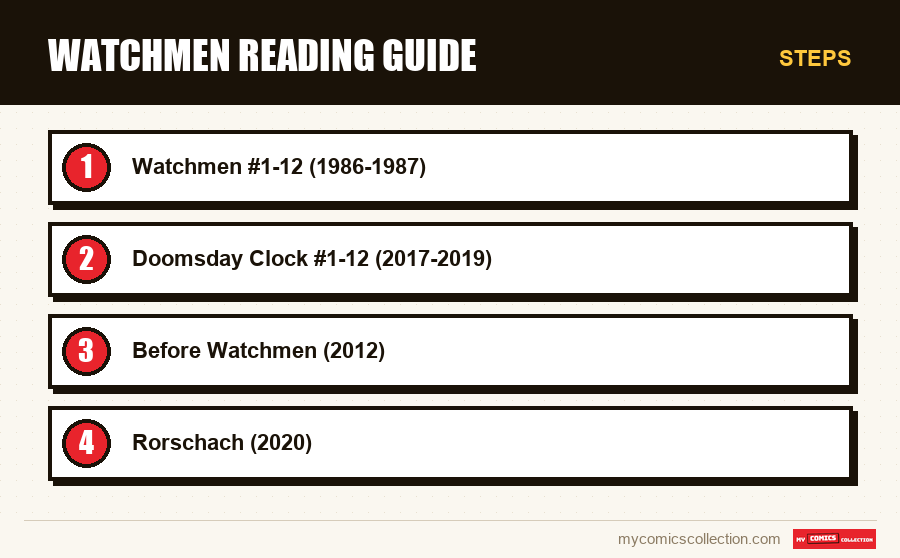
- Watchmen #1-12 (1986-1987): the canonical text, in singles or TPB.
- Doomsday Clock #1-12 (2017-2019): after reading DC Universe Rebirth #1 for setup.
- Before Watchmen (2012): as a supplement, read each miniseries in its own internal order.
- Rorschach (2020): last, once the Doomsday Clock universe is familiar.
Own one or more Watchmen issues? Get a free valuation with our tool based on real eBay sales to find the low, median, and high value of each copy.
Frequently asked questions
In publication order, from #1 to #12: each chapter is designed for linear reading, with no jumping back and forth. The maxiseries ran from September 1986 to October 1987.
The 1987 trade paperback is the reference edition for reading: same breakdown, same order, same pagination. The original singles mainly interest collectors for their first-print value.
Every issue except #12 ends with several pages of fictional prose by Alan Moore: Under the Hood, the memoirs of Hollis Mason, articles, an interview with Sally Jupiter, then Adrian Veidt's correspondence. These texts do not appear in every TPB edition.
Fearful Symmetry features a perfectly mirrored layout: page 1 is page 28 reversed. It is a formal tour de force that illustrates the series' meticulous construction.
Absolute Watchmen (2005), a bound large-format edition in a slipcase with restored colors, is the reference edition for lovers of the book as an object. The Deluxe Edition and the 12-volume Collectors Edition Box Set (2016) round out the offer.