THE 80s comics occupy a special place among collectors: a pivotal decade between the Bronze Age and the Modern Age, it saw the birth of major works like Watchmen , The Dark Knight Returns or the rise of characters who have become central. We explain why these comics are sought after and what makes them collectible.
Neither quite vintage, nor truly modern: the comics of the 80s form a unique decade, rich in cult works and key issues. Deciphering their appeal for collectors.
As always in this guide, only verified information (established elements from this period) is stated; the analysis is ours, without reproduction of plates or protected dialogue.
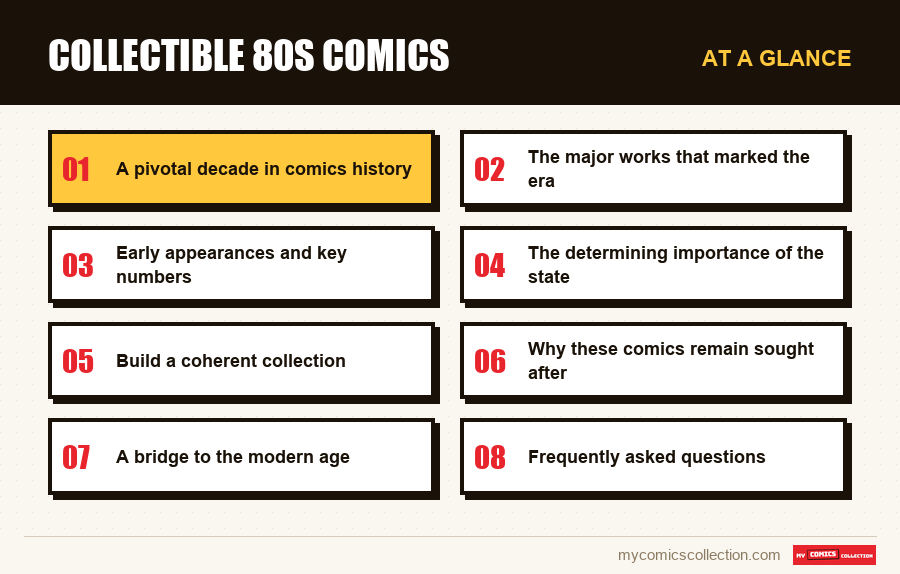
A pivotal decade in comics history
The 80s constitute a pivotal period in the history of comics, on the border between the Bronze Age and the Modern Age. This decade saw the medium evolve profoundly, both narratively and in terms of its cultural recognition. More adult, darker and more ambitious works emerged, transforming the perception of comics from simple entertainment for young people to a form of expression taken seriously. This maturation of the medium made the 1980s a founding decade, the influence of which is still felt today. For the collector, this pivotal position gives comics from this era a particular historical importance, at the crossroads of two eras.
This evolution has been accompanied by changes in the industry itself. The market has become structured, specialized stores have multiplied, and new distribution methods have emerged. Print runs have increased, which has a direct consequence on rarity: unlike comics from previous decades, often printed in limited numbers and poorly preserved, those from the 80s exist in greater quantities. This relative abundance means that rarity alone is not enough to determine value: it is the importance of the work, the state of conservation and the presence of key numbers which distinguish the sought-after copies. Understanding this dynamic is essential to approaching the comics collection of this decade.
The major works that marked the era
The '80s gave rise to some of the most revered works in comic book history. Watchmen, by Alan Moore and Dave Gibbons, and The Dark Knight Returns, by Frank Miller, are emblematic examples of this new ambition: complex, adult stories that redefined what a comic could be. These works, published in the middle of the decade, marked a turning point and became essential references. For the collector, they represent major pieces, of which the first issues and first editions are particularly sought after. Their status as cult works, regularly republished and studied, guarantees a lasting interest which supports their attractiveness.
Beyond these flagship titles, the decade saw the emergence of numerous notable series and creators. Runs that have become legendary, characters introduced or redefined, ambitious sagas: the 80s are full of content that shaped the comic book universes as we know them today. This creative richness makes the decade an exciting collecting field, where we find both recognized masterpieces and lesser-known gems. For the collector, exploring '80s comics means traveling through a period of exceptional fertility, during which the medium produced some of its most enduring achievements. This abundance of striking works is one of the great attractions of the decade.
Early appearances and key numbers
As with any period, it is the first appearances and the key issues which concentrate most of the value of the comics of the 80s. The decade saw the introduction of characters destined to become central, as well as major turning points in the major series. These key issues (first appearance of a character who has become popular, pivotal episode of a saga, significant event) are the most prized pieces among collectors. Identifying these issues within the decade's teeming production is a valuable skill: it's what distinguishes a valuable copy from a run-of-the-mill episode. Knowledge of these key issues is at the heart of collecting comics from this era.
Interest in these first appearances is often reinforced by current events, particularly film and series adaptations. When a character introduced in the 80s gains notoriety through an adaptation, the demand for their first issue increases, driving up their rating. This dynamic explains why certain comics of the decade, long modest, saw their value soar. For the collector, anticipating these movements-identifying characters likely to be adapted-can be a profitable strategy. But beyond speculation, these key issues retain an intrinsic value linked to their importance in the history of comic book universes. They remain the centerpieces of any collection dedicated to the 80s.
The determining importance of the state
For comics from the 80s, the state of conservation plays a determining role in the value. As these comics exist in relatively abundant quantities, it is the copies in excellent condition that stand out and fetch the highest prices. A key number preserved impeccably, without bending or wear, is worth much more than the same title in average condition. This premium to the condition is all the more marked as many copies were read and handled at the time, making perfectly preserved copies relatively rare. For the collector, favoring the quality of conservation is therefore an essential rule when it comes to comics from this decade.
This importance of condition explains the growing role of grading, the professional certification of the condition of a comic. For valuable pieces from the 80s, a graded and well-rated example provides a guarantee appreciated by buyers, which often justifies a higher price. Grading transforms a subjective assessment of condition into an objective and recognized grade, which secures transactions on important pieces. For the collector, having his best examples from the 1980s graded can be a wise investment, both to preserve their value and to facilitate possible resale. The state, in all its forms, remains the key factor in the promotion of comics of this decade.
Build a coherent collection
Approaching 80s comics as a collector requires defining a strategy. Faced with the abundance of production, it is wise to concentrate rather than wanting to possess everything. Some choose to specialize in a character, a series or a publisher; others target the major works and key numbers of the decade. This targeted approach makes it possible to build a coherent, quality collection, rather than a disparate collection. It also facilitates research and estimation, by concentrating effort on a defined perimeter. For the collector, defining a common thread gives meaning to the collection and increases its overall value.
Building such a collection requires patience and method. You have to look for examples in the best possible condition, verify their authenticity, and monitor market developments to seize opportunities. Keeping a precise inventory of what you have and what you are looking for is a valuable asset, which avoids duplication and guides acquisitions. Comics from the 80s, with their richness and historical importance, offer ideal ground for this type of thoughtful collection. By prioritizing consistency and quality, the collector builds a set that is both pleasant to own and solid in terms of heritage. It is this methodical approach that makes collecting this pivotal decade so interesting.
Why these comics remain sought after
The enduring appeal of '80s comics comes down to a combination of factors. They belong to a generation of readers who have now become collectors with the means to repurchase the comics of their youth, which supports a constant nostalgic demand. They contain works recognized as peaks of the medium, whose importance cannot be denied. And they introduce characters and concepts regularly brought forward by adaptations. This conjunction of nostalgia, quality and topicality maintains a sustained interest in the decade, which shows no sign of slowing down.
For the collector, comics from the 80s represent a field that is both accessible and promising. Accessible, because their relative abundance makes it possible to find numerous titles at reasonable prices; promising, as key pieces in good condition often retain and increase their value. This decade offers a rare balance between the pleasure of collecting and the solidity of heritage. Whether we approach it out of nostalgia, out of admiration for his major works or out of interest in his key numbers, it constitutes a rich and rewarding terrain. The comics of the 80s, at the crossroads of two ages, remain one of the most endearing and sought-after periods in the history of the medium.
A bridge to the modern age
The comics of the 80s are better understood placed in the chronology of the medium. Situated at the end of the Bronze Age and the beginning of the Modern Age, they mark a transition whose importance goes beyond just the decade. Many of the developments initiated at this time (more adult stories, increased role of authors, structuring of the collection market) were fully deployed in the following decades. Collecting comics from the 80s is therefore interested in the roots of the modern age, in the period when the medium took the turning point that would define its current form. This dimension of a bridge between two eras adds historical depth to their interest.
This pivotal position also explains why 80s comics dialogue with both the past and the future. They extend the legacy of previous decades while announcing the codes of the present, which makes them an ideal entry point for understanding the overall evolution of the medium. For the curious collector, exploring this decade illuminates both what preceded it and what followed it. This continuity makes the comics of the 80s much more than just a period to collect: an essential milestone for understanding the entire history of the ninth art and the trajectory that led to the comic book universes as we know them today. It is this richness, both historical and heritage, which explains the lasting appeal of the decade to collectors of all generations.
Frequently asked questions
For a combination of factors: the nostalgia of a generation of readers who have become collectors, the presence of works recognized as peaks of the medium, and the introduction of characters regularly brought to the fore by adaptations. This conjunction maintains sustained and lasting interest.
Not particularly: unlike previous decades, they exist in relatively abundant quantities due to larger print runs. Rarity alone therefore does not make them valuable; it is the importance of the work, the presence of key numbers and above all the state of conservation which distinguish the sought-after copies.
Watchmen by Alan Moore and Dave Gibbons, and The Dark Knight Returns by Frank Miller are among the iconic works of the decade, which redefined what a comic could be. The decade also saw many legendary runs and the introduction of characters who became central.
Yes, it is decisive. As these comics are abundant, it is the copies in excellent condition that stand out and fetch the highest prices. Many having been read and handled, perfectly preserved copies are relatively rare, which gives them a high premium.
By defining a strategy: focus on a character, a series or a publisher, or target major works and key issues. This targeted approach makes it possible to build a coherent and quality collection. Keeping an accurate inventory and prioritizing the best possible condition are essential rules.