To find a comic's value online, look only at completed sales, never asking prices, and compare them in the same condition as your copy. Add a specialist price database, the grading census and, for a whole collection, an app that values each issue automatically.
⚠️ For reference only: This information is provided for educational purposes only. My Comics Collection is not an investment advisor. Prices vary with condition, scarcity, and market trends. Always check recent sales before any buy or sell decision.
You're holding a comic and you want to know what it's really worth. You type the title into Google, you land on contradictory forums, prices that swing 10x from one site to another, and you walk away more confused than when you started. Welcome to the world of comic pricing, where the information exists but you have to know how to read it.
This guide walks you through the best methods to check comic prices online in 2026, from completed eBay sales to specialized databases, with the traps to avoid and the factors that actually drive prices.
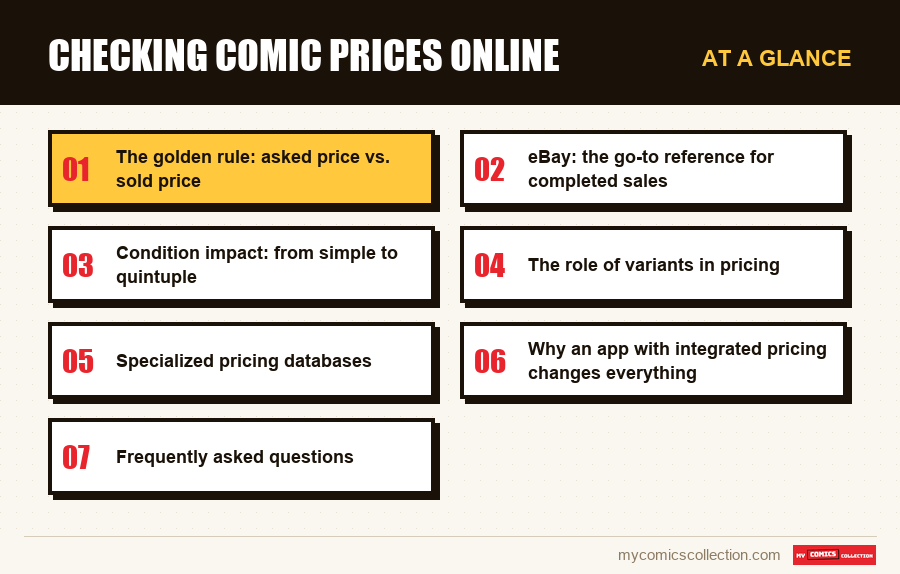
The golden rule: asked price vs. sold price
Before we talk tools, understand the most important principle of any comic valuation: only the sold price matters. A seller can list a 1970s Amazing Spider-Man at $2,200: that doesn't mean anyone agreed to pay it. The real market value of a comic is what a buyer actually paid in a completed transaction.
This distinction radically changes how you search. Active listings on any platform are intentions to sell, not market references. What you want are past sales, and the more recent, the better. A sale completed 30 days ago reflects the current market. An 18-month-old sale may belong to a completely different market cycle.
eBay: the go-to reference for completed sales
eBay remains the most voluminous and accessible free comic sales database. The key is to use only completed listings with the "Sold Items" filter: not active listings.
Here's how: search your comic on eBay, then in the filters (usually in the left column or under "Refine results"), activate the "Sold Items" checkbox. You'll see the last 90 days of transactions with their real prices. Collect 5 to 10 sales of the same condition as your copy, then calculate the median, not the average, since a few outlier sales can skew the math.
Practical tip: if your comic doesn't generate enough sales on your regional eBay, switch to eBay.com (the US version). The American market is much more liquid and will give you statistically more reliable data.
Condition impact: from simple to quintuple
The single most influential variable in a comic's price isn't rarity or publisher: it's condition. The same issue can be worth $16 in "Good" (GD) and $82 in "Near Mint" (NM). For Silver Age or Golden Age comics, that gap can hit a 1-to-10 ratio.
The standard grade scale, used worldwide for decades, runs from Poor (P) up through Fair, Good, Very Good, Fine, Very Fine, Near Mint, and Mint (MT). Each grade corresponds to precise criteria: cover creases, stains, edge tears, interior page browning, rusty staples…
Here are typical ranges relative to the Near Mint reference price:
- Near Mint (NM 9.0-9.6): 100%, reference price
- Very Fine (VF 8.0): 60 to 70% of NM price
- Fine (FN 6.0): 35 to 45% of NM price
- Very Good (VG 4.0): 20 to 30% of NM price
- Good (GD 2.0): 10 to 15% of NM price
Practical consequence: when searching for a comic's price, you must find sales for the same condition as your copy. Using the NM price to evaluate a VG comic will give you an estimate twice as high as reality.
Collecting this series?
Track what you own, what you are missing and what your collection is worth. 7 day trial.
Start my trial →The role of variants in pricing
Cover variants are another frequent source of confusion. Since the 1990s, Marvel, DC, and Image publishers have regularly issued multiple covers for the same issue: regular covers, retailer variants, incentive variants (1 per 25, 1 per 50, 1 per 100 copies ordered), newsstand editions vs. direct market…
These variants can have radically different values. A regular Amazing Spider-Man cover might trade for $5, while the 1:50 incentive of the same issue reaches $220. When searching prices online, make sure to specify exactly which version you have: direct or newsstand edition, which cover, which incentive ratio.
For newsstand editions especially, the value gap vs. direct editions has widened considerably since 2018. Specialized collectors pay a 30% to 100% premium on newsstands for popular key issues, because their print run was much smaller.
Specialized pricing databases
Beyond eBay, several tools are dedicated to comic price analysis:
GoCollect aggregates sales data from major platforms and provides trend charts by grade. Especially useful for CGC-graded comics, it lets you see price evolution over time and identify whether a comic is trending up or down. The free version gives basic data; the premium version unlocks full history.
The Overstreet Price Guide, published annually since 1970, remains the institutional industry reference. Its grade-based pricing system is universal. It's particularly relevant for Golden Age (pre-1956) and Silver Age (1956-1970) comics, for which online sales data is scarcer. Limitations: annual updates make it lag fast-moving modern key issues.
The CGC Census is free and indispensable: it's the registry of all CGC-graded comics. It tells you how many graded copies exist at each level. A comic with only 3 copies at 9.8 in the Census is worth far more than one with 600 copies certified at the same grade.
Why an app with integrated pricing changes everything
Manually looking up each comic's price in your collection is time-consuming. For a 200-issue collection, it takes hours of work if you have to consult eBay individually for each title, each issue, in the right condition. And the result is already potentially outdated a week later.
A dedicated app like My Comics Collection fully automates this process. By scanning or adding your comics to your digital library, you get an up-to-date valuation of your entire collection, with alerts when an issue's price moves significantly. What used to take a day of research takes a few minutes.
Frequently asked questions
The asked price is what a seller hopes to get: an intention, not a market reality. The sold price is what a buyer actually paid in a completed transaction. Only the latter reflects the real price. To know a comic's true value, always check eBay "completed listings" with the "Sold Items" filter, never active listings.
Condition is the most determining factor after intrinsic issue scarcity. The same comic can be worth 5× less in Good (GD) than in Near Mint (NM). The standard grading scale runs from Poor (P) to Mint (MT) with precise criteria. When researching, always compare sales in the same condition as your copy for a reliable estimate.
For most comics, eBay.com (the US version) gives more reliable data because sales volume is much higher there. With more transactions, the median price is statistically more representative. Your regional eBay is useful to check if a comic sells at a similar price on the local market, which can differ slightly from the US market.
Yes: sometimes dramatically. Incentive variants (1 per 25, 1 per 50 copies ordered) have much smaller print runs than the regular edition, translating to significantly higher prices. Newsstand editions also carry a growing premium. When researching, always specify exactly which version you have to find comparable sales.