To value a comic before selling it, rely on sales actually completed in recent months, never on the asking prices of live listings. Compare several sales of the same grade and use the median rather than the average, discarding outliers. For graded or very old comics, add a price database by grade and an annual price guide.
⚠️ For reference only: This information is provided for informational purposes only. My Comics Collection is not an investment advisor. Prices vary with condition, scarcity, and market trends. Check recent eBay or GoCollect sales before any buy decision.
You want to sell comics from your collection but you don't know what price to ask. Too low and you leave money on the table. Too high and your listings sit unanswered for weeks. Correctly estimating your comics' value is a skill you can learn, and it can gain or save you hundreds of dollars.
This guide shows you the professional method experienced collectors and comic dealers use, adapted for everyone. No unnecessary jargon: concrete tools, step-by-step methodology, and the classic mistakes to absolutely avoid.
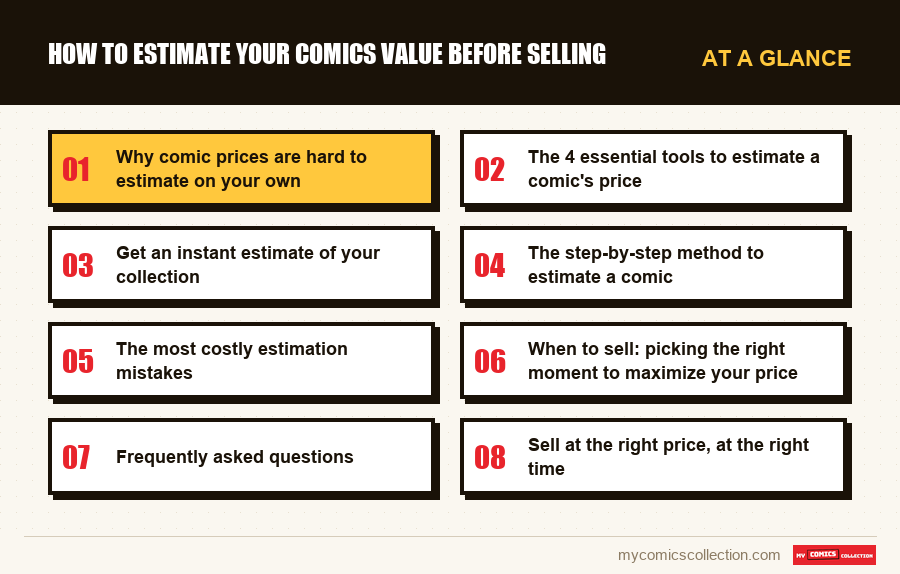
Why comic prices are hard to estimate on your own
Unlike books or vinyl, comics have wildly divergent values that depend on factors that aren't immediately visible. Two copies of the same issue, published the same month by the same publisher, can have a 1-to-50 value ratio depending on their condition.
On top of that, the comics market is highly reactive to pop culture news. A Marvel announcement on Monday morning can double an issue's value by Tuesday. Conversely, the release of a disappointing film can erode a key issue's value by 30% in a few weeks. Estimating "by instinct" without recent data is a guaranteed mistake.
Finally, the gap between asked price and actual price is often dizzying. On eBay, sellers post fantasy prices completely disconnected from market reality. Basing your estimate on these active listings would be a serious methodological error.
Fundamental principle: A comic's real value is the price a buyer actually paid recently, not the price asked by a seller. Always base your estimate on completed sales, never on active listings.
The 4 essential tools to estimate a comic's price
eBay Completed / Sold Listings
The most complete and reliable data source for common comics. In the eBay search bar, type the title and issue number of your comic, then in the left filters, activate "Sold Items." You'll see the last 90 days of real transaction prices. Calculate the median (not the average: ignore outliers) to get your reference price.
GoCollect
The price-analysis specialist for CGC-graded comics. GoCollect aggregates sales data from the main marketplaces and gives you prices by grade for thousands of key issues. Particularly powerful for CGC-slabbed comics. The free version gives basic data; the premium version offers full history and trend charts.
Overstreet Comic Book Price Guide
The collector's bible, published annually since 1970. Overstreet is particularly relevant for Golden Age (pre-1956) and Silver Age (1956-1970) comics for which online sales data is scarce. Its grade-based pricing (GD, VG, FN, VF, NM) is the industry reference. Caveat: its annual publication makes it lag fast-moving modern key issues.
CGC Census
The official registry of all comics graded by CGC (Certified Guaranty Company). By consulting the census for your issue, you know how many graded copies exist at each level: crucial info for evaluating your copy's real scarcity. A comic whose census shows 5 copies at 9.8 is worth far more than one with 500 certified at the same grade.
Get an instant estimate of your collection
My Comics Collection estimates the current value of each comic in your collection from eBay data, which you can then check against the CGC Census. Try free for 7 days.
🚀 Free 7-day trialNo charge during trial · Cancel anytime
The step-by-step method to estimate a comic
Precisely identify your copy
Exact title, issue number, publication year, publisher, edition (direct market vs. newsstand, cover variants). An X-Men #1 can mean three different comics published in 1963, 1991, or 2010: with radically different values.
Honestly assess condition
Use the standard scale: Poor (P), Fair (FA), Good (GD), Very Good (VG), Fine (FN), Very Fine (VF), Near Mint (NM), Mint (MT). Be critical: most sellers overestimate their comics' condition. Look for cover creases, stains, edge tears, page browning.
Check recent eBay sales (max 90 days)
Filter by "Sold Items," specify condition in your search if possible. Note the 5-10 most recent sales for the same condition as your copy. Calculate the median. That's your baseline reference price.
Cross-check with GoCollect and Overstreet
GoCollect for graded comics and post-1970, Overstreet for older comics. If the three sources agree, you have a solid estimate. If they diverge strongly, try to understand why (outlier sales, transient spike/trough, context change).
Adjust for current context
Is there an imminent MCU announcement for your comic? A film just out featuring the character? Is the market trending up or down? These factors can justify a price 20-30% above or below the historical median.
Collecting this series?
Track what you own, what you are missing and what your collection is worth. 7 day trial.
Start my trial →The most costly estimation mistakes
Here are the pitfalls inexperienced sellers fall into regularly, and how to avoid them.
Using the Overstreet catalog as a sale price
Overstreet is a historical reference, not a real-time market price. For 1990s-2010s comics, its guide can over- or underestimate 50% to 300% vs. real eBay sales. Use it as a complement, never as the sole source.
Pricing based on aberrant eBay sales
A $550 sale of a comic normally worth $90 is an anomaly (buyer error, bidding war between two passionate collectors, or market manipulation attempt). Never rely on a single data point: look for the central tendency across 5 to 10 sales.
Ignoring the "hot book" effect
Some comics see their price explode for a few weeks after an announcement, then partially retreat. Selling at the peak of a hot book is ideal, but waiting too long after the announcement means selling during the correction. Timing matters as much as estimation.
Overestimating your copy's condition
Every seller thinks their comic is in better condition than average. The reality is that most "well-kept" comics are in Very Fine (VF) at best, not Near Mint (NM) as their owners believe. Overestimating condition by 2 grades can lead to pricing 2-3 times too high.
Quick guide to grades and their price impact
- Near Mint (NM) 9.0-9.6: Reference price × 1 (baseline)
- Very Fine (VF) 8.0: About 60-70% of NM price
- Fine (FN) 6.0: About 35-45% of NM price
- Very Good (VG) 4.0: About 20-30% of NM price
- Good (GD) 2.0: About 10-15% of NM price
When to sell: picking the right moment to maximize your price
In the comics market, timing is as important as price. A comic sold at the right time can bring 30-50% more than one sold in a quiet period.
Predictable demand spikes: San Diego Comic-Con International (July), D23 Expo (odd years), Marvel and DC film casting announcements, major film trailer drops, theatrical release dates. In the 48-72 hours after a major announcement, demand for related key issues explodes.
Periods to avoid: weeks after a disappointing film release (demand drops sharply), crypto market correction periods (many speculative comic buyers are also in crypto), fiscal year-end for professional sellers.
Bullish signals to watch: increased sales volume on GoCollect, CGC census growth (signal that collectors are submitting copies to cash in on a strong market), growing mentions of a comic on Reddit r/comicbooks and CGC Chat.
Frequently asked questions
Sell at the right price, at the right time
My Comics Collection keeps your comics' estimated values current and charts your collection's total over time, so a market peak on your key issues doesn't go unnoticed.
🚀 Start for free7-day free trial · No commitment