Conventional home insurance is almost never enough to properly cover a comic book collection: its “valuable objects” ceiling is too low and compensation is often based on the declared value, with depreciation. To seriously protect a collection, you need a dedicated endorsement or a specific contract with an agreed value, a dated and regularly updated photographic inventory, certification (CGC, CBCS) for the most valuable pieces, storage protected from humidity and light, and a periodic reassessment of the insured value: because the comics market can move quickly, particularly around cinema releases.
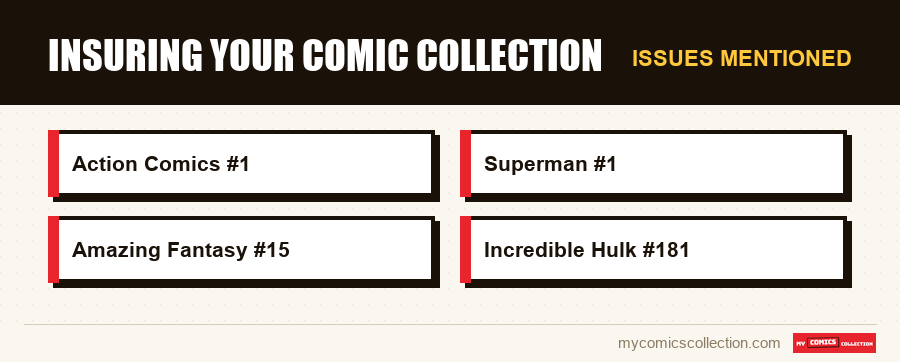
A copy of Action Comics #1 graded CGC 9.0 sold for $15 million in a private transaction organized by a platform specializing in comics, becoming the most expensive pop culture object ever traded and shattering the previous record of $9.12 million established a few weeks earlier for a copy of Superman #1. These figures, dizzying for exceptional pieces, have a very real ripple effect on the entire market: comic book collections, even modest ones, are today worth much more than most collectors imagine, and much more than what their home insurance covers, without thinking about it. That's the paradox: you insure your car, your home, sometimes your electric bike, but you leave a collection accumulated over fifteen or twenty years (key numbers, limited editions, graded copies) under the simple mention "furniture" of a comprehensive home contract. In the event of a disaster (theft, fire, water damage), the gap between the real value of the collection and what the insurer is prepared to compensate can be considerable, and the proof requested afterwards is often difficult to gather in an emergency. This guide details, step by step, how to correctly assess the risk, choose between the different coverage options, document your collection so that evidence never poses a problem, and adapt your protection over time: particularly when a film or series adaptation suddenly increases the value of a key number that you already have.
From reading piles to heritage assets: a story of valuation
For decades, a comic book was an object of everyday consumption: we bought it on newsstands, we read it, we lent it, sometimes we threw it away. It was only from the 1970s-1980s, with the appearance of the first Overstreet-type listing guides in the United States, that the notion of "collectible value" was structured around rarity, the state of conservation and the editorial importance of an issue (first appearance of a character, origin, significant death). The real turning point came in 2000, with the creation of CGC (Certified Guaranty Company), which introduced an independent grading system on a scale of 0.5 to 10.0. By sealing each copy in a tamper-proof case after examination, CGC has transformed a market previously based on subjective assessments ("good condition", "average condition") into a standardized market, where two copies of the same number at the same grade are truly comparable. This traceability directly enabled the growth of six- and seven-figure sales. The "census" (or population report) published by CGC clearly illustrates this dynamic of rarity: of all the comics graded, less than 0.2% reach the ultimate grades of 9.9 or 10.0, while the grade 9.8 - already considered almost perfect: alone represents more than a third of all the comics ever graded by the company. In other words, a very high grade example is never "just good condition": it is a statistically rare piece, which justifies both its market value and the special attention it deserves in terms of insurance. The record sales of recent years give the measure of the phenomenon. A Action Comics #1 graded CGC 8.5, an example of the prestigious “Kansas City” provenance, sold for $6 million in April 2024. Another example of the same number, graded CGC 6.0 and known as the “Rocket Copy,” reached $2.76 million. On the Marvel side, a Amazing Fantasy #15: first appearance of Spider-Man: graded CGC 9.6 sold for $3.6 million in 2021, while a more modest example, graded CGC 8.5, set a record for its grade at $552,000 at the end of 2022. These amounts concern exceptional pieces, but they mechanically raise the price of all the much more accessible key issues that the majority of collectors own.
Classic home insurance: why it is almost never enough
Most multi-risk home contracts include a “valuable objects” or “precious goods” guarantee with an overall ceiling, often between a few thousand and a few tens of thousands of euros depending on the insurers and the options taken out. This ceiling generally covers all valuable items in the home (jewelry, photo equipment, musical instruments, works of art) and not just the comic book collection. A collector who owns, without even realizing it, several dozen graded key numbers can very quickly exceed this ceiling without having declared anything specific. Two compensation logics coexist in collection insurance, and the difference between the two changes everything in the event of a claim:
Declared value
You yourself indicate the value of your goods to the insurer, but in the event of a claim, it is up to you to provide proof of this value (invoices, estimates, captures of comparable sales). Compensation may be reduced if the insurer considers the proof insufficient, and it takes into account possible depreciation.
Approved value
The amount is contractually fixed at the time of subscription, generally after an independent expertise for significant documents. In the event of total loss, compensation corresponds to this fixed amount, without negotiation or depreciation a posteriori. This is the recommended option as soon as the collection reaches a substantial value, precisely because the comic book market is volatile and a piece purchased for €500 can, a few years later, be worth ten times more after a cinema release. In practice, an appraisal is generally recommended as soon as an isolated item exceeds €1,500 to €2,000, a threshold beyond which an expert's report serves as a solid basis for the approved value. For collections as a whole, two approaches exist in France: the "valuables" endorsement which increases the ceiling of home insurance by specifically declaring each item (coverage generally limited to the home), or a dedicated all-risk contract, more complete, which also covers transport, loans of copies for exhibitions, losses occurring outside the home, and which applies the approved value without deductible in many cases. Certain contracts specific to comic book collections offered by French brokers operate in stages: a dedicated annex becomes relevant from a certain volume of albums (of the order of several hundred items, or an insured amount of several thousand euros), with ceilings that can rise to €200,000 for the largest collections. The principle remains the same: the larger the collection, the more risky the gap between the reflex “I am covered by my home insurance” and the reality of the applicable ceiling becomes.
Documenting your collection: the basis of any compensation
Whether declared value or agreed value, no correct compensation is possible without proof. Three elements constitute the basis of a solid file:
The inventory
Each significant piece should be listed with its series, number, year, publisher, condition (or gradation), and a value estimate. This inventory must be updated regularly, at each major acquisition or transfer, and kept outside the home (cloud, copy to a loved one) to remain accessible even in the event of a disaster affecting the place where it is stored. Cataloging your collection with a dedicated application greatly facilitates this exercise over time: collection management application allows this register to be kept up to date as additions are made, with photos and status information associated with each copy.
Certification and traceability
For key numbers, having a copy graded by CGC (or CBCS) provides objective and dated proof of its condition at the time of the assessment, which can be used against an insurer or an expert in the event of a dispute. The sealed certificate, with its unique serial number, constitutes in itself a much more solid piece of documentation than a simple personal estimate: especially since the CGC census makes it possible to objectively situate the rarity of a copy in relation to the entire population graded for this number.
Proof of purchase and dating
Purchase invoice, screenshot of won auction, corresponding bank statement: any dated document strengthens the case. In the absence of an original invoice (inheritance, old purchase, donation), dated photographs with a precise description, a certificate of authenticity or a notarized inventory for goods transmitted by inheritance can also serve as proof. To establish a current and documented reference value, relying on recent actual sales rather than a rough estimate remains the most solid method: an estimator based on current eBay listings allows you to obtain a low, median and high range by series, number and state, which can be directly used to support a value declaration.
Collecting this series?
Track what you own, what you are missing and what your collection is worth. 7 day trial.
Start my trial →Storage and preservation: reducing risk before it arises
A large part of the insured risk is in reality an avoidable risk of deterioration. Comics are paper objects, sensitive to humidity, direct light and temperature variations, which accelerate the yellowing and brittleness of the pages: factors which mechanically lower a grading rating and, with it, the insured value. Standard archival preservation practices consist of protecting each copy in an acid-free sleeve and cardboard (polypropylene or Mylar rather than PVC, which degrades paper over the long term), storing boxes upright in a dry, temperate place away from direct light, and avoiding basements or attics exposed to variations in humidity and the risk of infiltration. For the most valuable pieces, a fireproof safe at home or a secure storage space outside the home significantly reduces exposure to theft and fire: two disasters which, in the United States, have seen a documented increase: American authorities report an increase of around 20% in theft of collectibles since 2020, a trend directly linked to the increase in value of the collectibles market, including comics. This preventive dimension is not only a matter of common sense: many collection contracts require, even before subscription, a description of the storage conditions, and some adjust their conditions or their excess according to the level of security observed.
Common claims and what they actually involve
The guarantees generally covered by an endorsement or a dedicated collection contract include fire, natural and technological disasters, water damage, burglary and vandalism. Some more comprehensive contracts add a "mysterious disappearance" guarantee, which covers the loss of an object without identifiable circumstances of theft: a useful clause for isolated and sealed items, often conditional on a minimum amount per declared object. A documented case across the Atlantic clearly illustrates the concrete functioning of a well-prepared file: a collector victim of the theft of a copy of Amazing Fantasy #15 was awarded $75,000 in compensation after providing its CGC grading certificate and photographs of the part, with the case processed within three weeks. Conversely, the refusals of compensation observed in this type of contract almost always concern objects that were insufficiently documented at the time of the loss: which brings back, once again, the importance of the inventory being kept up to date and the evidence kept upstream rather than improvised after the fact. On a strictly administrative level, in the event of a disaster, the declaration must generally be made within a short contractual period (often 48 hours for a theft, 5 working days for other disasters in France), accompanied by a complaint for the theft and an up-to-date inventory. It is precisely for this reason that the list of insured items must be revised several times a year in active collections, and not rediscovered when completing a report.
The impact of adaptations on the rating
Comics are a market that is particularly sensitive to audiovisual news, and this sensitivity has a direct effect on the relevance of an insured value frozen in time. The example of Incredible Hulk #181, which contains the first complete appearance of Wolverine, speaks for itself: this copy was trading for around $600 in 2009; a CGC 9.8 graded copy sold for $39,000 in 2018, then $146,000 at the end of 2022, driven by the omnipresence of the character in the cinema and by successive announcements concerning his integration into the Marvel cinematic universe. The rating of Amazing Fantasy #15, the first issue of Spider-Man, experienced a comparable trajectory, with each new wave of cinema adaptations of the character maintaining speculative interest around the best-preserved copies. This dynamic has a direct consequence for insurance: an approved value fixed several years previously can find itself largely undervalued if the character concerned experiences sudden cinema or series news, exposing the collector to compensation much lower than the actual replacement value in the event of a loss. Conversely, a speculative craze can ebb just as quickly once the announcement has worn off. This is why professionals in the sector recommend reassessing the approved value of a collection approximately every two to three years, and systematically after any major announcement (film, series, adaptation) involving a character for which you have a first appearance or a key number.
Buying guide
Before subscribing or upgrading coverage for a comic book collection, a few concrete checks can help avoid unpleasant surprises:
- Take inventory before contacting an insurer. List series, number, condition or grading note, and estimated value for each piece exceeding a few hundred euros: an encrypted file speeds up subscription and avoids involuntary under-declarations.
- Compare overall home insurance ceiling and actual cumulative value. Add up the estimated value of your graded key numbers: if the total exceeds the “valuables” ceiling of your current contract, an amendment or a dedicated contract becomes necessary, not optional.
- Favor the approved value as soon as individual pieces exceed €1,500 to €2,000. This is the threshold generally used to justify an independent expertise and set a non-negotiable contractual value in the event of a claim.
- Graduate the most valuable pieces. A sealed CGC or CBCS certificate constitutes dated and objective proof of condition, difficult to contest, and facilitates the initial assessment as well as the settlement of a claim.
- Check out-of-home coverage if you transport or lend parts. A convention or trade show involving the movement of security numbers requires a guarantee that is not limited to the place of residence alone.
- Update inventory with each significant movement. A significant addition or transfer must be reflected in the insured list, ideally several times a year for an active collection.
- Document your storage conditions. Acid-free pouches and boxes, dry and temperate room, fireproof box for major items: these elements can influence the conditions proposed by the insurer.
- Re-evaluate the insured value after any cinema or series news affecting your key characters. An announced adaptation can increase a rating in a few months, making an old approved value obsolete.