For a long time, a comic collection was something very private. Longboxes neatly stored in a dedicated room, a personal Excel sheet, at most a few photos shared with friends. But habits are changing, and more and more collectors are taking the step: publishing their collection online, or at least making it accessible to certain people.
Making your comic collection visible online: why and how
For a long time, a comic collection was something very private. Longboxes neatly stored in a dedicated room, a personal Excel sheet, at most a few photos shared with friends. But habits are changing, and more and more collectors are taking the step: publishing their collection online, or at least making it accessible to certain people.
Why this change? And above all, how to do it smartly, without taking unnecessary risks? This guide covers the real good reasons to make your collection visible, and the essential safeguards to not regret the move.
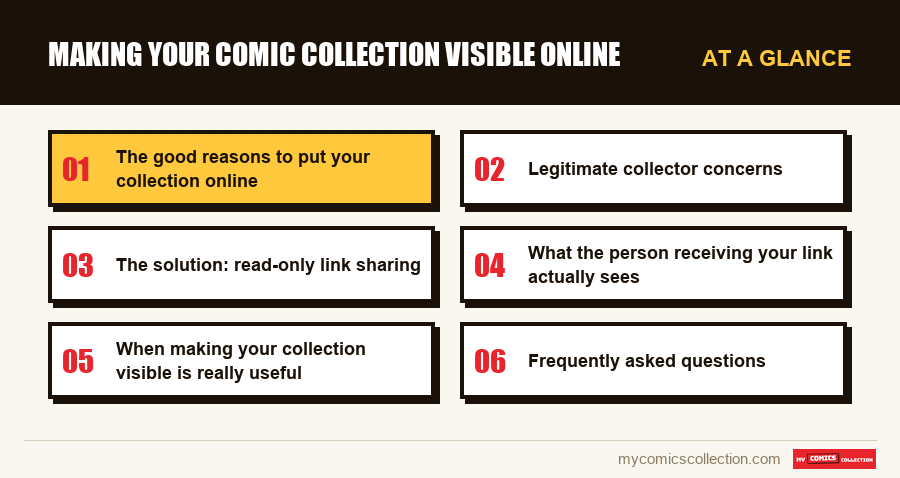
The good reasons to put your collection online
Finding takers for your duplicates
Every active collector accumulates duplicates. An issue bought twice without realizing, a complete series acquired as a lot with issues already owned, variants that look too similar. These duplicates take up space and represent tied-up money.
Having a list of your collection accessible online means being able to tell other collectors: "Here's what I have as duplicates, interested?" Without a visible digital catalog, these exchanges stay random and complicated to organize. With an online collection, they become natural.
Identifying what's missing
The flip side of the same problem: missing issues. When you're trying to complete a series or find a specific key issue, being able to share your "have/need" list with the community considerably speeds up the search. Collector groups, forums, conventions: in all these contexts, a link to your visible collection beats a text list in an email.
Connecting with other enthusiasts
Comic collecting is often a solitary passion. Many collectors know very few people who share the interest in their immediate circle. Making your collection visible online opens a door to active communities, discussions about favorite arcs, artists, rare editions. It's turning a personal inventory into a starting point for genuinely interesting exchanges.
Having inventory proof for insurance
A practical aspect often overlooked: a comic collection can represent considerable value. Hundreds, sometimes thousands of dollars. In case of a disaster (fire, flood, theft) proving the existence and value of your collection to an insurance company is an ordeal if you don't have a documented, dated inventory.
A digitized collection, with covers, conditions, and values recorded, is solid proof. And if this list is accessible online with a timestamp, even better. It's a pragmatic argument, far from community considerations, but often decisive in taking the step.
Legitimate collector concerns
These benefits are real, but reluctance is too. It would be dishonest to dismiss them.
Privacy: publishing your collection potentially discloses the address where it's located, your standard of living, your interests. That's not a paranoid worry.
Security: displaying that you own high-value comics can attract unwanted attention. A collection whose total value is publicly visible represents concrete risk.
Displayed value: some collectors simply prefer to keep the value of their marquee pieces to themselves. It's a legitimate preference, not necessarily tied to security.
The solution: read-only link sharing
This is where an app like My Comics Collection provides a concrete answer to these concerns. The principle is simple: you create a sharing link to your collection, and only people who have the link can access it. It's not a public page indexed by Google, visible to anyone. It's a private link, shareable selectively.
The difference between "public" and "shared by link" is fundamental:
- Public collection: your catalog appears in search results, anyone can find it, it's permanent and hard to control.
- Shared by link: only people you give the link to can access. You can revoke the link anytime. No personal info is visible: not your name, not your address, not your contact info.
This mode directly addresses the three concerns above. Privacy is preserved because the link contains no personal data. Security is maintained because you control who sees what. And you can choose whether to display your comics' estimated values.
Collecting this series?
Track what you own, what you are missing and what your collection is worth. 7 day trial.
Start my trial →What the person receiving your link actually sees
When you share your collection via My Comics Collection, your recipient sees your catalog: covers, titles, issue numbers, condition if recorded, any notes. It's a clear, readable catalog: useful for an exchange or so your loved ones know what to give you for your birthday.
What they don't see: your full name, email, phone number, mailing address, or any other identifying info. The link gives access to your comic library, not your profile.
When making your collection visible is really useful
A few concrete situations where a sharing link genuinely changes things:
Before a comic convention: share your wishlist and duplicates list with other collectors in the same Facebook or Discord groups. Upfront exchanges are much more efficient than running booth to booth.
For Christmas or your birthday: send the link to your loved ones. No more duplicate purchases, no more gifts off the mark. Your wishlist is directly visible.
During a sale: a potential buyer can browse your catalog before traveling. It filters out the curious and attracts serious buyers.
For insurance documentation: if needed, you have a dated, accessible, verifiable list. Some collectors even take regularly-dated screenshots to archive their collection's state.
Making your collection visible online isn't an all-or-nothing move. With the right tools, it's a graduated, controlled decision you adapt to each situation and each audience.
Frequently asked questions
The risk depends entirely on what you make visible and to whom. A private share link, shared only with trusted people, poses no more risk than a conversation. On the other hand, publishing a public collection with each comic's value, tied to your real name and location, would be unwise. My Comics Collection fully dissociates your personal identity from the share link.
Yes. In My Comics Collection, you control what appears in your share link. You can choose to display only the catalog (titles, issues, conditions) without estimated values. A particularly useful option for sharing with family for gifts, without revealing your collection's total investment.
Yes. You can disable a share link anytime from the app. The person who had the link will no longer be able to access it. It's one of the key advantages of link sharing vs. a public page: you keep total control.
Not with My Comics Collection's link sharing mode. Only collections explicitly made public by their owner can be indexed. A private link is accessible only to those who possess it and is not referenced by search engines.