Selling a comic collection in complete security is based on three pillars: document and authenticate each issue before being put on sale (real condition, possible undeclared restoration, CGC certification if the value justifies it), choose a payment method that offers real seller protection (tracking number, proof of delivery, signature required by PayPal for transactions over $750), and ship with rigid packaging accompanied by insurance adapted to the declared value: standard USPS postage caps at $5,000, beyond that you have to go to Registered Mail. Also remain vigilant against the most widespread scams: CGC slab reholder, undeclared restoration, withdrawal of payment after confirmed delivery.
Parting with a collection of comics, whether a few longboxes accumulated since childhood or an investment fund patiently built up in graded copies, is not trivial as soon as the value exceeds a few dozen euros. A well-preserved key issue can be worth several hundred or even several thousand euros: for example, a copy of Superman #1 has already sold for more than half a million dollars on the American market. At this scale of value, each stage of the sale becomes a point of vigilance: authentication of the number, the method of payment chosen, physical packaging, insurance during transport, and management of any dispute with the buyer.
The growth of the professional dimming market since the early 2000s has paradoxically made the sale both safer and more exposed. Safer, because a certificate from a recognized organization identifies the condition of a comic and reassures the buyer. More exposed, because the value concentrated in a compact and easily transportable object makes it a prime target for increasingly sophisticated fraud: even reaching the slabs themselves, as shown by the reholding scandal revealed in early 2023.
This guide details, step by step and using verifiable data, how to document your collection before the sale, recognize the most frequent scams, secure payment, properly package and insure shipping, and avoid the classic pitfalls of the unwary seller.
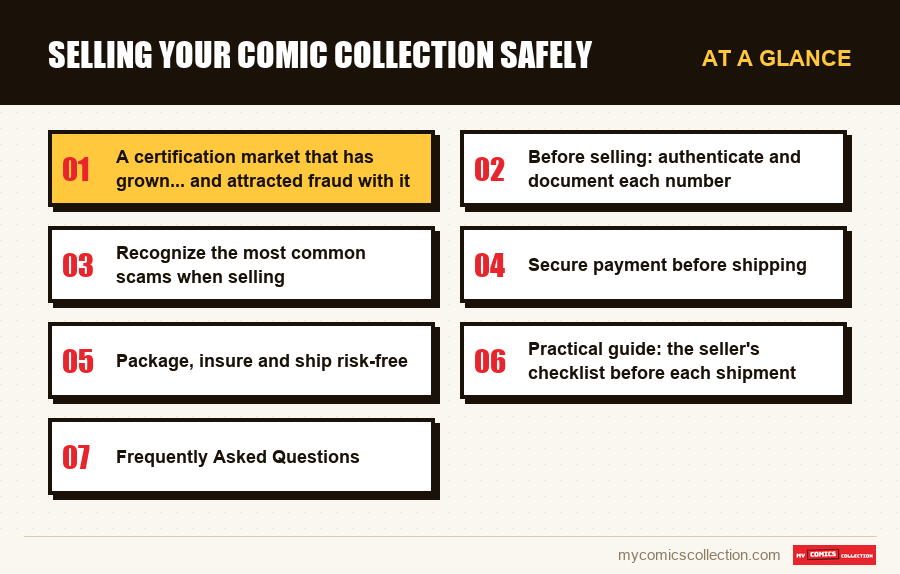
A certification market that has grown... and attracted fraud with it
The Certified Guaranty Company (CGC), founded in 2000 by expert Steve Borock, was the first independent structure to offer an objective and impartial assessment of the authenticity and condition of comics. In just under a decade, the organization had already certified more than a million copies; since its creation, this figure now exceeds 20 million pieces in all categories (comics, collectible cards since 2018, video games, concert posters). This standardization has transformed resale: a certified slab reassures the buyer about the real state of the issue and facilitates remote transactions that would have been unthinkable with a simple bulk comic.
But this concentration of value in a sealed object also created a target. The most documented case remains the so-called “reholding” scandal, publicly revealed on January 3, 2023: CGC published a list of 350 comics whose slabs had been tampered with: a low-value copy substituted inside an authentic shell bearing the label of a much more highly valued copy. The company itself admitted in a press release that the incident affected “a few hundred” comics. The case led to legal action against two former employees, Brandon and Ayana Terrazas, accused of stealing comics from the company's premises and generating false CGC labels to resell them; a preliminary injunction order was obtained against the defendants in February 2024. This episode illustrates a simple reality: even the most recognized certification system in the sector does not eliminate the risk of fraud, it only shifts its nature. Hence the importance for any seller to understand precisely what they are selling and how to prove it.
Before selling: authenticate and document each number
The first line of defense against post-sales disputes is not the packaging or the method of payment: it's the description. A seller who has correctly identified, photographed and documented his item eliminates most of the “item not as described” grounds for dispute, which remain the main lever used by bad faith buyers to obtain a refund after receipt.
Concretely, before putting up for sale a number whose value exceeds a few dozen euros, you should:
- Check that it is indeed an original print and not a reprint. Counterfeits mainly affect independent black and white comics and certain titles from the 1970s and 1980s, which are easier to reproduce while remaining rare enough to be worth counterfeiting; an examination of the quality of the paper and the printing screen (poorly formed colored dots, slightly shifted shades) often allows you to spot a copy.
- Examine the pages under raking light and in transparency to detect undeclared restoration: color retouching, re-glued pages, margins reconstituted from another copy. An unreported restored comic, sold as if it were "originally raw", exposes the seller to a formal dispute if the buyer has it examined after receipt.
- Photograph the front, back, edge, spine and any visible defects (fold, discoloration, stain) under neutral lighting, before packaging.
- Keep the provenance if it exists: purchase invoice, previous certificate, sales history, which reassures the buyer and serves as proof in the event of a dispute.
Have a high-value number certified
For numbers whose potential value exceeds a few hundred euros, certification by a third party remains the most effective way to remove any doubt about the condition and authenticity before being put on sale. CGC applies a tiered pricing scale in 2026: the Modern tier (comics after 1975) is billed at $30 per copy with an announced deadline of 8 to 12 months depending on the volume of the queue; the Vintage tier (before 1975) costs $45, with an announced lead time of 12 to 18 months and an actual average observed closer to 14 months; the High Value tier amounts to $105; the Unlimited Value tier starts at a minimum of $135. A Vintage Bulk tier at $42 per copy has also been introduced, capped at $400 declared value per issue and subject to a minimum of 25 copies per bulk shipment. For sellers in a hurry, the Express option reduces the lead time to around two weeks, and the WalkThrough option to 7-10 business days: for a significantly higher price. It should be kept in mind that these deadlines remain unguaranteed estimates, which may extend during peak periods.
Certification has a cost and a delay which is not justified for an entire collection: it especially makes sense for key numbers (first appearance, limited edition, small recorded population) whose value far exceeds the amount of grading costs. For the rest of the collection, an honest, photographed description and a “raw” grading consistent with market standards (Near Mint, Very Fine, Fine, etc.) are generally sufficient.
Recognize the most common scams when selling
Beyond the reholding mentioned above, several fraud schemes regularly recur when a collector puts valuable pieces up for sale. Knowing them in advance allows you to reject a transaction before it goes bad, rather than trying to make up for it after the fact.
The off-platform payment request
A buyer who offers to finalize the transaction outside of the initial sales channel (direct deposit, peer-to-peer payment application, check sent by mail) generally does so for one reason: to take the transaction out of the framework that offers seller protection in the event of a dispute. Once payment has been made off-platform and the item has been shipped, there is no longer any structured recourse if the buyer denies having received the item or requests a refund.
Withdrawal after confirmed delivery
The classic scenario: the buyer pays, receives the comic, then opens a dispute claiming that the item does not match the description, with the sole aim of obtaining a refund while keeping the copy, or returning a different item (sometimes intentionally damaged, sometimes substituted). It is precisely to protect against this scenario that photographic documentation before shipment and proof of delivery with tracking take on their importance: they make it possible to demonstrate the real condition of the object at the time of shipment and its effective receipt by the buyer.
Bank card reloading (chargeback)
Distinct from a simple dispute, chargeback consists of the buyer directly contesting the payment with their bank or card issuer, completely bypassing the dispute resolution circuit of the platform or payment provider. The funds are then automatically debited from the seller's account, sometimes accompanied by additional processing fees charged by the payment provider. This is a scenario that traditional seller protections cover poorly, if at all, as long as the buyer has gone directly through their bank rather than through the standard returns procedure.
Counterfeiting and the fictitious variant
Some unscrupulous sellers offer “error variants” or supposedly extremely rare prints that never existed in this form, or resell a reprint by passing it off as an original print. This risk mainly concerns the buyer, but a seller who has himself acquired a copy in this way, without knowing it, can find himself in a delicate position if he in turn resells it without prior verification.
Collecting this series?
Track what you own, what you are missing and what your collection is worth. 7 day trial.
Start my trial →Secure payment before shipping
The choice of payment method directly determines the level of protection enjoyed by the seller in the event of a dispute. For payment via a “goods and services” type service (Goods & Services), several cumulative conditions must be respected to remain covered:
- The item sold must be a tangible, shippable physical good: which is the case for comics, unlike digital content.
- The shipment must be sent to the delivery address indicated on the transaction itself. A shipment redirected to another address, even at the buyer's request, loses the benefit of seller protection.
- The carrier used must provide online tracking and searchable proof of delivery, including at least the city or postal code of destination, the delivery date and the identity of the carrier.
- Above $750 total amount (shipping and taxes included), a signature on delivery is required for seller protection to fully apply.
- The seller must respond within the allotted time to any request for supporting documents made by the payment service provider during a dispute: a failure to respond on time results in the automatic loss of protection, regardless of the legitimacy of the file otherwise.
These rules, although demanding, are the best guarantee available for a private seller facing a malicious buyer. In practice, they involve always choosing a traceable delivery service, even for a low-value shipment, and systematically keeping screenshots of the conversation with the buyer, the published description and proof of deposit at the post office.
Package, insure and ship risk-free
A poorly protected comic book can arrive bent, damaged or dislocated even on a short journey. The packaging must systematically combine a rigid support, two rigid cardboard plates framing the comic slipped into a protective sleeve, with an envelope or cardboard strong enough to withstand mechanical handling in a sorting center. Sending in a simple flexible envelope, even padded, remains one of the most frequent causes of “item damaged upon receipt” disputes.
In terms of postal insurance, the thresholds to be aware of for a domestic shipment via the American postal operator (USPS, reference for a large part of the online comic sales market) are as follows: standard insurance costs $2.05 for a declared value of $0.01 to $50, with an overall ceiling set at $5,000; Priority Mail, Priority Mail Express and Ground Advantage services automatically include $100 of coverage at no extra cost. Beyond $5,000 of declared value, you must use the Registered Mail service, whose base rate rises to $19.70 in 2026 (in addition to basic postage), for a coverage ceiling of $50,000 and a delivery time of 2 to 10 days due to chain of custody controls at each stage of transport. This option, slower and more expensive, remains the only legal solution to fully ensure a very high value shipment.
For the collection itself, outside of any sales transaction, it is useful to remember that a standard home insurance policy generally caps coverage for collectibles between $1,000 and $2,500, an amount quickly exceeded by a graded comic book collection. A valuables endorsement or specialist collectors policy helps cover actual collectible value rather than new replacement value, with coverage often extending to transportation and temporary storage: something to check before shipping multiple high-value issues simultaneously.
Practical guide: the seller's checklist before each shipment
Before validating a sale, in particular for a key number or a lot of significant value, it is useful to systematically review the following points:
- Verify the buyer's identity and history if the platform allows it, and be wary of a recently created account with no transaction history.
- Refuse any payment request outside of the initial secure channel, even if the buyer cites high platform fees.
- Photograph the copy from all angles just before packaging, date stamped.
- Pack with a rigid backing and moisture protection, whatever the journey.
- Choose a shipment with systematic online tracking, including for small-value shipments.
- Require a signature on delivery as soon as the transaction amount approaches or exceeds it.
- Declare an insurance value that reflects the actual sale value, not an arbitrary downward estimate to save a few euros in costs.
- Keep all written exchanges with the buyer until final confirmation of the transaction, in case a dispute is opened several weeks later.
- Never return money directly to a buyer who claims to have paid twice in error before verifying the reality of the second payment to their own account.
This discipline, repeated for each transaction, drastically reduces the number of disputes and allows, where applicable, to have all the necessary elements to assert good faith with the payment provider or platform.