You come back from a comics convention, arms full of new acquisitions. Once home, you store your purchases in a longbox, and then the bad surprise: you already have this issue. Maybe even two copies.
You come back from a comics convention, arms full of new acquisitions. Once home, you store your purchases in a longbox, and then the bad surprise: you already have this issue. Maybe even two copies. Every somewhat-active collector has experienced this scenario at least once. According to estimates from collector communities, 15 to 20% of the average annual budget is wasted on unintentional duplicates. On $550 per year, that's $85 to $110 up in smoke.
Good news: this problem is entirely avoidable with the right method. This guide explains why duplicates happen, how to systematically prevent them and how to handle those you've already accumulated.
Why do duplicates happen so often?
Duplicates don't come from lack of attention. They come because an active collector's buying conditions make verification difficult. Here are the most frequent causes:
Faulty memory
No one memorizes their entire collection. With hundreds or thousands of issues, it's impossible to remember with certainty whether you own a specific issue of a series.
Collection dispersed in multiple places
Comics in the basement, in the office, at your parents': when the collection is physically scattered, it's impossible to have an overview without centralized inventory.
Impulse purchases at conventions
Faced with a comic at a good price on a stand, you buy fast, without checking. Convention adrenaline favors quick decisions, and duplicates.
Online purchases from multiple devices
Ordering on eBay from your phone, then resuming the search on PC a few days later without remembering the first order: classic.
The real problem: It's not distraction: it's the absence of a single source of truth accessible anywhere. The solution fits in one sentence: your collection list must be in your pocket, on your smartphone, consultable in two seconds.
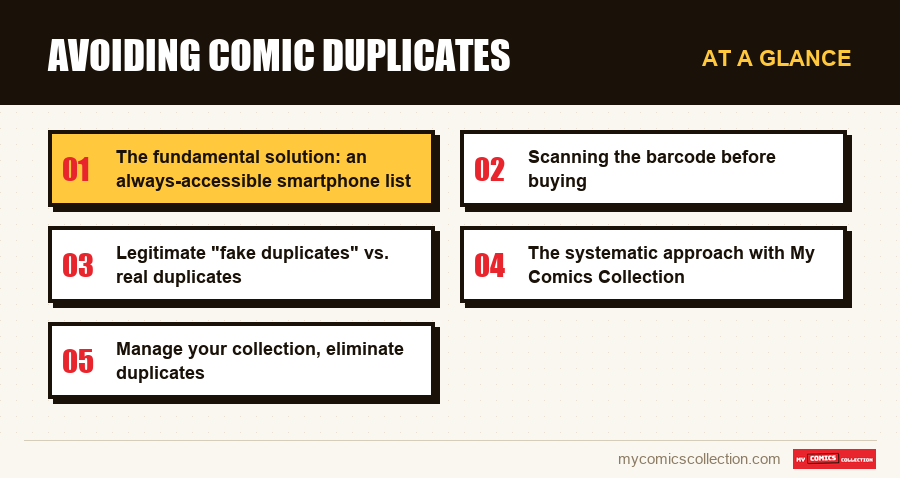
The fundamental solution: an always-accessible smartphone list
The most effective method to avoid duplicates is also the simplest: have an up-to-date list of all your comics, instantly consultable from your phone. Neither paper notebook (left at home), nor Excel file (only PC-accessible), nor memory suffices.
A dedicated app like My Comics Collection solves this problem at the root. Each comic you own is marked in the app. When you're face to face with an issue at a convention or shop, just open the app and search for the title and number. In five seconds, you know.
Import your series into the app
Choose each series you collect from the catalog. My Comics Collection automatically loads all issues, variants included. No manual entry.
Mark each owned issue
Browse the list and check what you have. This initial step takes time, but once done, daily maintenance takes only seconds per purchase.
Mark each purchase the same day
Golden rule: log each new comic in the app on purchase day, never "later." That's the discipline that keeps the list current and protects against future duplicates.
Check before each purchase
Before pulling out cash or card, open the app. If the issue is already checked, put the comic down. Two-second check, $85 saved over the year.
Scanning the barcode before buying
For comics published from the 1970s-1980s, the barcode scanner is the fastest verification possible. Rather than manually searching your list, you scan the comic's UPC and the app immediately tells you whether you own it.
My Comics Collection integrates this feature directly. At a convention, it's precious time saved: scanning the barcode of a comic takes less than three seconds. No need to remember the exact number, search a long list or trust your memory.
Caveat: comics before the 1970s (Golden Age, Silver Age, early Bronze Age) don't have UPC barcodes. For these issues, manual search in the app remains necessary.
Legitimate "fake duplicates" vs. real duplicates
Before considering a comic a duplicate, make sure you're actually dealing with the same issue. Cover variants are often confused with duplicates when they're actually distinct editions with potentially different values.
The legitimate "fake duplicates" to know
- Newsstand vs. Direct Edition: The same issue often exists in two versions: the newsstand edition (sold at newsstands, with barcode) and the direct edition (sold at comic shops, with a logo in place of the barcode). 80s-90s newsstands are generally rarer and can be worth more.
- Retailer incentive cover variants: The same issue can exist in cover A, B, C or ratio variant (1:25, 1:50). These are distinct copies, not duplicates.
- Reprints and second printings: Some issues were reprinted with "second printing" on the cover. Not the same copy as the first print.
The real duplicate
A real duplicate is two identical copies of the same issue, same edition. Same cover, same barcode, same publication date. In that case, owning two copies only has value if you plan to grade one or if the conditions are very different.
Collecting this series?
Track what you own, what you are missing and what your collection is worth. 7 day trial.
Start my trial →What to do with existing duplicates?
If you already have duplicates in your collection, several options are available:
- Convention sale: Build a lot of duplicates to sell on your own convention table. Common comics often go for $1-2 apiece, but a lot of 50 issues still represents a non-negligible sum.
- Trading with other collectors: Collector forums and Facebook groups are active on trading. Your duplicate might be another collector's missing issue.
- Lot sale on eBay: Thematic lots (same series, same period, same character) sell well, especially if you offer free shipping. List the lot at auction to maximize price.
- The local comic shop: Some shops buy back collections or accept comics on consignment. Buyback rates are modest but the transaction is fast.
Systematic approach to liquidate your duplicates
- Inventory all your duplicates in My Comics Collection (mark the second copy as "duplicate for sale")
- Sort by estimated value, prioritize selling the most valuable duplicates
- For key issue duplicates, consider CGC grading before selling if condition justifies it
- Build thematic lots for common comics
- Set a price slightly below market to sell fast
The systematic approach with My Comics Collection
Duplicate prevention isn't a willpower question: it's a systems question. My Comics Collection is designed so that checking becomes a natural reflex rather than a conscious effort. Here's how the app transforms your relationship to purchases:
Each series you collect clearly displays which issues you own (marked in green) and which you're missing. Before a convention, you can export your missing list or simply open the app on site. Duplicate risk drops to virtually zero for collectors who keep their list updated.
Key discipline: marking each purchase the same day. Not in three days. Not "when I have time." The same day, while the comic is still in the bag. This habit, once installed, takes less than two minutes and structurally eliminates future duplicate risk.
Remember: A collector who marks purchases daily in their app never re-buys the same comic by mistake. Discipline is the most effective, and cheapest, protection.
FAQ, Avoiding comic duplicates
Manage your collection, eliminate duplicates
With My Comics Collection, every comic is marked, every purchase logged. Check in two seconds from your smartphone before each purchase, and never re-buy the same comic again.
🚀 7-day free trial, no commitment